Transubstantiation
What does transubstantiation mean? Learn how Catholic teaching distinguishes substance from appearances and how Leadbeater reinterprets Eucharistic consecration.
In this article
What changes at consecration?
Transubstantiation is the Roman Catholic teaching that consecration changes the whole substance of the bread into Christ’s body and the whole substance of the wine into his blood in the Eucharist. Their appearances, including taste and texture, remain. The word substance here means what the bread and wine are. [1]
The Church of England’s Article XXVIII gives a different account of the Eucharist. It rejects transubstantiation and says Christ is received in a heavenly and spiritual manner through faith. [2][1]
The Science of the Sacraments by Charles W. Leadbeater
Charles W. Leadbeater describes the change through his Liberal Catholic account of invisible planes. In his diagram, the bread begins connected to several counterparts. At consecration, the Angel of the Presence replaces those connections with one directed to Christ. The physical appearance remains the same in his account. [3][4][5][6][7]
Leadbeater compares the connections to wires and the counterparts to beads. The drawing puts them in a straight line for the reader. He says perceiving what the model represents would require more than three dimensions. [4][5][7]
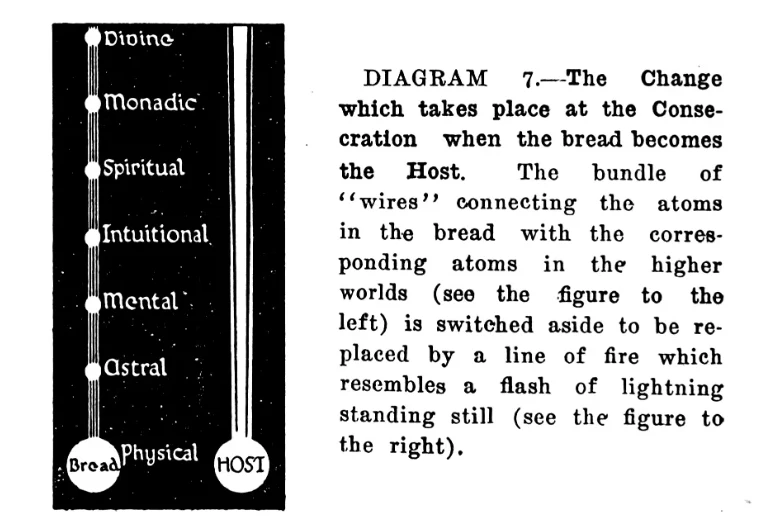
Diagram 7, printed page 180. Leadbeater pictures the bread’s supposed connections across the planes being replaced by a single line at consecration.
The Science of the Sacraments by Charles W. Leadbeater, The St. Alban Press, 1920. Library facsimile. · Image source ↗ · Public Domain
See references (5)
- The Science of the Sacraments, printed p. 179, Reader page 191
- The Science of the Sacraments, printed p. 180, Reader page 192
- The Science of the Sacraments, printed p. 181, Reader page 193
- The Science of the Sacraments, printed p. 182, Reader page 194
- The Science of the Sacraments, printed p. 183, Reader page 195
What changes beneath the appearances
The Catholic Catechism describes a change in what the elements are. Leadbeater describes a change in what the bread is connected to on other planes. Both accounts retain the visible appearances while explaining the change in different terms. [1][5][6][7]
In the library
The Science of the Sacraments
Reading note
The separately titled account draws on exact passages in the consulted Library edition.
Sources
See references (7)
- Catechism of the Catholic Church, §§1356–1381 ↗Holy See, Catechism of the Catholic Church, English edition.
- Articles of Religion, Articles XXV and XXVIII ↗Church of England, Book of Common Prayer.
- The Science of the Sacraments, printed p. 179, Reader page 191Charles W. Leadbeater, The Science of the Sacraments, The St. Alban Press, 1920. Exact Library edition IMJ-0615-E001.Read this page in The Science of the Sacraments ↗
- The Science of the Sacraments, printed p. 180, Reader page 192Charles W. Leadbeater, The Science of the Sacraments, The St. Alban Press, 1920. Exact Library edition IMJ-0615-E001.Read this page in The Science of the Sacraments ↗
- The Science of the Sacraments, printed p. 181, Reader page 193Charles W. Leadbeater, The Science of the Sacraments, The St. Alban Press, 1920. Exact Library edition IMJ-0615-E001.Read this page in The Science of the Sacraments ↗
- The Science of the Sacraments, printed p. 182, Reader page 194Charles W. Leadbeater, The Science of the Sacraments, The St. Alban Press, 1920. Exact Library edition IMJ-0615-E001.Read this page in The Science of the Sacraments ↗
- The Science of the Sacraments, printed p. 183, Reader page 195Charles W. Leadbeater, The Science of the Sacraments, The St. Alban Press, 1920. Exact Library edition IMJ-0615-E001.Read this page in The Science of the Sacraments ↗