Eucharistic Thought-Edifice
Explore Leadbeater’s Eucharistic thought-edifice, the invisible structure he said worship builds through prayer, music and the ordered actions of the rite.
In this article
What is a Eucharistic thought-edifice?
A Eucharistic thought-edifice is an invisible structure that Charles W. Leadbeater believed worshippers build during the Eucharist. In his Liberal Catholic account, prayer, music and ritual action contribute to a shared thought-form. The sequence of the service determines how the form grows. [4][5][6][7][8]
See references (5)
- The Science of the Sacraments, printed p. 22, Reader page 20
- The Science of the Sacraments, printed p. 23, Reader page 22
- The Science of the Sacraments, printed p. 62, Reader page 63
- The Science of the Sacraments, printed p. 100, Reader page 105
- The Science of the Sacraments, printed p. 103, Reader page 109
The Science of the Sacraments by Charles W. Leadbeater
Charles W. Leadbeater follows the structure through the service in The Science of the Sacraments. The canticle lays a patterned floor. The Introit supplies walls and a roof. At the Kyrie, bowl-like forms appear, and the central group expands into a dome during the Gloria. [9][6][10][7][8][11][12][13]
Leadbeater credits the celebrant’s words, the congregation’s devotion and, when present, music with supplying material for the form. He says the Angel of the Eucharist shapes what they contribute. For a visual precedent he points to the music plates in Thought-Forms, which he wrote with Annie Besant. [4][14][15][16]
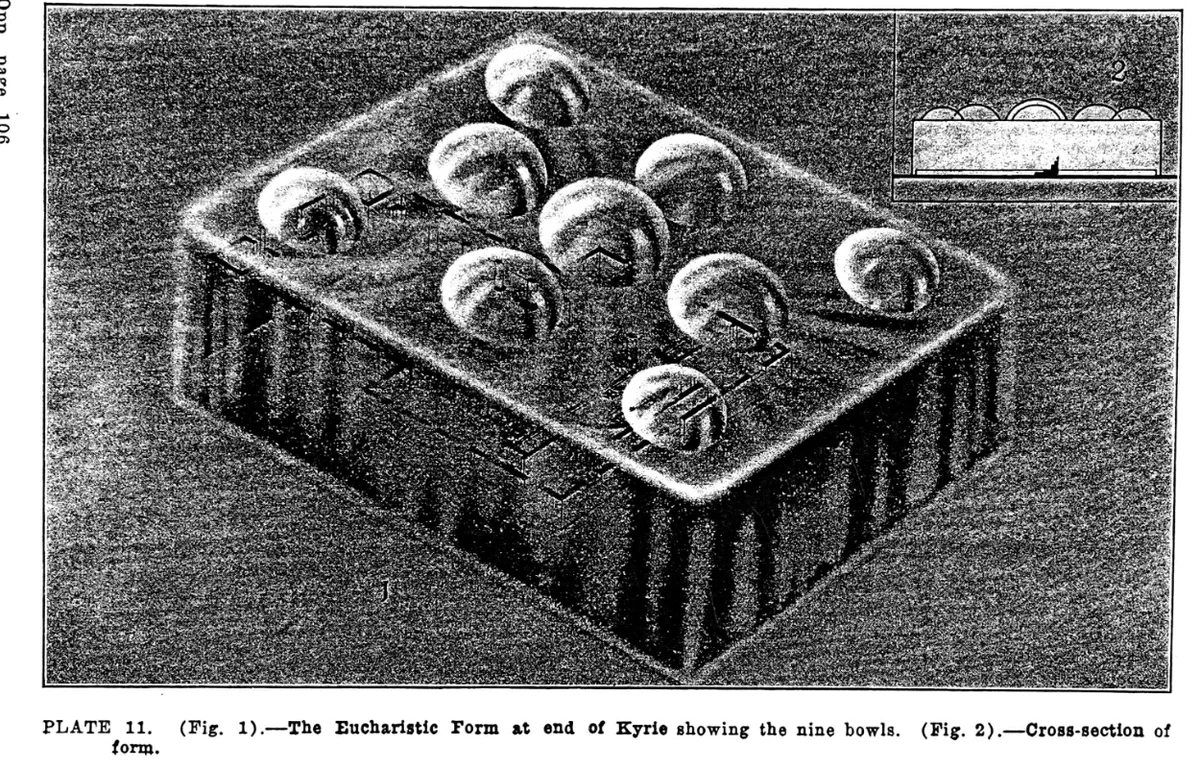
Plate 11, facing printed page 106. The nine bowls represent the Eucharistic form after the Kyrie according to Leadbeater.
The Science of the Sacraments by Charles W. Leadbeater, The St. Alban Press, 1920. Library facsimile. · Image source ↗ · Public Domain
See references (12)
- The Science of the Sacraments, printed p. 22, Reader page 20
- The Science of the Sacraments, printed p. 62, Reader page 63
- The Science of the Sacraments, printed p. 100, Reader page 105
- The Science of the Sacraments, printed p. 103, Reader page 109
- The Science of the Sacraments, printed p. 61, Reader page 62
- The Science of the Sacraments, printed p. 63, Reader page 65
- The Science of the Sacraments, printed p. 105, Reader page 112
- The Science of the Sacraments, Reader page 114
- The Science of the Sacraments, printed p. 110, Reader page 119
- The Science of the Sacraments, printed p. 66, Reader page 69
- The Science of the Sacraments, printed p. 68, Reader page 71
- The Science of the Sacraments, printed p. 69, Reader page 72
Thought-Forms by Annie Besant and Charles W. Leadbeater
Annie Besant and Charles W. Leadbeater picture the forms they attribute to performances of Mendelssohn, Gounod and Wagner. The church beneath them gives readers a familiar scale. The two plates below show how far the shapes and colours can vary between performances. [1][2][3]
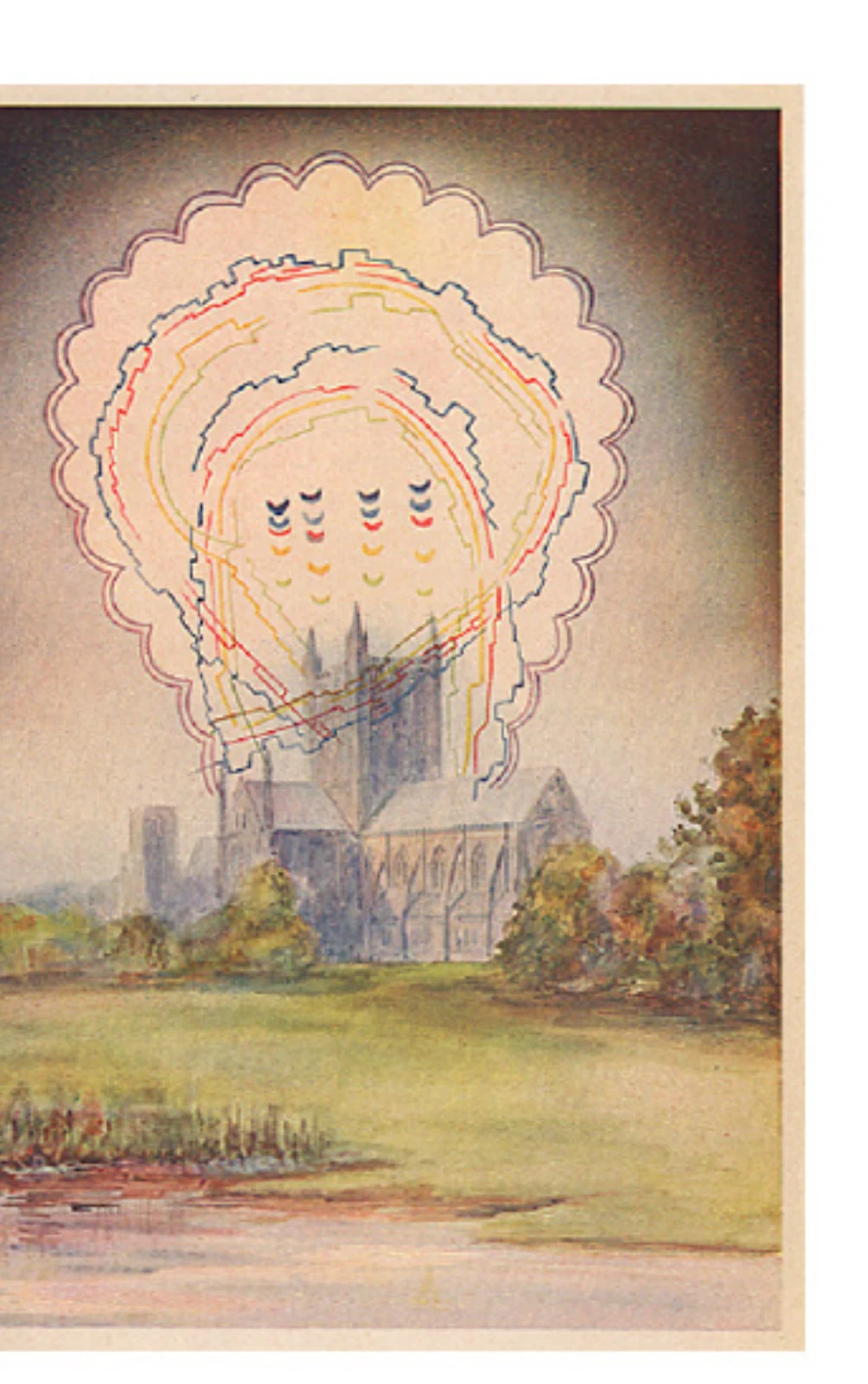
Plate M, Mendelssohn. Thin bands rise above the church in the form that Besant and Leadbeater attribute to the performance.
Annie Besant and C. W. Leadbeater, Thought-Forms, consulted Library edition (1905). · Image source ↗ · Public Domain
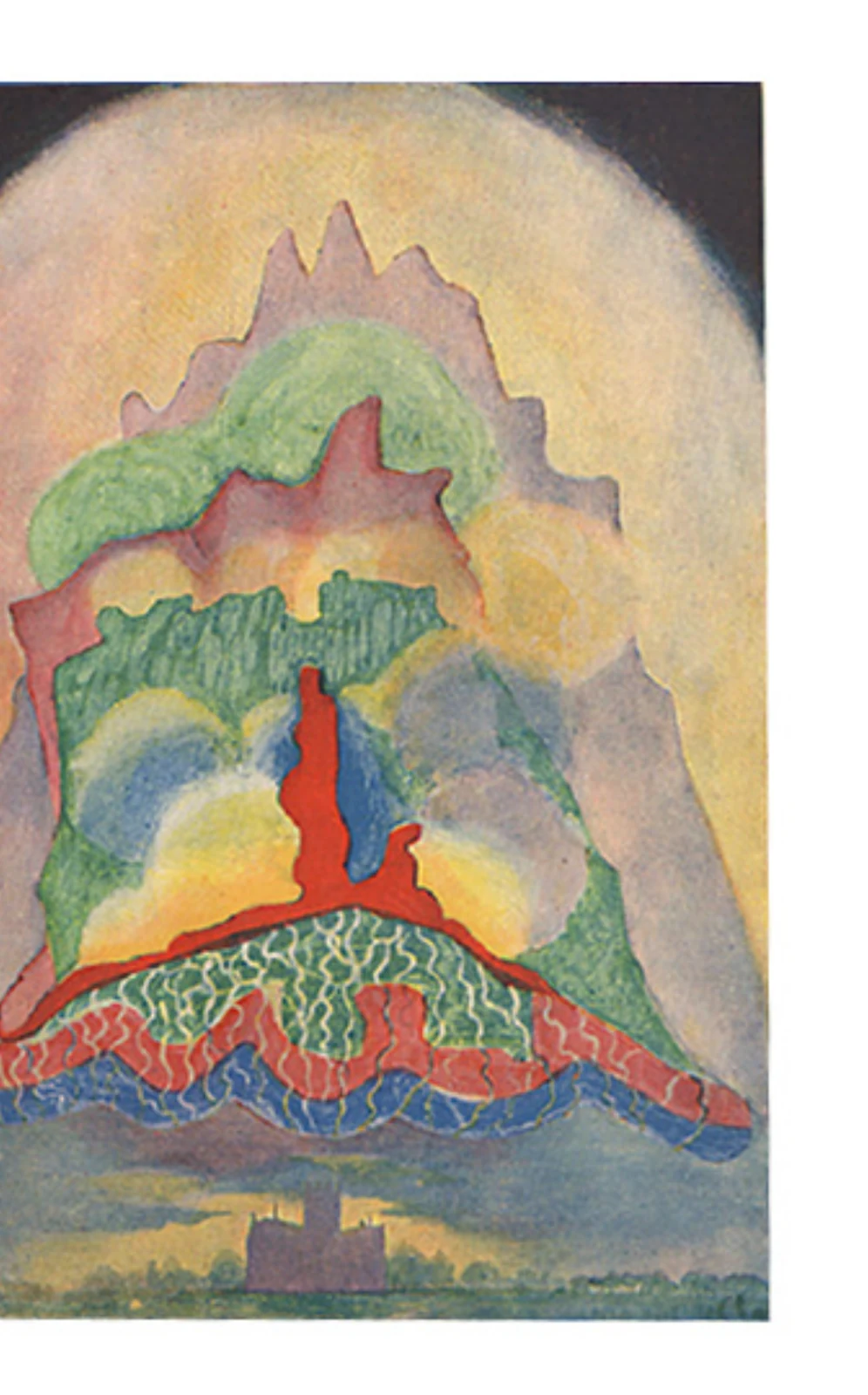
Plate W, Wagner. The form towers above the church in broad, dense bands of colour.
Annie Besant and C. W. Leadbeater, Thought-Forms, consulted Library edition (1905). · Image source ↗ · Public Domain
The Kingdom of the Gods by Geoffrey Hodson
Geoffrey Hodson describes an open-air Eucharist on the slopes of Arjoena Mountain in Java. He reports nature spirits gathering and joining the offering. At consecration, he describes a golden radiance around the Host and takes it as Christ’s presence reaching the surrounding life. [17][18]
Hodson says that at the dismissal the forces of the ceremony are released with the participation of angels. He uses the episode to reflect on what he believes worship contributes to the landscape around it. [18][19]
How the form grows and where its influence goes
The music plates compare the shapes attributed to separate performances. Leadbeater’s later diagrams follow one service as it unfolds. Hodson’s account follows the effects he perceived beyond an outdoor congregation, keeping the landscape in view. [4][7][8][13][1][2][3][17][18][19]
See references (10)
- Thought-Forms, Reader page 61
- Thought-Forms, Reader page 63
- Thought-Forms, Reader page 65
- The Science of the Sacraments, printed p. 22, Reader page 20
- The Science of the Sacraments, printed p. 100, Reader page 105
- The Science of the Sacraments, printed p. 103, Reader page 109
- The Science of the Sacraments, printed p. 110, Reader page 119
- The Kingdom of the Gods, Reader page 155
- The Kingdom of the Gods, Reader page 156
- The Kingdom of the Gods, Reader page 157
In the library

Thought-Forms
Reading note
Separately attributed primary Library account, cited on exact verified Reader leaves.
The Science of the Sacraments
Reading note
The separately titled account draws on exact passages in the consulted Library edition.
The Kingdom of the Gods
Reading note
The separately titled account draws on exact passages in the consulted Library edition.
Sources
See references (19)
- Thought-Forms, Reader page 61Exact source retained from the earlier attributed Thought-forms account.Read this page in Thought-Forms ↗
- Thought-Forms, Reader page 63Exact source retained from the earlier attributed Thought-forms account.Read this page in Thought-Forms ↗
- Thought-Forms, Reader page 65Exact source retained from the earlier attributed Thought-forms account.Read this page in Thought-Forms ↗
- The Science of the Sacraments, printed p. 22, Reader page 20Charles W. Leadbeater, The Science of the Sacraments, The St. Alban Press, 1920. Exact Library edition IMJ-0615-E001.Read this page in The Science of the Sacraments ↗
- The Science of the Sacraments, printed p. 23, Reader page 22Charles W. Leadbeater, The Science of the Sacraments, The St. Alban Press, 1920. Exact Library edition IMJ-0615-E001.Read this page in The Science of the Sacraments ↗
- The Science of the Sacraments, printed p. 62, Reader page 63Charles W. Leadbeater, The Science of the Sacraments, The St. Alban Press, 1920. Exact Library edition IMJ-0615-E001.Read this page in The Science of the Sacraments ↗
- The Science of the Sacraments, printed p. 100, Reader page 105Charles W. Leadbeater, The Science of the Sacraments, The St. Alban Press, 1920. Exact Library edition IMJ-0615-E001.Read this page in The Science of the Sacraments ↗
- The Science of the Sacraments, printed p. 103, Reader page 109Charles W. Leadbeater, The Science of the Sacraments, The St. Alban Press, 1920. Exact Library edition IMJ-0615-E001.Read this page in The Science of the Sacraments ↗
- The Science of the Sacraments, printed p. 61, Reader page 62Charles W. Leadbeater, The Science of the Sacraments, The St. Alban Press, 1920. Exact Library edition IMJ-0615-E001.Read this page in The Science of the Sacraments ↗
- The Science of the Sacraments, printed p. 63, Reader page 65Charles W. Leadbeater, The Science of the Sacraments, The St. Alban Press, 1920. Exact Library edition IMJ-0615-E001.Read this page in The Science of the Sacraments ↗
- The Science of the Sacraments, printed p. 105, Reader page 112Charles W. Leadbeater, The Science of the Sacraments, The St. Alban Press, 1920. Exact Library edition IMJ-0615-E001.Read this page in The Science of the Sacraments ↗
- The Science of the Sacraments, Reader page 114Charles W. Leadbeater, The Science of the Sacraments, The St. Alban Press, 1920. Exact Library edition IMJ-0615-E001.Read this page in The Science of the Sacraments ↗
- The Science of the Sacraments, printed p. 110, Reader page 119Charles W. Leadbeater, The Science of the Sacraments, The St. Alban Press, 1920. Exact Library edition IMJ-0615-E001.Read this page in The Science of the Sacraments ↗
- The Science of the Sacraments, printed p. 66, Reader page 69Charles W. Leadbeater, The Science of the Sacraments, The St. Alban Press, 1920. Exact Library edition IMJ-0615-E001.Read this page in The Science of the Sacraments ↗
- The Science of the Sacraments, printed p. 68, Reader page 71Charles W. Leadbeater, The Science of the Sacraments, The St. Alban Press, 1920. Exact Library edition IMJ-0615-E001.Read this page in The Science of the Sacraments ↗
- The Science of the Sacraments, printed p. 69, Reader page 72Charles W. Leadbeater, The Science of the Sacraments, The St. Alban Press, 1920. Exact Library edition IMJ-0615-E001.Read this page in The Science of the Sacraments ↗
- The Kingdom of the Gods, Reader page 155Geoffrey Hodson, The Kingdom of the Gods, Theosophical Publishing House, first published 1952, thirteenth reprint 2007. Lumitheca Library edition IMJ-0606-E001.Read this page in The Kingdom of the Gods ↗
- The Kingdom of the Gods, Reader page 156Geoffrey Hodson, The Kingdom of the Gods, Theosophical Publishing House, first published 1952, thirteenth reprint 2007. Lumitheca Library edition IMJ-0606-E001.Read this page in The Kingdom of the Gods ↗
- The Kingdom of the Gods, Reader page 157Geoffrey Hodson, The Kingdom of the Gods, Theosophical Publishing House, first published 1952, thirteenth reprint 2007. Lumitheca Library edition IMJ-0606-E001.Read this page in The Kingdom of the Gods ↗