Yajna
Yajna means sacrifice or offering in Hindu traditions. Read how the Gita and Vivekananda connect ritual, spiritual vision and the fruits of work.
In this article
Understanding the concept
Yajna is sacrifice or offering in Hindu religious traditions. A yajna can take the form of a ritual with a fire and material offerings. The Bhagavad Gita also asks what the act looks like when everything involved in it is understood through Brahman. [1][4]
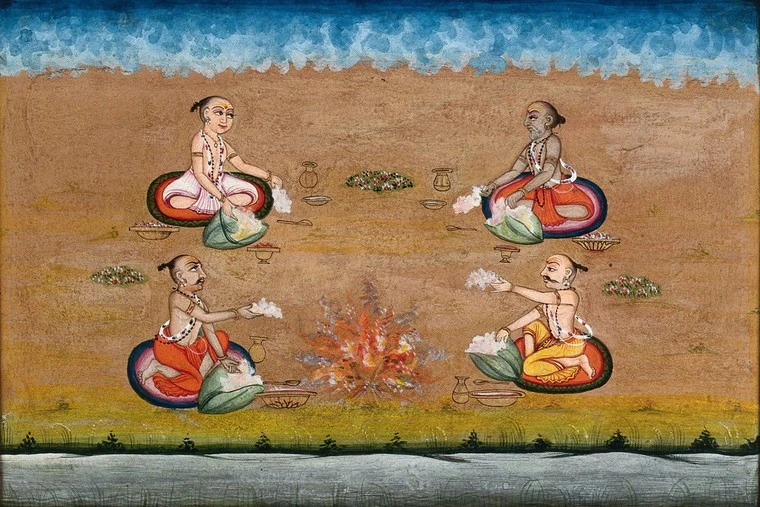
Four priests perform a yajna, Indian gouache, probably nineteenth century. The ritual fire is at the centre of the group.
Wellcome Collection, reference 577128i. Unidentified Indian artist. Public Domain Mark. · Image source ↗ · Public Domain
The Bhagavad Gita: offering understood through Brahman
In Bhagavad Gita 4.24, Brahman is seen in what is offered, the means of offering, the fire and the act itself. Swami Mukundananda’s translation presents this as the vision of a person absorbed in divine consciousness. [1]
Karma-Yoga by Swami Vivekananda
Swami Vivekananda applies sacrifice to an ordinary worker who can offer the fruits of action to the Lord. In the chapter on freedom he takes the image further. Body, mind and action become the offering, which gives sacrifice a place in continuing activity. [5][6][4]
The golden mongoose judges a royal sacrifice beside one hungry family’s gift of food. In Vivekananda’s retelling, the gift takes their lives. In Ganguli’s epic translation the guest reveals himself and the household ascends to heaven. Both scenes direct attention to what the donor gives up. [7][8][9][2]
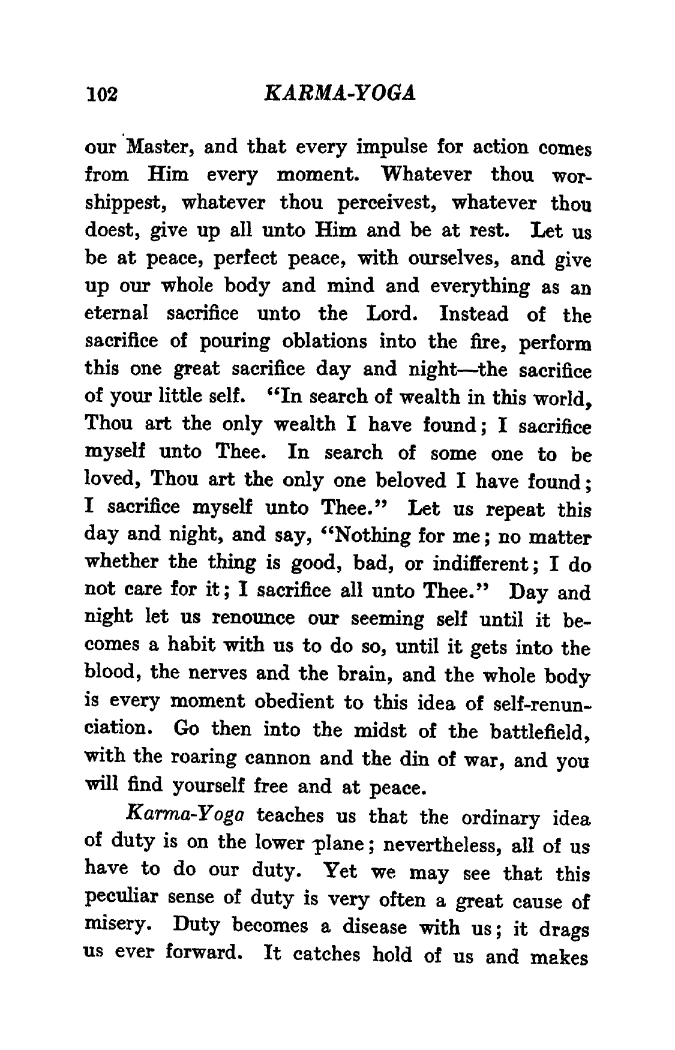
Source facsimile: Karma-Yoga (1939), Reader page 104. The devotional offering of the little self is contrasted with pouring oblations into fire.
Swami Vivekananda, Karma-Yoga, English second printing in the 1939 combined volume. Historical public-domain text, exact checksum-verified Library scan. · Image source ↗ · Public Domain
What is offered and what the giver sees
The Gita turns the act of offering into a question of what a person sees in it. Vivekananda asks what the person can give up in the act of working. The fire, the fruit of an ordinary task and the barley given to a guest each make the offering intelligible in a different way. [1][5][4]
Read further in the library

Karma Yoga
Reading note
The separately titled account draws on exact passages in the consulted Library edition.
Sources
See references (9)
- Bhagavad Gita 4.24, translated by Swami Mukundananda ↗Bhagavad Gita 4.24, Sanskrit, word meanings and Swami Mukundananda’s English translation; verse distinguished from the website’s following commentary.Return to text ↑
- Mahabharata, Aswamedha Parva, section XC, translated by Kisari Mohan Ganguli ↗Mahabharata, traditionally attributed to Vyasa, in Kisari Mohan Ganguli’s English translation. Book 14, section XC (90); the section’s numbered identity is the citation locator, not an invented Lumitheca Reader page.Return to text ↑
- Four priests perform a yagna, a fire sacrifice ↗Wellcome Collection 577128i. Unidentified Indian artist, probably nineteenth century; catalogue date uncertain. Public Domain Mark.
- Karma-Yoga, Reader page 104Swami Vivekananda, Karma-Yoga, in Karma-Yoga & Bhakti-Yoga, English second printing, Ramakrishna-Vivekananda Center of New York, Inc., 1939. Exact Library edition IMJ-0097-E002. Only the Karma-Yoga part is used in this crawl; the old Work slug mentioning Hindi does not identify this edition’s language.Read this page in Karma Yoga ↗Return to text ↑
- Karma-Yoga, Reader page 47Swami Vivekananda, Karma-Yoga, in Karma-Yoga & Bhakti-Yoga, English second printing, Ramakrishna-Vivekananda Center of New York, Inc., 1939. Exact Library edition IMJ-0097-E002. Only the Karma-Yoga part is used in this crawl; the old Work slug mentioning Hindi does not identify this edition’s language.Read this page in Karma Yoga ↗Return to text ↑
- Karma-Yoga, printed p. 101, Reader page 103Swami Vivekananda, Karma-Yoga, in Karma-Yoga & Bhakti-Yoga, English second printing, Ramakrishna-Vivekananda Center of New York, Inc., 1939. Exact Library edition IMJ-0097-E002. Only the Karma-Yoga part is used in this crawl; the old Work slug mentioning Hindi does not identify this edition’s language.Read this page in Karma Yoga ↗Return to text ↑
- Karma-Yoga, printed p. 46, Reader page 48Swami Vivekananda, Karma-Yoga, in Karma-Yoga & Bhakti-Yoga, English second printing, Ramakrishna-Vivekananda Center of New York, Inc., 1939. Exact Library edition IMJ-0097-E002. Only the Karma-Yoga part is used in this crawl; the old Work slug mentioning Hindi does not identify this edition’s language.Read this page in Karma Yoga ↗Return to text ↑
- Karma-Yoga, Reader page 49Swami Vivekananda, Karma-Yoga, in Karma-Yoga & Bhakti-Yoga, English second printing, Ramakrishna-Vivekananda Center of New York, Inc., 1939. Exact Library edition IMJ-0097-E002. Only the Karma-Yoga part is used in this crawl; the old Work slug mentioning Hindi does not identify this edition’s language.Read this page in Karma Yoga ↗Return to text ↑
- Karma-Yoga, Reader page 50Swami Vivekananda, Karma-Yoga, in Karma-Yoga & Bhakti-Yoga, English second printing, Ramakrishna-Vivekananda Center of New York, Inc., 1939. Exact Library edition IMJ-0097-E002. Only the Karma-Yoga part is used in this crawl; the old Work slug mentioning Hindi does not identify this edition’s language.Read this page in Karma Yoga ↗Return to text ↑