The Golden Mongoose
The golden mongoose challenges a royal sacrifice with the story of a poor family’s gift. Compare the Mahabharata with Vivekananda’s retelling in Karma-Yoga.
In this article
Understanding the concept
The golden mongoose is a speaking animal in the Mahabharata. Half its body turns gold after contact with the remains of a poor family’s gift of barley. At a royal sacrifice, the mongoose asks what the size of an offering tells us about the generosity of the giver. [1][3][4]
The mongoose wants a second gift to turn the rest of its body golden. The royal offering leaves its coat unchanged. The animal’s partly golden body gives the reader a visible way to compare two gifts made under very different circumstances. [3][4]
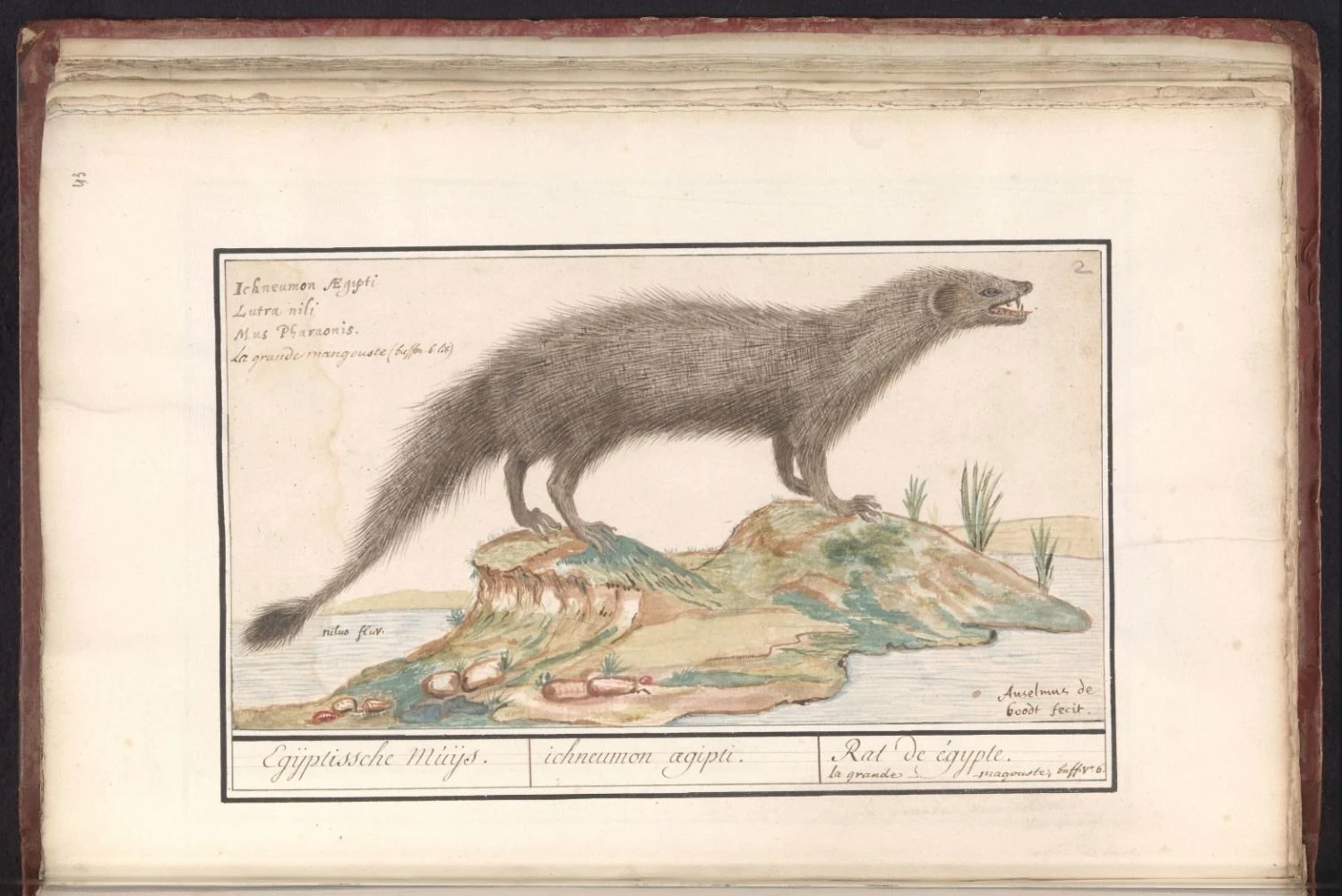
Anselmus Boëtius de Boodt, Egyptian Mongoose, 1596–1610. A natural-history drawing of a mongoose.
Rijksmuseum, on loan from a private collection · Image source ↗ · Public Domain
The Mahabharata: Ganguli’s section XC
In Kisari Mohan Ganguli’s translation of the Mahabharata, the episode follows Yudhishthira’s horse-sacrifice. A Brahman who lives by gleaning grain gives barley to a guest, and his family adds their portions. The guest reveals himself as the deity of righteousness and takes the family to heaven. [1]
Karma-Yoga by Swami Vivekananda
Swami Vivekananda tells the story in “The Secret of Work,” immediately after discussing selfless giving. The Pandava brothers have held a magnificent sacrifice and distributed wealth. Their admirers call it unparalleled, but a half-golden mongoose appears and refuses to accept that judgement. [5][3]
The mongoose recalls a poor Brahman living with his wife, son and daughter-in-law during a famine. When the family finally obtains a little barley flour, a hungry guest arrives. The father offers his portion; the others then surrender theirs in turn because the guest remains hungry. [3][4]
In this retelling, the guest leaves satisfied and the four members of the household die of starvation that night. The mongoose rolls in scattered flour, and half its body becomes golden. No subsequent ceremony has reproduced the effect, including the Pandavas’ richly praised sacrifice. [4]
Vivekananda places the tale where he discusses selfless work. The mongoose has heard people praise a ceremony for its splendour. Its story directs attention to what particular people gave up in order to feed one hungry guest. [4][6]
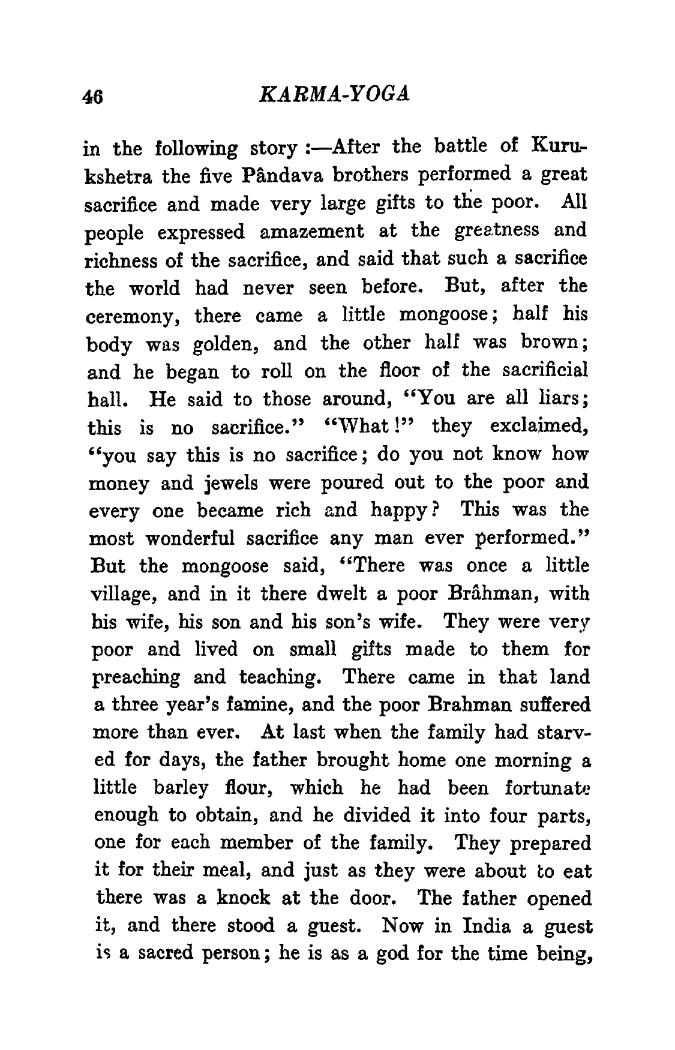
Karma-Yoga (1939), Library Reader page 48. The mongoose interrupts praise for the Pandavas’ sacrifice.
Swami Vivekananda, Karma-Yoga, English second printing in the 1939 combined volume. Historical public-domain text, exact checksum-verified Library scan. · Image source ↗ · Public Domain
Two endings for the family
Ganguli’s epic translation ends the household’s story with the guest’s revelation and the family’s ascent to heaven. In Vivekananda’s retelling, the guest leaves satisfied and the family dies of hunger. The sacrifice remains costly in both versions, and the epic gives it an explicit divine answer. [1][4]
The mongoose compares the cost of two gifts. Karma Yoga also asks whether the giver wants gratitude or recognition. The parable makes generosity visible, while the chapter extends the question to the expectations that can accompany a gift. [5][3][4][6][7][8]
Read further in the library
Karma Yoga
Reading note
The separately titled account draws on exact passages in the consulted Library edition.
Sources
See references (8)
- Mahabharata, Aswamedha Parva, section XC, translated by Kisari Mohan Ganguli ↗Mahabharata, traditionally attributed to Vyasa, in Kisari Mohan Ganguli’s English translation. Book 14, section XC (90); the section’s numbered identity is the citation locator, not an invented Lumitheca Reader page.Return to text ↑
- Egyptian mongoose (Herpestes ichneumon) ↗Anselmus Boetius de Boodt, 1596–1610. Rijksmuseum, RP-T-BR-2017-1-2-43. Public-domain animal drawing, separately identified from the epic narrative.
- Karma-Yoga, printed p. 46, Reader page 48Swami Vivekananda, Karma-Yoga, in Karma-Yoga & Bhakti-Yoga, English second printing, Ramakrishna-Vivekananda Center of New York, Inc., 1939. Exact Library edition IMJ-0097-E002. Only the Karma-Yoga part is used in this crawl; the old Work slug mentioning Hindi does not identify this edition’s language.Read this page in Karma Yoga ↗Return to text ↑
- Karma-Yoga, Reader page 49Swami Vivekananda, Karma-Yoga, in Karma-Yoga & Bhakti-Yoga, English second printing, Ramakrishna-Vivekananda Center of New York, Inc., 1939. Exact Library edition IMJ-0097-E002. Only the Karma-Yoga part is used in this crawl; the old Work slug mentioning Hindi does not identify this edition’s language.Read this page in Karma Yoga ↗Return to text ↑
- Karma-Yoga, Reader page 47Swami Vivekananda, Karma-Yoga, in Karma-Yoga & Bhakti-Yoga, English second printing, Ramakrishna-Vivekananda Center of New York, Inc., 1939. Exact Library edition IMJ-0097-E002. Only the Karma-Yoga part is used in this crawl; the old Work slug mentioning Hindi does not identify this edition’s language.Read this page in Karma Yoga ↗Return to text ↑
- Karma-Yoga, Reader page 50Swami Vivekananda, Karma-Yoga, in Karma-Yoga & Bhakti-Yoga, English second printing, Ramakrishna-Vivekananda Center of New York, Inc., 1939. Exact Library edition IMJ-0097-E002. Only the Karma-Yoga part is used in this crawl; the old Work slug mentioning Hindi does not identify this edition’s language.Read this page in Karma Yoga ↗Return to text ↑
- Karma-Yoga, Reader page 121Swami Vivekananda, Karma-Yoga, in Karma-Yoga & Bhakti-Yoga, English second printing, Ramakrishna-Vivekananda Center of New York, Inc., 1939. Exact Library edition IMJ-0097-E002. Only the Karma-Yoga part is used in this crawl; the old Work slug mentioning Hindi does not identify this edition’s language.Read this page in Karma Yoga ↗Return to text ↑
- Karma-Yoga, Reader page 122Swami Vivekananda, Karma-Yoga, in Karma-Yoga & Bhakti-Yoga, English second printing, Ramakrishna-Vivekananda Center of New York, Inc., 1939. Exact Library edition IMJ-0097-E002. Only the Karma-Yoga part is used in this crawl; the old Work slug mentioning Hindi does not identify this edition’s language.Read this page in Karma Yoga ↗Return to text ↑