Ritual
Ritual gives actions a recognised form and meaning. Compare an offering in the Gita, a rite of renunciation and Vivekananda’s account of symbols.
In this article
Understanding the concept
A ritual is an action or sequence people give a recognised form and meaning. It can use a gesture, a saying or a material offering. Some rituals express a relationship with the divine, and some mark a change in the life of the person taking part. [1][2][4]
The sources here offer examples of both. The Gita gives a little water or a leaf the significance of an offering. The Mahanirvana Tantra gives renunciation a ritual passage from one status to another. [4][5][6][7]
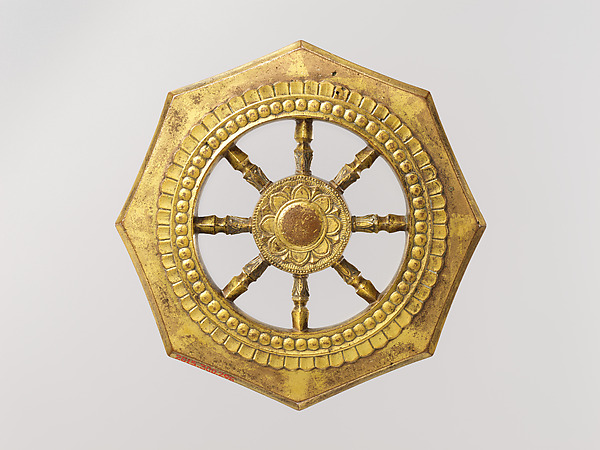
Wheel of the Buddhist Law, Japan, late thirteenth century. This gilt-bronze ritual object represents the Buddhist teaching and its eightfold path.
The Metropolitan Museum of Art, Mary Griggs Burke Collection, Gift of the Mary and Jackson Burke Foundation, 2015 · Image source ↗ · CC0
The Bhagavad Gita: a small offering
In Bhagavad Gita 9.26, Krishna accepts an offering made with devotion. The examples are modest and readily available, placing the emphasis on the character of the giving. The cited verse, in Swami Mukundananda’s translation, supplies one specific devotional setting rather than a complete theory of ritual. [1]
The Mahanirvana Tantra: a ritual transition
In Arthur Avalon’s translation of the Mahanirvana Tantra, VIII.240–244 describes the renunciant’s own funeral rites. The practice gives departure from the previous social condition a publicly recognisable form. [2]
Karma-Yoga by Swami Vivekananda
Swami Vivekananda distinguishes philosophy, which states an idea, mythology, which gives it a story, and ritual, which gives it something people can do. His defence asks what an enacted form makes intelligible to the people who use it. [4][6][7]
Vivekananda begins with words as symbols and extends the relation to colours, objects and places. He includes ritual within Karma Yoga because doing something with a form can bring a religious idea to mind. [5][6][7]
Vivekananda supports his argument with broad claims about the antiquity of symbols such as the cross and swastika. These claims show how he uses historical examples to argue for a relation between mind and symbol. [5][6]
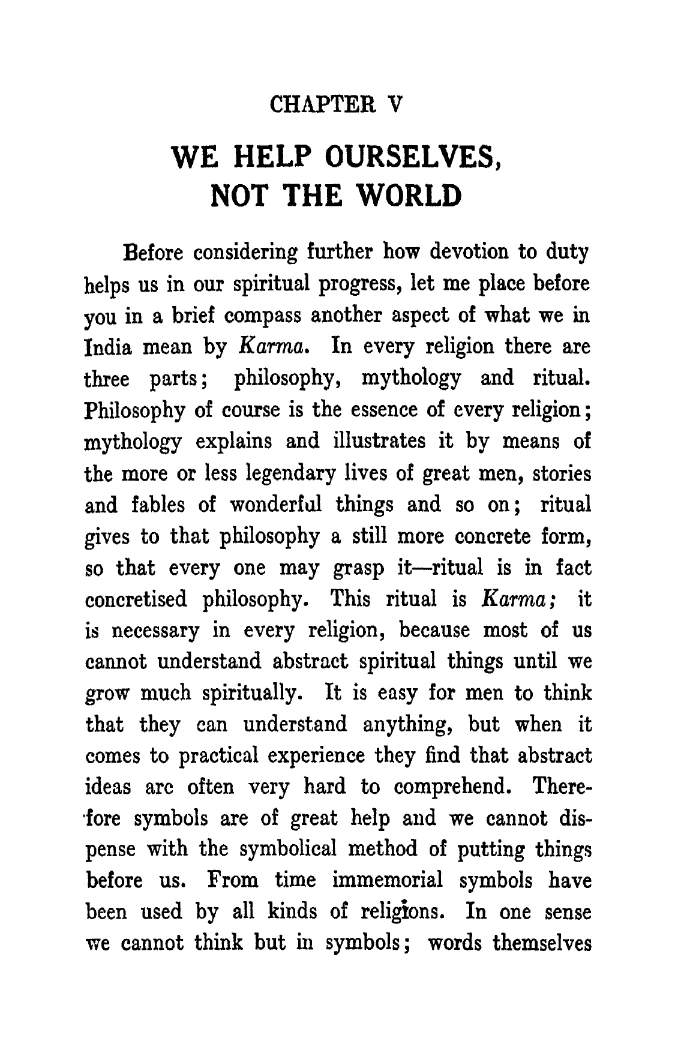
Source facsimile: Karma-Yoga (1939), Reader page 63. Ritual is introduced as a concrete expression of religious philosophy.
Swami Vivekananda, Karma-Yoga, English second printing in the 1939 combined volume. Historical public-domain text, exact checksum-verified Library scan. · Image source ↗ · Public Domain
What a ritual makes tangible
An offering makes devotion tangible in the Gita. The Tantra uses ceremonial action to change social and religious status. Vivekananda asks how enacted forms help a person grasp a religious idea. The examples show how much of a ritual’s meaning comes from the setting and purpose of the act. [1][2][4][6]
Read further in the library
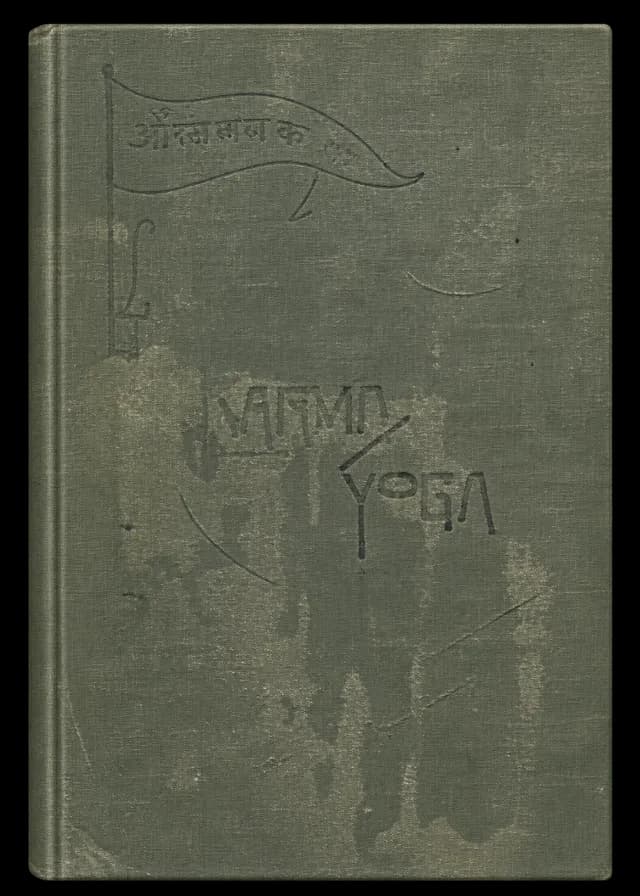
Karma Yoga
Reading note
The separately titled account draws on exact passages in the consulted Library edition.
Sources
See references (7)
- Bhagavad Gita 9.26, translated by Swami Mukundananda ↗Bhagavad Gita 9.26, Krishna’s words to Arjuna, translated by Swami Mukundananda. A simple offering is received with devotion.Return to text ↑
- Mahanirvana Tantra, chapter VIII, translated by Arthur Avalon (Sir John Woodroffe), 1913 ↗Mahanirvana Tantra, VIII.240–244, Arthur Avalon (Sir John Woodroffe), 1913 English translation. Selected numbered passages previously read during this Karma-Yoga crawl. This translation postdates Vivekananda and is a separately consulted textual witness.Return to text ↑
- Wheel of the Buddhist Law (Rinpō), late 13th century ↗The Metropolitan Museum of Art, accession 2015.300.296; CC0 image
- Karma-Yoga, Reader page 63Swami Vivekananda, Karma-Yoga, in Karma-Yoga & Bhakti-Yoga, English second printing, Ramakrishna-Vivekananda Center of New York, Inc., 1939. Exact Library edition IMJ-0097-E002. Only the Karma-Yoga part is used in this crawl; the old Work slug mentioning Hindi does not identify this edition’s language.Read this page in Karma Yoga ↗Return to text ↑
- Karma-Yoga, Reader page 64Swami Vivekananda, Karma-Yoga, in Karma-Yoga & Bhakti-Yoga, English second printing, Ramakrishna-Vivekananda Center of New York, Inc., 1939. Exact Library edition IMJ-0097-E002. Only the Karma-Yoga part is used in this crawl; the old Work slug mentioning Hindi does not identify this edition’s language.Read this page in Karma Yoga ↗Return to text ↑
- Karma-Yoga, Reader page 65Swami Vivekananda, Karma-Yoga, in Karma-Yoga & Bhakti-Yoga, English second printing, Ramakrishna-Vivekananda Center of New York, Inc., 1939. Exact Library edition IMJ-0097-E002. Only the Karma-Yoga part is used in this crawl; the old Work slug mentioning Hindi does not identify this edition’s language.Read this page in Karma Yoga ↗Return to text ↑
- Karma-Yoga, Reader page 66Swami Vivekananda, Karma-Yoga, in Karma-Yoga & Bhakti-Yoga, English second printing, Ramakrishna-Vivekananda Center of New York, Inc., 1939. Exact Library edition IMJ-0097-E002. Only the Karma-Yoga part is used in this crawl; the old Work slug mentioning Hindi does not identify this edition’s language.Read this page in Karma Yoga ↗Return to text ↑