Work as Worship
Work as worship means treating ordinary action as an offering. Compare the Bhagavad Gita with Vivekananda’s examples of care, craft and public service.
In this article
Understanding the concept
Work as worship is the practice of treating an ordinary task as an offering. The work can be earning a living, caring for someone or building something a community needs. Its devotional meaning comes from how and for whom it is done. [1][3][4]
Vivekananda sets the householder’s honest earning and generous spending beside a recluse’s prayer. Both can express self-surrender, even though the work each life requires looks different. [3][5]
The Bhagavad Gita: worship through one’s work
In Bhagavad Gita 18.46, Krishna says that a person can attain perfection through work offered in worship to the source of all beings. Swami Mukundananda’s translation brings out the connection between one’s occupation and devotion to that source. [1]
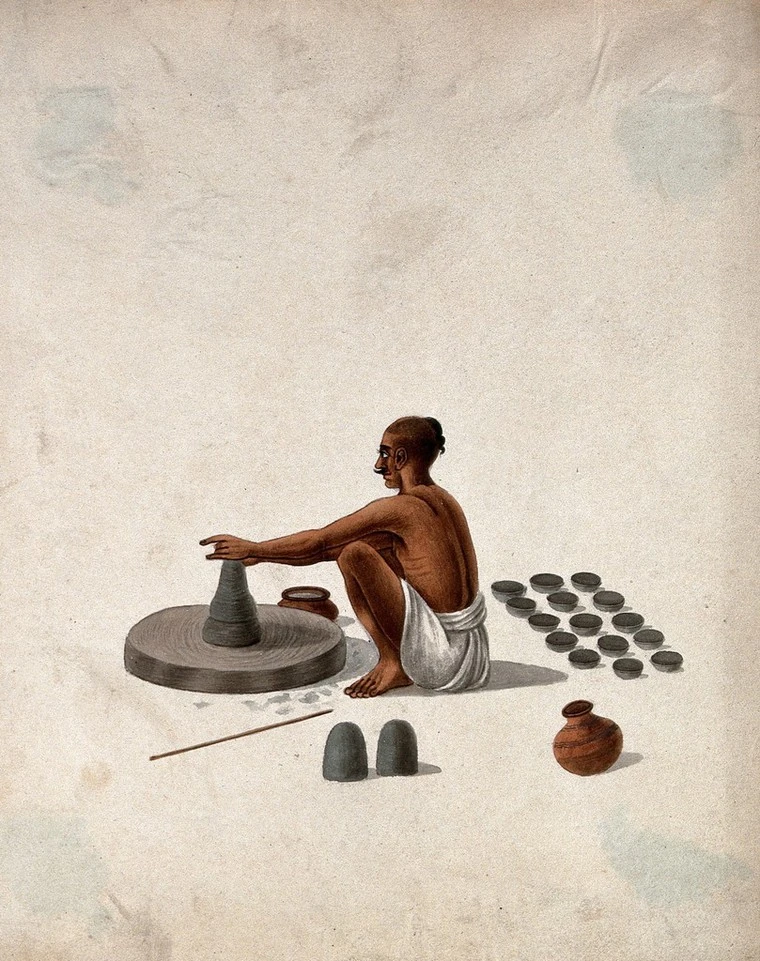
A potter at a wheel, Indian gouache, probably nineteenth century. The painting shows the care involved in an ordinary craft.
Wellcome Collection, reference 582309i. Unidentified Indian artist. Public Domain Mark. · Image source ↗ · Public Domain
Karma-Yoga by Swami Vivekananda
Swami Vivekananda’s Karma-Yoga gives worship a practical setting. In his discussion of household duties, wealth acquired by good means and used for good purposes can serve others. Digging reservoirs, planting roadside trees, providing rest-houses and making roads or bridges all enter the account of spiritual work. [3][5]
He later makes the offering explicit: someone who believes in a personal God can surrender the fruits of work to God. The deed is no longer presented as a bargain in which another person must supply gratitude. The devotional relationship changes the worker’s claim upon the act. [6][7][8]
A story supplies another setting. A monk learns from a housewife caring for an ill husband and from a butcher caring for his elderly parents. Vivekananda presents their illumination as arising through wholehearted, unattached performance of their responsibilities. These are events within a teaching narrative, not documented demonstrations of supernatural knowledge. [9][10][11][4]
After the story of the housewife and the butcher, Vivekananda recalls a sage who asks the worker to give the means the same attention as the end. Giving the task wholehearted attention is itself part of the worship. [4]
Vivekananda also describes a person so consumed by work that they call their attachment duty. His image of dying in harness shows how much compulsion can remain even when someone gives it a religious name. [8][12][13]
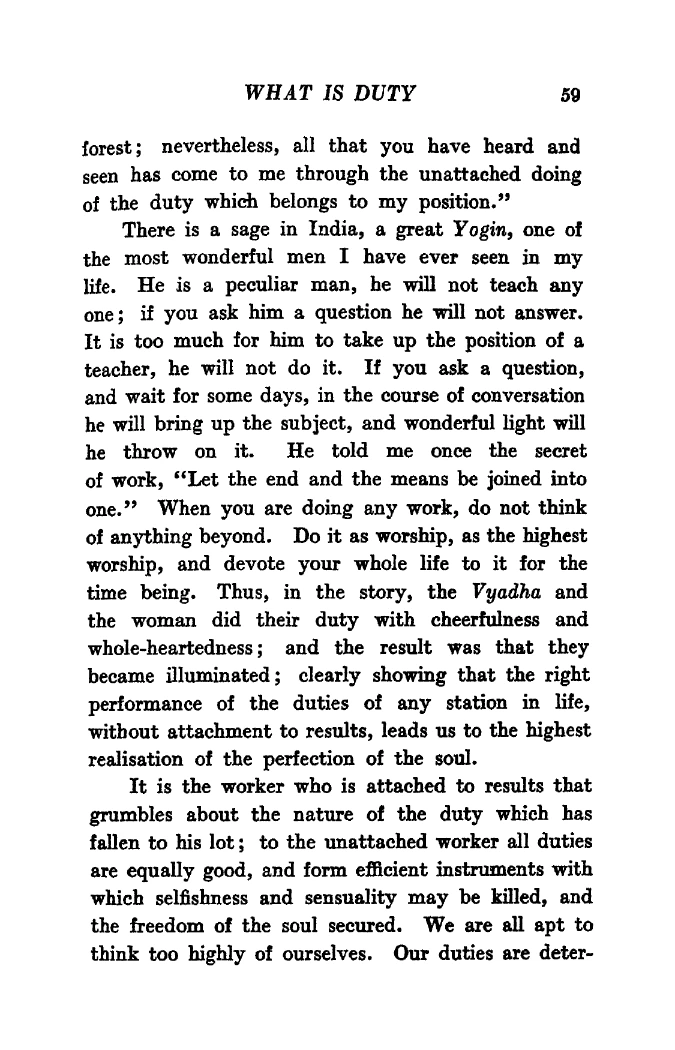
Karma-Yoga (1939), Library Reader page 61. Vivekananda joins attention to the task with the meaning of worship.
Swami Vivekananda, Karma-Yoga, English second printing in the 1939 combined volume. Historical public-domain text, exact checksum-verified Library scan. · Image source ↗ · Public Domain
See references (11)
- Karma-Yoga, Reader page 29
- Karma-Yoga, Reader page 61
- Karma-Yoga, Reader page 30
- Karma-Yoga, Reader page 47
- Karma-Yoga, printed p. 101, Reader page 103
- Karma-Yoga, Reader page 104
- Karma-Yoga, Reader page 58
- Karma-Yoga, Reader page 59
- Karma-Yoga, Reader page 60
- Karma-Yoga, Reader page 105
- Karma-Yoga, Reader page 106
How a task becomes an offering
The Gita speaks of worship through the work a person does. Vivekananda gives the idea a public dimension through honest earning, care for others and uses of wealth that benefit a community. The way a person earns and spends becomes part of the offering. [1][3][6]
Work as worship is a devotional expression of Karma Yoga. Vivekananda also addresses the worker who does not believe in God. The shared discipline concerns attachment to results, while worship describes the further act of offering them to God. [7][8][14]
Read further in the library
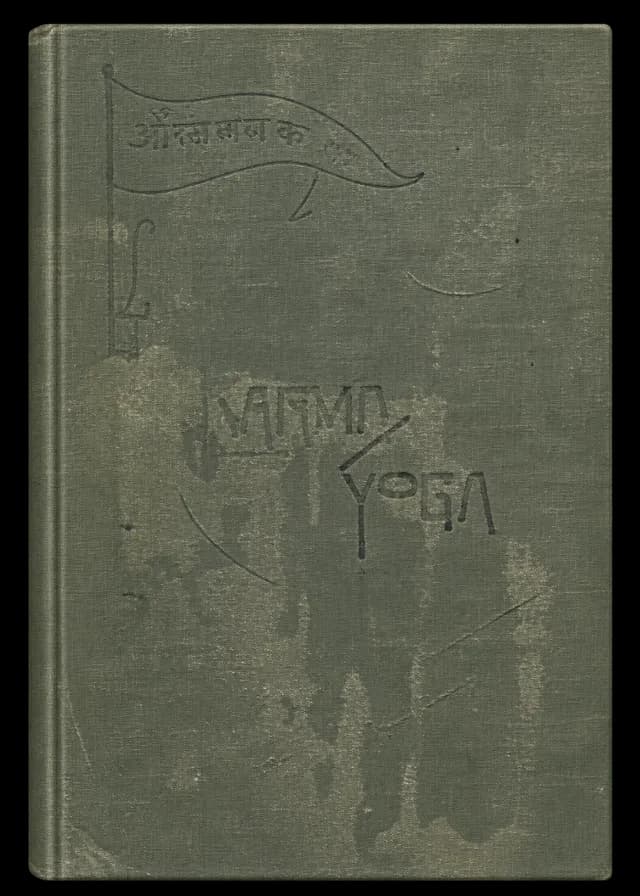
Karma Yoga
Reading note
The separately titled account draws on exact passages in the consulted Library edition.
Sources
See references (14)
- Bhagavad Gita 18.46, translated by Swami Mukundananda ↗Bhagavad Gita 18.46, in Swami Mukundananda’s devotional translation. Verse distinguished from the following commentary.Return to text ↑
- A potter working on the wheel. Gouache painting by an Indian artist. ↗Wellcome Collection, reference 582309i. Unidentified Indian artist, nineteenth century (catalogue date uncertain). Public Domain Mark. Historical occupational image, without an assertion about the sitter’s beliefs.
- Karma-Yoga, Reader page 29Swami Vivekananda, Karma-Yoga, in Karma-Yoga & Bhakti-Yoga, English second printing, Ramakrishna-Vivekananda Center of New York, Inc., 1939. Exact Library edition IMJ-0097-E002. Only the Karma-Yoga part is used in this crawl; the old Work slug mentioning Hindi does not identify this edition’s language.Read this page in Karma Yoga ↗Return to text ↑
- Karma-Yoga, Reader page 61Swami Vivekananda, Karma-Yoga, in Karma-Yoga & Bhakti-Yoga, English second printing, Ramakrishna-Vivekananda Center of New York, Inc., 1939. Exact Library edition IMJ-0097-E002. Only the Karma-Yoga part is used in this crawl; the old Work slug mentioning Hindi does not identify this edition’s language.Read this page in Karma Yoga ↗Return to text ↑
- Karma-Yoga, Reader page 30Swami Vivekananda, Karma-Yoga, in Karma-Yoga & Bhakti-Yoga, English second printing, Ramakrishna-Vivekananda Center of New York, Inc., 1939. Exact Library edition IMJ-0097-E002. Only the Karma-Yoga part is used in this crawl; the old Work slug mentioning Hindi does not identify this edition’s language.Read this page in Karma Yoga ↗Return to text ↑
- Karma-Yoga, Reader page 47Swami Vivekananda, Karma-Yoga, in Karma-Yoga & Bhakti-Yoga, English second printing, Ramakrishna-Vivekananda Center of New York, Inc., 1939. Exact Library edition IMJ-0097-E002. Only the Karma-Yoga part is used in this crawl; the old Work slug mentioning Hindi does not identify this edition’s language.Read this page in Karma Yoga ↗Return to text ↑
- Karma-Yoga, printed p. 101, Reader page 103Swami Vivekananda, Karma-Yoga, in Karma-Yoga & Bhakti-Yoga, English second printing, Ramakrishna-Vivekananda Center of New York, Inc., 1939. Exact Library edition IMJ-0097-E002. Only the Karma-Yoga part is used in this crawl; the old Work slug mentioning Hindi does not identify this edition’s language.Read this page in Karma Yoga ↗Return to text ↑
- Karma-Yoga, Reader page 104Swami Vivekananda, Karma-Yoga, in Karma-Yoga & Bhakti-Yoga, English second printing, Ramakrishna-Vivekananda Center of New York, Inc., 1939. Exact Library edition IMJ-0097-E002. Only the Karma-Yoga part is used in this crawl; the old Work slug mentioning Hindi does not identify this edition’s language.Read this page in Karma Yoga ↗Return to text ↑
- Karma-Yoga, Reader page 58Swami Vivekananda, Karma-Yoga, in Karma-Yoga & Bhakti-Yoga, English second printing, Ramakrishna-Vivekananda Center of New York, Inc., 1939. Exact Library edition IMJ-0097-E002. Only the Karma-Yoga part is used in this crawl; the old Work slug mentioning Hindi does not identify this edition’s language.Read this page in Karma Yoga ↗Return to text ↑
- Karma-Yoga, Reader page 59Swami Vivekananda, Karma-Yoga, in Karma-Yoga & Bhakti-Yoga, English second printing, Ramakrishna-Vivekananda Center of New York, Inc., 1939. Exact Library edition IMJ-0097-E002. Only the Karma-Yoga part is used in this crawl; the old Work slug mentioning Hindi does not identify this edition’s language.Read this page in Karma Yoga ↗Return to text ↑
- Karma-Yoga, Reader page 60Swami Vivekananda, Karma-Yoga, in Karma-Yoga & Bhakti-Yoga, English second printing, Ramakrishna-Vivekananda Center of New York, Inc., 1939. Exact Library edition IMJ-0097-E002. Only the Karma-Yoga part is used in this crawl; the old Work slug mentioning Hindi does not identify this edition’s language.Read this page in Karma Yoga ↗Return to text ↑
- Karma-Yoga, Reader page 105Swami Vivekananda, Karma-Yoga, in Karma-Yoga & Bhakti-Yoga, English second printing, Ramakrishna-Vivekananda Center of New York, Inc., 1939. Exact Library edition IMJ-0097-E002. Only the Karma-Yoga part is used in this crawl; the old Work slug mentioning Hindi does not identify this edition’s language.Read this page in Karma Yoga ↗Return to text ↑
- Karma-Yoga, Reader page 106Swami Vivekananda, Karma-Yoga, in Karma-Yoga & Bhakti-Yoga, English second printing, Ramakrishna-Vivekananda Center of New York, Inc., 1939. Exact Library edition IMJ-0097-E002. Only the Karma-Yoga part is used in this crawl; the old Work slug mentioning Hindi does not identify this edition’s language.Read this page in Karma Yoga ↗Return to text ↑
- Karma-Yoga, Reader page 115Swami Vivekananda, Karma-Yoga, in Karma-Yoga & Bhakti-Yoga, English second printing, Ramakrishna-Vivekananda Center of New York, Inc., 1939. Exact Library edition IMJ-0097-E002. Only the Karma-Yoga part is used in this crawl; the old Work slug mentioning Hindi does not identify this edition’s language.Read this page in Karma Yoga ↗Return to text ↑