Familiar Spirits
A familiar spirit is a recurring attendant or helper. Compare animal attendants in witchcraft allegations with the spirits assigned in The Book of Abra-Melin.
In this article
What is a familiar spirit?
A familiar spirit is a being described as someone’s regular attendant or helper. In English witchcraft accusations the helper often appeared in animal form. The Book of Abra-Melin uses the term for spirits assigned to serve a practitioner. [20][14][16][18][1][2]
Cats, dogs and toads appear alongside more unusual creatures in historical accounts. Their names and alleged duties often come from witch-finders and witnesses. The Discovery of Witches pictured and named some of the creatures its author attributed to people under accusation. [1][2][3][12]
A familiar is usually a separate attendant, while a shape-changing story gives an animal appearance to a person. The distinction changes who is supposed to be acting, and some pictures or accounts leave that identity uncertain. [1][4][5][6]
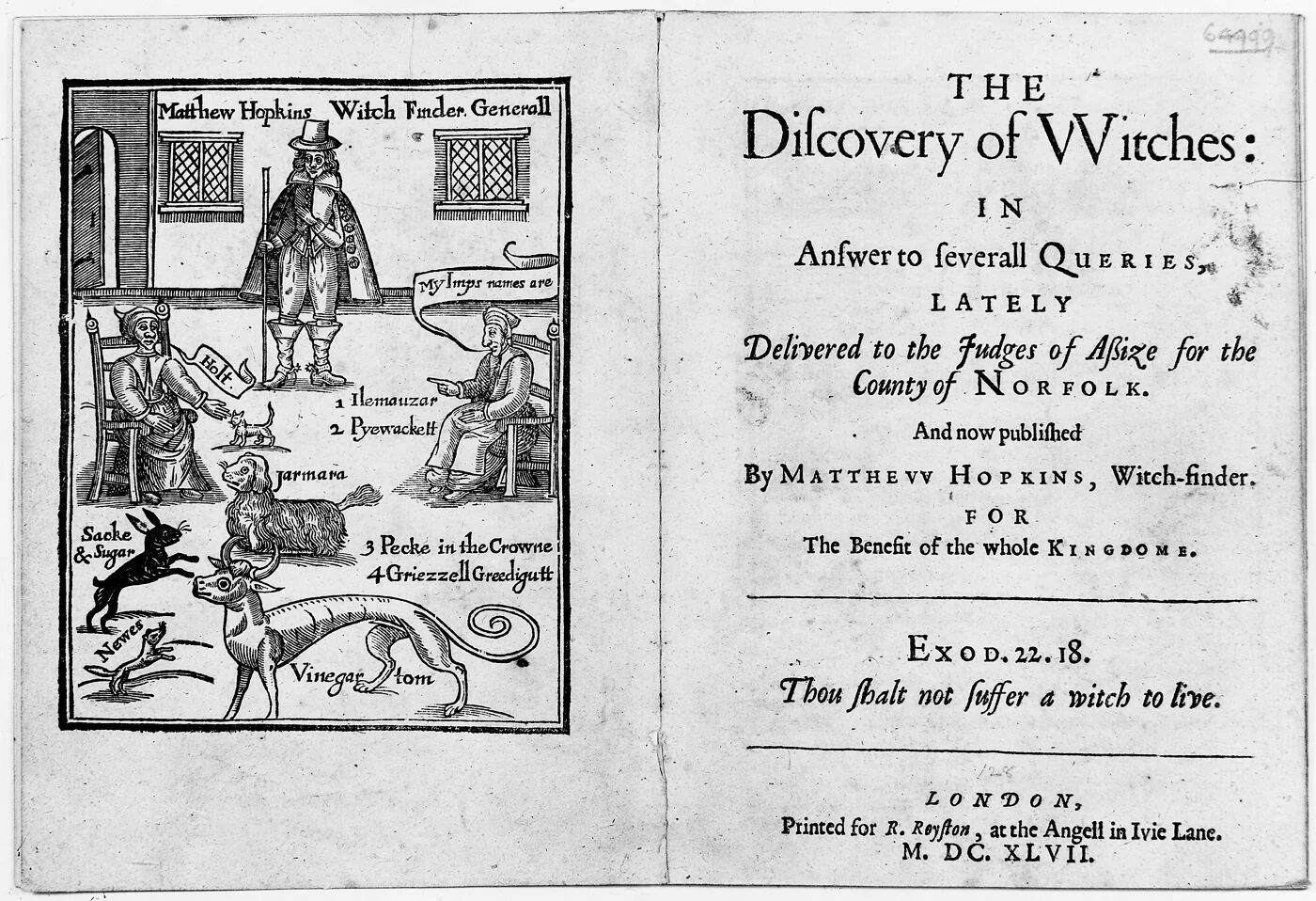
The Discovery of Witches, 1647, title page and frontispiece. The named creatures belong to a witch-finding publication’s allegations. Archival photograph made in December 1955.
Wellcome Collection, M0014361. Public Domain Mark. · Image source ↗ · Public Domain
See references (11)
- Human Animals, printed p. 120, Reader page 129
- Human Animals, printed p. 121, Reader page 130
- Human Animals, printed p. 122, Reader page 131
- Human Animals, printed p. 123, Reader page 132
- Human Animals, printed p. 124, Reader page 133
- Human Animals, printed p. 127, Reader page 136
- The Discovery of Witches: title page and frontispiece
- The Book of the Sacred Magic of Abra-Melin the Mage, Reader page 132
- The Book of the Sacred Magic of Abra-Melin the Mage, Reader page 134
- The Book of the Sacred Magic of Abra-Melin the Mage, Reader page 136
- The Book of the Sacred Magic of Abra-Melin the Mage, Reader page 25
Human Animals by Frank Hamel
Frank Hamel’s Human Animals explicitly distinguishes an animal-shaped witch from a separate helper or double. His butterfly example belongs to the problem of transformation, while subsequent English cases introduce named attendant beings. Reading the whole chapter as a catalogue of actual animals would miss these competing explanations. [1][2]
The material associated with Elizabeth Clarke and Matthew Hopkins describes imps and their alleged services. Hamel inherits the language and assumptions of earlier accounts. These claims arose within witchcraft accusations, and the page’s explanation must keep the accusers and reported testimony in view rather than adopting their charges as facts. [2][3][4][5][7]
The Flower family narrative links the cat Rutterkin with personal objects, including a glove. The supposed connection between an object and its owner provides a theory of harmful influence. It is significant as an accusation and a magical explanation, not as proof that a cat caused the illnesses attributed to it. [6][8]
Hamel’s later discussion of a daemon broadens the field beyond the malicious helper of a prosecution story. A protective or accompanying spirit need not share the moral identity assigned to an alleged witch’s imp. His compilation therefore contains several relationships under neighbouring terms. [9]
See references (9)
- Human Animals, printed p. 120, Reader page 129
- Human Animals, printed p. 121, Reader page 130
- Human Animals, printed p. 122, Reader page 131
- Human Animals, printed p. 123, Reader page 132
- Human Animals, printed p. 124, Reader page 133
- Human Animals, printed p. 127, Reader page 136
- Human Animals, printed p. 125, Reader page 134
- Human Animals, printed p. 128, Reader page 137
- Human Animals, printed p. 130, Reader page 139
Witchcraft Magic & Alchemy by Grillot de Givry
Grillot de Givry turns to a print in Francesco Maria Guazzo’s Compendium maleficarum that places a wolf and a smaller animal outside a witch’s house. He is unsure whether the smaller animal is a cat or a weasel. He plays on a further uncertainty: the wolf might be read as a demon and the smaller animal as a witch, or their roles might be reversed. In his reading, even a giant snail in the background is open to interpretation. [13]
Elsewhere on the same page, a toad on the witch’s shoulder is described as a shape taken by a demon, while an owl is a recurring companion whose function he leaves undefined. These details show why the presence of an animal in an image is only the beginning of the interpretation. Location, action and the accompanying text give a reader a stronger basis for identifying its role. [13]
De Givry’s reading starts with what the figures are doing and where they appear. A perched creature, a wolf at the door and a conspicuous figure in the background each call for a different reading. [13]
Hamel distinguishes a person taking animal form from an attendant or double. The uncertainty about the animals at the door in Guazzo’s print shows why the same distinction can be harder to make in an image. [1][2][3][13]
The Book of the Sacred Magic of Abra-Melin the Mage, translated by S. L. MacGregor Mathers
In S. L. MacGregor Mathers’s translation of The Book of Abra-Melin, the narrator Abraham places familiar spirits under named sub-princes. They are assigned after the encounter with the guardian angel. The text distinguishes them by their names and periods of attendance. [14][15][16][17]
The chapter on dismissal distinguishes the familiars from the other spirits in a further way. Their continued availability is part of their stated role. Elsewhere the book warns against becoming too familiar with them. The shared word points both to constant attendance and to a kind of familiarity the narrator discourages. [17][18][19]
See references (6)
- The Book of the Sacred Magic of Abra-Melin the Mage, Reader page 132
- The Book of the Sacred Magic of Abra-Melin the Mage, Reader page 133
- The Book of the Sacred Magic of Abra-Melin the Mage, Reader page 134
- The Book of the Sacred Magic of Abra-Melin the Mage, Reader page 135
- The Book of the Sacred Magic of Abra-Melin the Mage, Reader page 136
- The Book of the Sacred Magic of Abra-Melin the Mage, Reader page 165
Attendant, double or shape-changer?
Sympathetic magic explains a supposed effect through resemblance or contact. A familiar describes an agent or relationship. The Rutterkin story combines the two, but neither concept requires the other: a magical theory of contact can exist without an animal helper. [6][8]
An animal double is interpreted as another appearance of the person; a familiar is usually treated as a companion or subordinate being. Where a source wavers between these identities, that uncertainty is part of the historical account. [1][9][10][11]
The Guazzo print read by De Givry raises the question of whether an animal is an attendant or a person in another form. Abra-Melin makes the role legible through assigned service and the relationship of the familiar to a superior. The visual and administrative clues belong to different sources. [14][16][18][13]
See references (10)
- Human Animals, printed p. 120, Reader page 129
- Human Animals, printed p. 127, Reader page 136
- Human Animals, printed p. 128, Reader page 137
- Human Animals, printed p. 130, Reader page 139
- Human Animals, printed p. 261, Reader page 270
- Human Animals, printed p. 262, Reader page 271
- Witchcraft Magic & Alchemy, printed p. 136, Reader page 128
- The Book of the Sacred Magic of Abra-Melin the Mage, Reader page 132
- The Book of the Sacred Magic of Abra-Melin the Mage, Reader page 134
- The Book of the Sacred Magic of Abra-Melin the Mage, Reader page 136
Read further in the library

Human Animals
Reading note
Frank Hamel collects the particular stories and interpretations discussed here; the account identifies exact printed and Library Reader pages.
Witchcraft Magic and Alchemy
Reading note
The separately titled account draws on exact passages in the consulted Library edition.
The Book of the Sacred Magic of Abra-Melin the Mage
Reading note
The separately titled account draws on exact passages in the consulted Library edition.
Sources
See references (20)
- Human Animals, printed p. 120, Reader page 129Frank Hamel, Human Animals. Frederick A. Stokes Co., New York, undated title page; preface dated London, 1915. Exact printed pages refer to the retained Library scan.Read this page in Human Animals ↗Return to text ↑
- Human Animals, printed p. 121, Reader page 130Frank Hamel, Human Animals. Frederick A. Stokes Co., New York, undated title page; preface dated London, 1915. Exact printed pages refer to the retained Library scan.Read this page in Human Animals ↗Return to text ↑
- Human Animals, printed p. 122, Reader page 131Frank Hamel, Human Animals. Frederick A. Stokes Co., New York, undated title page; preface dated London, 1915. Exact printed pages refer to the retained Library scan.Read this page in Human Animals ↗Return to text ↑
- Human Animals, printed p. 123, Reader page 132Frank Hamel, Human Animals. Frederick A. Stokes Co., New York, undated title page; preface dated London, 1915. Exact printed pages refer to the retained Library scan.Read this page in Human Animals ↗Return to text ↑
- Human Animals, printed p. 124, Reader page 133Frank Hamel, Human Animals. Frederick A. Stokes Co., New York, undated title page; preface dated London, 1915. Exact printed pages refer to the retained Library scan.Read this page in Human Animals ↗Return to text ↑
- Human Animals, printed p. 127, Reader page 136Frank Hamel, Human Animals. Frederick A. Stokes Co., New York, undated title page; preface dated London, 1915. Exact printed pages refer to the retained Library scan.Read this page in Human Animals ↗Return to text ↑
- Human Animals, printed p. 125, Reader page 134Frank Hamel, Human Animals. Frederick A. Stokes Co., New York, undated title page; preface dated London, 1915. Exact printed pages refer to the retained Library scan.Read this page in Human Animals ↗Return to text ↑
- Human Animals, printed p. 128, Reader page 137Frank Hamel, Human Animals. Frederick A. Stokes Co., New York, undated title page; preface dated London, 1915. Exact printed pages refer to the retained Library scan.Read this page in Human Animals ↗Return to text ↑
- Human Animals, printed p. 130, Reader page 139Frank Hamel, Human Animals. Frederick A. Stokes Co., New York, undated title page; preface dated London, 1915. Exact printed pages refer to the retained Library scan.Read this page in Human Animals ↗Return to text ↑
- Human Animals, printed p. 261, Reader page 270Frank Hamel, Human Animals. Frederick A. Stokes Co., New York, undated title page; preface dated London, 1915. Exact printed pages refer to the retained Library scan.Read this page in Human Animals ↗Return to text ↑
- Human Animals, printed p. 262, Reader page 271Frank Hamel, Human Animals. Frederick A. Stokes Co., New York, undated title page; preface dated London, 1915. Exact printed pages refer to the retained Library scan.Read this page in Human Animals ↗Return to text ↑
- The Discovery of Witches: title page and frontispiece ↗Wellcome Collection, M0014361, archival photograph, December 1955; seventeenth-century publication. Public Domain Mark.Return to text ↑
- Witchcraft Magic & Alchemy, printed p. 136, Reader page 128Grillot de Givry, Witchcraft Magic & Alchemy, translated by J. Courtenay Locke. Boston and New York, Houghton Mifflin Company, 1931.Read this page in Witchcraft Magic and Alchemy ↗Return to text ↑
- The Book of the Sacred Magic of Abra-Melin the Mage, Reader page 132The Book of the Sacred Magic of Abra-Melin the Mage, translated by S. L. MacGregor Mathers. London, John M. Watkins, 1898. Lumitheca Library edition IMJ-0601-E001.Read this page in The Book of the Sacred Magic of Abra-Melin the Mage ↗Return to text ↑
- The Book of the Sacred Magic of Abra-Melin the Mage, Reader page 133The Book of the Sacred Magic of Abra-Melin the Mage, translated by S. L. MacGregor Mathers. London, John M. Watkins, 1898. Lumitheca Library edition IMJ-0601-E001.Read this page in The Book of the Sacred Magic of Abra-Melin the Mage ↗Return to text ↑
- The Book of the Sacred Magic of Abra-Melin the Mage, Reader page 134The Book of the Sacred Magic of Abra-Melin the Mage, translated by S. L. MacGregor Mathers. London, John M. Watkins, 1898. Lumitheca Library edition IMJ-0601-E001.Read this page in The Book of the Sacred Magic of Abra-Melin the Mage ↗Return to text ↑
- The Book of the Sacred Magic of Abra-Melin the Mage, Reader page 135The Book of the Sacred Magic of Abra-Melin the Mage, translated by S. L. MacGregor Mathers. London, John M. Watkins, 1898. Lumitheca Library edition IMJ-0601-E001.Read this page in The Book of the Sacred Magic of Abra-Melin the Mage ↗Return to text ↑
- The Book of the Sacred Magic of Abra-Melin the Mage, Reader page 136The Book of the Sacred Magic of Abra-Melin the Mage, translated by S. L. MacGregor Mathers. London, John M. Watkins, 1898. Lumitheca Library edition IMJ-0601-E001.Read this page in The Book of the Sacred Magic of Abra-Melin the Mage ↗Return to text ↑
- The Book of the Sacred Magic of Abra-Melin the Mage, Reader page 165The Book of the Sacred Magic of Abra-Melin the Mage, translated by S. L. MacGregor Mathers. London, John M. Watkins, 1898. Lumitheca Library edition IMJ-0601-E001.Read this page in The Book of the Sacred Magic of Abra-Melin the Mage ↗Return to text ↑
- The Book of the Sacred Magic of Abra-Melin the Mage, Reader page 25The Book of the Sacred Magic of Abra-Melin the Mage, translated by S. L. MacGregor Mathers. London, John M. Watkins, 1898. Lumitheca Library edition IMJ-0601-E001.Read this page in The Book of the Sacred Magic of Abra-Melin the Mage ↗Return to text ↑