Animal doubles
An animal double is an animal-shaped counterpart of a person. Compare Frank Hamel’s stories of projected forms, shared wounds and external souls.
In this article
What is an animal double?
An animal double is an animal-shaped counterpart or appearance connected with a person. A story can treat it as a second form of the person, a projected image or a separate animal whose life is linked with theirs. [1][2][3][4][5][6]
One clue is what the person’s ordinary body is doing. If it remains somewhere else while the animal is seen, the story is about a double. If harm to one affects the other, the account also claims a connection between the two forms. [2][3][4][7][8]
See references (8)
- Human Animals, printed p. 19, Reader page 28
- Human Animals, printed p. 20, Reader page 29
- Human Animals, printed p. 68, Reader page 77
- Human Animals, printed p. 69, Reader page 78
- Human Animals, printed p. 261, Reader page 270
- Human Animals, printed p. 262, Reader page 271
- Human Animals, printed p. 265, Reader page 274
- Human Animals, printed p. 266, Reader page 275
Human Animals by Frank Hamel
Frank Hamel’s Human Animals discusses animal doubles both in transformation stories and in its chapter on phantasms. The sidereal-body account attributed to Éliphas Lévi leaves the person’s physical body elsewhere while an animal appearance acts at a distance. This differs from a person’s body becoming a wolf. [3][4]
The later chapter draws on Adolphe d’Assier. It includes an animal-shaped apparition connected with a living person and an episode in which a shepherd appears abroad while his ordinary body remains behind. Dogs’ responses are used within the narrative to support the identification of the projected person. [5][6]
Hamel raises the possibility that an apparent animal ghost may be a human phantom in an animal’s form. In the story about a miller named Bigot, a wound to the apparition corresponds to an injury Bigot suffers. The shared wound is how the narrative identifies him with the figure. [7][8]
How a double is recognised
An external soul goes beyond resemblance by making one life depend on another. A familiar usually has its own identity and serves as an attendant. An animal double raises a different question: how far can a second appearance count as the same person? [2][9][10][7][8]
Astral projection is one explanation for a double appearing while a person stays elsewhere. A doppelgänger keeps the person’s human likeness. Rossetti’s lovers come face to face with that kind of double, while Hamel’s examples ask how someone might recognise the person in an unfamiliar form. [3][4][11][5][6][12]
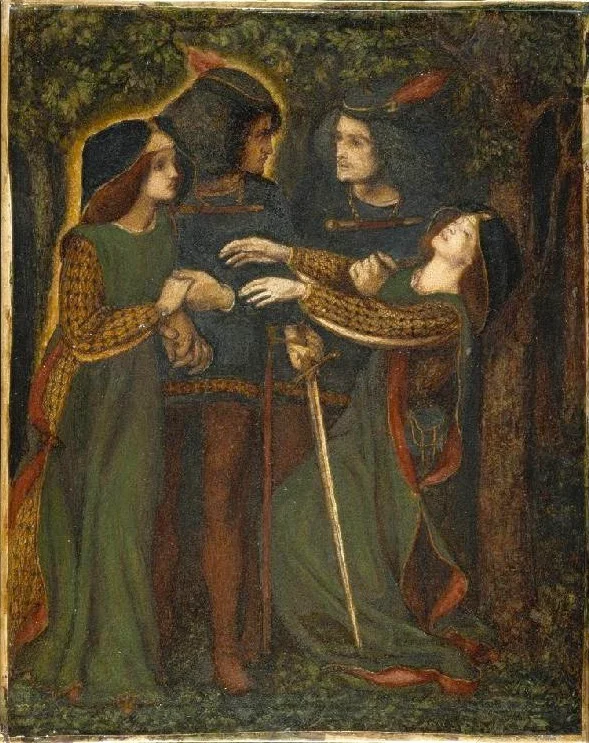
Dante Gabriel Rossetti, How They Met Themselves, about 1860–64. The lovers recognise their doubles by their human likeness.
Dante Gabriel Rossetti, 1828–1882. Faithful reproduction of a public-domain painting, via Wikimedia Commons. · Image source ↗ · Public Domain
See references (11)
- Human Animals, printed p. 20, Reader page 29
- Human Animals, printed p. 68, Reader page 77
- Human Animals, printed p. 69, Reader page 78
- Human Animals, printed p. 261, Reader page 270
- Human Animals, printed p. 262, Reader page 271
- Human Animals, printed p. 265, Reader page 274
- Human Animals, printed p. 266, Reader page 275
- Human Animals, printed p. 21, Reader page 30
- Human Animals, printed p. 120, Reader page 129
- Human Animals, printed p. 96, Reader page 105
- Dante Gabriel Rossetti, How They Met Themselves, about 1860–64
Read further in the library
Human Animals
Reading note
Frank Hamel collects the particular stories and interpretations discussed here; the account identifies exact printed and Library Reader pages.
Sources
See references (12)
- Human Animals, printed p. 19, Reader page 28Frank Hamel, Human Animals. Frederick A. Stokes Co., New York, undated title page; preface dated London, 1915. Exact printed pages refer to the retained Library scan.Read this page in Human Animals ↗Return to text ↑
- Human Animals, printed p. 20, Reader page 29Frank Hamel, Human Animals. Frederick A. Stokes Co., New York, undated title page; preface dated London, 1915. Exact printed pages refer to the retained Library scan.Read this page in Human Animals ↗Return to text ↑
- Human Animals, printed p. 68, Reader page 77Frank Hamel, Human Animals. Frederick A. Stokes Co., New York, undated title page; preface dated London, 1915. Exact printed pages refer to the retained Library scan.Read this page in Human Animals ↗Return to text ↑
- Human Animals, printed p. 69, Reader page 78Frank Hamel, Human Animals. Frederick A. Stokes Co., New York, undated title page; preface dated London, 1915. Exact printed pages refer to the retained Library scan.Read this page in Human Animals ↗Return to text ↑
- Human Animals, printed p. 261, Reader page 270Frank Hamel, Human Animals. Frederick A. Stokes Co., New York, undated title page; preface dated London, 1915. Exact printed pages refer to the retained Library scan.Read this page in Human Animals ↗Return to text ↑
- Human Animals, printed p. 262, Reader page 271Frank Hamel, Human Animals. Frederick A. Stokes Co., New York, undated title page; preface dated London, 1915. Exact printed pages refer to the retained Library scan.Read this page in Human Animals ↗Return to text ↑
- Human Animals, printed p. 265, Reader page 274Frank Hamel, Human Animals. Frederick A. Stokes Co., New York, undated title page; preface dated London, 1915. Exact printed pages refer to the retained Library scan.Read this page in Human Animals ↗Return to text ↑
- Human Animals, printed p. 266, Reader page 275Frank Hamel, Human Animals. Frederick A. Stokes Co., New York, undated title page; preface dated London, 1915. Exact printed pages refer to the retained Library scan.Read this page in Human Animals ↗Return to text ↑
- Human Animals, printed p. 21, Reader page 30Frank Hamel, Human Animals. Frederick A. Stokes Co., New York, undated title page; preface dated London, 1915. Exact printed pages refer to the retained Library scan.Read this page in Human Animals ↗Return to text ↑
- Human Animals, printed p. 120, Reader page 129Frank Hamel, Human Animals. Frederick A. Stokes Co., New York, undated title page; preface dated London, 1915. Exact printed pages refer to the retained Library scan.Read this page in Human Animals ↗Return to text ↑
- Human Animals, printed p. 96, Reader page 105Frank Hamel, Human Animals. Frederick A. Stokes Co., New York, undated title page; preface dated London, 1915. Exact printed pages refer to the retained Library scan.Read this page in Human Animals ↗Return to text ↑
- Dante Gabriel Rossetti, How They Met Themselves, about 1860–64 ↗Dante Gabriel Rossetti, 1828–1882. Faithful reproduction of a public-domain painting, via Wikimedia Commons.Return to text ↑