Astral Projection
Astral projection is the reported experience of travelling beyond the physical body. Compare the silver cord and accounts of return in esoteric books.
In this article
Robert Monroe’s accounts of the afterlife
The casebook on Belief System Territories compares what Monroe says he encounters with the outcomes he actually describes.
The idea
What does this mean?
Astral projection is the reported experience of a spiritual form travelling apart from the physical body. Esoteric and Spiritualist books describe visits to distant places or meetings with the dead while the traveller’s ordinary body remains behind. [3][5][6][1]
In several accounts a luminous cord keeps the travelling form connected to a body at rest. A return along that connection gives the journey its temporary character. [3][6][38]
See references (5)
- The Angels’ Diary and Celestion Study of Man, Reader page 200
- The Angels’ Diary and Celestion Study of Man, Reader page 54
- The Angels’ Diary and Celestion Study of Man, Reader page 103
- The Angels’ Diary and Celestion Study of Man, Reader page 104
- A Subaltern in Spirit Land, printed p. 34, Reader page 49
Picturing the soul apart from the body
In Schiavonetti’s engraving after Blake, a figure looks back at the body below. The print illustrates death in Robert Blair’s The Grave. Set beside the books’ accounts of projection, its hovering figure lets a reader compare how artists and writers picture separation. [47]
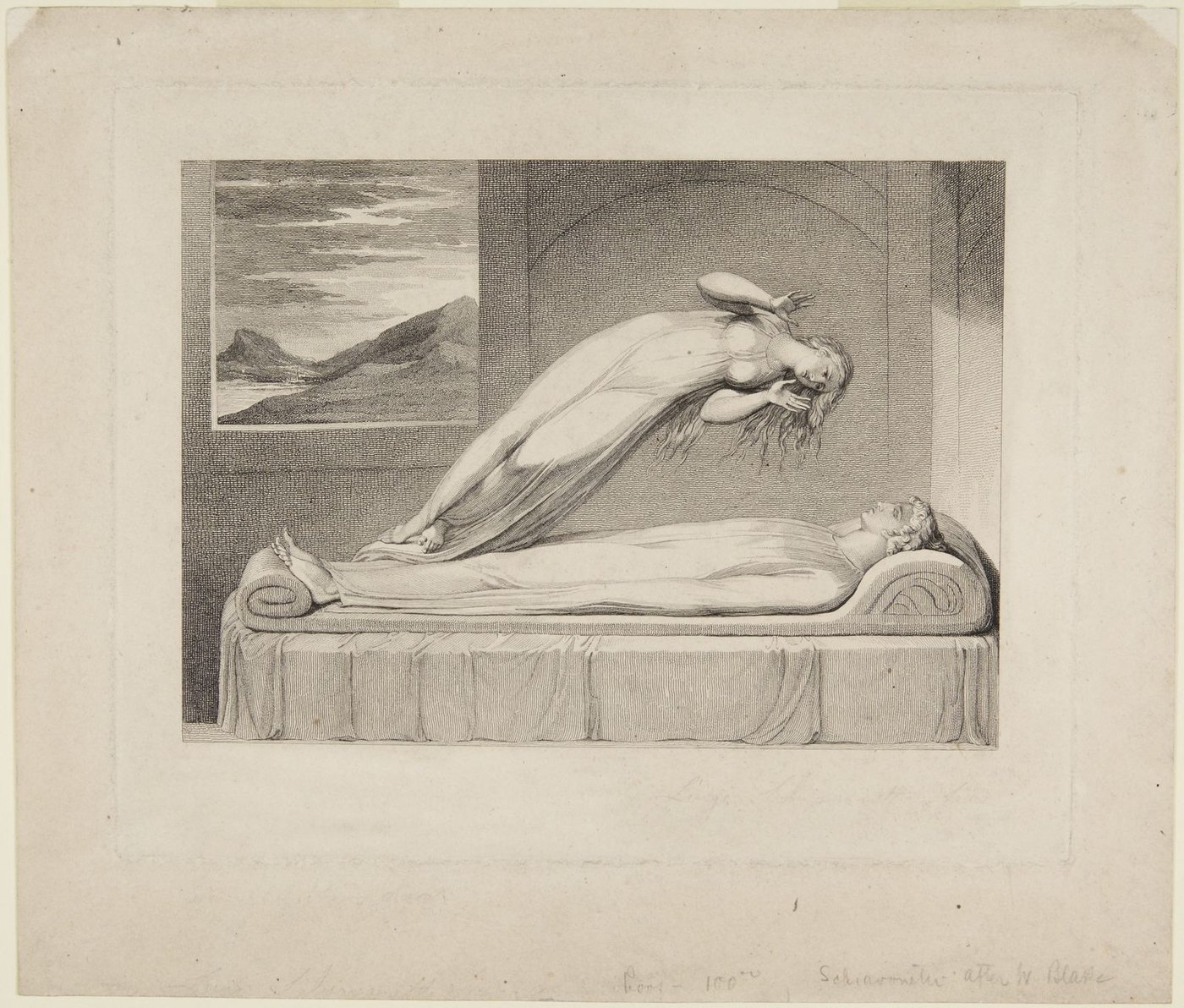
Luigi Schiavonetti after William Blake, The Soul Hovering over the Body Reluctantly Parting with Life, 1805–08. Illustration for Robert Blair’s The Grave. A poetic death scene, included here as a historical comparison for the image of a recognisable soul apart from its body.
Princeton University Art Museum. Gift of Frank Jewett Mather Jr., x1947-85. Public Domain. · Image source ↗ · Public Domain
Journeys, separation and return
The Angels’ Diary
The diary attributed to Effie M. Shirey describes journeys shared by living and departed relatives. During sleep, the living person’s spiritual form is said to remain connected to the body by a stream of light or silver cord. On a visit to the sun, the narrator and her brother accompany their mother, whose physical body remains asleep on earth. [3][4][5][6]
The connection sets a limit on the meeting. A sleeping body can draw its occupant back and interrupt a conversation. The departed travellers are described as having parted with that cord. This gives the story a way to distinguish a temporary journey from the narrator’s passage through death. [3][6]
The family’s destination belongs to the book’s visionary cosmology. It describes chambers, coloured formations and a Fountain of Living Waters within the sun. The passage reports the travellers’ spiritual experience and interprets solar activity through its own account of forces. Its significance here is the range of places the author imagines accessible to a traveller. [7][8][9][10]
Celestion Study of Man, attributed to Charles Samson, connects such travel with the subconscious mind. It distinguishes being apart from the physical body from becoming visible to someone else. The latter is said to require a temporary material covering. Travelling and appearing are treated as different capacities. [11][12][13][14]
The New Thought chapters place projection among developed powers of thought. The proposed sequence moves from pictures and writing to the projection of a spiritual being that can return to the physical body. The book therefore supplies both narrated journeys and a theory intended to make them intelligible. [15][16][1]
It also attaches warnings to some of its proposed practices, describing strain on the connection with the body. Those warnings form part of the historical account’s understanding of embodiment and spiritual development. The passages give context for its claims about travel and return. [17][18]
See references (17)
- The Angels’ Diary and Celestion Study of Man, Reader page 200
- The Angels’ Diary and Celestion Study of Man, Reader page 54
- The Angels’ Diary and Celestion Study of Man, Reader page 55
- The Angels’ Diary and Celestion Study of Man, Reader page 103
- The Angels’ Diary and Celestion Study of Man, Reader page 104
- The Angels’ Diary and Celestion Study of Man, Reader page 105
- The Angels’ Diary and Celestion Study of Man, Reader page 106
- The Angels’ Diary and Celestion Study of Man, Reader page 107
- The Angels’ Diary and Celestion Study of Man, Reader page 108
- The Angels’ Diary and Celestion Study of Man, Reader page 114
- The Angels’ Diary and Celestion Study of Man, Reader page 127
- The Angels’ Diary and Celestion Study of Man, Reader page 130
- The Angels’ Diary and Celestion Study of Man, Reader page 150
- The Angels’ Diary and Celestion Study of Man, Reader page 198
- The Angels’ Diary and Celestion Study of Man, Reader page 199
- The Angels’ Diary and Celestion Study of Man, Reader page 112
- The Angels’ Diary and Celestion Study of Man, Reader page 202
Gone West by J. S. M. Ward
In J. S. M. Ward’s Gone West, the author describes leaving a sleeping body and travelling to the country where H. J. L., one of Ward’s reported spirit contributors, lives. Familiar landscapes become misty, give way to other surroundings and return during the journey home. Ward presents these experiences as recurring trance visits, with conversations recorded afterwards. [19][20]
A later journey introduces two different travelling forms. H. J. L. says Ward has reached him in a spiritual body and must collect his astral body before visiting the astral plane. The guide returns with a temporary astral covering of his own, saying the body once used after death has already disintegrated. Projection here involves moving between conditions that require different forms. [21][22][23]
On that visit Ward watches crowds of sleepers, distinguished from the departed by trailing threads of light. Their awareness varies. Some seem to be sleepwalking, while others seek someone deliberately. These observations give the narrative a spectrum between an indistinct dream and a journey remembered clearly. [23][24]
He also describes meeting living members of his family. Carrie speaks with her departed father but only partly remembers her earthly circumstances. On waking she recalls part of the encounter as a dream, according to Ward’s note. The book therefore treats bringing a memory back as a separate difficulty from having an experience. [24][25][26][27]
Returning is described through intention, swift movement and a loss of consciousness as Ward rejoins the body. The book later records an interruption during his illness, when he stops the visits and automatic writing. These details locate the journeys within Ward’s own narrated life and the limits he places around it. [28][29]
See references (11)
- Gone West, printed p. 69, Reader page 82
- Gone West, printed p. 72, Reader page 85
- Gone West, printed p. 75, Reader page 88
- Gone West, printed p. 76, Reader page 89
- Gone West, printed p. 77, Reader page 90
- Gone West, printed p. 78, Reader page 91
- Gone West, printed p. 79, Reader page 92
- Gone West, printed p. 80, Reader page 93
- Gone West, printed p. 81, Reader page 94
- Gone West, printed p. 74, Reader page 87
- Gone West, printed p. 82, Reader page 95
A Subaltern in Spirit Land by J. S. M. Ward
J. S. M. Ward’s A Subaltern in Spirit Land describes a journey undertaken to help his brother Rex. Ward returns to his sleeping body to collect an astral double, while H. J. L., one of Ward’s reported spirit contributors, makes a temporary astral covering of his own. Ward compares entering the double with putting clothes on after bathing. His physical body remains asleep. [30][31]
Intention directs the journeys, but the body also sets a limit. Ward is told that concentrating on his companions will allow him to find them. Later he has to leave when he feels drawn back to earth. The landscape fades, he sees his sleeping body again and the visit ends with waking or a loss of consciousness. [32][33][34][35]
A family dream supplies a less clearly remembered journey. Ward’s father is said to have visited Rex and then tried to bring his wife to see him. The participants disagree over details carried back into waking memory. H. J. L. describes the father’s recollection as distorted. Within the book, having a visit and remembering it accurately remain different matters. [36]
Another return is imagined collectively. At dawn Ward joins a stream of dreamers leaving the village where his brother stays. He reports that their eyes are closed as they descend through darkness. His own remembered journey is set among many less conscious visits rather than treated as the only kind of travel. [37]
See references (8)
- A Subaltern in Spirit Land, printed p. 6, Reader page 21
- A Subaltern in Spirit Land, printed p. 7, Reader page 22
- A Subaltern in Spirit Land, printed p. 15, Reader page 30
- A Subaltern in Spirit Land, printed p. 26, Reader page 41
- A Subaltern in Spirit Land, printed p. 28, Reader page 43
- A Subaltern in Spirit Land, printed p. 29, Reader page 44
- A Subaltern in Spirit Land, printed p. 46, Reader page 61
- A Subaltern in Spirit Land, printed p. 67, Reader page 82
The Encyclopaedia of Death and Life in Spirit-World, Volume I
J. R. Francis’s The Encyclopaedia of Death and Life in Spirit-World, Volume I, includes A. M. Griffen’s account of an unusual experience after retiring for the night. Unable to move his ordinary body, he reports an embrace with his deceased father and perceives a second pair of arms which can pass through his bedclothes. He does not describe his head and chest as entirely separated from their physical counterparts. [39][40][41]
Touch is central to Griffen’s interpretation. Material bedding seems insubstantial to the spiritual hands, while his father’s form gives an intensely vivid sensation. He subsequently returns to ordinary embodiment through a process he says he cannot describe. He also acknowledges that his observations provide too little evidence for a complete science of spiritual biology. The passage is a first-person report, not a demonstration of an independently travelling body. [40][41]
A different narrative, by Mrs. M. J. Jefferson and introduced as a Banner of Light report, describes leaving her body during an illness. Guides conduct her through gateways, a ceremonial welcome and changing landscapes before bringing her back by boat. Her reluctance to return ends when a guide points out her earthly body and reminds her of work still to do. The two accounts preserve different degrees of separation and different kinds of journey, rather than a single required sequence. [42][43][44][45][46]
Griffen’s description also supplies a precise example of double bodily awareness. He reports two apparently inactive physical arms alongside another pair he experiences as transparent and responsive. His spiritual head and chest, however, do not seem fully separate from their physical counterparts. His report is therefore more specific than a complete second body travelling away. [64][65]
He describes touching his father but passing through bedding without feeling its material substance. After the encounter he remembers wanting to return, but not the process of doing so. The gaps and the partial separation belong to the testimony; filling them with a later system would make his account more definite than he leaves it. [65][66]
Griffen’s two pairs of arms concern the experience of embodiment at one location. A detailed journey through a landscape is a different claim. Both may appear under astral projection, but one should not be used to supply missing details in the other. [65][66]
J. S. M. Ward’s A Subaltern in Spirit Land describes collecting an astral double and joining a journey while his body sleeps. Griffen instead locates the most definite separation in his arms, while his head and chest seem partly joined. A journey using a complete covering and a remembered partial separation are different descriptions. [30][31][65][66]
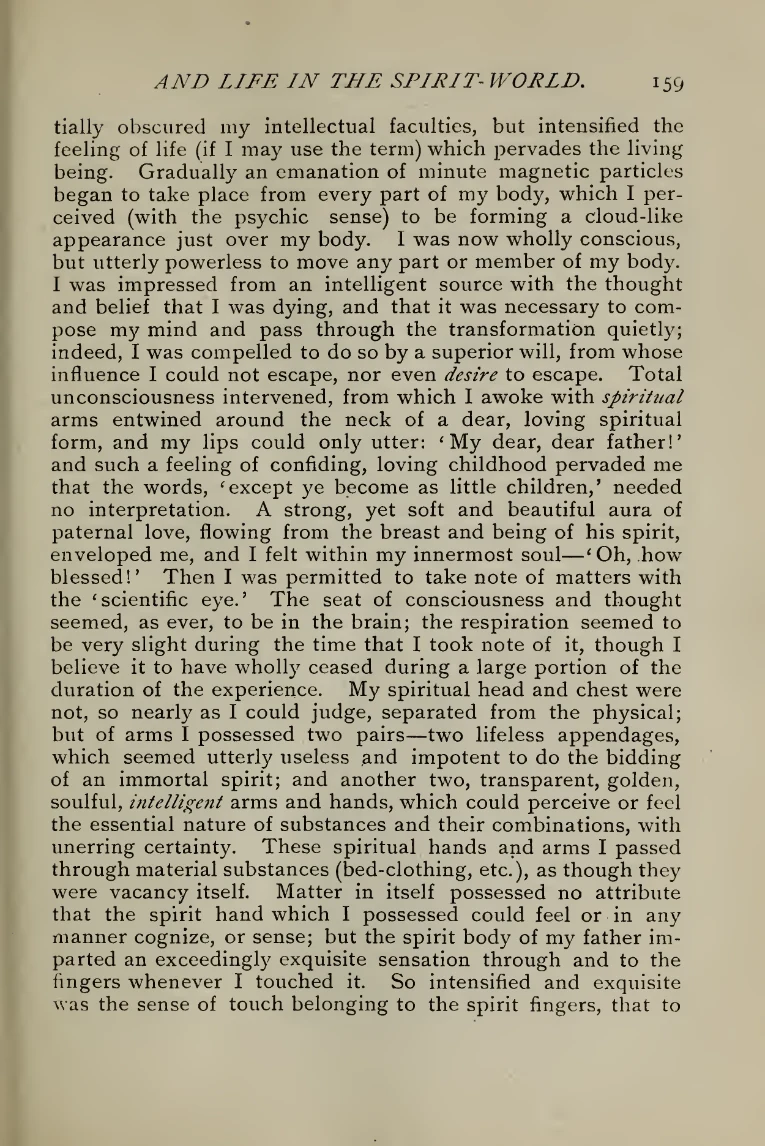
Source facsimile: The Encyclopaedia of Death and Life in the Spirit-World, Volume I (1903), printed p. 159, Reader page 158.
The Encyclopaedia of Death and Life in the Spirit-World, Volume I, fourth edition, 1903. Public-domain historical page extracted from the checksum-verified Library PDF. · Image source ↗ · Public Domain
See references (13)
- A Subaltern in Spirit Land, printed p. 6, Reader page 21
- A Subaltern in Spirit Land, printed p. 7, Reader page 22
- The Encyclopaedia of Death and Life in Spirit-World, Volume I, printed p. 158, Reader page 157
- The Encyclopaedia of Death and Life in Spirit-World, Volume I, printed p. 159, Reader page 158
- The Encyclopaedia of Death and Life in Spirit-World, Volume I, printed p. 160, Reader page 159
- The Encyclopaedia of Death and Life in Spirit-World, Volume I, printed p. 178, Reader page 177
- The Encyclopaedia of Death and Life in Spirit-World, Volume I, printed p. 179, Reader page 178
- The Encyclopaedia of Death and Life in Spirit-World, Volume I, printed p. 180, Reader page 179
- The Encyclopaedia of Death and Life in Spirit-World, Volume I, printed p. 181, Reader page 180
- The Encyclopaedia of Death and Life in Spirit-World, Volume I, printed p. 182, Reader page 181
- The Encyclopaedia of Death and Life in the Spirit-World, Volume I, printed p. 158, Reader page 157
- The Encyclopaedia of Death and Life in the Spirit-World, Volume I, printed p. 159, Reader page 158
- The Encyclopaedia of Death and Life in the Spirit-World, Volume I, printed p. 160, Reader page 159
Evolution of Immortality
In Evolution of Immortality, Freeman Benjamin Dowd writes as Rosicruciæ about the soul leaving the body during sleep or trance. The body supposedly remains while the person enters a condition with different relations to distance, time and form. The story of Adam’s deep sleep is interpreted through this possibility of an inward journey and a return. [51][52]
The author also distinguishes a mobile astral counterpart from a more complete fire body. The former resembles the physical body and is shaped by thought and action. The latter belongs to an advanced condition in which the entire person is said to transform how embodiment works. The text’s terms name different proposed capacities rather than one interchangeable vehicle. [48][49][50]
Near the conclusion, temporary withdrawal in sleep or trance becomes one stage in an argument about bodily disappearance. Rosicruciæ claims that a perfected person could withdraw the physical form as well. This goes beyond a reported experience of travelling outside an otherwise intact body, and remains a further assertion within the book’s theory of immortality. [53][54][55]
See references (8)
- Evolution of Immortality, printed p. 37, Reader page 34
- Evolution of Immortality, printed p. 38, Reader page 35
- Evolution of Immortality, printed p. 75, Reader page 72
- Evolution of Immortality, printed p. 105, Reader page 102
- Evolution of Immortality, printed p. 106, Reader page 103
- Evolution of Immortality, printed p. 125, Reader page 124
- Evolution of Immortality, printed p. 126, Reader page 125
- Evolution of Immortality, printed p. 127, Reader page 126
Human Animals by Frank Hamel
Frank Hamel’s Human Animals brings projection into a discussion of transformation. In the explanation attributed to Éliphas Lévi, a sidereal form can act as an animal while the ordinary body remains elsewhere. The claim changes the question from bodily mutation to the apparent form of a travelling counterpart. [56][57]
Hamel later draws on Adolphe d’Assier for phantasms associated with living people. The shepherd episode places an appearance away from the person’s ordinary body, with dogs reacting to the apparent visitor. These are reports relayed by Hamel, not independent observations added by the compiler. [58][59]
The account leaves a classification problem. An animal-shaped apparition may be interpreted as an animal’s own phantom or as a human projection. Hamel’s discussion acknowledges that outward form does not settle the identity. The matching-injury story associated with Bigot is offered as a way of identifying the latter possibility. [60][61]
In its closing occult discussion, the book explicitly quotes C. W. Leadbeater’s The Astral Plane on werewolves and temporary animal forms. That textual dependence matters when comparing the books: agreement in these passages shows Hamel receiving an existing Theosophical explanation, rather than independently confirming it. [62][63]
See references (8)
- Human Animals, printed p. 68, Reader page 77
- Human Animals, printed p. 69, Reader page 78
- Human Animals, printed p. 261, Reader page 270
- Human Animals, printed p. 262, Reader page 271
- Human Animals, printed p. 265, Reader page 274
- Human Animals, printed p. 266, Reader page 275
- Human Animals, printed p. 290, Reader page 299
- Human Animals, printed p. 291, Reader page 300
Human visitors and animal-shaped doubles
The Diary and Ward describe a living person connected to a sleeping body. Hamel asks what happens if the travelling form looks like an animal to someone else. That changes the question from how a visitor travels to how the visitor is recognised. [56][57][59][3][6][38]
See references (6)
- The Angels’ Diary and Celestion Study of Man, Reader page 54
- The Angels’ Diary and Celestion Study of Man, Reader page 104
- A Subaltern in Spirit Land, printed p. 34, Reader page 49
- Human Animals, printed p. 68, Reader page 77
- Human Animals, printed p. 69, Reader page 78
- Human Animals, printed p. 262, Reader page 271
A visit, a partial separation or a further transformation?
The Angels’ Diary and Ward describe visits while a body sleeps. Griffen reports a second pair of arms without leaving the bed entirely. Jefferson describes a guided journey while ill. The books give the idea of leaving the body several degrees of separation. [3][4][5][6][19][20][39][40][41][42][43][44][45][46]
Ward returns from a visit to a sleeping body. Dowd takes that possibility into a larger claim about a perfected person withdrawing a physical form. One passage records a reported experience. The other argues for what spiritual development could make possible. [51][52][53][54][55][28][29]
See references (21)
- The Angels’ Diary and Celestion Study of Man, Reader page 54
- The Angels’ Diary and Celestion Study of Man, Reader page 55
- The Angels’ Diary and Celestion Study of Man, Reader page 103
- The Angels’ Diary and Celestion Study of Man, Reader page 104
- Gone West, printed p. 69, Reader page 82
- Gone West, printed p. 72, Reader page 85
- Gone West, printed p. 74, Reader page 87
- Gone West, printed p. 82, Reader page 95
- The Encyclopaedia of Death and Life in Spirit-World, Volume I, printed p. 158, Reader page 157
- The Encyclopaedia of Death and Life in Spirit-World, Volume I, printed p. 159, Reader page 158
- The Encyclopaedia of Death and Life in Spirit-World, Volume I, printed p. 160, Reader page 159
- The Encyclopaedia of Death and Life in Spirit-World, Volume I, printed p. 178, Reader page 177
- The Encyclopaedia of Death and Life in Spirit-World, Volume I, printed p. 179, Reader page 178
- The Encyclopaedia of Death and Life in Spirit-World, Volume I, printed p. 180, Reader page 179
- The Encyclopaedia of Death and Life in Spirit-World, Volume I, printed p. 181, Reader page 180
- The Encyclopaedia of Death and Life in Spirit-World, Volume I, printed p. 182, Reader page 181
- Evolution of Immortality, printed p. 105, Reader page 102
- Evolution of Immortality, printed p. 106, Reader page 103
- Evolution of Immortality, printed p. 125, Reader page 124
- Evolution of Immortality, printed p. 126, Reader page 125
- Evolution of Immortality, printed p. 127, Reader page 126
Read further in the library
The Angels’ Diary and Celestion Study of Man
Reading note
A traveller who can return. Read the original passage in the 1903 edition.

Gone West
Reading note
Ward’s distinct, page-cited account of the subject.

A Subaltern in Spirit Land: A Sequel to Gone West
Reading note
Ward’s sequel adds the separately cited account of this subject.

The Encyclopaedia of Death and Life in the Spirit-World, Volume I
Reading note
Distinct attributed accounts in the 1903 fourth edition, cited to exact printed pages and retained Reader leaves.
Evolution of Immortality
Reading note
Sleep and trance journeys are distinguished from the further claim that an entire body could become invisible.

Human Animals
Reading note
Frank Hamel collects the particular stories and interpretations discussed here; the account identifies exact printed and Library Reader pages.
Sources
See references (66)
- The Angels’ Diary and Celestion Study of Man, Reader page 200Effie M. Shirey and Charles Samson, The Angels’ Diary and Celestion Study of Man (1903).Read this page in The Angels’ Diary and Celestion Study of Man ↗Return to text ↑
- The Angels’ Diary, Reader page 26The Angels’ Diary (1903), attributed to Effie M. Shirey and Charles SamsonRead this page in The Angels’ Diary and Celestion Study of Man ↗
- The Angels’ Diary and Celestion Study of Man, Reader page 54Effie M. Shirey and Charles Samson, The Angels’ Diary and Celestion Study of Man (1903).Read this page in The Angels’ Diary and Celestion Study of Man ↗Return to text ↑
- The Angels’ Diary and Celestion Study of Man, Reader page 55Effie M. Shirey and Charles Samson, The Angels’ Diary and Celestion Study of Man (1903).Read this page in The Angels’ Diary and Celestion Study of Man ↗Return to text ↑
- The Angels’ Diary and Celestion Study of Man, Reader page 103Effie M. Shirey and Charles Samson, The Angels’ Diary and Celestion Study of Man (1903).Read this page in The Angels’ Diary and Celestion Study of Man ↗Return to text ↑
- The Angels’ Diary and Celestion Study of Man, Reader page 104Effie M. Shirey and Charles Samson, The Angels’ Diary and Celestion Study of Man (1903).Read this page in The Angels’ Diary and Celestion Study of Man ↗Return to text ↑
- The Angels’ Diary and Celestion Study of Man, Reader page 105Effie M. Shirey and Charles Samson, The Angels’ Diary and Celestion Study of Man (1903).Read this page in The Angels’ Diary and Celestion Study of Man ↗Return to text ↑
- The Angels’ Diary and Celestion Study of Man, Reader page 106Effie M. Shirey and Charles Samson, The Angels’ Diary and Celestion Study of Man (1903).Read this page in The Angels’ Diary and Celestion Study of Man ↗Return to text ↑
- The Angels’ Diary and Celestion Study of Man, Reader page 107Effie M. Shirey and Charles Samson, The Angels’ Diary and Celestion Study of Man (1903).Read this page in The Angels’ Diary and Celestion Study of Man ↗Return to text ↑
- The Angels’ Diary and Celestion Study of Man, Reader page 108Effie M. Shirey and Charles Samson, The Angels’ Diary and Celestion Study of Man (1903).Read this page in The Angels’ Diary and Celestion Study of Man ↗Return to text ↑
- The Angels’ Diary and Celestion Study of Man, Reader page 114Charles Samson, Celestion Study of Man, in the 1903 volume.Read this page in The Angels’ Diary and Celestion Study of Man ↗Return to text ↑
- The Angels’ Diary and Celestion Study of Man, Reader page 127Charles Samson, Celestion Study of Man, in the 1903 volume.Read this page in The Angels’ Diary and Celestion Study of Man ↗Return to text ↑
- The Angels’ Diary and Celestion Study of Man, Reader page 130Charles Samson, Celestion Study of Man, in the 1903 volume.Read this page in The Angels’ Diary and Celestion Study of Man ↗Return to text ↑
- The Angels’ Diary and Celestion Study of Man, Reader page 150Charles Samson, Celestion Study of Man, in the 1903 volume.Read this page in The Angels’ Diary and Celestion Study of Man ↗Return to text ↑
- The Angels’ Diary and Celestion Study of Man, Reader page 198Effie M. Shirey and Charles Samson, The Angels’ Diary and Celestion Study of Man (1903).Read this page in The Angels’ Diary and Celestion Study of Man ↗Return to text ↑
- The Angels’ Diary and Celestion Study of Man, Reader page 199Effie M. Shirey and Charles Samson, The Angels’ Diary and Celestion Study of Man (1903).Read this page in The Angels’ Diary and Celestion Study of Man ↗Return to text ↑
- The Angels’ Diary and Celestion Study of Man, Reader page 112Effie M. Shirey and Charles Samson, The Angels’ Diary and Celestion Study of Man (1903).Read this page in The Angels’ Diary and Celestion Study of Man ↗Return to text ↑
- The Angels’ Diary and Celestion Study of Man, Reader page 202Effie M. Shirey and Charles Samson, The Angels’ Diary and Celestion Study of Man (1903).Read this page in The Angels’ Diary and Celestion Study of Man ↗Return to text ↑
- Gone West, printed p. 69, Reader page 82J. S. M. Ward, Gone West, 1920 third impression in the 2009 Geoff Cutler digital transcription.Read this page in Gone West ↗Return to text ↑
- Gone West, printed p. 72, Reader page 85J. S. M. Ward, Gone West, 1920 third impression in the 2009 Geoff Cutler digital transcription.Read this page in Gone West ↗Return to text ↑
- Gone West, printed p. 75, Reader page 88J. S. M. Ward, Gone West, 1920 third impression in the 2009 Geoff Cutler digital transcription.Read this page in Gone West ↗Return to text ↑
- Gone West, printed p. 76, Reader page 89J. S. M. Ward, Gone West, 1920 third impression in the 2009 Geoff Cutler digital transcription.Read this page in Gone West ↗Return to text ↑
- Gone West, printed p. 77, Reader page 90J. S. M. Ward, Gone West, 1920 third impression in the 2009 Geoff Cutler digital transcription.Read this page in Gone West ↗Return to text ↑
- Gone West, printed p. 78, Reader page 91J. S. M. Ward, Gone West, 1920 third impression in the 2009 Geoff Cutler digital transcription.Read this page in Gone West ↗Return to text ↑
- Gone West, printed p. 79, Reader page 92J. S. M. Ward, Gone West, 1920 third impression in the 2009 Geoff Cutler digital transcription.Read this page in Gone West ↗Return to text ↑
- Gone West, printed p. 80, Reader page 93J. S. M. Ward, Gone West, 1920 third impression in the 2009 Geoff Cutler digital transcription.Read this page in Gone West ↗Return to text ↑
- Gone West, printed p. 81, Reader page 94J. S. M. Ward, Gone West, 1920 third impression in the 2009 Geoff Cutler digital transcription.Read this page in Gone West ↗Return to text ↑
- Gone West, printed p. 74, Reader page 87J. S. M. Ward, Gone West, 1920 third impression in the 2009 Geoff Cutler digital transcription.Read this page in Gone West ↗Return to text ↑
- Gone West, printed p. 82, Reader page 95J. S. M. Ward, Gone West, 1920 third impression in the 2009 Geoff Cutler digital transcription.Read this page in Gone West ↗Return to text ↑
- A Subaltern in Spirit Land, printed p. 6, Reader page 21J. S. M. Ward, A Subaltern in Spirit Land: A Sequel to Gone West, William Rider & Son, 1920.Read this page in A Subaltern in Spirit Land: A Sequel to Gone West ↗Return to text ↑
- A Subaltern in Spirit Land, printed p. 7, Reader page 22J. S. M. Ward, A Subaltern in Spirit Land: A Sequel to Gone West, William Rider & Son, 1920.Read this page in A Subaltern in Spirit Land: A Sequel to Gone West ↗Return to text ↑
- A Subaltern in Spirit Land, printed p. 15, Reader page 30J. S. M. Ward, A Subaltern in Spirit Land: A Sequel to Gone West, William Rider & Son, 1920.Read this page in A Subaltern in Spirit Land: A Sequel to Gone West ↗Return to text ↑
- A Subaltern in Spirit Land, printed p. 26, Reader page 41J. S. M. Ward, A Subaltern in Spirit Land: A Sequel to Gone West, William Rider & Son, 1920.Read this page in A Subaltern in Spirit Land: A Sequel to Gone West ↗Return to text ↑
- A Subaltern in Spirit Land, printed p. 28, Reader page 43J. S. M. Ward, A Subaltern in Spirit Land: A Sequel to Gone West, William Rider & Son, 1920.Read this page in A Subaltern in Spirit Land: A Sequel to Gone West ↗Return to text ↑
- A Subaltern in Spirit Land, printed p. 29, Reader page 44J. S. M. Ward, A Subaltern in Spirit Land: A Sequel to Gone West, William Rider & Son, 1920.Read this page in A Subaltern in Spirit Land: A Sequel to Gone West ↗Return to text ↑
- A Subaltern in Spirit Land, printed p. 46, Reader page 61J. S. M. Ward, A Subaltern in Spirit Land: A Sequel to Gone West, William Rider & Son, 1920.Read this page in A Subaltern in Spirit Land: A Sequel to Gone West ↗Return to text ↑
- A Subaltern in Spirit Land, printed p. 67, Reader page 82J. S. M. Ward, A Subaltern in Spirit Land: A Sequel to Gone West, William Rider & Son, 1920.Read this page in A Subaltern in Spirit Land: A Sequel to Gone West ↗Return to text ↑
- A Subaltern in Spirit Land, printed p. 34, Reader page 49J. S. M. Ward, A Subaltern in Spirit Land: A Sequel to Gone West, William Rider & Son, 1920.Read this page in A Subaltern in Spirit Land: A Sequel to Gone West ↗Return to text ↑
- The Encyclopaedia of Death and Life in Spirit-World, Volume I, printed p. 158, Reader page 157J. R. Francis (compiler), The Encyclopaedia of Death and Life in Spirit-World, Volume I, fourth edition, Progressive Thinker Publishing House, Chicago, 1903. Individual contributors identified in the text.Read this page in The Encyclopaedia of Death and Life in the Spirit-World, Volume I ↗Return to text ↑
- The Encyclopaedia of Death and Life in Spirit-World, Volume I, printed p. 159, Reader page 158J. R. Francis (compiler), The Encyclopaedia of Death and Life in Spirit-World, Volume I, fourth edition, Progressive Thinker Publishing House, Chicago, 1903. Individual contributors identified in the text.Read this page in The Encyclopaedia of Death and Life in the Spirit-World, Volume I ↗Return to text ↑
- The Encyclopaedia of Death and Life in Spirit-World, Volume I, printed p. 160, Reader page 159J. R. Francis (compiler), The Encyclopaedia of Death and Life in Spirit-World, Volume I, fourth edition, Progressive Thinker Publishing House, Chicago, 1903. Individual contributors identified in the text.Read this page in The Encyclopaedia of Death and Life in the Spirit-World, Volume I ↗Return to text ↑
- The Encyclopaedia of Death and Life in Spirit-World, Volume I, printed p. 178, Reader page 177J. R. Francis (compiler), The Encyclopaedia of Death and Life in Spirit-World, Volume I, fourth edition, Progressive Thinker Publishing House, Chicago, 1903. Individual contributors identified in the text.Read this page in The Encyclopaedia of Death and Life in the Spirit-World, Volume I ↗Return to text ↑
- The Encyclopaedia of Death and Life in Spirit-World, Volume I, printed p. 179, Reader page 178J. R. Francis (compiler), The Encyclopaedia of Death and Life in Spirit-World, Volume I, fourth edition, Progressive Thinker Publishing House, Chicago, 1903. Individual contributors identified in the text.Read this page in The Encyclopaedia of Death and Life in the Spirit-World, Volume I ↗Return to text ↑
- The Encyclopaedia of Death and Life in Spirit-World, Volume I, printed p. 180, Reader page 179J. R. Francis (compiler), The Encyclopaedia of Death and Life in Spirit-World, Volume I, fourth edition, Progressive Thinker Publishing House, Chicago, 1903. Individual contributors identified in the text.Read this page in The Encyclopaedia of Death and Life in the Spirit-World, Volume I ↗Return to text ↑
- The Encyclopaedia of Death and Life in Spirit-World, Volume I, printed p. 181, Reader page 180J. R. Francis (compiler), The Encyclopaedia of Death and Life in Spirit-World, Volume I, fourth edition, Progressive Thinker Publishing House, Chicago, 1903. Individual contributors identified in the text.Read this page in The Encyclopaedia of Death and Life in the Spirit-World, Volume I ↗Return to text ↑
- The Encyclopaedia of Death and Life in Spirit-World, Volume I, printed p. 182, Reader page 181J. R. Francis (compiler), The Encyclopaedia of Death and Life in Spirit-World, Volume I, fourth edition, Progressive Thinker Publishing House, Chicago, 1903. Individual contributors identified in the text.Read this page in The Encyclopaedia of Death and Life in the Spirit-World, Volume I ↗Return to text ↑
- Luigi Schiavonetti after William Blake, The Soul Hovering over the Body Reluctantly Parting with Life, 1805–08. ↗Princeton University Art Museum. Gift of Frank Jewett Mather Jr., x1947-85. Public Domain.Return to text ↑
- Evolution of Immortality, printed p. 37, Reader page 34Rosicruciæ (catalogued as Freeman Benjamin Dowd), Evolution of Immortality. Eulian Publishing Company, Salem, 1900.Read this page in Evolution of Immortality ↗Return to text ↑
- Evolution of Immortality, printed p. 38, Reader page 35Rosicruciæ (catalogued as Freeman Benjamin Dowd), Evolution of Immortality. Eulian Publishing Company, Salem, 1900.Read this page in Evolution of Immortality ↗Return to text ↑
- Evolution of Immortality, printed p. 75, Reader page 72Rosicruciæ (catalogued as Freeman Benjamin Dowd), Evolution of Immortality. Eulian Publishing Company, Salem, 1900.Read this page in Evolution of Immortality ↗Return to text ↑
- Evolution of Immortality, printed p. 105, Reader page 102Rosicruciæ (catalogued as Freeman Benjamin Dowd), Evolution of Immortality. Eulian Publishing Company, Salem, 1900.Read this page in Evolution of Immortality ↗Return to text ↑
- Evolution of Immortality, printed p. 106, Reader page 103Rosicruciæ (catalogued as Freeman Benjamin Dowd), Evolution of Immortality. Eulian Publishing Company, Salem, 1900.Read this page in Evolution of Immortality ↗Return to text ↑
- Evolution of Immortality, printed p. 125, Reader page 124Rosicruciæ (catalogued as Freeman Benjamin Dowd), Evolution of Immortality. Eulian Publishing Company, Salem, 1900.Read this page in Evolution of Immortality ↗Return to text ↑
- Evolution of Immortality, printed p. 126, Reader page 125Rosicruciæ (catalogued as Freeman Benjamin Dowd), Evolution of Immortality. Eulian Publishing Company, Salem, 1900.Read this page in Evolution of Immortality ↗Return to text ↑
- Evolution of Immortality, printed p. 127, Reader page 126Rosicruciæ (catalogued as Freeman Benjamin Dowd), Evolution of Immortality. Eulian Publishing Company, Salem, 1900.Read this page in Evolution of Immortality ↗Return to text ↑
- Human Animals, printed p. 68, Reader page 77Frank Hamel, Human Animals. Frederick A. Stokes Co., New York, undated title page; preface dated London, 1915. Exact printed pages refer to the retained Library scan.Read this page in Human Animals ↗Return to text ↑
- Human Animals, printed p. 69, Reader page 78Frank Hamel, Human Animals. Frederick A. Stokes Co., New York, undated title page; preface dated London, 1915. Exact printed pages refer to the retained Library scan.Read this page in Human Animals ↗Return to text ↑
- Human Animals, printed p. 261, Reader page 270Frank Hamel, Human Animals. Frederick A. Stokes Co., New York, undated title page; preface dated London, 1915. Exact printed pages refer to the retained Library scan.Read this page in Human Animals ↗Return to text ↑
- Human Animals, printed p. 262, Reader page 271Frank Hamel, Human Animals. Frederick A. Stokes Co., New York, undated title page; preface dated London, 1915. Exact printed pages refer to the retained Library scan.Read this page in Human Animals ↗Return to text ↑
- Human Animals, printed p. 265, Reader page 274Frank Hamel, Human Animals. Frederick A. Stokes Co., New York, undated title page; preface dated London, 1915. Exact printed pages refer to the retained Library scan.Read this page in Human Animals ↗Return to text ↑
- Human Animals, printed p. 266, Reader page 275Frank Hamel, Human Animals. Frederick A. Stokes Co., New York, undated title page; preface dated London, 1915. Exact printed pages refer to the retained Library scan.Read this page in Human Animals ↗Return to text ↑
- Human Animals, printed p. 290, Reader page 299Frank Hamel, Human Animals. Frederick A. Stokes Co., New York, undated title page; preface dated London, 1915. Exact printed pages refer to the retained Library scan.Read this page in Human Animals ↗Return to text ↑
- Human Animals, printed p. 291, Reader page 300Frank Hamel, Human Animals. Frederick A. Stokes Co., New York, undated title page; preface dated London, 1915. Exact printed pages refer to the retained Library scan.Read this page in Human Animals ↗Return to text ↑
- The Encyclopaedia of Death and Life in the Spirit-World, Volume I, printed p. 158, Reader page 157J. R. Francis (compiler), The Encyclopaedia of Death and Life in the Spirit-World, Volume I, fourth edition. The Progressive Thinker Publishing House, Chicago, 1903. Individual authors, communicators and quoted sources identified in each account.Read this page in The Encyclopaedia of Death and Life in the Spirit-World, Volume I ↗Return to text ↑
- The Encyclopaedia of Death and Life in the Spirit-World, Volume I, printed p. 159, Reader page 158J. R. Francis (compiler), The Encyclopaedia of Death and Life in the Spirit-World, Volume I, fourth edition. The Progressive Thinker Publishing House, Chicago, 1903. Individual authors, communicators and quoted sources identified in each account.Read this page in The Encyclopaedia of Death and Life in the Spirit-World, Volume I ↗Return to text ↑
- The Encyclopaedia of Death and Life in the Spirit-World, Volume I, printed p. 160, Reader page 159J. R. Francis (compiler), The Encyclopaedia of Death and Life in the Spirit-World, Volume I, fourth edition. The Progressive Thinker Publishing House, Chicago, 1903. Individual authors, communicators and quoted sources identified in each account.Read this page in The Encyclopaedia of Death and Life in the Spirit-World, Volume I ↗Return to text ↑