External soul
An external soul is a life or vital identity held outside the body. Explore shared fate, animal counterparts and the lizard called a tamaniu in Hamel’s sources.
In this article
What is an external soul?
An external soul is a life or vital identity understood to exist outside the ordinary body. In some of the historical accounts collected by Frank Hamel, a person and an animal share a fate so closely that harm to one affects the other. [1][2][3][4]
A protective animal can remain separate from the person it guards. What marks an external-soul account is a dependence: the person’s continued life is thought to rest, at least in part, somewhere else. [2][3][4]
Human Animals by Frank Hamel
In the bush-soul chapter of Human Animals, Frank Hamel puts several life-linked relationships side by side. He writes of a Mesoamerican nagual, West African examples and Melanesian terms such as atai and tamaniu. Each reaches him through an earlier account, and the names belong to different settings. [1][2][3]
In the bush-soul passages, an animal’s death may entail the person’s death. Some of the reported connections are hereditary, and a person may be described as having more than one such relation. The model therefore does not always involve one detachable soul inhabiting one animal. [2]
In a report from Mota that Hamel takes from W. H. R. Rivers, a blind man asks a friend to check on the lizard tied to his life. The lizard appears sick, and the man dies soon afterwards. A fallen banyan is taken as a sign that the lizard has died too. The story makes the dependence visible through events in two lives. [2][3][4]
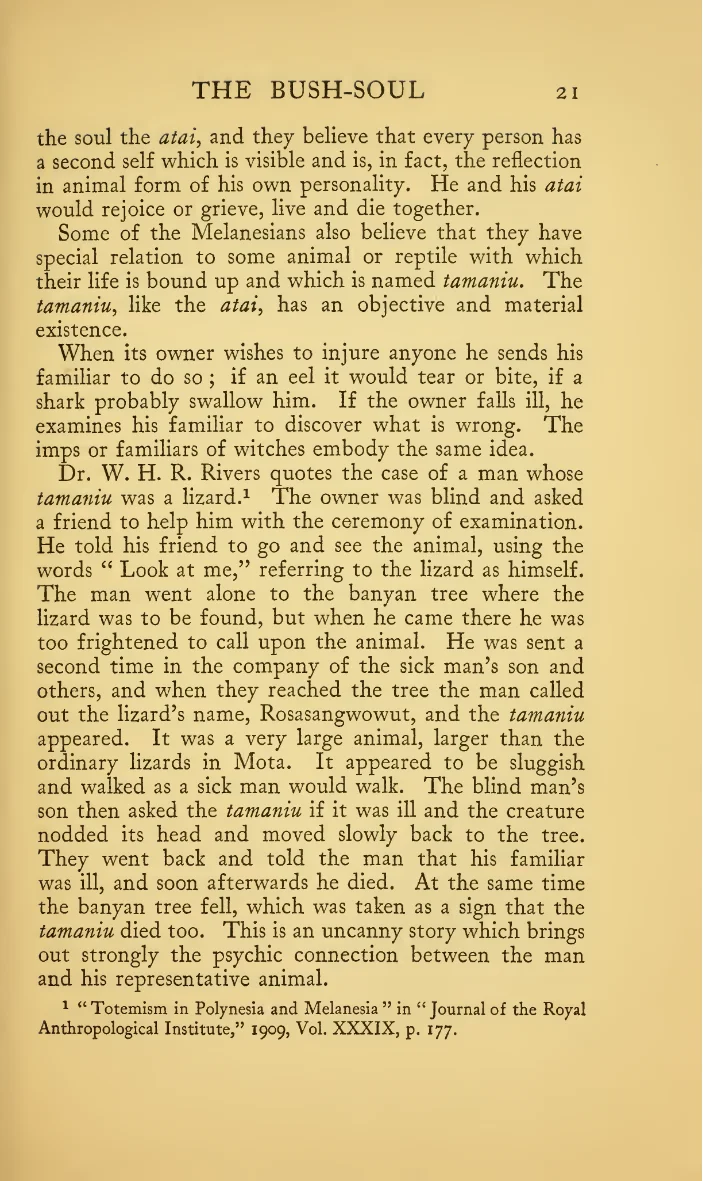
Human Animals, printed p. 21. Hamel’s Melanesian comparison includes a lizard described as a tamaniu and identifies the earlier report he is using. Facsimile of the historical source page.
Frank Hamel, Human Animals, undated Stokes edition; preface dated 1915. Public-domain text and facsimile. · Image source ↗ · Public Domain
Who shares a fate?
An animal double can be another appearance of the person. An external soul makes the person’s welfare or life depend on a counterpart. A familiar can have its own identity and act as an attendant. The same animal image can be used for three different relationships. [2][3][5][6][7]
Totemism concerns relationships involving a social group as well as an animal or other nonhuman identity. Hamel moves between collective kinship and individual life-links, but these scales should remain separate. Similar animal imagery does not establish an identical account of personhood. [8][9][1][2]
See references (8)
- Human Animals, printed p. 19, Reader page 28
- Human Animals, printed p. 20, Reader page 29
- Human Animals, printed p. 21, Reader page 30
- Human Animals, printed p. 120, Reader page 129
- Human Animals, printed p. 261, Reader page 270
- Human Animals, printed p. 262, Reader page 271
- Human Animals, printed p. 15, Reader page 24
- Human Animals, printed p. 16, Reader page 25
Read further in the library

Human Animals
Reading note
Frank Hamel collects the particular stories and interpretations discussed here; the account identifies exact printed and Library Reader pages.
Sources
See references (9)
- Human Animals, printed p. 19, Reader page 28Frank Hamel, Human Animals. Frederick A. Stokes Co., New York, undated title page; preface dated London, 1915. Exact printed pages refer to the retained Library scan.Read this page in Human Animals ↗Return to text ↑
- Human Animals, printed p. 20, Reader page 29Frank Hamel, Human Animals. Frederick A. Stokes Co., New York, undated title page; preface dated London, 1915. Exact printed pages refer to the retained Library scan.Read this page in Human Animals ↗Return to text ↑
- Human Animals, printed p. 21, Reader page 30Frank Hamel, Human Animals. Frederick A. Stokes Co., New York, undated title page; preface dated London, 1915. Exact printed pages refer to the retained Library scan.Read this page in Human Animals ↗Return to text ↑
- Human Animals, printed p. 22, Reader page 31Frank Hamel, Human Animals. Frederick A. Stokes Co., New York, undated title page; preface dated London, 1915. Exact printed pages refer to the retained Library scan.Read this page in Human Animals ↗Return to text ↑
- Human Animals, printed p. 120, Reader page 129Frank Hamel, Human Animals. Frederick A. Stokes Co., New York, undated title page; preface dated London, 1915. Exact printed pages refer to the retained Library scan.Read this page in Human Animals ↗Return to text ↑
- Human Animals, printed p. 261, Reader page 270Frank Hamel, Human Animals. Frederick A. Stokes Co., New York, undated title page; preface dated London, 1915. Exact printed pages refer to the retained Library scan.Read this page in Human Animals ↗Return to text ↑
- Human Animals, printed p. 262, Reader page 271Frank Hamel, Human Animals. Frederick A. Stokes Co., New York, undated title page; preface dated London, 1915. Exact printed pages refer to the retained Library scan.Read this page in Human Animals ↗Return to text ↑
- Human Animals, printed p. 15, Reader page 24Frank Hamel, Human Animals. Frederick A. Stokes Co., New York, undated title page; preface dated London, 1915. Exact printed pages refer to the retained Library scan.Read this page in Human Animals ↗Return to text ↑
- Human Animals, printed p. 16, Reader page 25Frank Hamel, Human Animals. Frederick A. Stokes Co., New York, undated title page; preface dated London, 1915. Exact printed pages refer to the retained Library scan.Read this page in Human Animals ↗Return to text ↑