Bush-soul
Bush-soul is a historical English term for an animal-linked aspect of life. Read the West African examples Frank Hamel collected and how he compared them.
In this article
What does bush-soul mean?
Bush-soul is a historical English term for an animal-linked aspect of a person’s life or identity. In the West African accounts Frank Hamel reports, the human and animal may be understood to share a fate. [1][2][3]
Hamel uses the term to group several reported relationships. Asking where an account comes from, who reported it and what ties the two lives together gives the term a clearer meaning than treating it as the name of a single religion. [1][2][3]
Human Animals by Frank Hamel
Frank Hamel’s Human Animals describes West African accounts in which a person has an animal-linked soul outside the ordinary body. Its life is connected with the human’s, so the animal’s death may be understood as fatal to the person. The book also reports hereditary connections and the possibility of several bush-souls. [2]
Hamel places these life-links near examples of group ancestry and protective animals. He is looking for a connection with transformation. In the West African cases at issue, though, the person shares the animal’s fortunes without having to take its bodily form. [4][1][2]
Hamel places the West African passages beside Mesoamerican, Siberian and Melanesian examples. This arrangement records an early twentieth-century comparative project. It does not establish that bush-soul, nagual and tamaniu are translations of one universally held doctrine. [1][2][3][5]
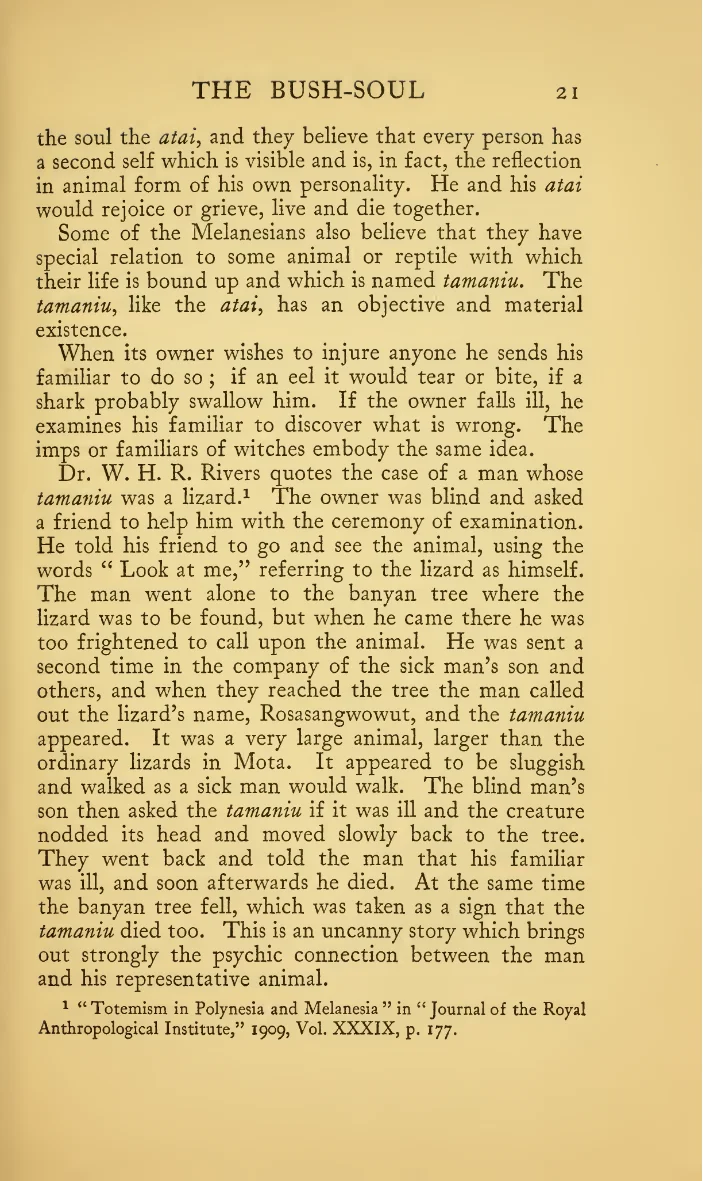
Human Animals, printed p. 21. Hamel sets a Melanesian tamaniu report beside examples from other regions in his chapter on bush-souls.
Frank Hamel, Human Animals, undated Stokes edition; preface dated 1915. Public-domain text and facsimile. · Image source ↗ · Public Domain
The name and the relationship
External soul is the broader question of whether a life can depend on something outside the body. Bush-soul names one strand of the reports Hamel uses to raise it. His comparisons with nagualism and animal ancestry become clearer once the individual life-link and the group’s relationship are distinguished. [4][1][2][3]
Hamel’s racial and evolutionary language shows how he placed these accounts in a hierarchy typical of his period. The attributed examples are narrower evidence: they record particular claims about the fate shared by a person and an animal. [1][2][6]
Read further in the library
Human Animals
Reading note
Frank Hamel collects the particular stories and interpretations discussed here; the account identifies exact printed and Library Reader pages.
Sources
See references (6)
- Human Animals, printed p. 19, Reader page 28Frank Hamel, Human Animals. Frederick A. Stokes Co., New York, undated title page; preface dated London, 1915. Exact printed pages refer to the retained Library scan.Read this page in Human Animals ↗Return to text ↑
- Human Animals, printed p. 20, Reader page 29Frank Hamel, Human Animals. Frederick A. Stokes Co., New York, undated title page; preface dated London, 1915. Exact printed pages refer to the retained Library scan.Read this page in Human Animals ↗Return to text ↑
- Human Animals, printed p. 21, Reader page 30Frank Hamel, Human Animals. Frederick A. Stokes Co., New York, undated title page; preface dated London, 1915. Exact printed pages refer to the retained Library scan.Read this page in Human Animals ↗Return to text ↑
- Human Animals, printed p. 15, Reader page 24Frank Hamel, Human Animals. Frederick A. Stokes Co., New York, undated title page; preface dated London, 1915. Exact printed pages refer to the retained Library scan.Read this page in Human Animals ↗Return to text ↑
- Human Animals, printed p. 22, Reader page 31Frank Hamel, Human Animals. Frederick A. Stokes Co., New York, undated title page; preface dated London, 1915. Exact printed pages refer to the retained Library scan.Read this page in Human Animals ↗Return to text ↑
- Human Animals, printed p. 293, Reader page 302Frank Hamel, Human Animals. Frederick A. Stokes Co., New York, undated title page; preface dated London, 1915. Exact printed pages refer to the retained Library scan.Read this page in Human Animals ↗Return to text ↑