What Do Angels Actually Look Like in the Bible?
Compare human-like messengers, six-winged seraphim, Ezekiel’s cherubim and the eye-covered creatures of Revelation, with chapter and verse.
In this article
Identify the figure by its features
Wings, faces and wheels tell you which passage to open.
Two wings cover the face
Isaiah’s seraphim have six wings in all. The other pairs cover the feet and enable flight.
Read Isaiah 6Four faces and a wheel at its side
Ezekiel sees a wheel alongside each living creature. Chapter 10 identifies the creatures as cherubim.
Read Ezekiel 1Six wings and many eyes
Revelation’s four living creatures have six wings each and are covered with eyes.
Read Revelation 4A visitor with a message
In Luke, Gabriel’s words and role identify him. The wings familiar from art are a visual convention.
Read Luke 1
Human-like visitors and the messenger Gabriel
Some biblical encounters give the visitor a recognisably human shape. Abraham sees three men in Genesis 18 and offers them food. The next chapter describes two angels arriving at Lot’s house. The scene does not pause to count wings or describe a halo. It lets the identity of the visitors emerge from what they say and do. [2][3]
In Luke 1, Gabriel identifies himself by name when he speaks to Zechariah. The same chapter sends him to Mary. Luke tells us where he comes from and what he announces. The familiar wings in later Annunciation pictures express his identity as a heavenly messenger through a visual convention. [1][8]
Seraphim, cherubim and their wings
- Seraphim, Isaiah 6:2–7. Each has six wings. Two cover the face, two cover the feet and two are used to fly. A seraph carries a coal to Isaiah’s lips. The chapter tells you what each pair of wings is for. [4]
- Cherubim, Ezekiel 1 and 10. The four creatures in Ezekiel 1 each have four faces and four wings. Their faces are human, lion, ox and eagle. Ezekiel 10 identifies the creatures as cherubim and describes the first of the four faces with its own wording. [5][6]
- Wheels, Ezekiel 1:15–21. The wheels are beside the creatures, and their rims are full of eyes. They move with the creatures. A wheel filled with eyes in this vision is distinct from the faced and winged creature standing beside it. [5][6]
- Living creatures, Revelation 4:6–9. The four creatures have six wings each and are covered with eyes. One resembles a lion, another an ox, another has a human face, and another resembles a flying eagle. Compare this one-feature-per-creature description with Ezekiel’s four faces on each creature. [7][5]
Which passage shows the eye-covered ‘biblically accurate angel’?
Start with the detail you recognise. The nested, eye-covered wheels belong to Ezekiel. Six wings used to cover the face and feet identify the seraphim in Isaiah. Six wings and many eyes together point to Revelation’s living creatures. Contemporary images often bring these motifs into a single figure. Reading the chapters separately restores what each author placed around the throne. [4][5][7]
Angelic Hierarchy treats the later effort to organise these names into orders. When the question is what a creature looks like, the quickest route is the verse number. Mignard’s study of Gabriel offers the complementary example of how an artist gave recognizable wings to a messenger whose appearance Luke leaves open. [1][8]
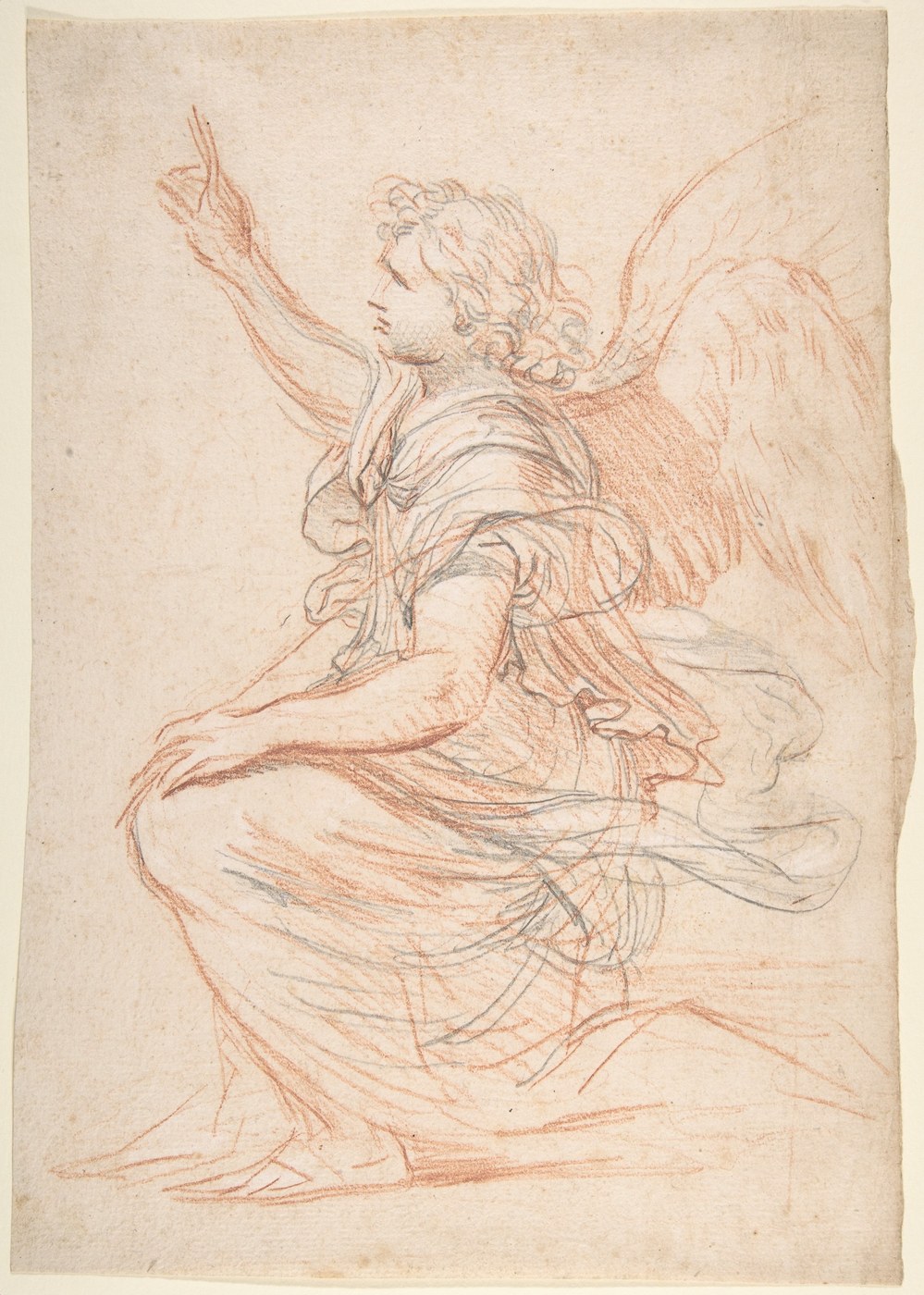
Nicolas Mignard gives Gabriel wings and a human body in this seventeenth-century study. Compare those choices with the description of the messenger in Luke 1.
The Metropolitan Museum of Art. Purchase, Stephen A. Geiger Gift, in honor of his mother, Mildred K. Geiger, and in memory of his father, Howard W. Geiger, 1999. Accession 1999.166. Public Domain (CC0). · Image source ↗ · CC0
Sources
See references (8)
- Luke 1:11–20, 26–38: Gabriel’s announcements ↗New American Bible, Revised EditionReturn to text ↑
- Genesis 18:1–8: Abraham’s three visitors ↗New American Bible, Revised EditionReturn to text ↑
- Genesis 19:1–3: The angels come to Lot ↗New American Bible, Revised EditionReturn to text ↑
- Isaiah 6:1–7: The seraphim ↗Hebrew Bible and Jewish Publication Society translation via SefariaReturn to text ↑
- Ezekiel 1:4–21: Living creatures and wheels ↗New American Bible, Revised EditionReturn to text ↑
- Ezekiel 10:9–22: The creatures identified as cherubim ↗New American Bible, Revised EditionReturn to text ↑
- Revelation 4:6–9: The living creatures around the throne ↗New American Bible, Revised EditionReturn to text ↑
- Nicolas Mignard, Study for the Archangel Gabriel ↗The Metropolitan Museum of Art, 1999.166, public domainReturn to text ↑