Weretigers and werelions
Explore weretiger and werelion stories through Frank Hamel’s accounts of Javanese tiger kinship, the Pondoro and ancestors linked with lions.
In this article
What are weretigers and werelions?
A weretiger is a person said to take tiger form, and a werelion a person said to take lion form. Older collections sometimes use those terms more loosely for accounts of people believed to share a power or kinship with the animals. [1][2][3][4]
A person believed to become a lion during life and a chief believed to inhabit one after death belong to different stories. Names can shift in translation too. An American animal called a tiger in older English is sometimes a jaguar. [4][5][6][7]
See references (7)
- Human Animals, printed p. 76, Reader page 85
- Human Animals, printed p. 77, Reader page 86
- Human Animals, printed p. 78, Reader page 87
- Human Animals, printed p. 82, Reader page 91
- Human Animals, printed p. 83, Reader page 92
- Human Animals, printed p. 84, Reader page 93
- Human Animals, printed p. 87, Reader page 96
Human Animals by Frank Hamel
Frank Hamel’s Human Animals recounts Javanese stories in which a connection with a tiger can be inherited or traced to ancestors. A tiger-person can protect relatives. The resemblance to European werewolf lore is in the link between human and animal form, while the role within a family gives the Javanese examples their own meaning. [1][2]
Hamel takes the Pondoro account from David Livingstone. A man is said to take lion form and to have a secluded place maintained by his wife. Hamel also records an attempt to see the transformation that produced no demonstration. Both details matter because the belief comes to the reader through a traveller’s report. [4][5]
Other passages connect lions with departed chiefs or describe harmful human associations with predatory animals. Hamel’s final American example concerns a jaguar and a matching wound. Its geography and species should remain visible; calling every case a weretiger would erase the differences his own collection contains. [5][6][8][7]
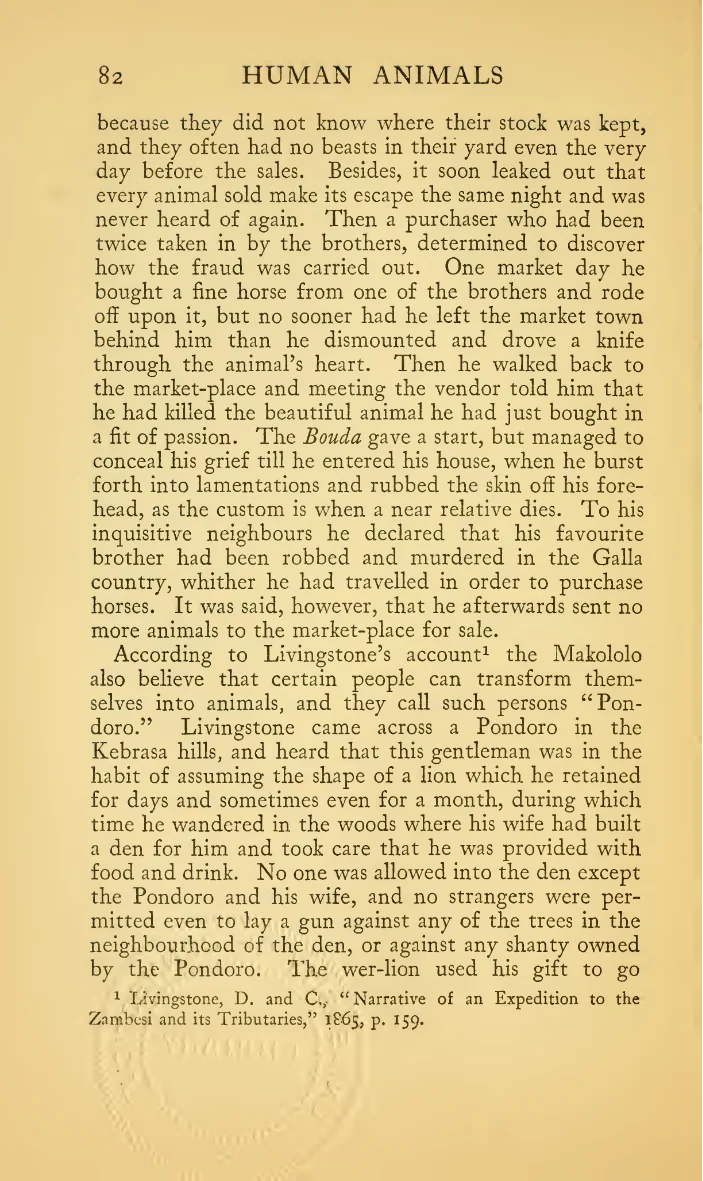
The Pondoro discussion in Frank Hamel’s Human Animals, printed p. 82. Hamel attributes this account to David Livingstone.
Frank Hamel, Human Animals, undated Stokes edition; preface dated 1915. Public-domain text and facsimile. · Image source ↗ · Public Domain
See references (7)
- Human Animals, printed p. 76, Reader page 85
- Human Animals, printed p. 77, Reader page 86
- Human Animals, printed p. 82, Reader page 91
- Human Animals, printed p. 83, Reader page 92
- Human Animals, printed p. 84, Reader page 93
- Human Animals, printed p. 87, Reader page 96
- Human Animals, printed p. 85, Reader page 94
What a similar motif can tell us
Matching injuries occur in Hamel’s wolf stories and in his American jaguar example. In both, a wound lets the characters connect two forms. The same storytelling device can occur in accounts that differ in place, animal and meaning. [9][7]
The animal double concerns a connection between two forms, whereas reincarnation concerns life after death in another embodiment. A protective ancestor-lion may overlap with the second question without implying that a living person physically changes species. [10][11][4][5]
Read further in the library

Human Animals
Reading note
Frank Hamel collects the particular stories and interpretations discussed here; the account identifies exact printed and Library Reader pages.
Sources
See references (11)
- Human Animals, printed p. 76, Reader page 85Frank Hamel, Human Animals. Frederick A. Stokes Co., New York, undated title page; preface dated London, 1915. Exact printed pages refer to the retained Library scan.Read this page in Human Animals ↗Return to text ↑
- Human Animals, printed p. 77, Reader page 86Frank Hamel, Human Animals. Frederick A. Stokes Co., New York, undated title page; preface dated London, 1915. Exact printed pages refer to the retained Library scan.Read this page in Human Animals ↗Return to text ↑
- Human Animals, printed p. 78, Reader page 87Frank Hamel, Human Animals. Frederick A. Stokes Co., New York, undated title page; preface dated London, 1915. Exact printed pages refer to the retained Library scan.Read this page in Human Animals ↗Return to text ↑
- Human Animals, printed p. 82, Reader page 91Frank Hamel, Human Animals. Frederick A. Stokes Co., New York, undated title page; preface dated London, 1915. Exact printed pages refer to the retained Library scan.Read this page in Human Animals ↗Return to text ↑
- Human Animals, printed p. 83, Reader page 92Frank Hamel, Human Animals. Frederick A. Stokes Co., New York, undated title page; preface dated London, 1915. Exact printed pages refer to the retained Library scan.Read this page in Human Animals ↗Return to text ↑
- Human Animals, printed p. 84, Reader page 93Frank Hamel, Human Animals. Frederick A. Stokes Co., New York, undated title page; preface dated London, 1915. Exact printed pages refer to the retained Library scan.Read this page in Human Animals ↗Return to text ↑
- Human Animals, printed p. 87, Reader page 96Frank Hamel, Human Animals. Frederick A. Stokes Co., New York, undated title page; preface dated London, 1915. Exact printed pages refer to the retained Library scan.Read this page in Human Animals ↗Return to text ↑
- Human Animals, printed p. 85, Reader page 94Frank Hamel, Human Animals. Frederick A. Stokes Co., New York, undated title page; preface dated London, 1915. Exact printed pages refer to the retained Library scan.Read this page in Human Animals ↗Return to text ↑
- Human Animals, printed p. 67, Reader page 76Frank Hamel, Human Animals. Frederick A. Stokes Co., New York, undated title page; preface dated London, 1915. Exact printed pages refer to the retained Library scan.Read this page in Human Animals ↗Return to text ↑
- Human Animals, printed p. 23, Reader page 32Frank Hamel, Human Animals. Frederick A. Stokes Co., New York, undated title page; preface dated London, 1915. Exact printed pages refer to the retained Library scan.Read this page in Human Animals ↗Return to text ↑
- Human Animals, printed p. 24, Reader page 33Frank Hamel, Human Animals. Frederick A. Stokes Co., New York, undated title page; preface dated London, 1915. Exact printed pages refer to the retained Library scan.Read this page in Human Animals ↗Return to text ↑