Welsh customs as described by Wirt Sikes
Wedding Bidding
The Bidding is presented as a form of Welsh assistance gathering associated with marriage. Sikes prints an invitation that solicits contributions and promises repayment when a similar occasion arises. He says the celebration might occur on the wedding day or on the preceding day and night, with variation between districts. When it took place the night before, dancing, harp music and sales of cakes and beer contributed to the couple’s income. The source calls this preceding-night festival Nos Blaen and identifies the Bidding as a Priodas Cymmhorth. Its emphasis is on a network of contributions and returned favours, rather than a gift disconnected from future relationships. The entry follows the printed invitation and accompanying description; it does not assume every Welsh wedding followed this arrangement or turn Sikes’s generalization into a contemporary rule.
Also known as Priodas Cymmhorth
Loading your archive…
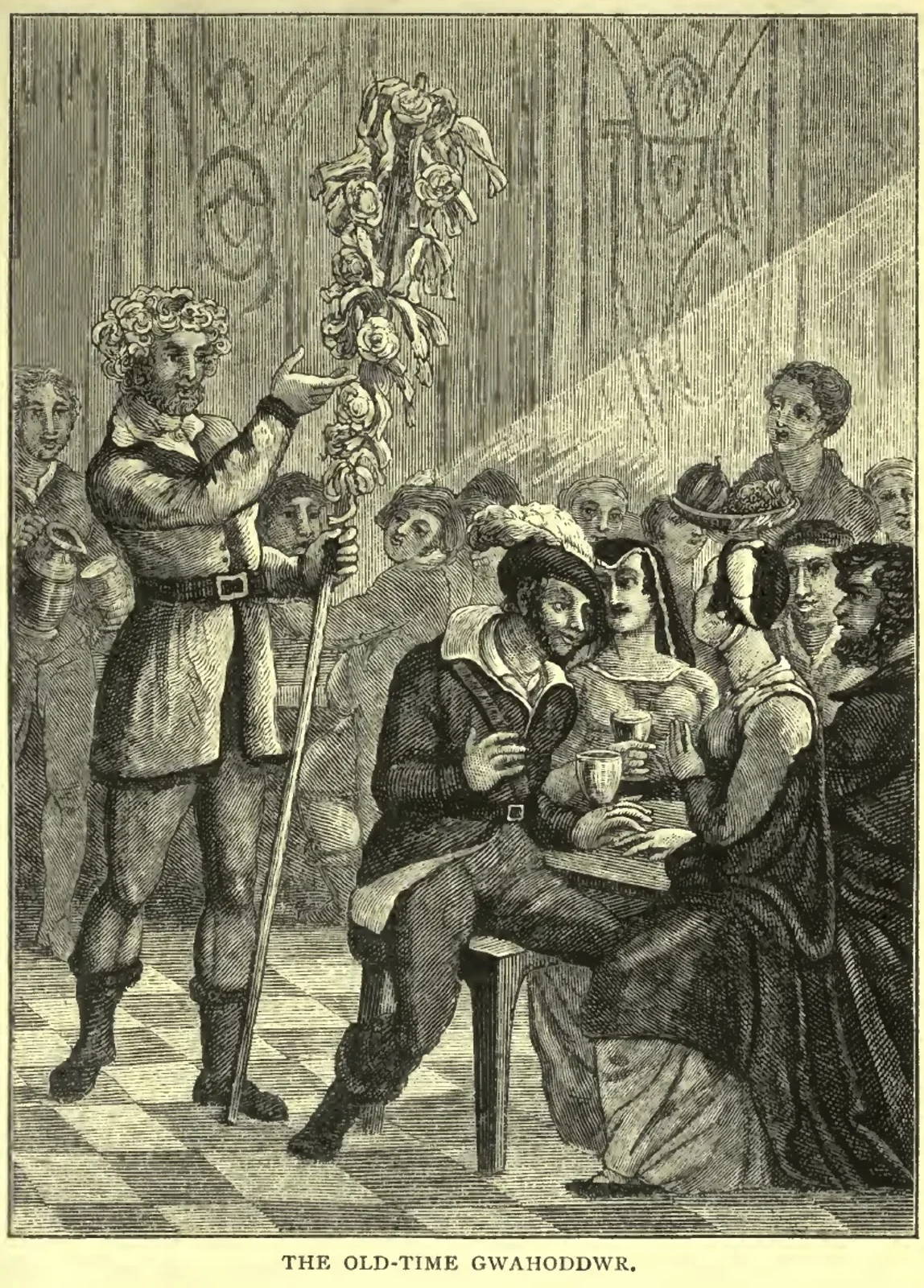
In the sources
The described custom or role
TraditionalThe Bidding is presented as a form of Welsh assistance gathering associated with marriage. Sikes prints an invitation that solicits contributions and promises repayment when a similar occasion arises. He says the celebration might occur on the wedding day or on the preceding day and night, with variation between districts. When it took place the night before, dancing, harp music and sales of cakes and beer contributed to the couple’s income.
Context and limits
TraditionalThe source calls this preceding-night festival Nos Blaen and identifies the Bidding as a Priodas Cymmhorth. Its emphasis is on a network of contributions and returned favours, rather than a gift disconnected from future relationships. The entry follows the printed invitation and accompanying description; it does not assume every Welsh wedding followed this arrangement or turn Sikes’s generalization into a contemporary rule.
Context & interpretation
This entry follows the supplied 1880 British Goblins edition. Its descriptions and proposed origins are historical source accounts, not certification of present-day practice or proof of the author’s generalizations.
Original passages
Source 1
British Goblins
The Bidding is sometimes held on the day of the weddingOpen this page in the book
Passage & edition details
Location recorded at citation review: British Goblins; printed page 308
Actual full scan viewed; passage and short quotation manually checked.
- Edition
- IMJ-0044-E001
- Reader page
- IMJ-0044-E001-P0323
- Original scan leaf
- 324
- Recorded leaf number
- 324
- Current Reader position
- 322
- Reader verification
- Source-preserving update confirmed
Source 2
British Goblins
The Bidding is a Priodas CymmhorthOpen this page in the book
Passage & edition details
Location recorded at citation review: British Goblins; printed page 308
Actual full scan viewed; passage and short quotation manually checked.
- Edition
- IMJ-0044-E001
- Reader page
- IMJ-0044-E001-P0323
- Original scan leaf
- 324
- Recorded leaf number
- 324
- Current Reader position
- 322
- Reader verification
- Source-preserving update confirmed
Illustrations
Continue exploring
Cymmhorth
Sikes’s term for a broader form of Welsh mutual assistance, including wedding bidding and assistance meetings.
Shared illustrationGwahoddwr
The wedding-bidding representative described by Sikes, whose garlanded staff served as an emblem of office.
Same subject and traditionEaster Lifting
The Easter chair-lifting custom described by Wirt Sikes, with men and women taking turns on successive days.
Same subject and traditionStocsio
An Easter Monday custom at Aberconwy, involving proclaimed rules about rising early and mock punishment in the stocks.