The water trial
Steiner’s water trial asks the candidate to carry out a duty without a visible prompt. The swimmer who cannot touch bottom explains the name.
In this article
Understanding the concept
The water trial is Rudolf Steiner’s second trial of initiation. It asks the candidate to recognize and carry out a duty when the usual prompts are absent. Steiner compares this to swimming in water too deep to reach the bottom. [5][6][7][8][9]
See references (5)
- Knowledge of the Higher Worlds and Its Attainment, Reader page 73
- Knowledge of the Higher Worlds and Its Attainment, Reader page 74
- Knowledge of the Higher Worlds and Its Attainment, Reader page 75
- Knowledge of the Higher Worlds and Its Attainment, Reader page 76
- Knowledge of the Higher Worlds and Its Attainment, Reader page 77
Knowledge of the Higher Worlds by Rudolf Steiner
Rudolf Steiner says the candidate reads what must be done through esoteric writing. A task follows, and the figures, colours or tones the candidate perceives are expected to change in a definite way if the action succeeds. [10][5][6][7][8]
The test is one of self-control and judgement. Steiner says personal preference can interfere with the task. He takes the ability to follow a principle despite competing wishes as useful preparation and requires the judgement to give up a belief when the reasons for it fail. [8][9][11]
Steiner holds that no higher duty can require neglect of an everyday obligation. He mentions responsibilities to family and work as obligations that stay in force during training. [5][6]
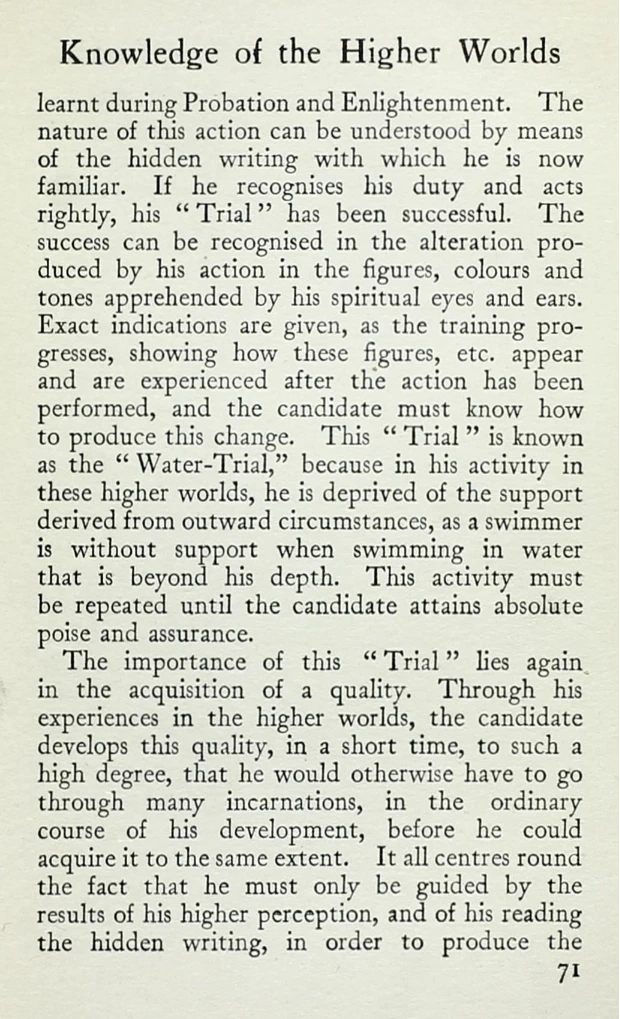
Steiner compares the loss of outward incentives to a swimmer losing contact with the ground. Knowledge of the Higher Worlds, printed p. 71, Library reader p. 75.
Rudolf Steiner, G. Metaxa translation, edited by Harry Collison. Historical public-domain source facsimile from the exact checksum-verified Library edition. Repository date 1932; the inspected title page is undated. · Image source ↗ · Public Domain
See references (7)
- Knowledge of the Higher Worlds and Its Attainment, Reader page 73
- Knowledge of the Higher Worlds and Its Attainment, Reader page 74
- Knowledge of the Higher Worlds and Its Attainment, Reader page 75
- Knowledge of the Higher Worlds and Its Attainment, Reader page 76
- Knowledge of the Higher Worlds and Its Attainment, Reader page 77
- Knowledge of the Higher Worlds and Its Attainment, Reader page 72
- Knowledge of the Higher Worlds and Its Attainment, Reader page 78
Karma-Yoga by Swami Vivekananda
Swami Vivekananda opens his chapter on duty by showing how custom and circumstance affect what a person takes to be obligatory. Later, in “Freedom,” he questions the urgency that keeps someone working for rewards while calling it duty. His ideal is to offer the work freely and loosen attachment to its results. [1][2][3][4]
How a person knows what to do
Vivekananda asks how someone comes to feel bound to work and what it takes to act freely. Steiner asks how the candidate finds a task when external circumstances give no direction. Both make the person’s motive important. Steiner adds the claimed capacity to read a duty in what the candidate perceives. [1][2][3][4][6][7]
The air trial takes away another form of support. In the water trial the candidate still has signs to interpret and a particular action to perform. [7][11][12][13]
See references (9)
- Karma-Yoga, Reader page 51
- Karma-Yoga, Reader page 52
- Karma-Yoga, Reader page 105
- Karma-Yoga, Reader page 106
- Knowledge of the Higher Worlds and Its Attainment, Reader page 74
- Knowledge of the Higher Worlds and Its Attainment, Reader page 75
- Knowledge of the Higher Worlds and Its Attainment, Reader page 78
- Knowledge of the Higher Worlds and Its Attainment, Reader page 79
- Knowledge of the Higher Worlds and Its Attainment, Reader page 80
Read further in the library

Karma Yoga
Reading note
Separately attributed primary Library account, cited on exact verified Reader leaves.

Knowledge of the Higher Worlds and Its Attainment
Reading note
The separately titled account draws on exact passages in the consulted Library edition.
Sources
See references (13)
- Karma-Yoga, Reader page 51Swami Vivekananda, Karma-Yoga, in Karma-Yoga & Bhakti-Yoga, English second printing, Ramakrishna-Vivekananda Center of New York, Inc., 1939. Exact Library edition IMJ-0097-E002. Only the Karma-Yoga part is used in this crawl; the old Work slug mentioning Hindi does not identify this edition’s language.Read this page in Karma Yoga ↗Return to text ↑
- Karma-Yoga, Reader page 52Swami Vivekananda, Karma-Yoga, in Karma-Yoga & Bhakti-Yoga, English second printing, Ramakrishna-Vivekananda Center of New York, Inc., 1939. Exact Library edition IMJ-0097-E002. Only the Karma-Yoga part is used in this crawl; the old Work slug mentioning Hindi does not identify this edition’s language.Read this page in Karma Yoga ↗Return to text ↑
- Karma-Yoga, Reader page 105Swami Vivekananda, Karma-Yoga, in Karma-Yoga & Bhakti-Yoga, English second printing, Ramakrishna-Vivekananda Center of New York, Inc., 1939. Exact Library edition IMJ-0097-E002. Only the Karma-Yoga part is used in this crawl; the old Work slug mentioning Hindi does not identify this edition’s language.Read this page in Karma Yoga ↗Return to text ↑
- Karma-Yoga, Reader page 106Swami Vivekananda, Karma-Yoga, in Karma-Yoga & Bhakti-Yoga, English second printing, Ramakrishna-Vivekananda Center of New York, Inc., 1939. Exact Library edition IMJ-0097-E002. Only the Karma-Yoga part is used in this crawl; the old Work slug mentioning Hindi does not identify this edition’s language.Read this page in Karma Yoga ↗Return to text ↑
- Knowledge of the Higher Worlds and Its Attainment, Reader page 73Rudolf Steiner, Knowledge of the Higher Worlds and Its Attainment, authorized English translation by G. Metaxa, edited by Harry Collison, Anthroposophic Press, New York City. Exact Library edition IMJ-0513-E001. No publication year is visible on the inspected title page; the repository assigns 1932. Claims of supersensible perception remain attributed to Steiner.Read this page in Knowledge of the Higher Worlds and Its Attainment ↗Return to text ↑
- Knowledge of the Higher Worlds and Its Attainment, Reader page 74Rudolf Steiner, Knowledge of the Higher Worlds and Its Attainment, authorized English translation by G. Metaxa, edited by Harry Collison, Anthroposophic Press, New York City. Exact Library edition IMJ-0513-E001. No publication year is visible on the inspected title page; the repository assigns 1932. Claims of supersensible perception remain attributed to Steiner.Read this page in Knowledge of the Higher Worlds and Its Attainment ↗Return to text ↑
- Knowledge of the Higher Worlds and Its Attainment, Reader page 75Rudolf Steiner, Knowledge of the Higher Worlds and Its Attainment, authorized English translation by G. Metaxa, edited by Harry Collison, Anthroposophic Press, New York City. Exact Library edition IMJ-0513-E001. No publication year is visible on the inspected title page; the repository assigns 1932. Claims of supersensible perception remain attributed to Steiner.Read this page in Knowledge of the Higher Worlds and Its Attainment ↗Return to text ↑
- Knowledge of the Higher Worlds and Its Attainment, Reader page 76Rudolf Steiner, Knowledge of the Higher Worlds and Its Attainment, authorized English translation by G. Metaxa, edited by Harry Collison, Anthroposophic Press, New York City. Exact Library edition IMJ-0513-E001. No publication year is visible on the inspected title page; the repository assigns 1932. Claims of supersensible perception remain attributed to Steiner.Read this page in Knowledge of the Higher Worlds and Its Attainment ↗Return to text ↑
- Knowledge of the Higher Worlds and Its Attainment, Reader page 77Rudolf Steiner, Knowledge of the Higher Worlds and Its Attainment, authorized English translation by G. Metaxa, edited by Harry Collison, Anthroposophic Press, New York City. Exact Library edition IMJ-0513-E001. No publication year is visible on the inspected title page; the repository assigns 1932. Claims of supersensible perception remain attributed to Steiner.Read this page in Knowledge of the Higher Worlds and Its Attainment ↗Return to text ↑
- Knowledge of the Higher Worlds and Its Attainment, Reader page 72Rudolf Steiner, Knowledge of the Higher Worlds and Its Attainment, authorized English translation by G. Metaxa, edited by Harry Collison, Anthroposophic Press, New York City. Exact Library edition IMJ-0513-E001. No publication year is visible on the inspected title page; the repository assigns 1932. Claims of supersensible perception remain attributed to Steiner.Read this page in Knowledge of the Higher Worlds and Its Attainment ↗Return to text ↑
- Knowledge of the Higher Worlds and Its Attainment, Reader page 78Rudolf Steiner, Knowledge of the Higher Worlds and Its Attainment, authorized English translation by G. Metaxa, edited by Harry Collison, Anthroposophic Press, New York City. Exact Library edition IMJ-0513-E001. No publication year is visible on the inspected title page; the repository assigns 1932. Claims of supersensible perception remain attributed to Steiner.Read this page in Knowledge of the Higher Worlds and Its Attainment ↗Return to text ↑
- Knowledge of the Higher Worlds and Its Attainment, Reader page 79Rudolf Steiner, Knowledge of the Higher Worlds and Its Attainment, authorized English translation by G. Metaxa, edited by Harry Collison, Anthroposophic Press, New York City. Exact Library edition IMJ-0513-E001. No publication year is visible on the inspected title page; the repository assigns 1932. Claims of supersensible perception remain attributed to Steiner.Read this page in Knowledge of the Higher Worlds and Its Attainment ↗Return to text ↑
- Knowledge of the Higher Worlds and Its Attainment, Reader page 80Rudolf Steiner, Knowledge of the Higher Worlds and Its Attainment, authorized English translation by G. Metaxa, edited by Harry Collison, Anthroposophic Press, New York City. Exact Library edition IMJ-0513-E001. No publication year is visible on the inspected title page; the repository assigns 1932. Claims of supersensible perception remain attributed to Steiner.Read this page in Knowledge of the Higher Worlds and Its Attainment ↗Return to text ↑