The air trial
Steiner’s air trial tests presence of mind when outward incentives and earlier spiritual signs offer no support. Explore its place after the fire and water trials.
In this article
Understanding the concept
The air trial is the third of Rudolf Steiner’s trials of initiation. Its test is presence of mind: the candidate has to find a motive and the strength to act without the support offered by either ordinary circumstances or the signs used in earlier stages. [3][4][5]
Knowledge of the Higher Worlds by Rudolf Steiner
Rudolf Steiner takes away the direction the candidate previously had. No person, event or definite goal supplies the next step. He asks the candidate to draw on the higher self and respond to what he calls spiritual inspiration. [3][4][6]
Someone who can act when misfortune suddenly threatens may already have practised this kind of presence of mind in ordinary life, Steiner suggests. In the air trial, the forms, tones and colours that guided the candidate in the water trial cease to be the direct basis for action. [5]
Steiner’s next scene takes the successful candidate into the Temple of Higher Wisdom. The language of a vow describes the tact and responsibility with which knowledge is to be used. Steiner explains the obligation without describing a promise demanded by an outside authority. [5][7]
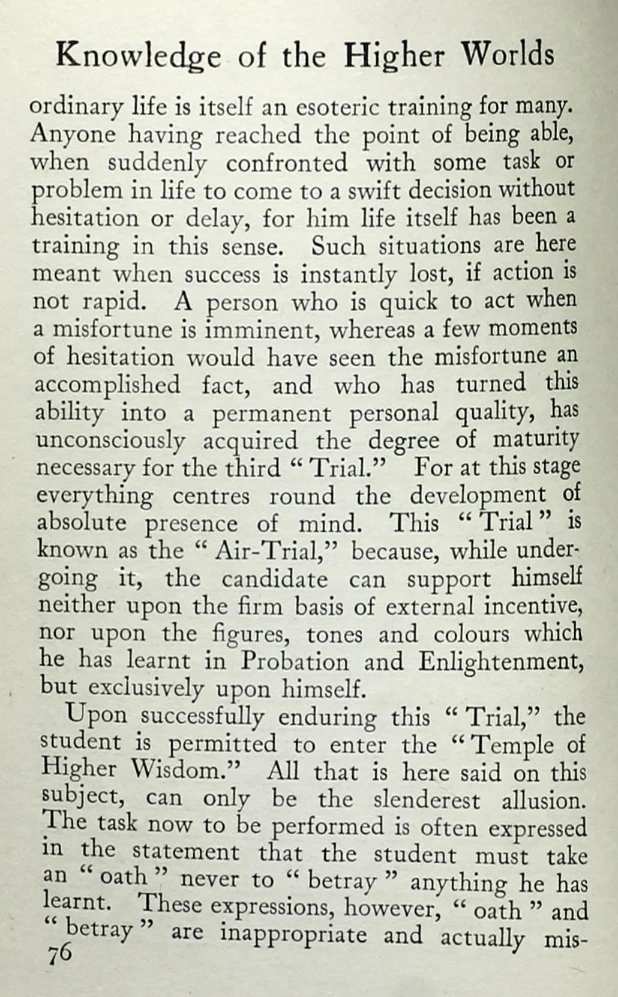
Steiner calls the third trial a test of presence of mind. Knowledge of the Higher Worlds, printed p. 76, Library reader p. 80.
Rudolf Steiner, G. Metaxa translation, edited by Harry Collison. Historical public-domain source facsimile from the exact checksum-verified Library edition. Repository date 1932; the inspected title page is undated. · Image source ↗ · Public Domain
See references (5)
- Knowledge of the Higher Worlds and Its Attainment, Reader page 78
- Knowledge of the Higher Worlds and Its Attainment, Reader page 79
- Knowledge of the Higher Worlds and Its Attainment, Reader page 80
- Knowledge of the Higher Worlds and Its Attainment, Reader page 77
- Knowledge of the Higher Worlds and Its Attainment, Reader page 81
Thought-Forms by Annie Besant and C. W. Leadbeater
In Thought-Forms, Annie Besant and Charles Webster Leadbeater compare three responses to a shipwreck. They give the sharper outline to an officer taking responsibility for the passengers. They read the ragged grey shapes as fear and a small scarlet point in the officer’s form as anger. [1][2]
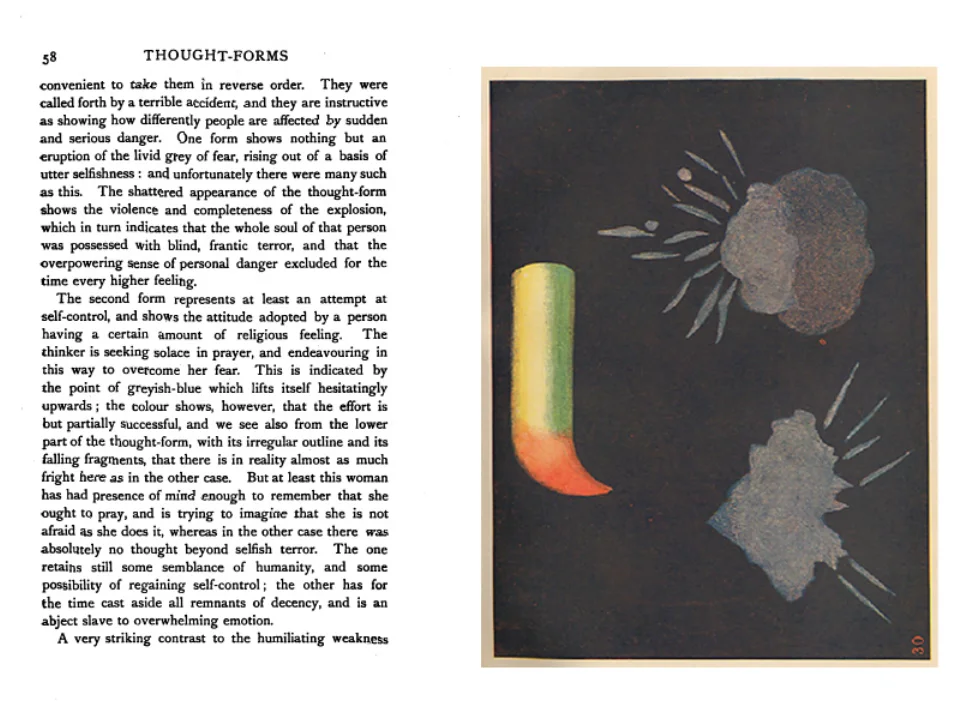
“At a Shipwreck,” figure 30 in Thought-Forms. Besant and Leadbeater assign the clear-edged form at left to the officer and the ragged forms to two people they describe as afraid.
Annie Besant and C. W. Leadbeater, Thought-Forms. Lumitheca Library, 1905 edition. · Image source ↗ · Public Domain
Presence of mind under pressure
The shipwreck plate gives the reader a particular emergency and an officer with a clear duty. The air trial poses a different problem: the candidate has to find direction when no comparable duty has been made clear. The two passages give readers different scenes in which to consider composure. [1][2][4][5]
Read further in the library

Thought-Forms
Reading note
Separately attributed primary Library account, cited on exact verified Reader leaves.

Knowledge of the Higher Worlds and Its Attainment
Reading note
The separately titled account draws on exact passages in the consulted Library edition.
Sources
See references (7)
- Prayer and composure at the shipwreck (Library scan), Reader page 40Exact source retained from the earlier attributed Thought-forms account.Read this page in Thought-Forms ↗Return to text ↑
- Three reactions to the shipwreck (Library scan), Reader page 39Exact source retained from the earlier attributed Thought-forms account.Read this page in Thought-Forms ↗Return to text ↑
- Knowledge of the Higher Worlds and Its Attainment, Reader page 78Rudolf Steiner, Knowledge of the Higher Worlds and Its Attainment, authorized English translation by G. Metaxa, edited by Harry Collison, Anthroposophic Press, New York City. Exact Library edition IMJ-0513-E001. No publication year is visible on the inspected title page; the repository assigns 1932. Claims of supersensible perception remain attributed to Steiner.Read this page in Knowledge of the Higher Worlds and Its Attainment ↗Return to text ↑
- Knowledge of the Higher Worlds and Its Attainment, Reader page 79Rudolf Steiner, Knowledge of the Higher Worlds and Its Attainment, authorized English translation by G. Metaxa, edited by Harry Collison, Anthroposophic Press, New York City. Exact Library edition IMJ-0513-E001. No publication year is visible on the inspected title page; the repository assigns 1932. Claims of supersensible perception remain attributed to Steiner.Read this page in Knowledge of the Higher Worlds and Its Attainment ↗Return to text ↑
- Knowledge of the Higher Worlds and Its Attainment, Reader page 80Rudolf Steiner, Knowledge of the Higher Worlds and Its Attainment, authorized English translation by G. Metaxa, edited by Harry Collison, Anthroposophic Press, New York City. Exact Library edition IMJ-0513-E001. No publication year is visible on the inspected title page; the repository assigns 1932. Claims of supersensible perception remain attributed to Steiner.Read this page in Knowledge of the Higher Worlds and Its Attainment ↗Return to text ↑
- Knowledge of the Higher Worlds and Its Attainment, Reader page 77Rudolf Steiner, Knowledge of the Higher Worlds and Its Attainment, authorized English translation by G. Metaxa, edited by Harry Collison, Anthroposophic Press, New York City. Exact Library edition IMJ-0513-E001. No publication year is visible on the inspected title page; the repository assigns 1932. Claims of supersensible perception remain attributed to Steiner.Read this page in Knowledge of the Higher Worlds and Its Attainment ↗Return to text ↑
- Knowledge of the Higher Worlds and Its Attainment, Reader page 81Rudolf Steiner, Knowledge of the Higher Worlds and Its Attainment, authorized English translation by G. Metaxa, edited by Harry Collison, Anthroposophic Press, New York City. Exact Library edition IMJ-0513-E001. No publication year is visible on the inspected title page; the repository assigns 1932. Claims of supersensible perception remain attributed to Steiner.Read this page in Knowledge of the Higher Worlds and Its Attainment ↗Return to text ↑