Esoteric writing
In Steiner’s esoteric training, spiritual forms, colours and tones can be read as connected signs. Compare the idea with picture-books in Gone West.
In this article
Understanding the concept
Esoteric writing is Rudolf Steiner’s name for forms, colours and tones understood as signs. In his account, the trained observer begins by noticing separate impressions and eventually learns to read their relations, much as a person moves from spelling words to reading a passage. [3][4][5]
Reading in Steiner’s training
Knowledge of the Higher Worlds by Rudolf Steiner
Rudolf Steiner introduces the writing after the fire trial. He says the hidden qualities of things resist expression in everyday language. The student learns to recognize a connection between impressions that until then appeared separately. The comparison with reading explains how an impression might become intelligible. [3][4]
Steiner holds that the signs express forces active in the spiritual world. During the water trial they are supposed to tell the student what action a situation calls for in the absence of an ordinary outward incentive. [4][6][7][8]
See references (5)
- Knowledge of the Higher Worlds and Its Attainment, Reader page 71
- Knowledge of the Higher Worlds and Its Attainment, Reader page 72
- Knowledge of the Higher Worlds and Its Attainment, Reader page 73
- Knowledge of the Higher Worlds and Its Attainment, Reader page 74
- Knowledge of the Higher Worlds and Its Attainment, Reader page 75
Signs and symbols in the appendix
In the appendix Steiner distinguishes these signs from the alphabets or symbols that esoteric schools may teach. He asks readers to understand the signs as the way the soul comes to grasp what it experiences. The same appendix says that the reader can treat the book as personal instruction and that its essential teaching is available in the text. [5][9]
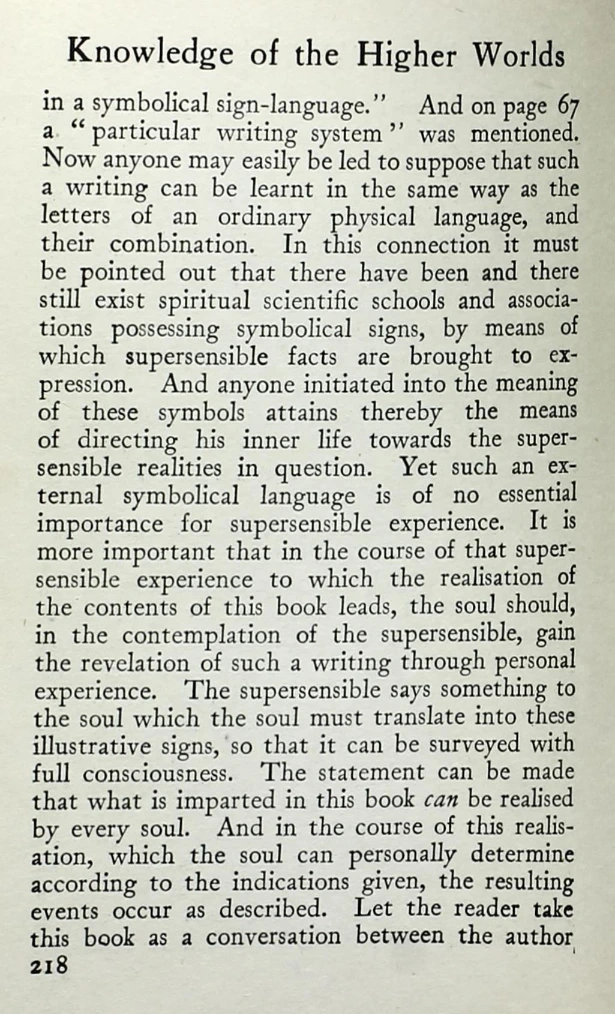
The appendix distinguishes the signs Steiner describes from a learned alphabet. Knowledge of the Higher Worlds, printed p. 218, Library reader p. 222.
Rudolf Steiner, G. Metaxa translation, edited by Harry Collison. Historical public-domain source facsimile from the exact checksum-verified Library edition. Repository date 1932; the inspected title page is undated. · Image source ↗ · Public Domain
The libraries in Gone West
Gone West by J. S. M. Ward
In Gone West, J. S. M. Ward summarizes reports from the book’s spirit contributor, J. B. P. The libraries in the account preserve lost earthly books as well as works made in the spirit world. Words are comparatively rare in the latter group. The authors communicate through pictures formed by thought, and scholars can also reconstruct historical scenes collectively. [1][2]
Reading an event or reading a book
Ward describes authors making works that readers receive as pictures. Steiner is concerned with the observer’s work of interpretation: an event in the proposed spiritual world becomes intelligible as a set of signs. The comparison is between two ways of giving unfamiliar experiences a readable form. [1][2][3][4][5]
Read further in the library

Gone West
Reading note
Separately attributed primary Library account, cited on exact verified Reader leaves.
Knowledge of the Higher Worlds and Its Attainment
Reading note
The separately titled account draws on exact passages in the consulted Library edition.
Sources
See references (9)
- Gone West, printed p. iv, Reader page 8J. S. M. Ward, Gone West: Three Narratives of After-Death Experiences, third impression, William Rider & Son, London, 1920, as reproduced in Geoff Cutler’s December 2009 digital transcription. Ward’s introduction is distinct from the supplied 1974 foreword.Read this page in Gone West ↗Return to text ↑
- Gone West, printed p. v, Reader page 9J. S. M. Ward, Gone West: Three Narratives of After-Death Experiences, third impression, William Rider & Son, London, 1920, as reproduced in Geoff Cutler’s December 2009 digital transcription. Ward’s introduction is distinct from the supplied 1974 foreword.Read this page in Gone West ↗Return to text ↑
- Knowledge of the Higher Worlds and Its Attainment, Reader page 71Rudolf Steiner, Knowledge of the Higher Worlds and Its Attainment, authorized English translation by G. Metaxa, edited by Harry Collison, Anthroposophic Press, New York City. Exact Library edition IMJ-0513-E001. No publication year is visible on the inspected title page; the repository assigns 1932. Claims of supersensible perception remain attributed to Steiner.Read this page in Knowledge of the Higher Worlds and Its Attainment ↗Return to text ↑
- Knowledge of the Higher Worlds and Its Attainment, Reader page 72Rudolf Steiner, Knowledge of the Higher Worlds and Its Attainment, authorized English translation by G. Metaxa, edited by Harry Collison, Anthroposophic Press, New York City. Exact Library edition IMJ-0513-E001. No publication year is visible on the inspected title page; the repository assigns 1932. Claims of supersensible perception remain attributed to Steiner.Read this page in Knowledge of the Higher Worlds and Its Attainment ↗Return to text ↑
- Knowledge of the Higher Worlds and Its Attainment, Reader page 222Rudolf Steiner, Knowledge of the Higher Worlds and Its Attainment, authorized English translation by G. Metaxa, edited by Harry Collison, Anthroposophic Press, New York City. Exact Library edition IMJ-0513-E001. No publication year is visible on the inspected title page; the repository assigns 1932. Claims of supersensible perception remain attributed to Steiner.Read this page in Knowledge of the Higher Worlds and Its Attainment ↗Return to text ↑
- Knowledge of the Higher Worlds and Its Attainment, Reader page 73Rudolf Steiner, Knowledge of the Higher Worlds and Its Attainment, authorized English translation by G. Metaxa, edited by Harry Collison, Anthroposophic Press, New York City. Exact Library edition IMJ-0513-E001. No publication year is visible on the inspected title page; the repository assigns 1932. Claims of supersensible perception remain attributed to Steiner.Read this page in Knowledge of the Higher Worlds and Its Attainment ↗Return to text ↑
- Knowledge of the Higher Worlds and Its Attainment, Reader page 74Rudolf Steiner, Knowledge of the Higher Worlds and Its Attainment, authorized English translation by G. Metaxa, edited by Harry Collison, Anthroposophic Press, New York City. Exact Library edition IMJ-0513-E001. No publication year is visible on the inspected title page; the repository assigns 1932. Claims of supersensible perception remain attributed to Steiner.Read this page in Knowledge of the Higher Worlds and Its Attainment ↗Return to text ↑
- Knowledge of the Higher Worlds and Its Attainment, Reader page 75Rudolf Steiner, Knowledge of the Higher Worlds and Its Attainment, authorized English translation by G. Metaxa, edited by Harry Collison, Anthroposophic Press, New York City. Exact Library edition IMJ-0513-E001. No publication year is visible on the inspected title page; the repository assigns 1932. Claims of supersensible perception remain attributed to Steiner.Read this page in Knowledge of the Higher Worlds and Its Attainment ↗Return to text ↑
- Knowledge of the Higher Worlds and Its Attainment, Reader page 223Rudolf Steiner, Knowledge of the Higher Worlds and Its Attainment, authorized English translation by G. Metaxa, edited by Harry Collison, Anthroposophic Press, New York City. Exact Library edition IMJ-0513-E001. No publication year is visible on the inspected title page; the repository assigns 1932. Claims of supersensible perception remain attributed to Steiner.Read this page in Knowledge of the Higher Worlds and Its Attainment ↗Return to text ↑