Telepathy
Telepathy is the proposed transfer of thoughts without sensory signals. Explore its early study and compare Thought-Forms with two accounts of mental communication.
In this article
What is telepathy?
Telepathy is the proposed transfer of thoughts, feelings or experiences between minds without ordinary sensory signals such as speech, writing or gesture. A report of two people experiencing something similar raises a further question: how could we tell thought transfer from coincidence, suggestion or information they already shared? [1][2]
In esoteric books, the idea often sits beside clairvoyance, inspiration or travel outside the body. Those claims ask different questions. Receiving a thought at a distance, perceiving its supposed shape and meeting someone in an unseen place each require their own explanation. [3][4][5][6][2]
See references (6)
- Zofia Weaver, Our History: the Society’s early years
- Evolution of Immortality, printed p. 144, Reader page 143
- Evolution of Immortality, printed p. 135, Reader page 134
- Evolution of Immortality, printed p. 136, Reader page 135
- Evolution of Immortality, printed p. 139, Reader page 138
- Evolution of Immortality, printed p. 140, Reader page 139
An early field of psychical research
The Society for Psychical Research was founded in London in 1882. Its early committees investigated thought-reading, which Frederic Myers renamed telepathy, alongside mesmerism and reports of apparitions. The investigators collected reports of spontaneous experiences as well as conducting experiments. [1]
Thought-Forms by Annie Besant and C. W. Leadbeater
In Thought-Forms, Annie Besant and Charles Webster Leadbeater publish a sender’s account of trying to communicate helpful thoughts at a fixed hour. The recipient sketched the shapes they believed they saw and posted the sketches back. The sender associated a larger, clearer shape with steady concentration and smaller forms with a more distracted attempt. [15][16]
The figures are a selection. The book supplies the sender’s interpretation of agreements and changes in shape and colour. It does not give a complete record of attempts from which a reader could judge how often the descriptions matched. [15][16]
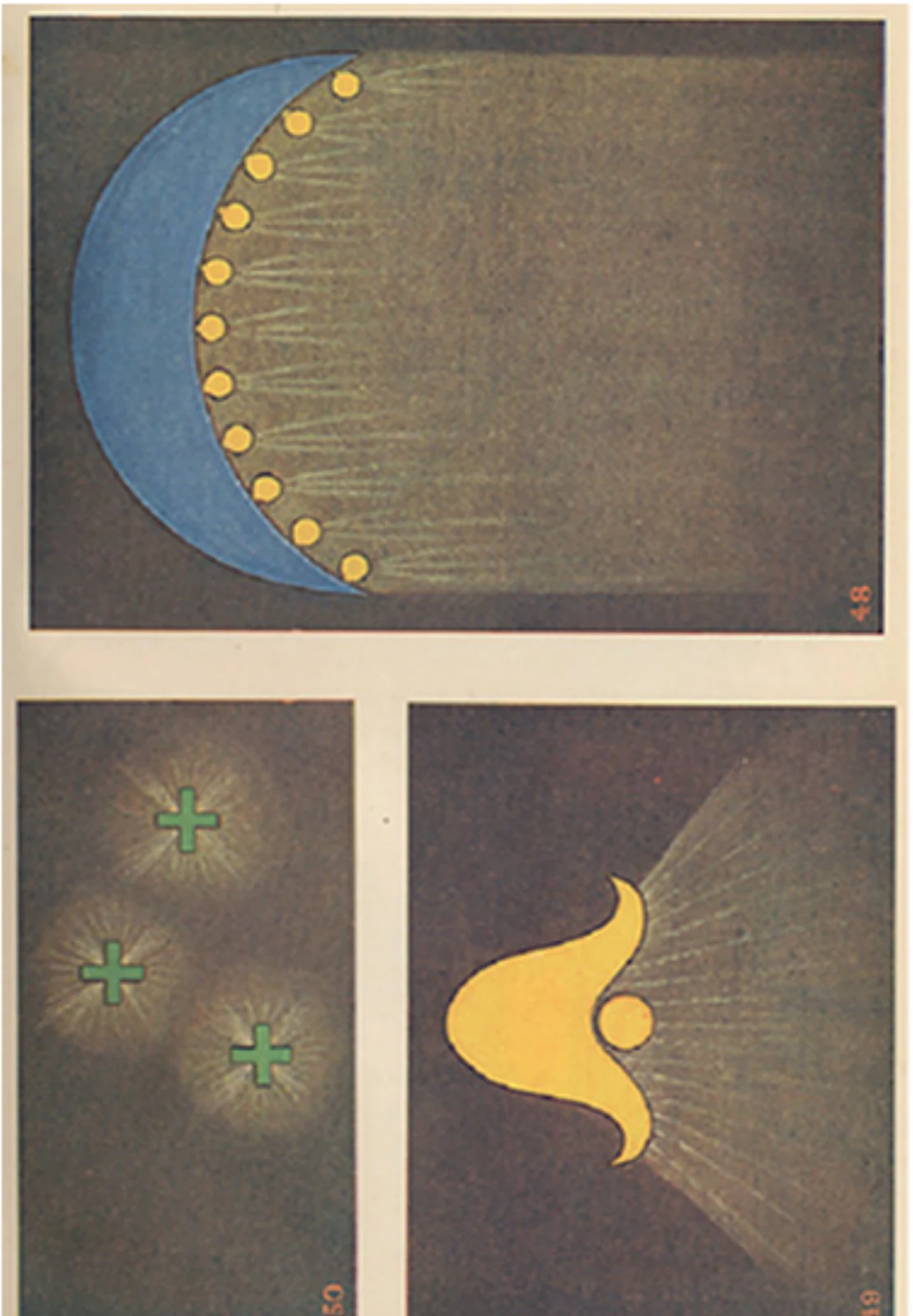
Helpful Thoughts, figures 48–50, in Annie Besant and C. W. Leadbeater’s Thought-Forms. Printed p. 74, Library Reader page 58.
Annie Besant and C. W. Leadbeater, Thought-Forms. Lumitheca Library and Gallery. Public domain historical illustration. · Image source ↗ · Public Domain
Evolution of Immortality
Freeman Benjamin Dowd, writing as Rosicruciæ in Evolution of Immortality, predicts a mental age that will follow the electrical age. He imagines that learners will receive knowledge directly, changing what education requires. This is a forecast in the appendix, where he sets telepathy alongside other powers he expects people to develop. [7][2]
The prediction belongs to a larger theory of mind and spiritual affinity. The appendix describes minds and souls responding through vibrations in an ether, and training directed towards connections with spiritual spaces. A person’s capacities supposedly determine what knowledge can be received. These are the book’s proposed means of contact, expressed in the scientific and esoteric vocabulary it brings together. [8][3][4]
Rosicruciæ also describes councils involving people still embodied on earth and those who have died. Some living participants supposedly enter those gatherings through soul projection. This offers another setting for the exchange of ideas, although presence in such a council is a different claim from the direct mental instruction forecast later in the appendix. [5][6]
The book’s future also includes the photography of mental states and the mapping of human character. These predictions show the breadth of its expectations for mind. Their appearance in a historical text records an ambition and a belief, rather than demonstrating an established technology or supplying evidence that thought transmission has replaced ordinary education. [2]
See references (7)
- Evolution of Immortality, printed p. 144, Reader page 143
- Evolution of Immortality, printed p. 135, Reader page 134
- Evolution of Immortality, printed p. 136, Reader page 135
- Evolution of Immortality, printed p. 139, Reader page 138
- Evolution of Immortality, printed p. 140, Reader page 139
- Evolution of Immortality, printed p. 143, Reader page 142
- Evolution of Immortality, printed p. 134, Reader page 133
Life Here and Hereafter: Charlotte E. Dresser and Fred Rafferty
The appendix to Charlotte E. Dresser and Fred Rafferty’s Life Here and Hereafter describes direct thought alongside speech and written-like symbols. A lecture may be spoken while its thought is received at the same time, and a listener can direct attention to one channel. Thought transfer does not make voice obsolete in the reported world. [9][10][11]
Familiarity is important. Members of a circle recognise a characteristic way of thinking much as people recognise a voice. With strangers, they usually begin vocally until they learn how the other person sends and receives. A message intended for several people also requires adjustment to differing receptive abilities. [11][12]
The same discussion preserves private reflection. A person can reconsider a lecture alone without sending that thought outward, while a shared period of study is said to produce a helpful harmony. The narrative thus combines claimed mental exchange with choice, attention and learned social habits. [13][11]
What is being communicated?
Besant and Leadbeater describe one sender and one receiver, comparing notes afterwards. Dowd predicts mental instruction on the scale of education. Dresser and Rafferty describe a spirit society still using lectures, reading and conversation alongside direct thought. The accounts differ in what they claim is being received: a helpful impulse, a lesson or another person’s characteristic way of thinking. [7][2][14][10][11][15][16]
See references (7)
- Evolution of Immortality, printed p. 144, Reader page 143
- Evolution of Immortality, printed p. 143, Reader page 142
- Life Here and Hereafter, Reader page 257
- Life Here and Hereafter, Reader page 258
- Life Here and Hereafter, Reader page 256
- Thought-Forms, Helpful Thoughts and figures 48–50, printed p. 74, Reader page 57
- Thought-Forms, Helpful Thoughts, printed p. 75, Reader page 59
Read further in the library
Evolution of Immortality
Reading note
A prediction that direct mental communication will change education, alongside a wider theory of spiritual affinity.

Life Here and Hereafter
Reading note
The separately titled account draws on exact passages in the consulted Library edition.
Thought-Forms
Reading note
A Theosophical account of sending helpful thoughts and comparing the forms reported by the receiver.
Sources
See references (16)
- Zofia Weaver, Our History: the Society’s early years ↗Zofia Weaver, Our History, Society for Psychical Research. Institutional account of its early investigations and terminology.Return to text ↑
- Evolution of Immortality, printed p. 144, Reader page 143Rosicruciæ (catalogued as Freeman Benjamin Dowd), Evolution of Immortality. Eulian Publishing Company, Salem, 1900.Read this page in Evolution of Immortality ↗Return to text ↑
- Evolution of Immortality, printed p. 135, Reader page 134Rosicruciæ (catalogued as Freeman Benjamin Dowd), Evolution of Immortality. Eulian Publishing Company, Salem, 1900.Read this page in Evolution of Immortality ↗Return to text ↑
- Evolution of Immortality, printed p. 136, Reader page 135Rosicruciæ (catalogued as Freeman Benjamin Dowd), Evolution of Immortality. Eulian Publishing Company, Salem, 1900.Read this page in Evolution of Immortality ↗Return to text ↑
- Evolution of Immortality, printed p. 139, Reader page 138Rosicruciæ (catalogued as Freeman Benjamin Dowd), Evolution of Immortality. Eulian Publishing Company, Salem, 1900.Read this page in Evolution of Immortality ↗Return to text ↑
- Evolution of Immortality, printed p. 140, Reader page 139Rosicruciæ (catalogued as Freeman Benjamin Dowd), Evolution of Immortality. Eulian Publishing Company, Salem, 1900.Read this page in Evolution of Immortality ↗Return to text ↑
- Evolution of Immortality, printed p. 143, Reader page 142Rosicruciæ (catalogued as Freeman Benjamin Dowd), Evolution of Immortality. Eulian Publishing Company, Salem, 1900.Read this page in Evolution of Immortality ↗Return to text ↑
- Evolution of Immortality, printed p. 134, Reader page 133Rosicruciæ (catalogued as Freeman Benjamin Dowd), Evolution of Immortality. Eulian Publishing Company, Salem, 1900.Read this page in Evolution of Immortality ↗Return to text ↑
- Life Here and Hereafter, Reader page 243Charlotte E. Dresser and Fred Rafferty, Life Here and Hereafter, edited by Fred Rafferty. Modern transcription reproducing the Author’s Edition, San Jose, California, 1927. Exact selected Library edition IMJ-0447-E001; original PageIDs and current Reader positions verified. Communications and their claimed spiritual origins remain attributed to this source.Read this page in Life Here and Hereafter ↗Return to text ↑
- Life Here and Hereafter, Reader page 257Charlotte E. Dresser and Fred Rafferty, Life Here and Hereafter, edited by Fred Rafferty. Modern transcription reproducing the Author’s Edition, San Jose, California, 1927. Exact selected Library edition IMJ-0447-E001; original PageIDs and current Reader positions verified. Communications and their claimed spiritual origins remain attributed to this source.Read this page in Life Here and Hereafter ↗Return to text ↑
- Life Here and Hereafter, Reader page 258Charlotte E. Dresser and Fred Rafferty, Life Here and Hereafter, edited by Fred Rafferty. Modern transcription reproducing the Author’s Edition, San Jose, California, 1927. Exact selected Library edition IMJ-0447-E001; original PageIDs and current Reader positions verified. Communications and their claimed spiritual origins remain attributed to this source.Read this page in Life Here and Hereafter ↗Return to text ↑
- Life Here and Hereafter, Reader page 259Charlotte E. Dresser and Fred Rafferty, Life Here and Hereafter, edited by Fred Rafferty. Modern transcription reproducing the Author’s Edition, San Jose, California, 1927. Exact selected Library edition IMJ-0447-E001; original PageIDs and current Reader positions verified. Communications and their claimed spiritual origins remain attributed to this source.Read this page in Life Here and Hereafter ↗Return to text ↑
- Life Here and Hereafter, Reader page 99Charlotte E. Dresser and Fred Rafferty, Life Here and Hereafter, edited by Fred Rafferty. Modern transcription reproducing the Author’s Edition, San Jose, California, 1927. Exact selected Library edition IMJ-0447-E001; original PageIDs and current Reader positions verified. Communications and their claimed spiritual origins remain attributed to this source.Read this page in Life Here and Hereafter ↗Return to text ↑
- Life Here and Hereafter, Reader page 256Charlotte E. Dresser and Fred Rafferty, Life Here and Hereafter, edited by Fred Rafferty. Modern transcription reproducing the Author’s Edition, San Jose, California, 1927. Exact selected Library edition IMJ-0447-E001; original PageIDs and current Reader positions verified. Communications and their claimed spiritual origins remain attributed to this source.Read this page in Life Here and Hereafter ↗Return to text ↑
- Thought-Forms, Helpful Thoughts and figures 48–50, printed p. 74, Reader page 57Annie Besant and Charles Webster Leadbeater, Thought-Forms.Read this page in Thought-Forms ↗Return to text ↑
- Thought-Forms, Helpful Thoughts, printed p. 75, Reader page 59Annie Besant and Charles Webster Leadbeater, Thought-Forms.Read this page in Thought-Forms ↗Return to text ↑