Swedenborg’s False Heavens and the Last Judgment
Why did Swedenborg’s false heavens seem real? Read how they formed, why they endured, and what changed at the Last Judgment he dated to 1757.
In this article
Before and after the Last Judgment
Swedenborg gives the temporary heavens a history. Compare what held people together before the judgment with what guides new arrivals in his later account.
How the first heaven came apart
A reading diagram of Swedenborg’s account. Each column links to the numbered passage it summarises.
What drew people together?
- Before the judgment
- Familiar worship, respectable conduct and shared pleasures let spirits with different motives keep company.
- After the judgment
- New arrivals follow paths according to the loves already guiding their lives.
What held their communities in place?
- Before the judgment
- Good-hearted spirits trusted outward appearances. Swedenborg compares early separation to pulling up wheat with weeds.
- After the judgment
- Each community in the intermediate world has a close connection to heaven or hell.
Could another first heaven form?
- Before the judgment
- Large gatherings could sustain communities that looked like heaven.
- After the judgment
- The new arrangement prevents another pseudo-heaven from forming in the same way.
What were Swedenborg’s false heavens in Last Judgment?
For the Swedish theologian Emanuel Swedenborg, a false heaven was a community of spirits held together by outward resemblance to heaven. Its inhabitants could appear devout, honest and useful to their neighbours. Beneath that conduct Swedenborg describes motives such as fear of disgrace and the pursuit of wealth or influence. He calls the collection of these communities the first heaven and says it came apart at a Last Judgment in the spiritual world, which he dated to 1757. [2][1]
The word first comes from Swedenborg’s reading of Revelation 21:1. It identifies the heaven that passes away in the vision. In his interpretation the disappearance concerns an order in the spiritual world and the life of the church. He wrote about it in 1758 as an event he claimed to have witnessed. In Heaven and Hell, a work published the same year, his starting point is that heaven exists through what its angels receive from the Lord. That account supplies the criterion by which a community can resemble heaven and still fall short of it. [1][2][7]
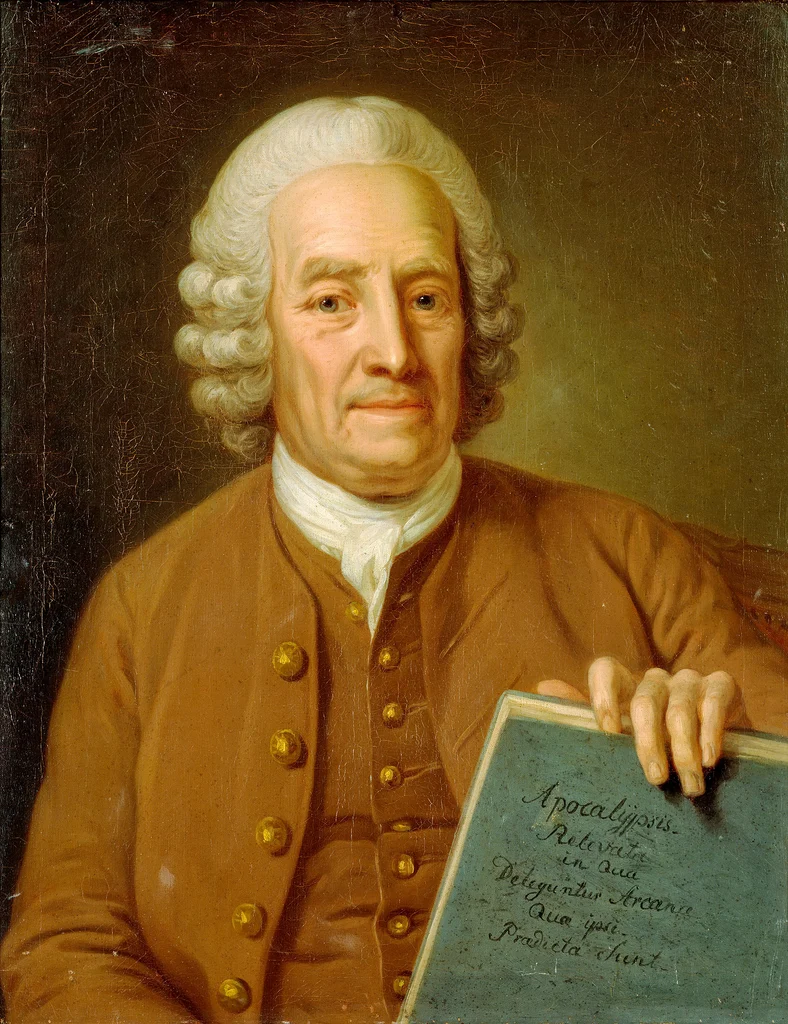
Per Krafft the Elder painted Emanuel Swedenborg in 1766. Swedenborg holds the manuscript of Apocalypse Revealed, the later work in which he gives an extended reading of Revelation.
Per Krafft the Elder, Nationalmuseum, Stockholm, via Wikimedia Commons. · Image source ↗ · Public Domain
Why did the first heaven look convincing?
Swedenborg describes spirits continuing a recognisable social life. They take pleasure in things they had enjoyed on earth and gather on rocky heights and mountains. Height feels like evidence that they are in heaven. To understand how such a mistake can hold a community together, read §69 alongside §66. One section supplies the landscape and familiar pleasures. The other supplies the human evidence that outsiders would ordinarily trust, including useful work, public worship and respectable conduct. [2]
Take the case of a person who does useful work chiefly because it secures a position. The work can still benefit neighbours, who see its result and may have good reason to trust the person. Swedenborg’s question is what the person loves through the work. An office that serves the common good and one used solely to preserve status can look much the same from the street. His contrast between an inward and an outward life gives that example its force. [2][7]
The account mentions people of several religions and reflects Swedenborg’s eighteenth-century arguments about church life, especially arguments over faith and charity. The illustrative case in §69 is a person who professes and can teach a doctrine while living by a different set of aims. His account of non-Christians in heaven gives a wider view of how he treats sincerity and conduct across traditions. [2][5]
Why was the false heaven allowed to last?
The problem in §70 is the company some of its inhabitants kept. Their visible honesty and devotion joined them to good-hearted spirits who trusted what they could see. Swedenborg locates some of those people in the lowest heaven and others in the world of spirits. Pulling the impostors away prematurely, he says, would have torn away relationships on which the lowest heaven depended. The apparent heaven had become entangled with genuine attachments. [3]
Swedenborg reads the parable of the wheat and tares in Matthew 13 as an explanation of the delay. Roots grow together in the same field, and an early attempt to clear the weeds could uproot the wheat. He also cites the parable of the net, in which the catch is sorted after it is brought ashore. The field helps explain why separation waits. The net helps explain why people who shared a place can have different destinations. [3]
The world of spirits in Heaven and Hell
The world of spirits is the intermediate place and state described at the start of the afterlife section of Heaven and Hell. Swedenborg describes a usual course in which people initially resemble their earthly selves, their inner aims then become evident, and those entering heaven receive instruction. The first stage allows friends and relatives to recognise one another, and it allows people with very different inward lives to continue in company for a time. In that setting outward familiarity is a normal part of arriving. [9][10][11][12]
Last Judgment gives that tension a collective form. The first heaven is the particular network of communities established under the earlier arrangement. A person still presenting familiar manners in the intermediate world is in the ordinary process described by Heaven and Hell. A community that endures because people mistake its outward unity for spiritual kinship is the problem Swedenborg addresses in Last Judgment. Read the two accounts together to see why a temporary resemblance can be ordinary in one passage and consequential in the other. [10][11][2][3]
See references (6)
- Last Judgment §§65–69 · Who formed the first heaven
- Last Judgment §§70–71 · The wheat and tares and the outward alliance
- Heaven and Its Wonders and Hell, printed p. 363, Reader page 370
- Heaven and Its Wonders and Hell, printed p. 445, Reader page 452
- Heaven and Its Wonders and Hell, printed p. 452, Reader page 459
- Heaven and Its Wonders and Hell, printed p. 468, Reader page 475
What changed at the Last Judgment?
In §72 Swedenborg describes the disclosure of inward motives as the turning point. As people are brought into their inner lives, he says, the deeper affiliations that had existed beneath their outward dealings become apparent. In his account, groups are separated according to what they love and the beliefs that support those loves. The social resemblance that had kept the first heaven together can no longer do that work. [2][4]
In §45 he recounts the separation through the language of Revelation. He says that the good were raised to heaven, a new church was established there, and the balance between heaven and hell was restored. He identifies this church with the New Jerusalem. The later Supplements sees the change as reopening communication between heaven and the church on earth. That claim explains why the failure of these communities matters to him beyond the fate of their inhabitants. [1][5]
The later Supplements describes the changed arrangement in §57. Newly arrived spirits follow paths drawn by their characteristic loves and reach communities already connected to heaven or hell. The intermediate world still contains communities under this arrangement. What changes is the chance for large groups to gather and sustain a pseudo-heaven in the old way. This is how the account can describe both an event in 1757 and a world of spirits that continues to receive the dead. [1][6][9]
Start reading at §68, where Swedenborg gives three questions about the first heaven. Who formed it? What was it like? How did it pass away? Then read §§70 and 72 as a pair. The delay makes sense once you see whom an early separation would harm. Finish with §57 of the Supplements, where the paths make clear what Swedenborg thought had changed for later arrivals. [2][3][4][6]
See references (7)
- Last Judgment §§45–49 · What Swedenborg says took place in 1757
- Last Judgment §§65–69 · Who formed the first heaven
- Last Judgment §§70–71 · The wheat and tares and the outward alliance
- Last Judgment §72 · The passing away of the first heaven
- Supplements §§9–12 · The communities before the Last Judgment
- Supplements §57 · The paths according to love
- Heaven and Its Wonders and Hell, printed p. 363, Reader page 370
Read further in the library

Heaven and Its Wonders and Hell
Reading note
Compare Swedenborg’s general account of the afterlife with the unusual communities he describes in Last Judgment.
Sources
See references (12)
- Last Judgment §§45–49 · What Swedenborg says took place in 1757 ↗Emanuel Swedenborg, Last Judgment and Supplements, New Century Edition, Swedenborg Foundation.Return to text ↑
- Last Judgment §§65–69 · Who formed the first heaven ↗Emanuel Swedenborg, Last Judgment and Supplements, New Century Edition, Swedenborg Foundation.Return to text ↑
- Last Judgment §§70–71 · The wheat and tares and the outward alliance ↗Emanuel Swedenborg, Last Judgment and Supplements, New Century Edition, Swedenborg Foundation.Return to text ↑
- Last Judgment §72 · The passing away of the first heaven ↗Emanuel Swedenborg, Last Judgment and Supplements, New Century Edition, Swedenborg Foundation.Return to text ↑
- Supplements §§9–12 · The communities before the Last Judgment ↗Emanuel Swedenborg, Last Judgment and Supplements, New Century Edition, Swedenborg Foundation.Return to text ↑
- Supplements §57 · The paths according to love ↗Emanuel Swedenborg, Last Judgment and Supplements, New Century Edition, Swedenborg Foundation.Return to text ↑
- Heaven and Hell §§7–12 · What makes heaven ↗Emanuel Swedenborg, Heaven and Hell, New Century Edition, translated by George F. Dole.Return to text ↑
- Per Krafft the Elder · Emanuel Swedenborg, 1766 ↗Nationalmuseum, Stockholm, via Wikimedia Commons. Public Domain Mark 1.0.
- Heaven and Its Wonders and Hell, printed p. 363, Reader page 370Emanuel Swedenborg, Heaven and Its Wonders and Hell, translated by J. C. Ager. The American Swedenborg Printing and Publishing Society, New York, 1916. Original Latin work first published in 1758.Read this page in Heaven and Its Wonders and Hell ↗Return to text ↑
- Heaven and Its Wonders and Hell, printed p. 445, Reader page 452Emanuel Swedenborg, Heaven and Its Wonders and Hell, translated by J. C. Ager. The American Swedenborg Printing and Publishing Society, New York, 1916. Original Latin work first published in 1758.Read this page in Heaven and Its Wonders and Hell ↗Return to text ↑
- Heaven and Its Wonders and Hell, printed p. 452, Reader page 459Emanuel Swedenborg, Heaven and Its Wonders and Hell, translated by J. C. Ager. The American Swedenborg Printing and Publishing Society, New York, 1916. Original Latin work first published in 1758.Read this page in Heaven and Its Wonders and Hell ↗Return to text ↑
- Heaven and Its Wonders and Hell, printed p. 468, Reader page 475Emanuel Swedenborg, Heaven and Its Wonders and Hell, translated by J. C. Ager. The American Swedenborg Printing and Publishing Society, New York, 1916. Original Latin work first published in 1758.Read this page in Heaven and Its Wonders and Hell ↗Return to text ↑