The Subliminal Self
The subliminal self names mental life below ordinary awareness. Compare Frederic Myers’s account with the enduring soul-mind of Celestion Study of Man.
In this article
Understanding the subliminal self in spiritualism
The subliminal self is a way of describing mental life outside ordinary awareness. Frederic W. H. Myers used the word for experiences, thoughts and capacities below the threshold of usual consciousness. Celestion Study of Man gives this deeper life a particular name: the mind of the soul. [1][2][3][4][9]
The idea asks what a person can experience or retain outside waking awareness. The two books link that question to survival after death, with different explanations of what sits beneath ordinary consciousness. [1][3][9]
See references (5)
- The Angels’ Diary and Celestion Study of Man, Reader page 117
- The Angels’ Diary and Celestion Study of Man, Reader page 126
- The Angels’ Diary and Celestion Study of Man, Reader page 127
- The Angels’ Diary and Celestion Study of Man, Reader page 188
- Frederic W. H. Myers, Human Personality and Its Survival of Bodily Death, vol. 1, Introduction, printed pp. 14–15
Frederic Myers’s Human Personality
In Human Personality and Its Survival of Bodily Death, Frederic W. H. Myers describes a threshold between ordinary waking awareness and a wider mental life. Experiences beneath that threshold can sometimes enter awareness. He treats ordinary consciousness as a selection from a greater self and argues that the wider consciousness can survive bodily death. [9]
The Angels’ Diary and Celestion Study of Man
The volume attributes the material to Effie M. Shirey and Charles Samson as spirit communications, with Elizabeth Maud Weatherhead credited as the medium. The book distinguishes the mind a person ordinarily notices from a subconscious mind of the soul. The first expresses impressions through the brain. The second is said to be active during sleep and to carry experiences forward after death. [5][1][10]
The chapter on thought proposes moving through conscious attention towards a deeper inward awareness. A memory carrying strong joy or grief supplies its example of a lasting impression. The author assigns such pictures to the soul’s mind and claims that they remain with the person into the next world. [2][3]
Sleep then supplies another proposed expression of the same capacity. The subconscious mind accompanies the astral form on its travels; in sleepwalking, it is said instead to predominate over the physical body. These are the author’s explanations for different kinds of experience, not independently established mechanisms. [3]
The later music chapter calls the subliminal consciousness the mind of the soul. A composer supposedly withdraws into this inward region, hears harmonies spiritually and gives them expression through the body and instruments. The term connects memory, sleep and creativity within one spiritual model. [6][4]
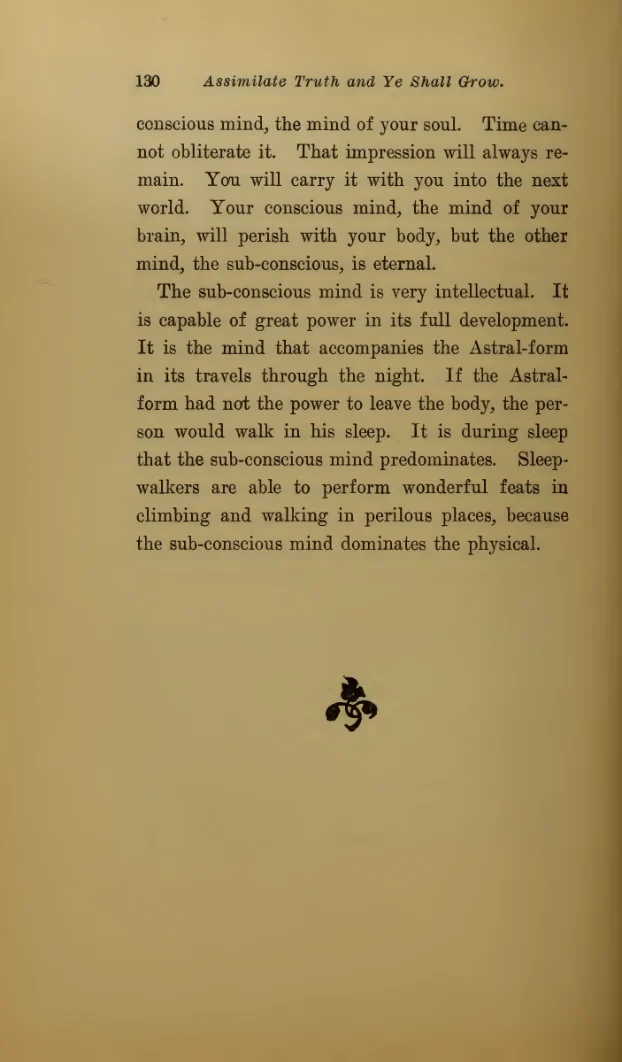
Celestion Study of Man (1903), printed p. 130, Library Reader page 127. The book places enduring impressions and the astral traveller’s awareness in the subconscious mind.
Lumitheca Library, edition IMJ-0055-E001. Public-domain 1903 text and page image; extracted from the checksum-verified retained scan. · Image source ↗ · Public Domain
See references (7)
- The Angels’ Diary and Celestion Study of Man, Reader page 117
- The Angels’ Diary and Celestion Study of Man, Reader page 126
- The Angels’ Diary and Celestion Study of Man, Reader page 127
- The Angels’ Diary and Celestion Study of Man, Reader page 188
- The Angels’ Diary and Celestion Study of Man, Reader page 115
- The Angels’ Diary and Celestion Study of Man, Reader page 187
- The Angels’ Diary and Celestion Study of Man, Denver, 1903
What belongs to the deeper mind
The soul-dynamo names a power behind thought. The Hall of Memory pictures what remains from experience. The subliminal self asks who retains those impressions when they are out of reach of ordinary awareness. [7][8][2][3]
Myers pictures ordinary consciousness as one part of a more extensive self. Celestion distinguishes the impressions expressed through the brain from an enduring mind of the soul. The terms overlap in addressing what goes on beyond awareness, while Celestion adds its own claims about the fate of each mind after death. [1][9][3]
See references (6)
- The Angels’ Diary and Celestion Study of Man, Reader page 117
- The Angels’ Diary and Celestion Study of Man, Reader page 126
- The Angels’ Diary and Celestion Study of Man, Reader page 127
- The Angels’ Diary and Celestion Study of Man, Reader page 121
- The Angels’ Diary and Celestion Study of Man, Reader page 123
- Frederic W. H. Myers, Human Personality and Its Survival of Bodily Death, vol. 1, Introduction, printed pp. 14–15
Read further in the library

The Angels’ Diary and Celestion Study of Man
Reading note
The 1903 volume supplies the distinct teaching or narrated experience discussed in the attributed account, with exact Library page references.
Sources
See references (10)
- The Angels’ Diary and Celestion Study of Man, Reader page 117Effie M. Shirey and Charles Samson, The Angels’ Diary and Celestion Study of Man (1903), communicated through Elizabeth Maud Weatherhead according to the volume’s acknowledgment. Accounts below refer to the exact retained Library edition IMJ-0055-E001.Read this page in The Angels’ Diary and Celestion Study of Man ↗Return to text ↑
- The Angels’ Diary and Celestion Study of Man, Reader page 126Effie M. Shirey and Charles Samson, The Angels’ Diary and Celestion Study of Man (1903), communicated through Elizabeth Maud Weatherhead according to the volume’s acknowledgment. Accounts below refer to the exact retained Library edition IMJ-0055-E001.Read this page in The Angels’ Diary and Celestion Study of Man ↗Return to text ↑
- The Angels’ Diary and Celestion Study of Man, Reader page 127Effie M. Shirey and Charles Samson, The Angels’ Diary and Celestion Study of Man (1903), communicated through Elizabeth Maud Weatherhead according to the volume’s acknowledgment. Accounts below refer to the exact retained Library edition IMJ-0055-E001.Read this page in The Angels’ Diary and Celestion Study of Man ↗Return to text ↑
- The Angels’ Diary and Celestion Study of Man, Reader page 188Effie M. Shirey and Charles Samson, The Angels’ Diary and Celestion Study of Man (1903), communicated through Elizabeth Maud Weatherhead according to the volume’s acknowledgment. Accounts below refer to the exact retained Library edition IMJ-0055-E001.Read this page in The Angels’ Diary and Celestion Study of Man ↗Return to text ↑
- The Angels’ Diary and Celestion Study of Man, Reader page 115Effie M. Shirey and Charles Samson, The Angels’ Diary and Celestion Study of Man (1903), communicated through Elizabeth Maud Weatherhead according to the volume’s acknowledgment. Accounts below refer to the exact retained Library edition IMJ-0055-E001.Read this page in The Angels’ Diary and Celestion Study of Man ↗Return to text ↑
- The Angels’ Diary and Celestion Study of Man, Reader page 187Effie M. Shirey and Charles Samson, The Angels’ Diary and Celestion Study of Man (1903), communicated through Elizabeth Maud Weatherhead according to the volume’s acknowledgment. Accounts below refer to the exact retained Library edition IMJ-0055-E001.Read this page in The Angels’ Diary and Celestion Study of Man ↗Return to text ↑
- The Angels’ Diary and Celestion Study of Man, Reader page 121Effie M. Shirey and Charles Samson, The Angels’ Diary and Celestion Study of Man (1903), communicated through Elizabeth Maud Weatherhead according to the volume’s acknowledgment. Accounts below refer to the exact retained Library edition IMJ-0055-E001.Read this page in The Angels’ Diary and Celestion Study of Man ↗Return to text ↑
- The Angels’ Diary and Celestion Study of Man, Reader page 123Effie M. Shirey and Charles Samson, The Angels’ Diary and Celestion Study of Man (1903), communicated through Elizabeth Maud Weatherhead according to the volume’s acknowledgment. Accounts below refer to the exact retained Library edition IMJ-0055-E001.Read this page in The Angels’ Diary and Celestion Study of Man ↗Return to text ↑
- Frederic W. H. Myers, Human Personality and Its Survival of Bodily Death, vol. 1, Introduction, printed pp. 14–15 ↗Frederic W. H. Myers, posthumously published 1903, scanned first volume.Return to text ↑
- The Angels’ Diary and Celestion Study of Man, Denver, 1903 ↗Library of Congress catalogue and preface note.Return to text ↑