The Hall of Memory
The Hall of Memory is an inward gallery in Celestion Study of Man. Compare its lasting mental pictures with Swedenborg’s account of conduct revealed after death.
In this article
Understanding the hall of memory
The Hall of Memory is a room pictured inside the mind in Celestion Study of Man. Memories hang like paintings on its walls. Some stay vivid when the person who remembers them would rather take them down. [1][2][3]
The room is part of an imagined journey through the mind during life. Looking at the pictures means encountering what experience has left behind, including things one did not choose to keep. [2][3]
The Angels’ Diary and Celestion Study of Man
The volume attributes the material to Effie M. Shirey and Charles Samson as spirit communications, with Elizabeth Maud Weatherhead credited as the medium. The book asks its reader to enter the body as a temple and pass through the brain’s winding corridors. Thoughts leave impressions in its rooms. Unfinished rooms stand for capacities that have yet to develop. [1][2][3][13]
In the hall, the painter can mix colours and make images vivid. Even the artist cannot take down all the pictures they would like to remove. The detail gives memory an independence from what someone wants to remember now. [3]
Other rooms contain printing presses and imagined machinery. An inventor’s inner activity appears as pieces being fitted together, with wheels and belts driven by magnetic force. These adjacent images give the hall a place inside a working model of mental life, rather than leaving it as an isolated poetic phrase. [3]
The following chapter distinguishes surface impressions from experiences said to be impressed on the mind of the soul. A deeply felt joy or grief can become an enduring inward picture. The author claims that this record accompanies the person after death, while the conscious mind associated with the brain perishes with the body. [4][5][6]
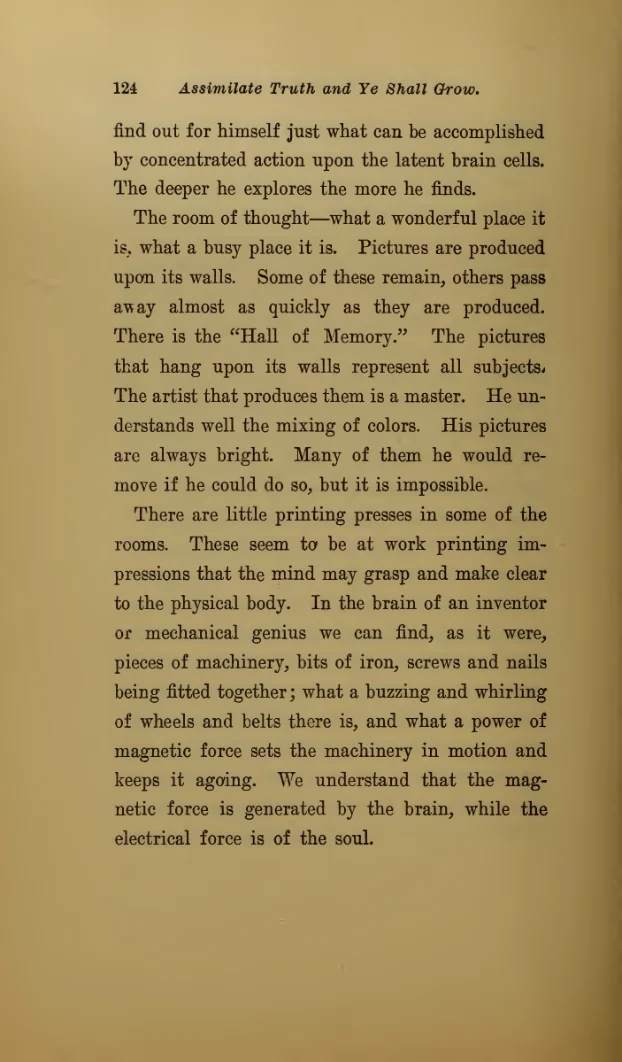
Celestion Study of Man (1903), printed p. 124, Library Reader page 121. The Hall of Memory appears amid rooms of thought and imagined printing presses.
Lumitheca Library, edition IMJ-0055-E001. Public-domain 1903 text and page image; extracted from the checksum-verified retained scan. · Image source ↗ · Public Domain
See references (7)
- The Angels’ Diary and Celestion Study of Man, Reader page 119
- The Angels’ Diary and Celestion Study of Man, Reader page 120
- The Angels’ Diary and Celestion Study of Man, Reader page 121
- The Angels’ Diary and Celestion Study of Man, Reader page 125
- The Angels’ Diary and Celestion Study of Man, Reader page 126
- The Angels’ Diary and Celestion Study of Man, Reader page 127
- The Angels’ Diary and Celestion Study of Man, Denver, 1903
Heaven and Its Wonders and Hell by Emanuel Swedenborg
Emanuel Swedenborg’s Heaven and Its Wonders and Hell describes a disclosure of conduct from a person’s own memory. Places, faces, conversations and intentions are said to become visible in detail. He distinguishes an outward memory from a deeper record inscribed upon the spiritual person, using the biblical book of life to express that continuity. [8][9][10][11][12]
See references (5)
- Heaven and Its Wonders and Hell, printed p. 401, Reader page 408
- Heaven and Its Wonders and Hell, printed p. 402, Reader page 409
- Heaven and Its Wonders and Hell, printed p. 403, Reader page 410
- Heaven and Its Wonders and Hell, printed p. 404, Reader page 411
- Heaven and Its Wonders and Hell, printed p. 405, Reader page 412
When the past becomes visible
A life review also makes earlier experience present, but the two books stage that encounter differently. Celestion begins with an inward journey during life. Swedenborg describes conduct and intentions being disclosed after death. The first image emphasises what a person can find within, the second what their life reveals. [2][3][5][6][8][9][10][11][12]
The pictures also serve a different purpose from a thought-form. In the hall, an image stands for an experience that remains part of an individual’s memory. The emphasis falls on what is retained. [3][7][4][5]
See references (11)
- The Angels’ Diary and Celestion Study of Man, Reader page 120
- The Angels’ Diary and Celestion Study of Man, Reader page 121
- The Angels’ Diary and Celestion Study of Man, Reader page 125
- The Angels’ Diary and Celestion Study of Man, Reader page 126
- The Angels’ Diary and Celestion Study of Man, Reader page 127
- The Angels’ Diary and Celestion Study of Man, Reader page 123
- Heaven and Its Wonders and Hell, printed p. 401, Reader page 408
- Heaven and Its Wonders and Hell, printed p. 402, Reader page 409
- Heaven and Its Wonders and Hell, printed p. 403, Reader page 410
- Heaven and Its Wonders and Hell, printed p. 404, Reader page 411
- Heaven and Its Wonders and Hell, printed p. 405, Reader page 412
Read further in the library
The Angels’ Diary and Celestion Study of Man
Reading note
The 1903 volume supplies the distinct teaching or narrated experience discussed in the attributed account, with exact Library page references.

Heaven and Its Wonders and Hell
Reading note
Hidden actions and motives are disclosed from a person’s own internal memory.
Sources
See references (13)
- The Angels’ Diary and Celestion Study of Man, Reader page 119Effie M. Shirey and Charles Samson, The Angels’ Diary and Celestion Study of Man (1903), communicated through Elizabeth Maud Weatherhead according to the volume’s acknowledgment. Accounts below refer to the exact retained Library edition IMJ-0055-E001.Read this page in The Angels’ Diary and Celestion Study of Man ↗Return to text ↑
- The Angels’ Diary and Celestion Study of Man, Reader page 120Effie M. Shirey and Charles Samson, The Angels’ Diary and Celestion Study of Man (1903), communicated through Elizabeth Maud Weatherhead according to the volume’s acknowledgment. Accounts below refer to the exact retained Library edition IMJ-0055-E001.Read this page in The Angels’ Diary and Celestion Study of Man ↗Return to text ↑
- The Angels’ Diary and Celestion Study of Man, Reader page 121Effie M. Shirey and Charles Samson, The Angels’ Diary and Celestion Study of Man (1903), communicated through Elizabeth Maud Weatherhead according to the volume’s acknowledgment. Accounts below refer to the exact retained Library edition IMJ-0055-E001.Read this page in The Angels’ Diary and Celestion Study of Man ↗Return to text ↑
- The Angels’ Diary and Celestion Study of Man, Reader page 125Effie M. Shirey and Charles Samson, The Angels’ Diary and Celestion Study of Man (1903), communicated through Elizabeth Maud Weatherhead according to the volume’s acknowledgment. Accounts below refer to the exact retained Library edition IMJ-0055-E001.Read this page in The Angels’ Diary and Celestion Study of Man ↗Return to text ↑
- The Angels’ Diary and Celestion Study of Man, Reader page 126Effie M. Shirey and Charles Samson, The Angels’ Diary and Celestion Study of Man (1903), communicated through Elizabeth Maud Weatherhead according to the volume’s acknowledgment. Accounts below refer to the exact retained Library edition IMJ-0055-E001.Read this page in The Angels’ Diary and Celestion Study of Man ↗Return to text ↑
- The Angels’ Diary and Celestion Study of Man, Reader page 127Effie M. Shirey and Charles Samson, The Angels’ Diary and Celestion Study of Man (1903), communicated through Elizabeth Maud Weatherhead according to the volume’s acknowledgment. Accounts below refer to the exact retained Library edition IMJ-0055-E001.Read this page in The Angels’ Diary and Celestion Study of Man ↗Return to text ↑
- The Angels’ Diary and Celestion Study of Man, Reader page 123Effie M. Shirey and Charles Samson, The Angels’ Diary and Celestion Study of Man (1903), communicated through Elizabeth Maud Weatherhead according to the volume’s acknowledgment. Accounts below refer to the exact retained Library edition IMJ-0055-E001.Read this page in The Angels’ Diary and Celestion Study of Man ↗Return to text ↑
- Heaven and Its Wonders and Hell, printed p. 401, Reader page 408Emanuel Swedenborg, Heaven and Its Wonders and Hell, translated by J. C. Ager. The American Swedenborg Printing and Publishing Society, New York, 1916. Original Latin work first published in 1758.Read this page in Heaven and Its Wonders and Hell ↗Return to text ↑
- Heaven and Its Wonders and Hell, printed p. 402, Reader page 409Emanuel Swedenborg, Heaven and Its Wonders and Hell, translated by J. C. Ager. The American Swedenborg Printing and Publishing Society, New York, 1916. Original Latin work first published in 1758.Read this page in Heaven and Its Wonders and Hell ↗Return to text ↑
- Heaven and Its Wonders and Hell, printed p. 403, Reader page 410Emanuel Swedenborg, Heaven and Its Wonders and Hell, translated by J. C. Ager. The American Swedenborg Printing and Publishing Society, New York, 1916. Original Latin work first published in 1758.Read this page in Heaven and Its Wonders and Hell ↗Return to text ↑
- Heaven and Its Wonders and Hell, printed p. 404, Reader page 411Emanuel Swedenborg, Heaven and Its Wonders and Hell, translated by J. C. Ager. The American Swedenborg Printing and Publishing Society, New York, 1916. Original Latin work first published in 1758.Read this page in Heaven and Its Wonders and Hell ↗Return to text ↑
- Heaven and Its Wonders and Hell, printed p. 405, Reader page 412Emanuel Swedenborg, Heaven and Its Wonders and Hell, translated by J. C. Ager. The American Swedenborg Printing and Publishing Society, New York, 1916. Original Latin work first published in 1758.Read this page in Heaven and Its Wonders and Hell ↗Return to text ↑
- The Angels’ Diary and Celestion Study of Man, Denver, 1903 ↗Library of Congress catalogue and preface note.Return to text ↑