The Soul-Dynamo
The soul-dynamo is Celestion Study of Man’s image for the soul’s power behind thought. See how the book compares the brain to a printing press.
In this article
Understanding the soul-dynamo
The soul-dynamo is an image in Celestion Study of Man for the power the soul is said to supply to thought. The brain is the instrument that gives impressions a form. The soul is what gives the instrument life and creative force. [1][2]
The book uses two images to explain the relationship. A printing press gives an impression an outward form. A temple with inner rooms shows how, in this account, attention can travel beyond what a person usually notices. [3][1][2]
The Angels’ Diary and Celestion Study of Man
The volume attributes the material to Effie M. Shirey and Charles Samson as spirit communications, with Elizabeth Maud Weatherhead credited as the medium. The chapter opens with the brain as a printing press. The press expresses its own impressions as well as those of the soul. The soul is the power behind the press, which the chapter calls the dynamo of thought. [1][2][8]
The chapter continues an imagined journey through the body as a temple. Beyond the familiar rooms of the brain lies another chamber, entered through concentration. There the observer is said to encounter the creation of thought, spiritual laws and communication with angelic friends. Machinery explains expression; the temple gives inward attention a sacred destination. [4][1][2]
To distinguish kinds of impression, the text contrasts a fleeting visual afterimage with an image deliberately recalled through effort. It then describes a deeper inward picture associated with a lasting emotional experience. The sequence moves from immediate sensation to recollection and then to what the author calls the mind of the soul. [2][5][6]
The last distinction gives the metaphor its importance for immortality. Brain impressions are linked to changing bodily tissue, whereas deeply impressed experiences are said to remain in the subconscious mind and pass with the person into another life. The dynamo thus belongs to a theory of survival as well as a theory of thought. [5][6][7]
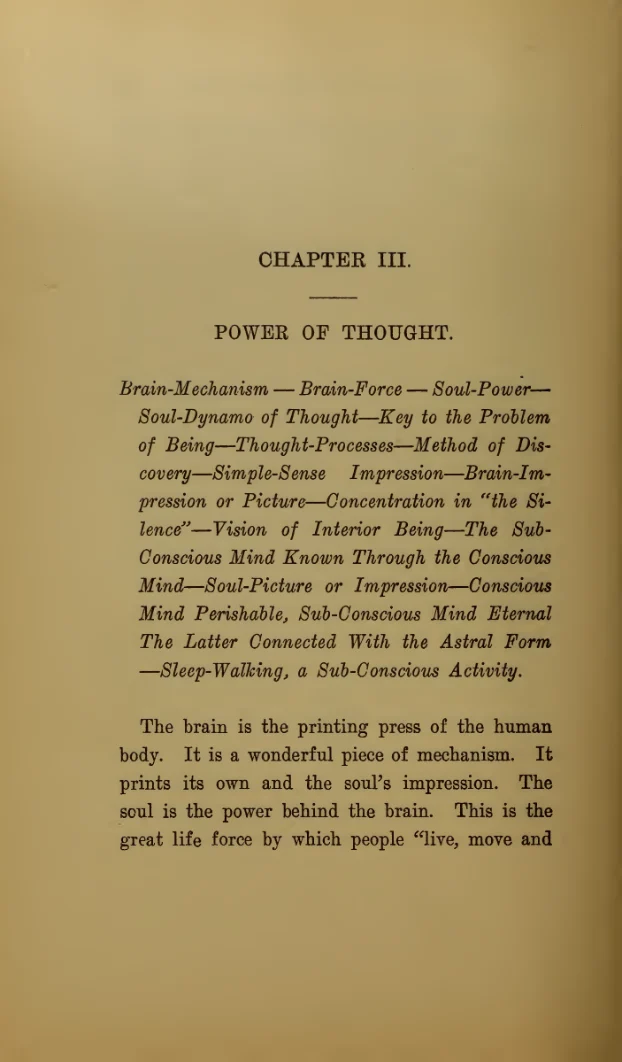
Opening of “Power of Thought” in Celestion Study of Man (1903), Library Reader page 123. The chapter outline calls the soul the dynamo of thought.
Lumitheca Library, edition IMJ-0055-E001. Public-domain 1903 text and page image; extracted from the checksum-verified retained scan. · Image source ↗ · Public Domain
See references (7)
- The Angels’ Diary and Celestion Study of Man, Reader page 123
- The Angels’ Diary and Celestion Study of Man, Reader page 124
- The Angels’ Diary and Celestion Study of Man, Reader page 120
- The Angels’ Diary and Celestion Study of Man, Reader page 125
- The Angels’ Diary and Celestion Study of Man, Reader page 126
- The Angels’ Diary and Celestion Study of Man, Reader page 127
- The Angels’ Diary and Celestion Study of Man, Denver, 1903
Making an impression and keeping it
The Hall of Memory pictures what stays with a person after an impression is made. The soul-dynamo explains where the power to form or express an impression is supposed to come from. The gallery and the machine give memory and thought different roles. [3][1][2]
The press, dynamo and temple come from different parts of life in 1903. In the chapter they work together: the press explains expression, the dynamo explains power and the temple gives inward attention somewhere to go. [3][1][2][7][9]
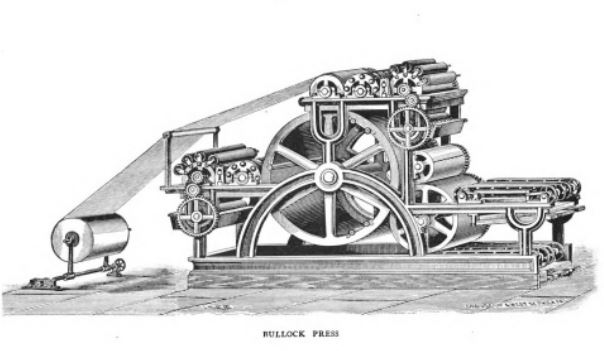
Bullock rotary press, illustrated in Robert Hoe’s A Short History of the Printing Press (1902). It shows the kind of machinery readers of Celestion Study of Man could picture when the book described thought as printing an impression.
Robert Hoe, A Short History of the Printing Press (1902). Historical illustration reproduced by the Library of Congress from HathiTrust. · Image source ↗ · Public Domain
See references (5)
- The Angels’ Diary and Celestion Study of Man, Reader page 123
- The Angels’ Diary and Celestion Study of Man, Reader page 124
- The Angels’ Diary and Celestion Study of Man, Reader page 121
- The Angels’ Diary and Celestion Study of Man, Reader page 127
- Bullock press, illustrated in Robert Hoe’s A Short History of the Printing Press, 1902
Read further in the library
The Angels’ Diary and Celestion Study of Man
Reading note
The 1903 volume supplies the distinct teaching or narrated experience discussed in the attributed account, with exact Library page references.
Sources
See references (9)
- The Angels’ Diary and Celestion Study of Man, Reader page 123Effie M. Shirey and Charles Samson, The Angels’ Diary and Celestion Study of Man (1903), communicated through Elizabeth Maud Weatherhead according to the volume’s acknowledgment. Accounts below refer to the exact retained Library edition IMJ-0055-E001.Read this page in The Angels’ Diary and Celestion Study of Man ↗Return to text ↑
- The Angels’ Diary and Celestion Study of Man, Reader page 124Effie M. Shirey and Charles Samson, The Angels’ Diary and Celestion Study of Man (1903), communicated through Elizabeth Maud Weatherhead according to the volume’s acknowledgment. Accounts below refer to the exact retained Library edition IMJ-0055-E001.Read this page in The Angels’ Diary and Celestion Study of Man ↗Return to text ↑
- The Angels’ Diary and Celestion Study of Man, Reader page 121Effie M. Shirey and Charles Samson, The Angels’ Diary and Celestion Study of Man (1903), communicated through Elizabeth Maud Weatherhead according to the volume’s acknowledgment. Accounts below refer to the exact retained Library edition IMJ-0055-E001.Read this page in The Angels’ Diary and Celestion Study of Man ↗Return to text ↑
- The Angels’ Diary and Celestion Study of Man, Reader page 120Effie M. Shirey and Charles Samson, The Angels’ Diary and Celestion Study of Man (1903), communicated through Elizabeth Maud Weatherhead according to the volume’s acknowledgment. Accounts below refer to the exact retained Library edition IMJ-0055-E001.Read this page in The Angels’ Diary and Celestion Study of Man ↗Return to text ↑
- The Angels’ Diary and Celestion Study of Man, Reader page 125Effie M. Shirey and Charles Samson, The Angels’ Diary and Celestion Study of Man (1903), communicated through Elizabeth Maud Weatherhead according to the volume’s acknowledgment. Accounts below refer to the exact retained Library edition IMJ-0055-E001.Read this page in The Angels’ Diary and Celestion Study of Man ↗Return to text ↑
- The Angels’ Diary and Celestion Study of Man, Reader page 126Effie M. Shirey and Charles Samson, The Angels’ Diary and Celestion Study of Man (1903), communicated through Elizabeth Maud Weatherhead according to the volume’s acknowledgment. Accounts below refer to the exact retained Library edition IMJ-0055-E001.Read this page in The Angels’ Diary and Celestion Study of Man ↗Return to text ↑
- The Angels’ Diary and Celestion Study of Man, Reader page 127Effie M. Shirey and Charles Samson, The Angels’ Diary and Celestion Study of Man (1903), communicated through Elizabeth Maud Weatherhead according to the volume’s acknowledgment. Accounts below refer to the exact retained Library edition IMJ-0055-E001.Read this page in The Angels’ Diary and Celestion Study of Man ↗Return to text ↑
- The Angels’ Diary and Celestion Study of Man, Denver, 1903 ↗Library of Congress catalogue and preface note.Return to text ↑
- Bullock press, illustrated in Robert Hoe’s A Short History of the Printing Press, 1902 ↗Robert Hoe, A Short History of the Printing Press (1902). Historical illustration reproduced by the Library of Congress from HathiTrust.Return to text ↑