Spiritual sound
Spiritual sound can mean an inward hearing or a form attributed to performed music. Compare Arundale’s song of Kundalini with the plates in Thought-Forms.
In this article
Understanding the concept
Spiritual sound is sound understood as an expression of spiritual life. It can be described as an inward hearing, or as an effect of audible music believed to persist beyond what the ear can hear. [4][5][6][7]
Kundalini: An Occult Experience by George S. Arundale
George S. Arundale describes Kundalini as a blending of colour and sound. A single song can hold the experience of an entire life. He declines to assign it a universal note, since each person is supposed to receive what he calls colour-sound in their own way. [4][5][8]
Arundale imagines the Earth answering the Sun in song. A student is supposed to discover the same unity of life inwardly as a song with innumerable notes. The passage eventually reaches a stillness that retains a nearly imperceptible throb. [9][6][10][7]
See references (7)
- Kundalini: An Occult Experience, Reader page 97
- Kundalini: An Occult Experience, printed p. 96, Reader page 98
- Kundalini: An Occult Experience, printed p. 98, Reader page 100
- Kundalini: An Occult Experience, printed p. 100, Reader page 102
- Kundalini: An Occult Experience, printed p. 5, Reader page 21
- Kundalini: An Occult Experience, printed p. 97, Reader page 99
- Kundalini: An Occult Experience, Reader page 101
Thought-Forms by Annie Besant and C. W. Leadbeater
Annie Besant and Charles Webster Leadbeater place a church beneath each of the three music forms at the end of Thought-Forms. The church gives a scale for the narrow bands they assign to Mendelssohn, the brighter clusters of Gounod and the larger, denser form of Wagner. They present the paintings as representations of forms they believed performed music had produced. [1][2][3]
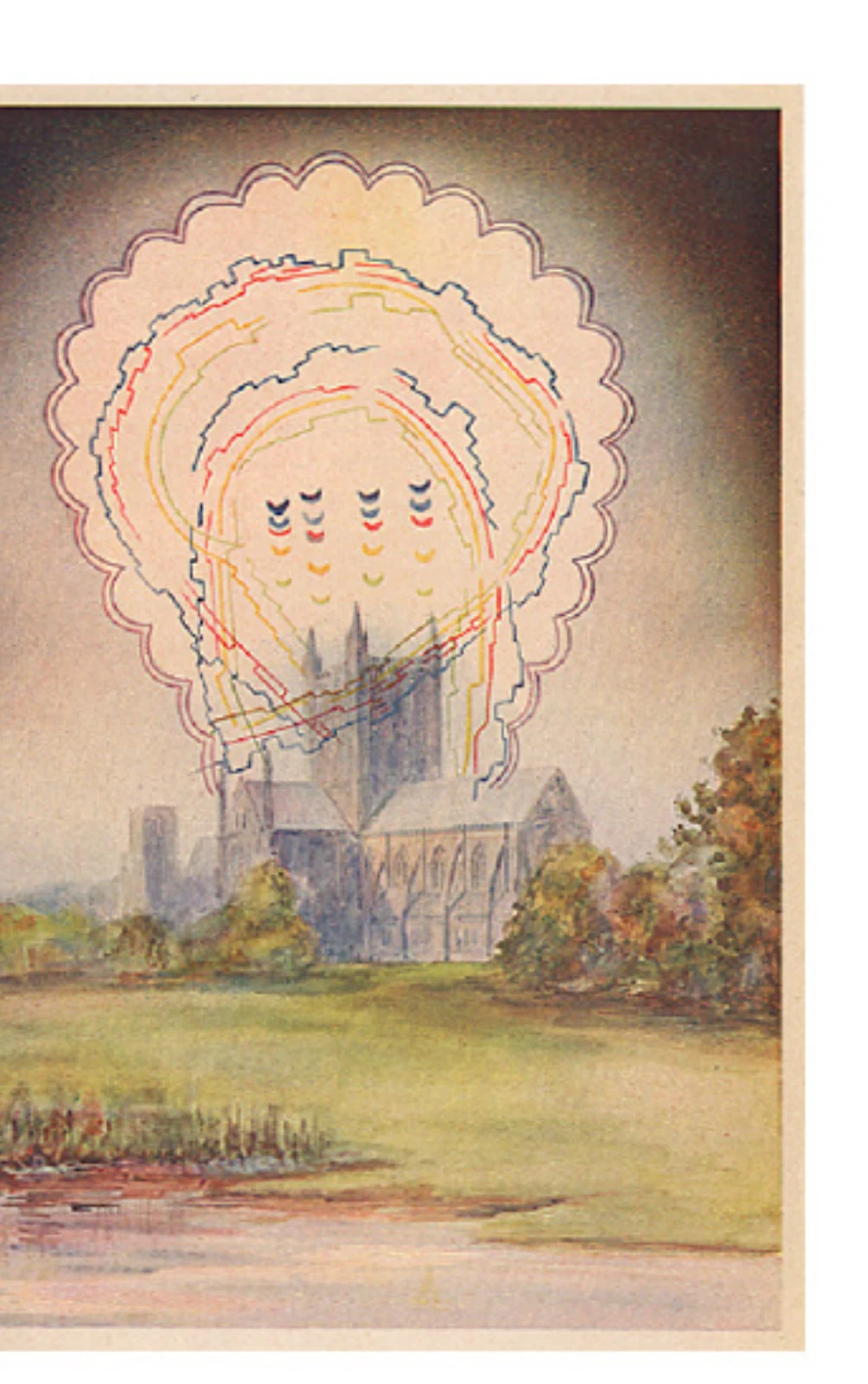
Plate M, Mendelssohn. Thin bands rise above the church in the form that Besant and Leadbeater attribute to the performance.
Annie Besant and C. W. Leadbeater, Thought-Forms, consulted Library edition (1905). · Image source ↗ · Public Domain

Plate G, Gounod. A bright, compact cluster fills the sky above the church.
Annie Besant and C. W. Leadbeater, Thought-Forms, consulted Library edition (1905). · Image source ↗ · Public Domain
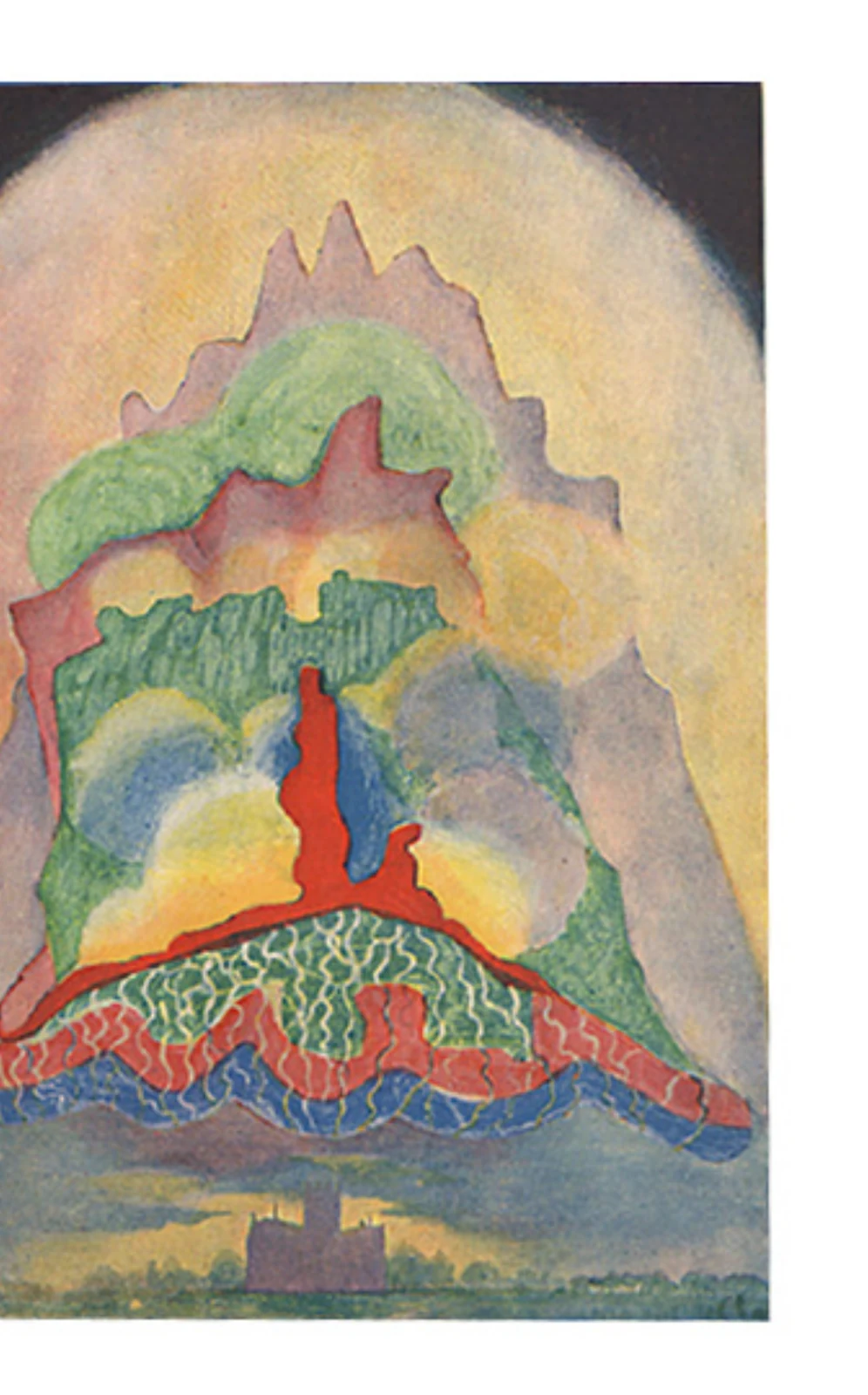
Plate W, Wagner. The form towers above the church in broad, dense bands of colour.
Annie Besant and C. W. Leadbeater, Thought-Forms, consulted Library edition (1905). · Image source ↗ · Public Domain
An inward song and the forms of performed music
The Thought-Forms plates begin with particular performances in an ordinary setting. Arundale begins with inward experience and uses a song to describe a unity he believes reaches beyond any single listener. His refusal to assign a single note gives the language of music a different role from the named composers in the plates. [1][2][3][4][5][6][10][7]
See references (8)
- Thought-Forms, Reader page 61
- Thought-Forms, Reader page 63
- Thought-Forms, Reader page 65
- Kundalini: An Occult Experience, Reader page 97
- Kundalini: An Occult Experience, printed p. 96, Reader page 98
- Kundalini: An Occult Experience, printed p. 98, Reader page 100
- Kundalini: An Occult Experience, printed p. 100, Reader page 102
- Kundalini: An Occult Experience, Reader page 101
Read further in the library
Thought-Forms
Reading note
Separately attributed primary Library account, cited on exact verified Reader leaves.

Kundalini: An Occult Experience
Reading note
The separately titled account draws on exact passages in the consulted Library edition.
Sources
See references (10)
- Thought-Forms, Reader page 61Exact source retained from the earlier attributed Thought-forms account.Read this page in Thought-Forms ↗Return to text ↑
- Thought-Forms, Reader page 63Exact source retained from the earlier attributed Thought-forms account.Read this page in Thought-Forms ↗Return to text ↑
- Thought-Forms, Reader page 65Exact source retained from the earlier attributed Thought-forms account.Read this page in Thought-Forms ↗Return to text ↑
- Kundalini: An Occult Experience, Reader page 97George S. Arundale, Kundalini: An Occult Experience, The Theosophical Publishing House, Adyar, Madras, India, 1938. Consulted Library edition IMJ-0227-E001.Read this page in Kundalini: An Occult Experience ↗Return to text ↑
- Kundalini: An Occult Experience, printed p. 96, Reader page 98George S. Arundale, Kundalini: An Occult Experience, The Theosophical Publishing House, Adyar, Madras, India, 1938. Consulted Library edition IMJ-0227-E001.Read this page in Kundalini: An Occult Experience ↗Return to text ↑
- Kundalini: An Occult Experience, printed p. 98, Reader page 100George S. Arundale, Kundalini: An Occult Experience, The Theosophical Publishing House, Adyar, Madras, India, 1938. Consulted Library edition IMJ-0227-E001.Read this page in Kundalini: An Occult Experience ↗Return to text ↑
- Kundalini: An Occult Experience, printed p. 100, Reader page 102George S. Arundale, Kundalini: An Occult Experience, The Theosophical Publishing House, Adyar, Madras, India, 1938. Consulted Library edition IMJ-0227-E001.Read this page in Kundalini: An Occult Experience ↗Return to text ↑
- Kundalini: An Occult Experience, printed p. 5, Reader page 21George S. Arundale, Kundalini: An Occult Experience, The Theosophical Publishing House, Adyar, Madras, India, 1938. Consulted Library edition IMJ-0227-E001.Read this page in Kundalini: An Occult Experience ↗Return to text ↑
- Kundalini: An Occult Experience, printed p. 97, Reader page 99George S. Arundale, Kundalini: An Occult Experience, The Theosophical Publishing House, Adyar, Madras, India, 1938. Consulted Library edition IMJ-0227-E001.Read this page in Kundalini: An Occult Experience ↗Return to text ↑
- Kundalini: An Occult Experience, Reader page 101George S. Arundale, Kundalini: An Occult Experience, The Theosophical Publishing House, Adyar, Madras, India, 1938. Consulted Library edition IMJ-0227-E001.Read this page in Kundalini: An Occult Experience ↗Return to text ↑