Spiritual colour perception
Spiritual colour can mean a felt quality, a painted representation or a symbolic label. Compare Steiner, Thought-Forms, Babbitt and Arundale.
In this article
Colour beyond ordinary sight
Understanding the concept
Spiritual colour perception is an experience that some esoteric writers describe in terms of colour while locating it outside ordinary sight. A colour can name a quality of experience, such as something that feels like blue. A book may then use ink or paint to represent it, or use a colour simply to distinguish one item in a diagram from another. [4][5][6]
Knowledge of the Higher Worlds by Rudolf Steiner
Rudolf Steiner warns that ordinary terms such as light and dark are approximate descriptions of what he means by spiritual perception. In the seed exercise he describes a lilac centre and a blue edge. The point becomes clearer when he explains that the experience resembles the feeling evoked by seeing a colour with physical eyes. [4][7][8][5]
He uses colour again when describing desires and thoughts in the astral body. A noble thought has a reddish-violet radiance in his description, and logical thinking has a sharply outlined yellowish form. A footnote cautions the reader against equating a colour vision with the spiritual experience he intends. [6]
Steiner also lays down a rule for his exercise concerning other people’s desires. Whatever the student claims to perceive, the person retains dignity, liberty and an inward life. He asks students to preserve that respect and use judgement about where their impressions come from. [9][10][11][5][12]
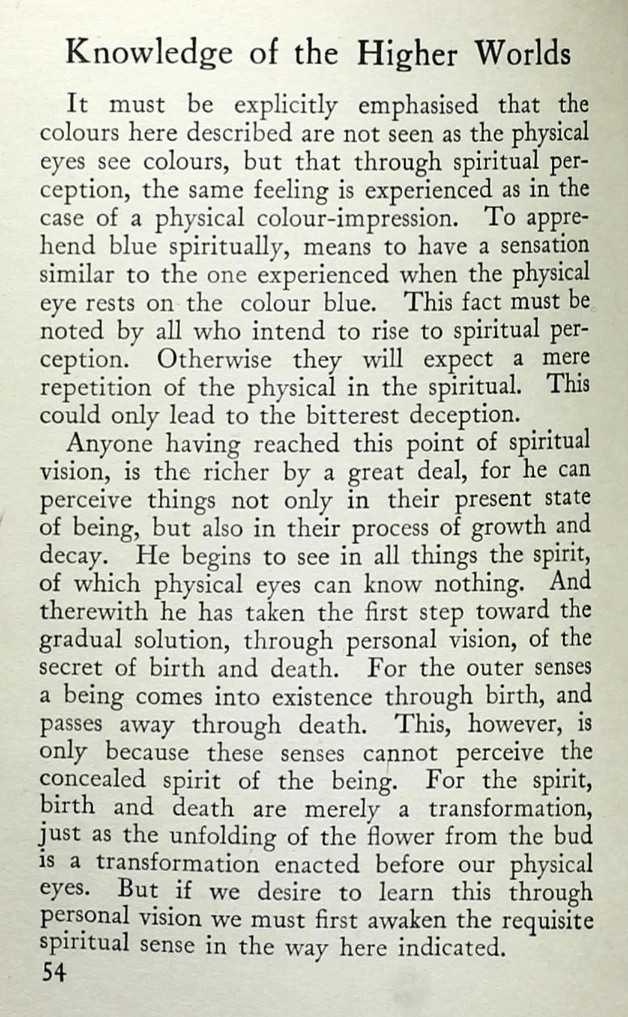
Steiner compares spiritual colour to the feeling evoked by ordinary colour. Knowledge of the Higher Worlds, printed p. 54, Library reader p. 58.
Rudolf Steiner, G. Metaxa translation, edited by Harry Collison. Historical public-domain source facsimile from the exact checksum-verified Library edition. Repository date 1932; the inspected title page is undated. · Image source ↗ · Public Domain
See references (9)
- Knowledge of the Higher Worlds and Its Attainment, Reader page 47
- Knowledge of the Higher Worlds and Its Attainment, Reader page 58
- Knowledge of the Higher Worlds and Its Attainment, Reader page 112
- Knowledge of the Higher Worlds and Its Attainment, Reader page 55
- Knowledge of the Higher Worlds and Its Attainment, Reader page 57
- Knowledge of the Higher Worlds and Its Attainment, Reader page 61
- Knowledge of the Higher Worlds and Its Attainment, Reader page 63
- Knowledge of the Higher Worlds and Its Attainment, Reader page 56
- Knowledge of the Higher Worlds and Its Attainment, Reader page 59
Painting and diagrams
Thought-Forms by Annie Besant and C. W. Leadbeater
Annie Besant and Charles Webster Leadbeater use colour to express the quality of a thought, shape for its nature and sharpness of outline for its definiteness. In the foreword Besant credits the artists who translated the authors’ reported observations into drawings and paintings. The affection plates make that translation visible: differences in pigment and contour are used to distinguish motives. [2][3][1]
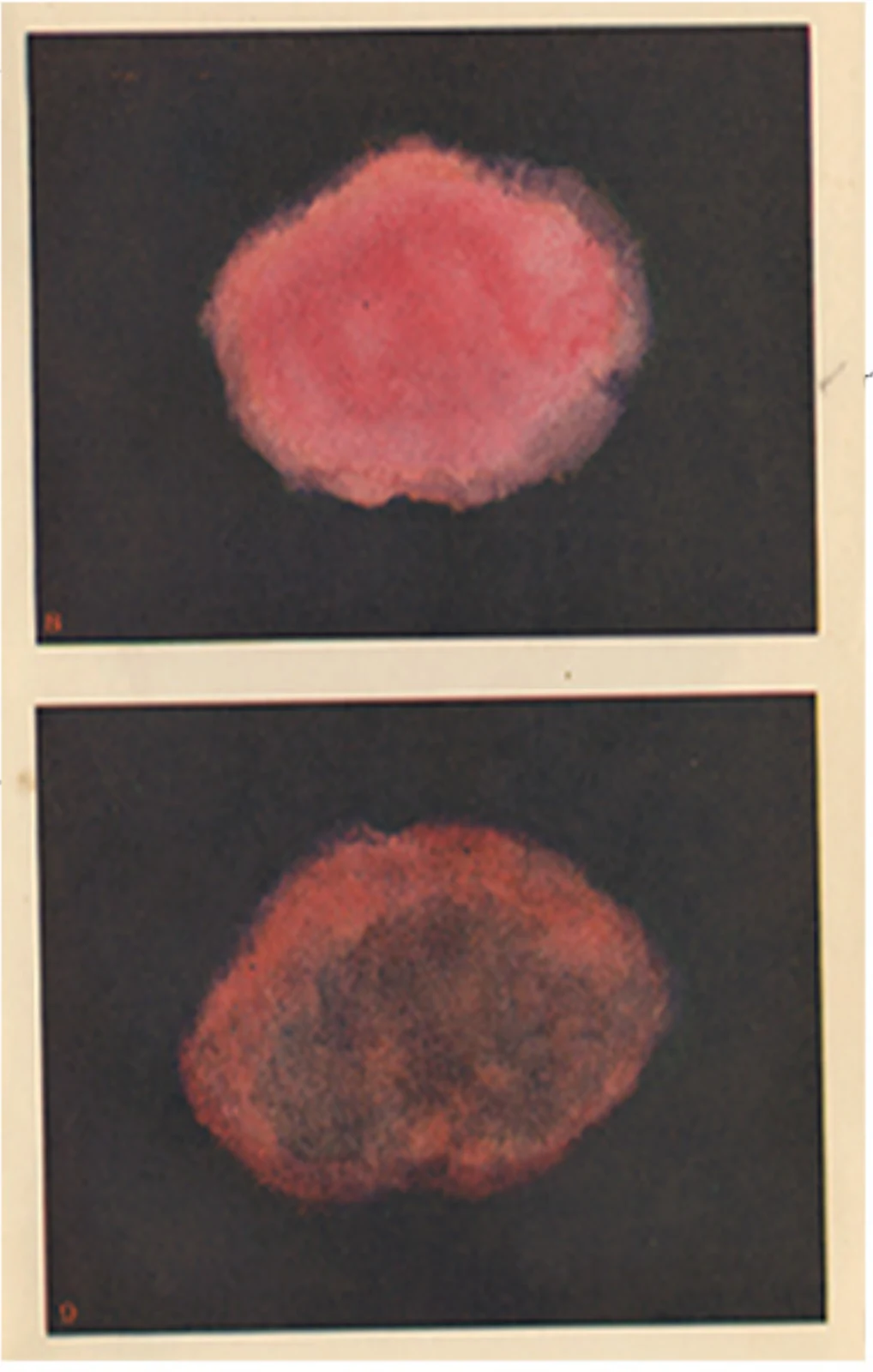
Figures 8 and 9 from Thought-Forms. Besant and Leadbeater interpret the brighter cloud as affection and the darker, muddier cloud as affection mixed with self-interest.
Annie Besant and C. W. Leadbeater, Thought-Forms (1901). Historical public-domain plate retained from the Library edition. The artists’ interpretation is part of the book’s account. · Image source ↗ · Public Domain
Man Visible and Invisible by Charles Webster Leadbeater
In Man Visible and Invisible, Charles Webster Leadbeater says the colours assigned to planes in his diagrams serve as distinguishing marks. He believes each higher plane contains many colours, including some unknown to ordinary sight. The diagram helps the reader identify a plane without specifying its prevailing colour. [19]
The Principles of Light and Color by Edwin D. Babbitt
Edwin D. Babbitt puts psychic colour beyond what he calls ordinary and odic light. He suggests that some of Reichenbach’s observers saw the beginning of this range. Plate IV maps purported psychic colours around a head. Babbitt credits Mrs. Merton’s description alongside his own observations and says the plate can only suggest their variety. [21][22][23][24]
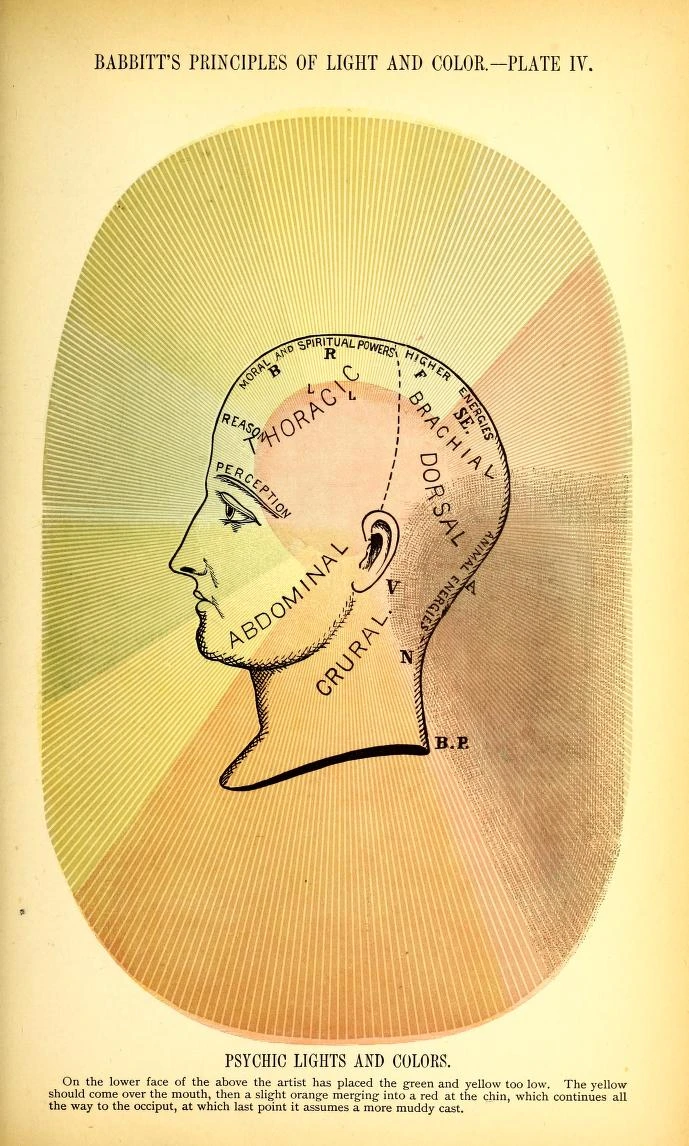
Plate IV in the 1878 edition maps purported psychic colours around a head. The Library’s 1896 edition reproduces the subject in monochrome.
Edwin D. Babbitt, The Principles of Light and Color, first edition (1878), Plate IV. Smithsonian Libraries and Archives. · Image source ↗ · CC0
Seeing and hearing in Kundalini
Kundalini: An Occult Experience by George S. Arundale
George S. Arundale imagines the Fire of Kundalini as both a rainbow and a song. The senses supply overlapping descriptions of what he takes to be one experience. He describes the Fire as crimson on one occasion and writes elsewhere that observers experience its colour and sound differently. [13][14][15][16][17]
Arundale extends the analogy to the Sun and the Earth. The Earth’s colour answers the Sun’s, and the colours of individual beings join in that response. Colour and sound become ways of imagining a shared life. [15][16]
See references (5)
Feeling, representation and diagram
Steiner compares spiritual colour to the feeling produced by a physical hue. Arundale brings colour and sound together to describe an experience that varies with the observer. Babbitt uses the position of coloured regions around the head to represent what he believes observers can see. Each account tells the reader what the term is supposed to describe. [1][2][3][5][6][11][10][18][14][23][25]
The thought-form plates give individual emotions shapes and colours through the authors’ key. Leadbeater’s diagram of planes uses colour for a different job, closer to the colours on a map. A painted red form in Thought-Forms and a red plane on a diagram have to be read through their respective captions. [2][3][14][15][19]
See references (13)
- Annie Besant’s foreword, original Library page, Reader page 4
- Thought-Forms, Reader page 23
- Thought-Forms, Reader page 25
- Knowledge of the Higher Worlds and Its Attainment, Reader page 58
- Knowledge of the Higher Worlds and Its Attainment, Reader page 112
- Knowledge of the Higher Worlds and Its Attainment, Reader page 63
- Knowledge of the Higher Worlds and Its Attainment, Reader page 56
- Kundalini: An Occult Experience, printed p. 96, Reader page 98
- Kundalini: An Occult Experience, printed p. 97, Reader page 99
- Kundalini: An Occult Experience, Reader page 15
- C. W. Leadbeater, Man Visible and Invisible (1903), “Man’s Vehicles,” printed p. 23
- The Principles of Light and Color, Reader page 485
- The Principles of Light and Color, printed p. 502, Reader page 511
Read further in the library

Thought-Forms
Reading note
Separately attributed primary Library account, cited on exact verified Reader leaves.

Knowledge of the Higher Worlds and Its Attainment
Reading note
The separately titled account draws on exact passages in the consulted Library edition.

Kundalini: An Occult Experience
Reading note
The separately titled account draws on exact passages in the consulted Library edition.

Man Visible and Invisible
Reading note
Selected passages and plates compared in a distinct 1903 John Lane scan. Exact external PDF leaves are cited; Library PageRefs are not inferred.

The Principles of Light and Color
Reading note
The separately titled account draws on exact passages in the consulted Library edition.
Sources
See references (25)
- Annie Besant’s foreword, original Library page, Reader page 4Exact source retained from the earlier attributed Thought-forms account.Read this page in Thought-Forms ↗Return to text ↑
- Thought-Forms, Reader page 23Exact source retained from the earlier attributed Thought-forms account.Read this page in Thought-Forms ↗Return to text ↑
- Thought-Forms, Reader page 25Exact source retained from the earlier attributed Thought-forms account.Read this page in Thought-Forms ↗Return to text ↑
- Knowledge of the Higher Worlds and Its Attainment, Reader page 47Rudolf Steiner, Knowledge of the Higher Worlds and Its Attainment, authorized English translation by G. Metaxa, edited by Harry Collison, Anthroposophic Press, New York City. Exact Library edition IMJ-0513-E001. No publication year is visible on the inspected title page; the repository assigns 1932. Claims of supersensible perception remain attributed to Steiner.Read this page in Knowledge of the Higher Worlds and Its Attainment ↗Return to text ↑
- Knowledge of the Higher Worlds and Its Attainment, Reader page 58Rudolf Steiner, Knowledge of the Higher Worlds and Its Attainment, authorized English translation by G. Metaxa, edited by Harry Collison, Anthroposophic Press, New York City. Exact Library edition IMJ-0513-E001. No publication year is visible on the inspected title page; the repository assigns 1932. Claims of supersensible perception remain attributed to Steiner.Read this page in Knowledge of the Higher Worlds and Its Attainment ↗Return to text ↑
- Knowledge of the Higher Worlds and Its Attainment, Reader page 112Rudolf Steiner, Knowledge of the Higher Worlds and Its Attainment, authorized English translation by G. Metaxa, edited by Harry Collison, Anthroposophic Press, New York City. Exact Library edition IMJ-0513-E001. No publication year is visible on the inspected title page; the repository assigns 1932. Claims of supersensible perception remain attributed to Steiner.Read this page in Knowledge of the Higher Worlds and Its Attainment ↗Return to text ↑
- Knowledge of the Higher Worlds and Its Attainment, Reader page 55Rudolf Steiner, Knowledge of the Higher Worlds and Its Attainment, authorized English translation by G. Metaxa, edited by Harry Collison, Anthroposophic Press, New York City. Exact Library edition IMJ-0513-E001. No publication year is visible on the inspected title page; the repository assigns 1932. Claims of supersensible perception remain attributed to Steiner.Read this page in Knowledge of the Higher Worlds and Its Attainment ↗Return to text ↑
- Knowledge of the Higher Worlds and Its Attainment, Reader page 57Rudolf Steiner, Knowledge of the Higher Worlds and Its Attainment, authorized English translation by G. Metaxa, edited by Harry Collison, Anthroposophic Press, New York City. Exact Library edition IMJ-0513-E001. No publication year is visible on the inspected title page; the repository assigns 1932. Claims of supersensible perception remain attributed to Steiner.Read this page in Knowledge of the Higher Worlds and Its Attainment ↗Return to text ↑
- Knowledge of the Higher Worlds and Its Attainment, Reader page 61Rudolf Steiner, Knowledge of the Higher Worlds and Its Attainment, authorized English translation by G. Metaxa, edited by Harry Collison, Anthroposophic Press, New York City. Exact Library edition IMJ-0513-E001. No publication year is visible on the inspected title page; the repository assigns 1932. Claims of supersensible perception remain attributed to Steiner.Read this page in Knowledge of the Higher Worlds and Its Attainment ↗Return to text ↑
- Knowledge of the Higher Worlds and Its Attainment, Reader page 63Rudolf Steiner, Knowledge of the Higher Worlds and Its Attainment, authorized English translation by G. Metaxa, edited by Harry Collison, Anthroposophic Press, New York City. Exact Library edition IMJ-0513-E001. No publication year is visible on the inspected title page; the repository assigns 1932. Claims of supersensible perception remain attributed to Steiner.Read this page in Knowledge of the Higher Worlds and Its Attainment ↗Return to text ↑
- Knowledge of the Higher Worlds and Its Attainment, Reader page 56Rudolf Steiner, Knowledge of the Higher Worlds and Its Attainment, authorized English translation by G. Metaxa, edited by Harry Collison, Anthroposophic Press, New York City. Exact Library edition IMJ-0513-E001. No publication year is visible on the inspected title page; the repository assigns 1932. Claims of supersensible perception remain attributed to Steiner.Read this page in Knowledge of the Higher Worlds and Its Attainment ↗Return to text ↑
- Knowledge of the Higher Worlds and Its Attainment, Reader page 59Rudolf Steiner, Knowledge of the Higher Worlds and Its Attainment, authorized English translation by G. Metaxa, edited by Harry Collison, Anthroposophic Press, New York City. Exact Library edition IMJ-0513-E001. No publication year is visible on the inspected title page; the repository assigns 1932. Claims of supersensible perception remain attributed to Steiner.Read this page in Knowledge of the Higher Worlds and Its Attainment ↗Return to text ↑
- Kundalini: An Occult Experience, Reader page 97George S. Arundale, Kundalini: An Occult Experience, The Theosophical Publishing House, Adyar, Madras, India, 1938. Consulted Library edition IMJ-0227-E001.Read this page in Kundalini: An Occult Experience ↗Return to text ↑
- Kundalini: An Occult Experience, printed p. 96, Reader page 98George S. Arundale, Kundalini: An Occult Experience, The Theosophical Publishing House, Adyar, Madras, India, 1938. Consulted Library edition IMJ-0227-E001.Read this page in Kundalini: An Occult Experience ↗Return to text ↑
- Kundalini: An Occult Experience, printed p. 97, Reader page 99George S. Arundale, Kundalini: An Occult Experience, The Theosophical Publishing House, Adyar, Madras, India, 1938. Consulted Library edition IMJ-0227-E001.Read this page in Kundalini: An Occult Experience ↗Return to text ↑
- Kundalini: An Occult Experience, printed p. 98, Reader page 100George S. Arundale, Kundalini: An Occult Experience, The Theosophical Publishing House, Adyar, Madras, India, 1938. Consulted Library edition IMJ-0227-E001.Read this page in Kundalini: An Occult Experience ↗Return to text ↑
- Kundalini: An Occult Experience, printed p. 71, Reader page 73George S. Arundale, Kundalini: An Occult Experience, The Theosophical Publishing House, Adyar, Madras, India, 1938. Consulted Library edition IMJ-0227-E001.Read this page in Kundalini: An Occult Experience ↗Return to text ↑
- Kundalini: An Occult Experience, Reader page 15George S. Arundale, Kundalini: An Occult Experience, The Theosophical Publishing House, Adyar, Madras, India, 1938. Consulted Library edition IMJ-0227-E001.Read this page in Kundalini: An Occult Experience ↗Return to text ↑
- C. W. Leadbeater, Man Visible and Invisible (1903), “Man’s Vehicles,” printed p. 23 ↗Charles Webster Leadbeater, Man Visible and Invisible, New York: John Lane, 1903. Exact separately consulted PDF leaf; this scan is distinct from the Library edition.Return to text ↑
- The Principles of Light and Color, 1878, Plate IV ↗Edwin D. Babbitt, The Principles of Light and Color, first edition (1878), Plate IV. Smithsonian Libraries and Archives.
- The Principles of Light and Color, printed p. 446, Reader page 454Edwin D. Babbitt, The Principles of Light and Color, second edition, College of Fine Forces, East Orange, New Jersey, 1896. Lumitheca Library edition IMJ-0607-E001.Read this page in The Principles of Light and Color ↗Return to text ↑
- The Principles of Light and Color, printed p. 450, Reader page 458Edwin D. Babbitt, The Principles of Light and Color, second edition, College of Fine Forces, East Orange, New Jersey, 1896. Lumitheca Library edition IMJ-0607-E001.Read this page in The Principles of Light and Color ↗Return to text ↑
- The Principles of Light and Color, Reader page 485Edwin D. Babbitt, The Principles of Light and Color, second edition, College of Fine Forces, East Orange, New Jersey, 1896. Lumitheca Library edition IMJ-0607-E001.Read this page in The Principles of Light and Color ↗Return to text ↑
- The Principles of Light and Color, printed p. 477, Reader page 486Edwin D. Babbitt, The Principles of Light and Color, second edition, College of Fine Forces, East Orange, New Jersey, 1896. Lumitheca Library edition IMJ-0607-E001.Read this page in The Principles of Light and Color ↗Return to text ↑
- The Principles of Light and Color, printed p. 502, Reader page 511Edwin D. Babbitt, The Principles of Light and Color, second edition, College of Fine Forces, East Orange, New Jersey, 1896. Lumitheca Library edition IMJ-0607-E001.Read this page in The Principles of Light and Color ↗Return to text ↑