Books in the spirit world
What do Spiritualist books say people read after death? Compare Ward’s afterlife libraries, thought-written pages and John Critchley Prince’s reported visit to Burns.
In this article
Understanding books in the spirit world
In Spiritualist literature, people can go on reading and writing after death. Some accounts place recognisable volumes in libraries. Others imagine words inscribed by thought, pictures that convey ideas or historical scenes performed before readers. [1][2][6][7][9][10]
The books described in these accounts are part of the reported afterlife. The Library editions are the earthly publications where Ward and other writers tell those stories. [1][2]
See references (6)
- The Angels’ Diary and Celestion Study of Man, Reader page 179
- The Angels’ Diary and Celestion Study of Man, Reader page 180
- Gone West, printed p. iv, Reader page 8
- Gone West, printed p. v, Reader page 9
- Life and Labor in the Spirit World, printed p. 395, Reader page 396
- Life and Labor in the Spirit World, printed p. 396, Reader page 397
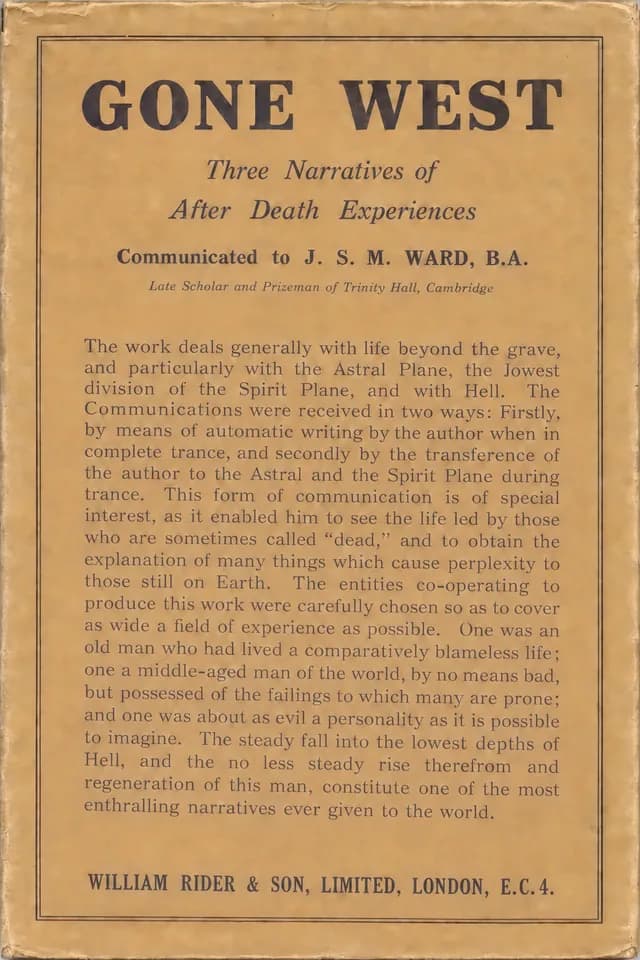
Gone West by J. S. M. Ward
In his introduction to Gone West, J. S. M. Ward summarises an account attributed to the spirit contributor J. B. P. Its immense libraries contain three kinds of work. The first preserves the forms of earthly volumes that have ceased to exist. This is an archive of particular books, rather than simply a store of their ideas. [6]
The second category consists of books composed in the spiritual world. They communicate ideas through pictures understood like the thought-pictures of other people. Ward’s contributor says that relatively few new works there are written in ordinary script. The change concerns how meaning is presented, not the disappearance of authorship or learning. [6]
The third category is closer to a performance. A group of scholars forms thought-images that reenact an episode of history for an audience. Ward summarises the scene in his introduction because printing costs kept the accounts of the higher realms out of the main narratives. [6][7]
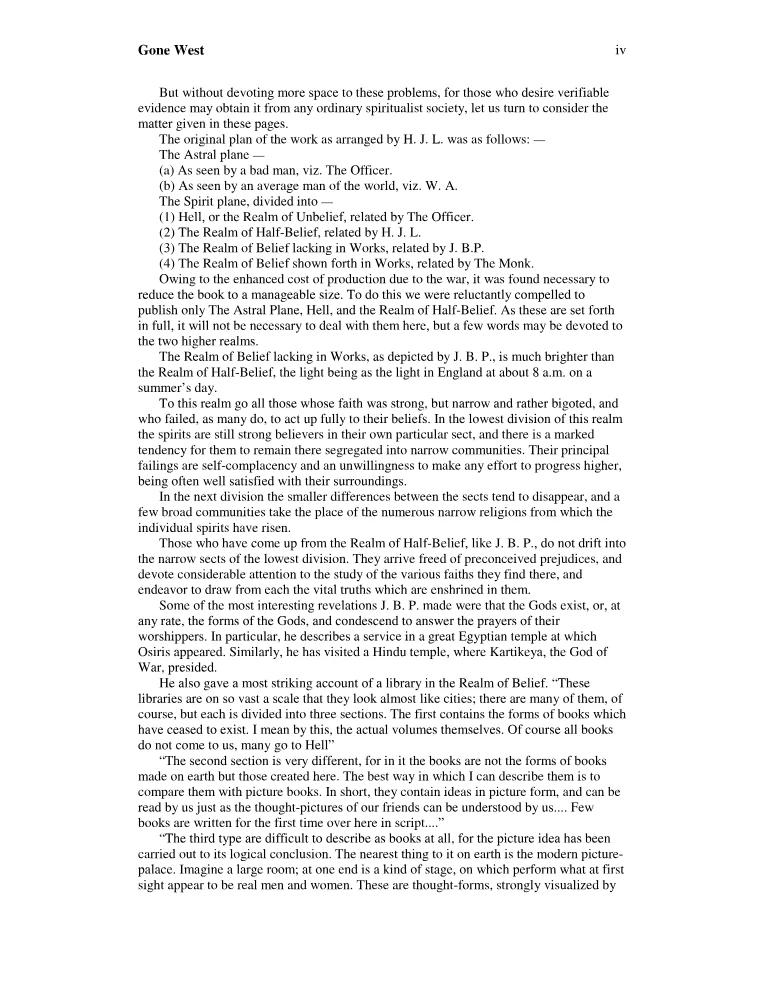
Gone West, introduction, printed p. iv, Library Reader page 8. The Library presents Ward’s 1920 text in Geoff Cutler’s 2009 digital transcription.
J. S. M. Ward, Gone West, historical text in the public domain. Geoff Cutler’s 2009 transcription expressly permits reuse for any purpose on source leaf2. This image shows the digital transcription, not an original printed facsimile. · Image source ↗ · Public Domain
The Angels’ Diary and Celestion Study of Man
The volume attributes the material to Effie M. Shirey and Charles Samson as spirit communications, with Elizabeth Maud Weatherhead credited as the medium. The book says T. H. Burgoyne continued writing after death. It attributes to him a work called The Light of Eternity, said to correct errors in his earthly book The Light of Egypt. [1][11]
Writing in Heaven is said to occur directly through thought. Words appear in enduring lettering on large coloured sheets made from pressed spiritual flowers. The account insists that the flowers’ life-principle persists despite the change in form. A familiar book is therefore remade from the materials and powers assigned to the spiritual world. [2]
Reading still depends on development. Some passages in the supposed book remain beyond people who have not reached the corresponding understanding. The account retains study, difficulty and intellectual progress even while removing the need to write through an ordinary bodily action. [2][3]
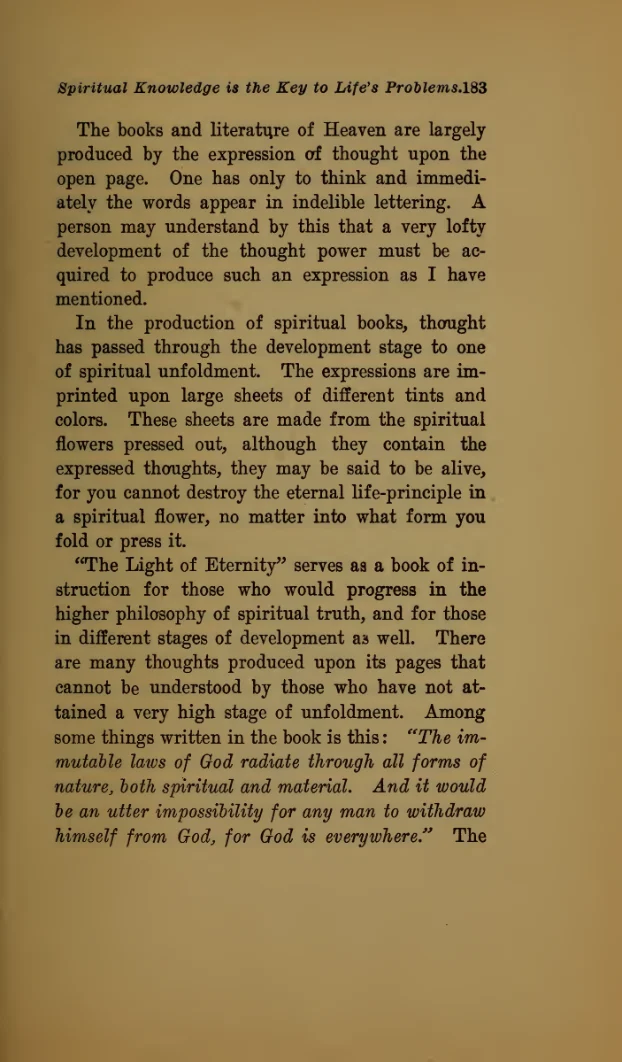
The Angels’ Diary and Celestion Study of Man (1903), printed p. 183, Library Reader page 180. The passage describes thought-made words on coloured sheets of pressed flowers.
Lumitheca Library, edition IMJ-0055-E001. Public-domain 1903 text and page image; extracted from the checksum-verified retained scan. · Image source ↗ · Public Domain
Life and Labor in the Spirit World: Shelhamer’s spirit-band
Life and Labor in the Spirit World, credited to the medium M. T. Shelhamer’s spirit-band, describes a library in the contribution attributed to John Critchley Prince. During a reported visit to Robert Burns, Prince finds volumes by poets and philosophers. Some are described as prototypes of earthly works, while others have never been known to living readers. [9]
Books are one means of learning in this account. Prince also imagines an ability to visit a great mind and receive understanding through direct association. Burns values the works around him while continuing to draw inspiration from nature and human life. The library belongs to an intellectual and social world with several ways to learn. [9][10]
Prince’s scene imagines reading alongside intellectual companionship. Books give visitors access to absent writers. Conversation gives them a different way of learning from the people they can meet. The narrative presents both as parts of Burns’s continuing literary life. [9][10]
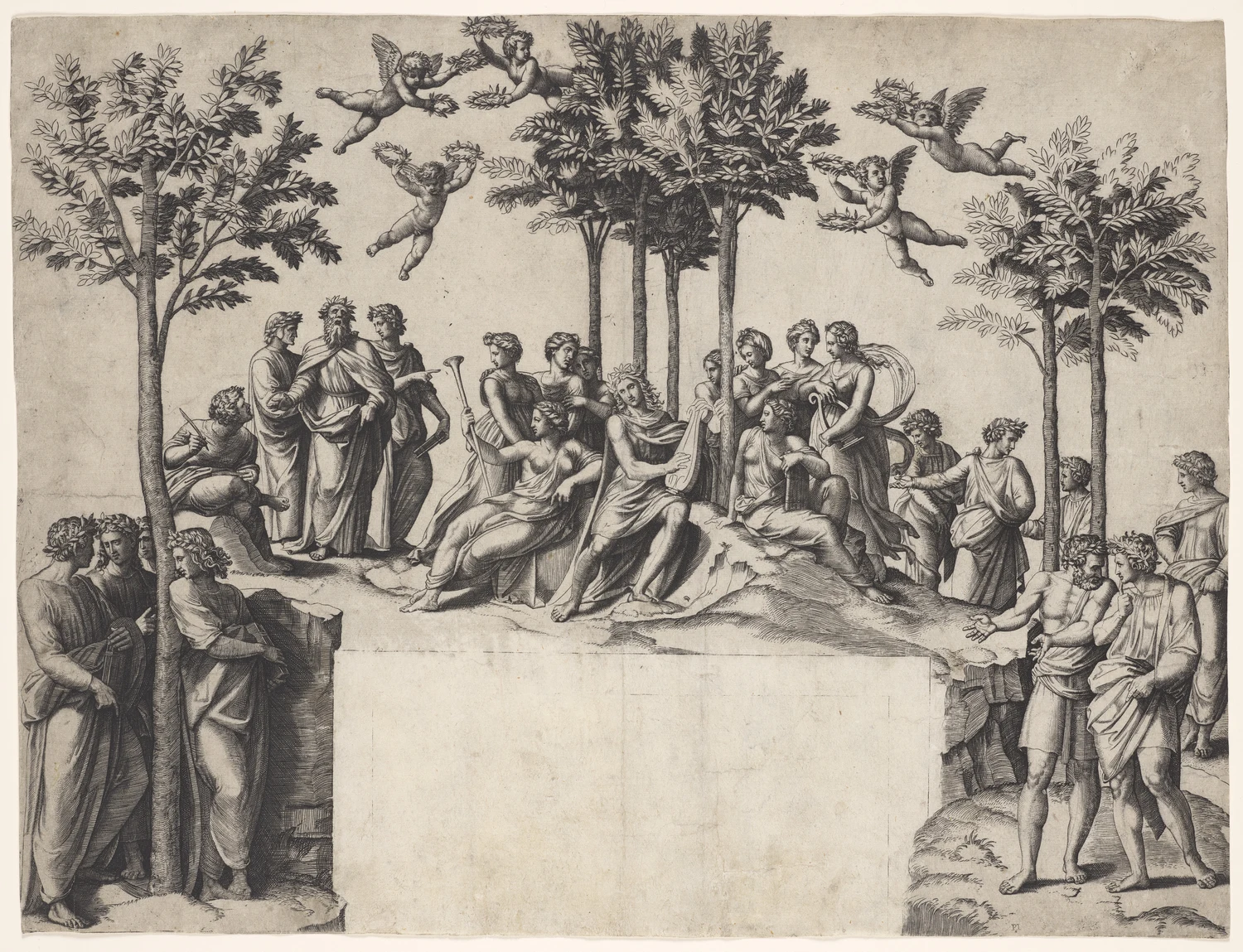
Marcantonio Raimondi after Raphael, Apollo on Parnassus, c. 1517–20. Books appear among this classical company of poets and Muses. The print offers a historical image of literary companionship beside Prince’s later Spiritualist account of a library and conversations beyond books.
Cleveland Museum of Art. Gift of The Print Club of Cleveland. CC0. Resized and converted to WebP. · Image source ↗ · CC0
What a reader can do with a book
Spirit-writing asks how a communication reaches someone. The Hall of Memory concerns what a person keeps of their own experience. An afterlife library imagines a shared collection in which people can encounter the work of others. [1][2][4][5]
The Angels’ Diary imagines readers growing into the meaning of a work they can already see. Prince imagines learning from books and from meeting other minds. Ward puts some ideas into pictures or performances. The accounts keep study alive after death while giving a reader different ways to learn. [1][2][3][9][10][6][7]
An archived volume preserves a particular book. A new picture-book composes something for a reader. A historical reenactment asks scholars to select and visualise what an audience will see. [6][7]
Ward imagines an author communicating without ordinary writing, and scholars working together to make an episode visible. The flower pages in The Angels’ Diary give that power a different form: thought leaves a sentence another person can read. [1][2][6][7]
See references (9)
- The Angels’ Diary and Celestion Study of Man, Reader page 179
- The Angels’ Diary and Celestion Study of Man, Reader page 180
- The Angels’ Diary and Celestion Study of Man, Reader page 184
- The Angels’ Diary and Celestion Study of Man, Reader page 200
- The Angels’ Diary and Celestion Study of Man, Reader page 121
- Gone West, printed p. iv, Reader page 8
- Gone West, printed p. v, Reader page 9
- Life and Labor in the Spirit World, printed p. 395, Reader page 396
- Life and Labor in the Spirit World, printed p. 396, Reader page 397
Read further in the library
The Angels’ Diary and Celestion Study of Man
Reading note
The 1903 volume supplies the distinct teaching or narrated experience discussed in the attributed account, with exact Library page references.
Gone West
Reading note
The separately titled account draws on exact passages in the consulted Library edition.
Life and Labour in the Spirit World
Reading note
The separately titled account draws on exact passages in the consulted Library edition.
Sources
See references (11)
- The Angels’ Diary and Celestion Study of Man, Reader page 179Effie M. Shirey and Charles Samson, The Angels’ Diary and Celestion Study of Man (1903), communicated through Elizabeth Maud Weatherhead according to the volume’s acknowledgment. Accounts below refer to the exact retained Library edition IMJ-0055-E001.Read this page in The Angels’ Diary and Celestion Study of Man ↗Return to text ↑
- The Angels’ Diary and Celestion Study of Man, Reader page 180Effie M. Shirey and Charles Samson, The Angels’ Diary and Celestion Study of Man (1903), communicated through Elizabeth Maud Weatherhead according to the volume’s acknowledgment. Accounts below refer to the exact retained Library edition IMJ-0055-E001.Read this page in The Angels’ Diary and Celestion Study of Man ↗Return to text ↑
- The Angels’ Diary and Celestion Study of Man, Reader page 184Effie M. Shirey and Charles Samson, The Angels’ Diary and Celestion Study of Man (1903), communicated through Elizabeth Maud Weatherhead according to the volume’s acknowledgment. Accounts below refer to the exact retained Library edition IMJ-0055-E001.Read this page in The Angels’ Diary and Celestion Study of Man ↗Return to text ↑
- The Angels’ Diary and Celestion Study of Man, Reader page 200Effie M. Shirey and Charles Samson, The Angels’ Diary and Celestion Study of Man (1903), communicated through Elizabeth Maud Weatherhead according to the volume’s acknowledgment. Accounts below refer to the exact retained Library edition IMJ-0055-E001.Read this page in The Angels’ Diary and Celestion Study of Man ↗Return to text ↑
- The Angels’ Diary and Celestion Study of Man, Reader page 121Effie M. Shirey and Charles Samson, The Angels’ Diary and Celestion Study of Man (1903), communicated through Elizabeth Maud Weatherhead according to the volume’s acknowledgment. Accounts below refer to the exact retained Library edition IMJ-0055-E001.Read this page in The Angels’ Diary and Celestion Study of Man ↗Return to text ↑
- Gone West, printed p. iv, Reader page 8J. S. M. Ward, Gone West: Three Narratives of After-Death Experiences, third impression, William Rider & Son, London, 1920, as reproduced in Geoff Cutler’s December 2009 digital transcription. Ward’s introduction is distinct from the supplied 1974 foreword.Read this page in Gone West ↗Return to text ↑
- Gone West, printed p. v, Reader page 9J. S. M. Ward, Gone West: Three Narratives of After-Death Experiences, third impression, William Rider & Son, London, 1920, as reproduced in Geoff Cutler’s December 2009 digital transcription. Ward’s introduction is distinct from the supplied 1974 foreword.Read this page in Gone West ↗Return to text ↑
- Apollo on Parnassus, c. 1517–20 ↗Cleveland Museum of Art. Current museum metadata verifies this digital image as CC0; original historical work and context identified separately.
- Life and Labor in the Spirit World, printed p. 395, Reader page 396Members of the Spirit-Band of Miss M. T. Shelhamer, Life and Labor in the Spirit World, Second Thousand, Boston: Colby & Rich, 1885. Exact Library edition IMJ-0202-E001. Parts I, II and III are respectively attributed to Spirit Violet, Spirit May and John Critchley Prince. Original metadata and retained Library PageRefs verified; consequential passages checked against actual Library facsimiles. Original Library PDF bytes remain unavailable.Read this page in Life and Labour in the Spirit World ↗Return to text ↑
- Life and Labor in the Spirit World, printed p. 396, Reader page 397Members of the Spirit-Band of Miss M. T. Shelhamer, Life and Labor in the Spirit World, Second Thousand, Boston: Colby & Rich, 1885. Exact Library edition IMJ-0202-E001. Parts I, II and III are respectively attributed to Spirit Violet, Spirit May and John Critchley Prince. Original metadata and retained Library PageRefs verified; consequential passages checked against actual Library facsimiles. Original Library PDF bytes remain unavailable.Read this page in Life and Labour in the Spirit World ↗Return to text ↑
- The Angels’ Diary and Celestion Study of Man, Denver, 1903 ↗Library of Congress catalogue and preface note.Return to text ↑