Spirit garments
Spirit garments are clothes described in afterlife literature. Compare what they reveal, how they take shape and who can see them in four Library accounts.
In this article
Understanding spirit garments
Spirit garments are clothes worn by beings in some accounts of spiritual life or the afterlife. A familiar garment can help someone recognise the wearer. Colour, brightness and condition can also express what a book says about the wearer’s inward life. [1][2][3]
The books disagree about where such clothing comes from and who can interpret it. Some spirits put on clothes by willing a change, while Swedenborg’s angels say their clothes are given to them. In Gone West, even the appearance of a stain depends on who sees it. [1][2][3][9]
Angelic dress in historical art
In Petrus Christus’s Annunciation, Gabriel’s clothing helps give the meeting with Mary a visible form. Swedenborg asks a different question about angelic dress. For him, what an angel wears expresses how the angel receives truth. [12][7][9]
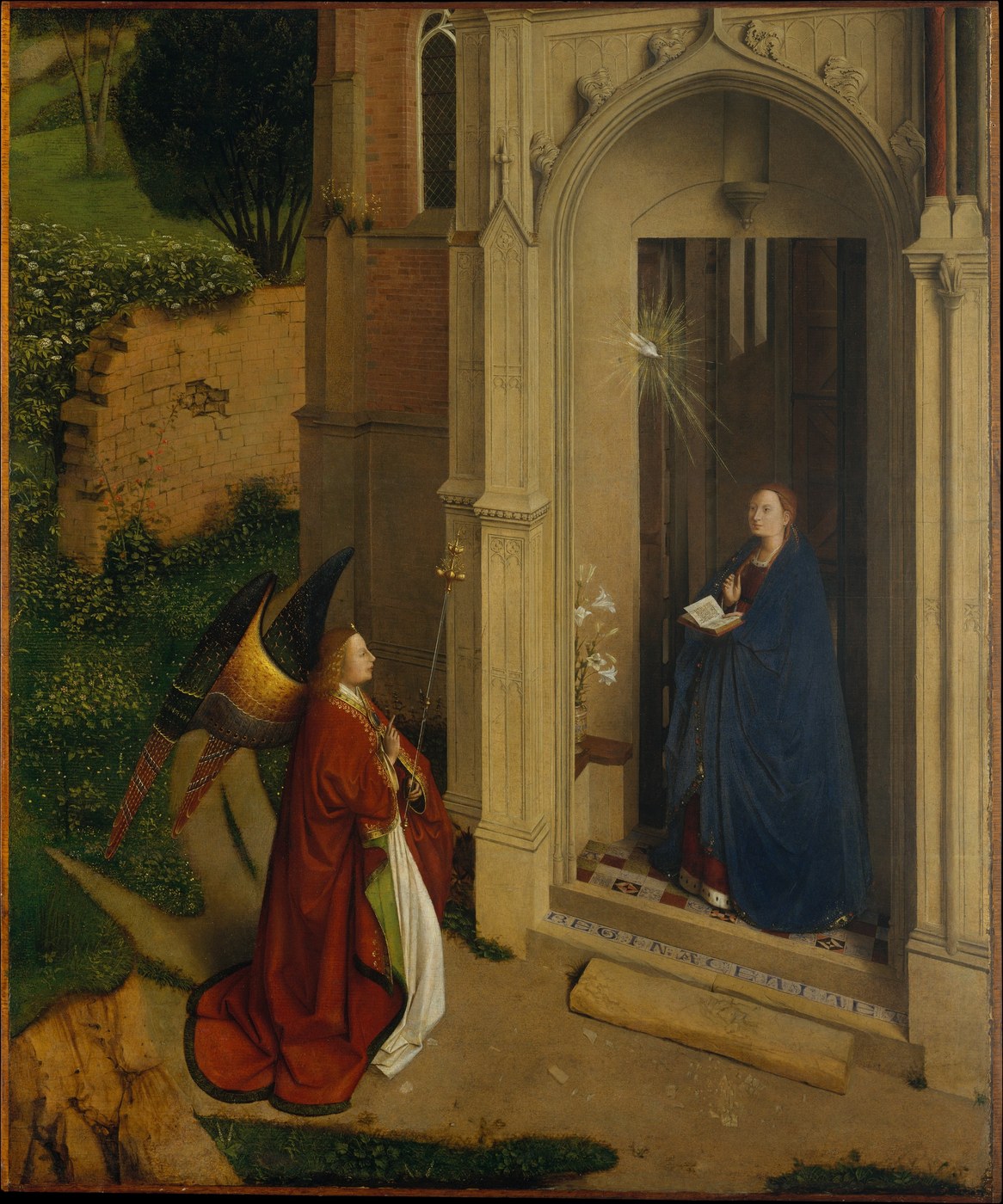
Petrus Christus, The Annunciation, about 1445. Gabriel greets Mary at the doorway of a church.
The Metropolitan Museum of Art. The Friedsam Collection, Bequest of Michael Friedsam, 1931. Accession 32.100.35. Public Domain (CC0). · Image source ↗ · CC0
Heaven and Its Wonders and Hell by Emanuel Swedenborg
In Heaven and Its Wonders and Hell §§177–182, Emanuel Swedenborg describes angelic clothing through its correspondence with intelligence and the reception of divine truth. Garments appear in flame, light, white or other colours. The inmost angels are unclothed, an appearance he associates with innocence. [7][8]
He insists that the garments are real within the world he describes. Angels see and feel them, put them on and take them off, and care for those not being used. His account therefore does not treat correspondence as a decorative image with no experienced substance. [9]
Asked where the garments come from, the angels answer that they receive them as gifts from the Lord, sometimes without noticing the moment of being clothed. Changes in brightness accompany changes of state. This explanation differs from an account in which the wearer deliberately thinks a new costume into shape. [9]
Swedenborg supports the interpretation by reading scriptural white garments and the wedding garment as signs of truth and intelligence. His contrasting description of infernal rags belongs to the same correspondential system. It is not a way to infer the worth of living people from the clothes they can afford. [8][10][9][11]
Innocence explains why the inmost angels go unclothed. Brightness and colour have their own meanings, so counting garments would miss what Swedenborg means by their appearance. [8]
The garment is given by the Lord in this account, and its brightness can still change with the angel’s state. The source of the garment and the meaning of its appearance are separate questions. [7][8][9][2][3]
Ward gives spirits a direct role in shaping what they wear. Swedenborg’s angels instead describe a gift they can put on, take off and care for. This difference explains why their accounts can agree that dress has meaning while giving its wearer a different role. [2][3][7][8][9]
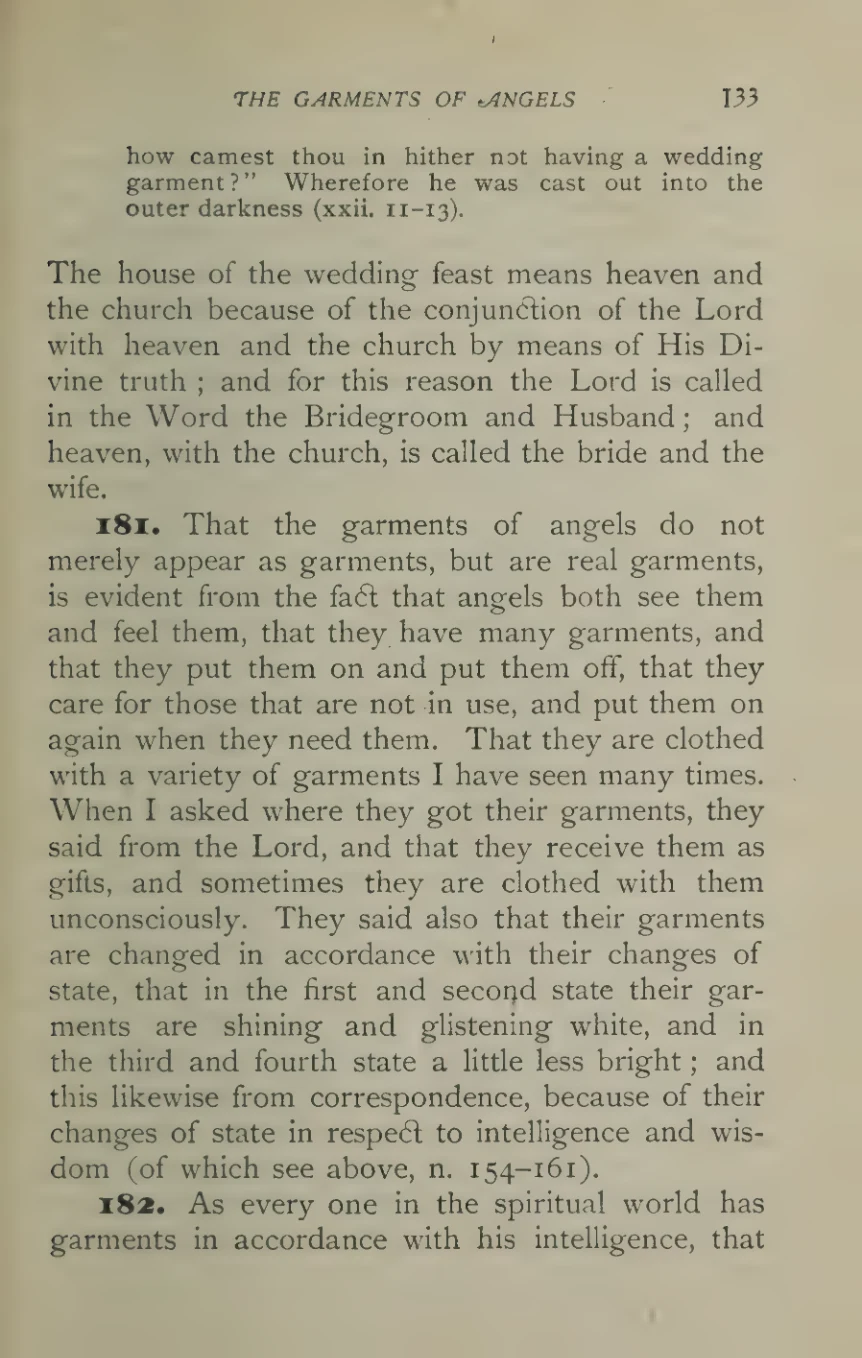
Source facsimile: Heaven and Its Wonders and Hell (1916), printed p. 133, Reader page 140.
Emanuel Swedenborg, Heaven and Its Wonders and Hell, J. C. Ager translation, New York, 1916. Public-domain historical page from the checksum-verified Library PDF. · Image source ↗ · Public Domain
See references (7)
- Gone West, printed p. 36, Reader page 49
- Gone West, printed p. 37, Reader page 50
- Heaven and Its Wonders and Hell, printed p. 130, Reader page 137
- Heaven and Its Wonders and Hell, printed p. 131, Reader page 138
- Heaven and Its Wonders and Hell, printed p. 133, Reader page 140
- Heaven and Its Wonders and Hell, printed p. 132, Reader page 139
- Heaven and Its Wonders and Hell, printed p. 134, Reader page 141
Gone West by J. S. M. Ward
During a vision in J. S. M. Ward’s Gone West, H. J. L. wears flowing white robes that seem mysteriously continuous with his body. Ward contrasts them with the earthly clothes in which the same person had appeared clairvoyantly. The difference raises a question that the narrative later answers explicitly. [1][2]
Asked whether he can take garments off and put others on, H. J. L. explains that will gives the clothes their form. To resemble his former earthly appearance, he thinks the required change. There is no ordinary sequence of undressing, replacement or wear. The garment remains responsive to its wearer’s thought. [2]
Clothing also makes moral comparison visible. When the Officer emerges from Hell, his garment looks ragged and stained to H. J. L. The guide replies that it would appear unusually clean to its wearer, and that he can see stains on H. J. L.’s own apparently clean clothes. A brighter observer might judge the guide’s clothes similarly. [3]
The scene complicates a simple code in which a visible colour gives an absolute spiritual rank. What a person can perceive depends on the observer’s condition. The lesson is also directed at H. J. L.’s confidence in judging someone whose progress differs from his own. [3]
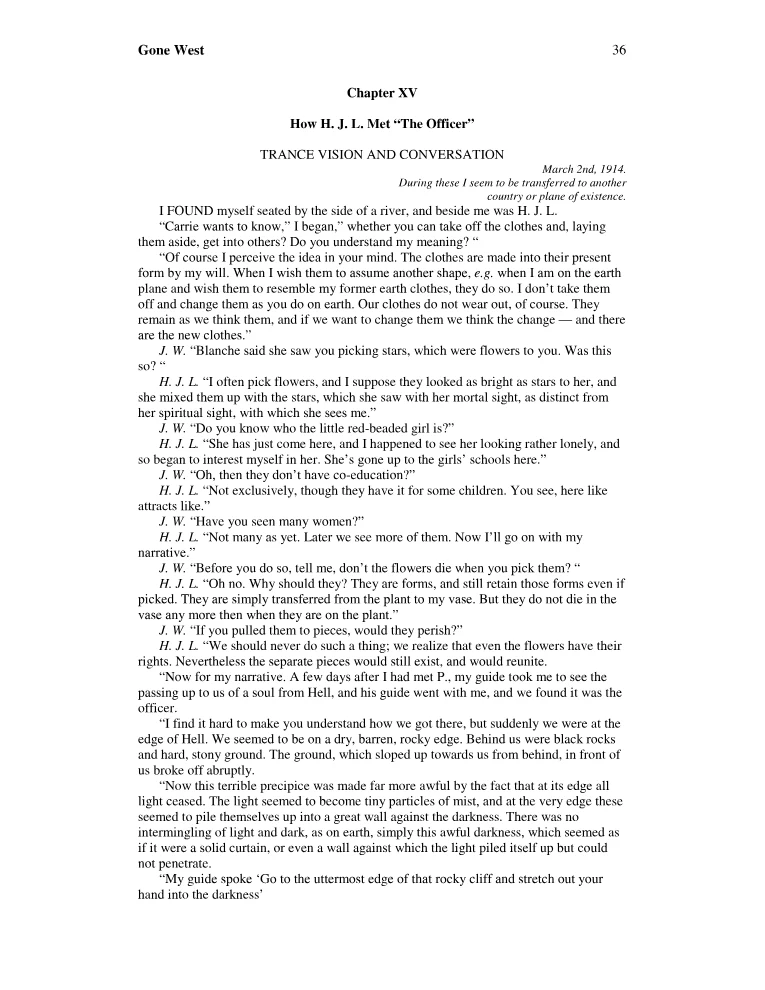
Source page: Gone West, Reader page 49. Ward’s 1920 text is shown in Geoff Cutler’s 2009 digital transcription, rather than an original printed facsimile.
J. S. M. Ward, Gone West, historical text in the public domain. Geoff Cutler’s 2009 transcription expressly permits reuse for any purpose on source leaf2. This image shows the digital transcription, not an original printed facsimile. · Image source ↗ · Public Domain
The Angels’ Diary and Celestion Study of Man
The diary attributed to Effie M. Shirey presents the newly departed narrator discovering a body with long hair, soft white garments and a feeling of youthful buoyancy. The clothing forms part of a recognisable continuing person encountered through sensation and appearance. [4][5][6]
Life Here and Hereafter: Charlotte E. Dresser and Fred Rafferty
Charlotte E. Dresser and Fred Rafferty’s Life Here and Hereafter describes clothing as responsive to thought and expressive of its wearer. Dee mentions delicate shades of pink and lavender, while Mary commonly wears a shining white robe. Garments can be put aside and others assumed at will, without the ordinary household labour of maintaining earthly clothes. [13][14]
The book also links appearance with character, but its examples involve taste and personal association as well as moral description. A. H. describes mixed colours while still overcoming former habits. This is the source’s spiritual colour language; it is not a basis for judging a living person’s skin, dress or worth. [15][16][17][18][19][13][14]
For confused newcomers, unfamiliar clothing becomes a narrative clue. People who believe they have merely recovered from illness try to explain why they no longer wear the clothes they remember. Their first explanation can be a nurse dressing them or someone playing a trick. Recognition of a different life comes gradually. [20][21][22][23][24][25][26][27][28]
See references (16)
- Life Here and Hereafter, Reader page 138
- Life Here and Hereafter, Reader page 139
- Life Here and Hereafter, Reader page 16
- Life Here and Hereafter, Reader page 45
- Life Here and Hereafter, Reader page 46
- Life Here and Hereafter, Reader page 106
- Life Here and Hereafter, Reader page 107
- Life Here and Hereafter, Reader page 187
- Life Here and Hereafter, Reader page 190
- Life Here and Hereafter, Reader page 191
- Life Here and Hereafter, Reader page 192
- Life Here and Hereafter, Reader page 197
- Life Here and Hereafter, Reader page 198
- Life Here and Hereafter, Reader page 235
- Life Here and Hereafter, Reader page 237
- Life Here and Hereafter, Reader page 238
Who dresses the spirit, and who sees the clothes?
Familiar clothes can make a person recognisable, as when H. J. L. appears in earthly dress. A garment formed in a vision and clothing that an apparition is said to make physically visible involve different claims. Ward’s changes of clothing happen within his account of spiritual appearance. [1][2][3]
The Angels’ Diary uses white clothes as part of the narrator’s first experience of a changed body. Dresser and Rafferty’s newcomers find unfamiliar clothes puzzling. Ward gives a garment another role: its stains look different to different observers. Dress becomes a clue about recognition, adjustment or perception according to the scene. [4][5][6][1][2][3][13][14][24][25]
See references (10)
- Gone West, printed p. 23, Reader page 36
- Gone West, printed p. 36, Reader page 49
- Gone West, printed p. 37, Reader page 50
- The Angels’ Diary and Celestion Study of Man, Reader page 25
- The Angels’ Diary and Celestion Study of Man, Reader page 26
- The Angels’ Diary and Celestion Study of Man, Reader page 29
- Life Here and Hereafter, Reader page 138
- Life Here and Hereafter, Reader page 139
- Life Here and Hereafter, Reader page 197
- Life Here and Hereafter, Reader page 198
Read further in the library

Gone West
Reading note
The separately titled account draws on exact passages in the consulted Library edition.
The Angels’ Diary and Celestion Study of Man
Reading note
Separately attributed comparison with exact previously researched Library passages.

Heaven and Its Wonders and Hell
Reading note
The separately titled account draws on exact passages in the consulted Library edition.

Life Here and Hereafter
Reading note
The separately titled account draws on exact passages in the consulted Library edition.
Sources
See references (28)
- Gone West, printed p. 23, Reader page 36J. S. M. Ward, Gone West: Three Narratives of After-Death Experiences, third impression, William Rider & Son, London, 1920, as reproduced in Geoff Cutler’s December 2009 digital transcription. Ward’s introduction is distinct from the supplied 1974 foreword.Read this page in Gone West ↗Return to text ↑
- Gone West, printed p. 36, Reader page 49J. S. M. Ward, Gone West: Three Narratives of After-Death Experiences, third impression, William Rider & Son, London, 1920, as reproduced in Geoff Cutler’s December 2009 digital transcription. Ward’s introduction is distinct from the supplied 1974 foreword.Read this page in Gone West ↗Return to text ↑
- Gone West, printed p. 37, Reader page 50J. S. M. Ward, Gone West: Three Narratives of After-Death Experiences, third impression, William Rider & Son, London, 1920, as reproduced in Geoff Cutler’s December 2009 digital transcription. Ward’s introduction is distinct from the supplied 1974 foreword.Read this page in Gone West ↗Return to text ↑
- The Angels’ Diary and Celestion Study of Man, Reader page 25Effie M. Shirey and Charles Samson, The Angels’ Diary and Celestion Study of Man (1903).Read this page in The Angels’ Diary and Celestion Study of Man ↗Return to text ↑
- The Angels’ Diary and Celestion Study of Man, Reader page 26Effie M. Shirey and Charles Samson, The Angels’ Diary and Celestion Study of Man (1903).Read this page in The Angels’ Diary and Celestion Study of Man ↗Return to text ↑
- The Angels’ Diary and Celestion Study of Man, Reader page 29Effie M. Shirey and Charles Samson, The Angels’ Diary and Celestion Study of Man (1903).Read this page in The Angels’ Diary and Celestion Study of Man ↗Return to text ↑
- Heaven and Its Wonders and Hell, printed p. 130, Reader page 137Emanuel Swedenborg, Heaven and Its Wonders and Hell, From Things Heard and Seen, translated by J. C. Ager. American Swedenborg Printing and Publishing Society, New York, 1916. Latin original first published in 1758. Numbered sections and exact pages refer to this consulted edition. Claims of spiritual experience remain attributed.Read this page in Heaven and Its Wonders and Hell ↗Return to text ↑
- Heaven and Its Wonders and Hell, printed p. 131, Reader page 138Emanuel Swedenborg, Heaven and Its Wonders and Hell, From Things Heard and Seen, translated by J. C. Ager. American Swedenborg Printing and Publishing Society, New York, 1916. Latin original first published in 1758. Numbered sections and exact pages refer to this consulted edition. Claims of spiritual experience remain attributed.Read this page in Heaven and Its Wonders and Hell ↗Return to text ↑
- Heaven and Its Wonders and Hell, printed p. 133, Reader page 140Emanuel Swedenborg, Heaven and Its Wonders and Hell, From Things Heard and Seen, translated by J. C. Ager. American Swedenborg Printing and Publishing Society, New York, 1916. Latin original first published in 1758. Numbered sections and exact pages refer to this consulted edition. Claims of spiritual experience remain attributed.Read this page in Heaven and Its Wonders and Hell ↗Return to text ↑
- Heaven and Its Wonders and Hell, printed p. 132, Reader page 139Emanuel Swedenborg, Heaven and Its Wonders and Hell, From Things Heard and Seen, translated by J. C. Ager. American Swedenborg Printing and Publishing Society, New York, 1916. Latin original first published in 1758. Numbered sections and exact pages refer to this consulted edition. Claims of spiritual experience remain attributed.Read this page in Heaven and Its Wonders and Hell ↗Return to text ↑
- Heaven and Its Wonders and Hell, printed p. 134, Reader page 141Emanuel Swedenborg, Heaven and Its Wonders and Hell, From Things Heard and Seen, translated by J. C. Ager. American Swedenborg Printing and Publishing Society, New York, 1916. Latin original first published in 1758. Numbered sections and exact pages refer to this consulted edition. Claims of spiritual experience remain attributed.Read this page in Heaven and Its Wonders and Hell ↗Return to text ↑
- The Annunciation, Petrus Christus ↗The Metropolitan Museum of Art; ca. 1445, accession 32.100.35Return to text ↑
- Life Here and Hereafter, Reader page 138Charlotte E. Dresser and Fred Rafferty, Life Here and Hereafter, edited by Fred Rafferty. Modern transcription reproducing the Author’s Edition, San Jose, California, 1927. Exact selected Library edition IMJ-0447-E001; original PageIDs and current Reader positions verified. Communications and their claimed spiritual origins remain attributed to this source.Read this page in Life Here and Hereafter ↗Return to text ↑
- Life Here and Hereafter, Reader page 139Charlotte E. Dresser and Fred Rafferty, Life Here and Hereafter, edited by Fred Rafferty. Modern transcription reproducing the Author’s Edition, San Jose, California, 1927. Exact selected Library edition IMJ-0447-E001; original PageIDs and current Reader positions verified. Communications and their claimed spiritual origins remain attributed to this source.Read this page in Life Here and Hereafter ↗Return to text ↑
- Life Here and Hereafter, Reader page 16Charlotte E. Dresser and Fred Rafferty, Life Here and Hereafter, edited by Fred Rafferty. Modern transcription reproducing the Author’s Edition, San Jose, California, 1927. Exact selected Library edition IMJ-0447-E001; original PageIDs and current Reader positions verified. Communications and their claimed spiritual origins remain attributed to this source.Read this page in Life Here and Hereafter ↗Return to text ↑
- Life Here and Hereafter, Reader page 45Charlotte E. Dresser and Fred Rafferty, Life Here and Hereafter, edited by Fred Rafferty. Modern transcription reproducing the Author’s Edition, San Jose, California, 1927. Exact selected Library edition IMJ-0447-E001; original PageIDs and current Reader positions verified. Communications and their claimed spiritual origins remain attributed to this source.Read this page in Life Here and Hereafter ↗Return to text ↑
- Life Here and Hereafter, Reader page 46Charlotte E. Dresser and Fred Rafferty, Life Here and Hereafter, edited by Fred Rafferty. Modern transcription reproducing the Author’s Edition, San Jose, California, 1927. Exact selected Library edition IMJ-0447-E001; original PageIDs and current Reader positions verified. Communications and their claimed spiritual origins remain attributed to this source.Read this page in Life Here and Hereafter ↗Return to text ↑
- Life Here and Hereafter, Reader page 106Charlotte E. Dresser and Fred Rafferty, Life Here and Hereafter, edited by Fred Rafferty. Modern transcription reproducing the Author’s Edition, San Jose, California, 1927. Exact selected Library edition IMJ-0447-E001; original PageIDs and current Reader positions verified. Communications and their claimed spiritual origins remain attributed to this source.Read this page in Life Here and Hereafter ↗Return to text ↑
- Life Here and Hereafter, Reader page 107Charlotte E. Dresser and Fred Rafferty, Life Here and Hereafter, edited by Fred Rafferty. Modern transcription reproducing the Author’s Edition, San Jose, California, 1927. Exact selected Library edition IMJ-0447-E001; original PageIDs and current Reader positions verified. Communications and their claimed spiritual origins remain attributed to this source.Read this page in Life Here and Hereafter ↗Return to text ↑
- Life Here and Hereafter, Reader page 187Charlotte E. Dresser and Fred Rafferty, Life Here and Hereafter, edited by Fred Rafferty. Modern transcription reproducing the Author’s Edition, San Jose, California, 1927. Exact selected Library edition IMJ-0447-E001; original PageIDs and current Reader positions verified. Communications and their claimed spiritual origins remain attributed to this source.Read this page in Life Here and Hereafter ↗Return to text ↑
- Life Here and Hereafter, Reader page 190Charlotte E. Dresser and Fred Rafferty, Life Here and Hereafter, edited by Fred Rafferty. Modern transcription reproducing the Author’s Edition, San Jose, California, 1927. Exact selected Library edition IMJ-0447-E001; original PageIDs and current Reader positions verified. Communications and their claimed spiritual origins remain attributed to this source.Read this page in Life Here and Hereafter ↗Return to text ↑
- Life Here and Hereafter, Reader page 191Charlotte E. Dresser and Fred Rafferty, Life Here and Hereafter, edited by Fred Rafferty. Modern transcription reproducing the Author’s Edition, San Jose, California, 1927. Exact selected Library edition IMJ-0447-E001; original PageIDs and current Reader positions verified. Communications and their claimed spiritual origins remain attributed to this source.Read this page in Life Here and Hereafter ↗Return to text ↑
- Life Here and Hereafter, Reader page 192Charlotte E. Dresser and Fred Rafferty, Life Here and Hereafter, edited by Fred Rafferty. Modern transcription reproducing the Author’s Edition, San Jose, California, 1927. Exact selected Library edition IMJ-0447-E001; original PageIDs and current Reader positions verified. Communications and their claimed spiritual origins remain attributed to this source.Read this page in Life Here and Hereafter ↗Return to text ↑
- Life Here and Hereafter, Reader page 197Charlotte E. Dresser and Fred Rafferty, Life Here and Hereafter, edited by Fred Rafferty. Modern transcription reproducing the Author’s Edition, San Jose, California, 1927. Exact selected Library edition IMJ-0447-E001; original PageIDs and current Reader positions verified. Communications and their claimed spiritual origins remain attributed to this source.Read this page in Life Here and Hereafter ↗Return to text ↑
- Life Here and Hereafter, Reader page 198Charlotte E. Dresser and Fred Rafferty, Life Here and Hereafter, edited by Fred Rafferty. Modern transcription reproducing the Author’s Edition, San Jose, California, 1927. Exact selected Library edition IMJ-0447-E001; original PageIDs and current Reader positions verified. Communications and their claimed spiritual origins remain attributed to this source.Read this page in Life Here and Hereafter ↗Return to text ↑
- Life Here and Hereafter, Reader page 235Charlotte E. Dresser and Fred Rafferty, Life Here and Hereafter, edited by Fred Rafferty. Modern transcription reproducing the Author’s Edition, San Jose, California, 1927. Exact selected Library edition IMJ-0447-E001; original PageIDs and current Reader positions verified. Communications and their claimed spiritual origins remain attributed to this source.Read this page in Life Here and Hereafter ↗Return to text ↑
- Life Here and Hereafter, Reader page 237Charlotte E. Dresser and Fred Rafferty, Life Here and Hereafter, edited by Fred Rafferty. Modern transcription reproducing the Author’s Edition, San Jose, California, 1927. Exact selected Library edition IMJ-0447-E001; original PageIDs and current Reader positions verified. Communications and their claimed spiritual origins remain attributed to this source.Read this page in Life Here and Hereafter ↗Return to text ↑
- Life Here and Hereafter, Reader page 238Charlotte E. Dresser and Fred Rafferty, Life Here and Hereafter, edited by Fred Rafferty. Modern transcription reproducing the Author’s Edition, San Jose, California, 1927. Exact selected Library edition IMJ-0447-E001; original PageIDs and current Reader positions verified. Communications and their claimed spiritual origins remain attributed to this source.Read this page in Life Here and Hereafter ↗Return to text ↑