Sīmiyāʾ
Sīmiyāʾ is a historical term for the occult science of letters. Read Ibn Khaldun on letter qualities and numbers, alongside Magica Sexualis.
In this article
Understanding sīmiyāʾ
Sīmiyāʾ is a historical term for an occult science of letters. Some writers attributed power to letters through their elemental qualities, arrangement or numerical values. Ibn Khaldun says that the word once referred more broadly to talismans and acquired a more specific meaning among some Sufi practitioners. [1][3][4][5]
The Muqaddimah by Ibn Khaldun
In The Muqaddimah, chapter VI, section 28, Ibn Khaldun describes two explanations of letter power. One rests on elemental qualities, the other on numerical proportion. He names al-Buni and Ibn al-Arabi and distinguishes the claimed spiritual assistance of practitioners who use words from the celestial assistance he associates with talismans. [1]
A later talismanic shirt in The Metropolitan Museum of Art shows how sacred inscriptions could be arranged on an object intended for protection. The museum identifies Qur’anic passages and the ninety-nine names of God in its design. [6]
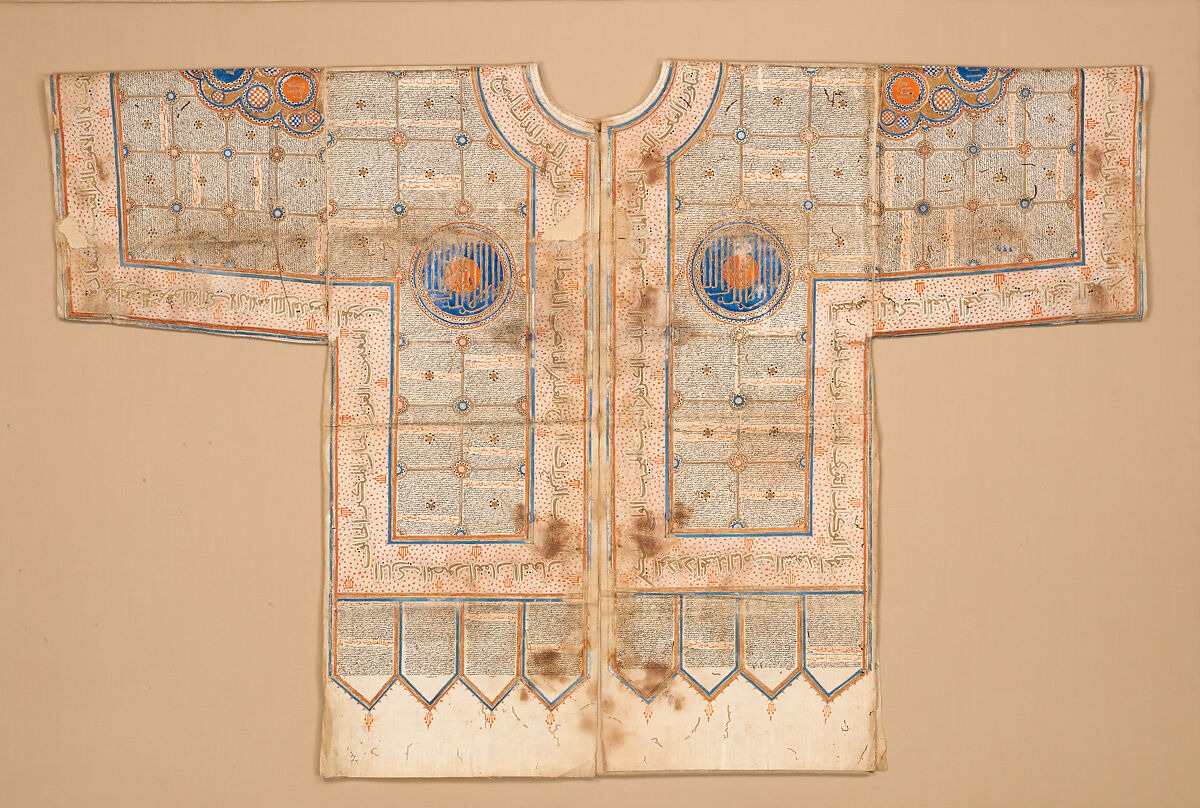
Talismanic shirt, 15th to early 16th century, attributed to Northern India or the Deccan. Qur’anic text fills the panels, with the ninety-nine names of God in the borders.
The Metropolitan Museum of Art, 1998.199. · Image source ↗ · Public Domain
Magica Sexualis by Émile Laurent and Paul Nagour
In Magica Sexualis, Émile Laurent and Paul Nagour cite Ibn Khaldun for the hidden powers of letters. They go on to discuss sacred names, talismans and numbers associated with Venus, placing different traditions together in one chapter. [3][4][5]
Their passage on “friendly” numbers links numerical relations with friendship. Its account of fractions and equal sums gives an idea of the connection they are drawing, but leaves the mathematical rule unclear. [4][3][5]
Checking the numerical analogy
In arithmetic, two different numbers are amicable if each equals the sum of the other’s proper divisors. The proper divisors of 220 sum to 284, and those of 284 sum to 220. This gives a precise example of how a pair of numbers can be said to have a reciprocal relationship. [2]
What letters and numbers are said to do
Ibn Khaldun distinguishes ways of explaining letter power. The compilation borrows one part of that discussion and quickly turns to numerical friendship. The arithmetic example gives a way to understand the numerical idea on its own. [4][5][1][2]
Read further in the library
Magica Sexualis
Reading note
The separately titled account draws on exact passages in the consulted Library edition.
Sources
See references (6)
- Ibn Khaldun, The Muqaddimah, chapter VI, section 28: opening, elemental/numerical explanations and talisman comparison ↗Ibn Khaldun, The Muqaddimah, Franz Rosenthal’s English translation, chapter VI, section 28. Opening through the distinction between talisman-workers and word-workers directly consulted. Later procedures are not reproduced. Exact section locator; no printed page or Library mapping invented.Return to text ↑
- Wolfram MathWorld, Amicable Pair: definition and the pair 220, 284 ↗Directly consulted mathematical definition and example only. Proper-divisor sums independently recomputed locally. This reference does not support any interpersonal or occult effect.Return to text ↑
- Magica Sexualis, printed p. 167, Reader page 175Émile Laurent and Paul Nagour, Magica Sexualis, privately printed by Falstaff Press Inc., New York, undated inspected edition. Exact original Library edition IMJ-0105-E001. The work is a historical compilation; its quoted fiction, trial allegations and medical interpretations are not treated as independently verified facts. Current Reader positions are mapped separately from printed pagination.Read this page in Magica Sexualis ↗Return to text ↑
- Magica Sexualis, Reader page 176Émile Laurent and Paul Nagour, Magica Sexualis, privately printed by Falstaff Press Inc., New York, undated inspected edition. Exact original Library edition IMJ-0105-E001. The work is a historical compilation; its quoted fiction, trial allegations and medical interpretations are not treated as independently verified facts. Current Reader positions are mapped separately from printed pagination.Read this page in Magica Sexualis ↗Return to text ↑
- Magica Sexualis, printed p. 169, Reader page 177Émile Laurent and Paul Nagour, Magica Sexualis, privately printed by Falstaff Press Inc., New York, undated inspected edition. Exact original Library edition IMJ-0105-E001. The work is a historical compilation; its quoted fiction, trial allegations and medical interpretations are not treated as independently verified facts. Current Reader positions are mapped separately from printed pagination.Read this page in Magica Sexualis ↗Return to text ↑
- Talismanic Shirt, 15th–early 16th century, The Metropolitan Museum of Art, 1998.199 ↗The Metropolitan Museum of Art, 1998.199.Return to text ↑