Divine names
Divine names identify or address a deity. Compare the revelation to Moses with Iamblichus, Agrippa and the compilations of Magica Sexualis.
In this article
Understanding divine names
A divine name identifies, describes or addresses a deity. It may be used in prayer, carried in an inscription or revealed in scripture. Some esoteric texts also assign significance to the name’s letters and sounds, treating the form of a name as part of its sacred power. [1][5][6][7][8][9]
Names in scripture and ritual
Exodus: a name and a mission
In Exodus 3:13–15, Moses asks what he should tell the Israelites if they ask who sent him. In the King James Version, God answers “I Am That I Am,” then identifies himself as the God of Abraham, Isaac and Jacob. The name is tied both to Moses’s mission and to collective remembrance. [1]
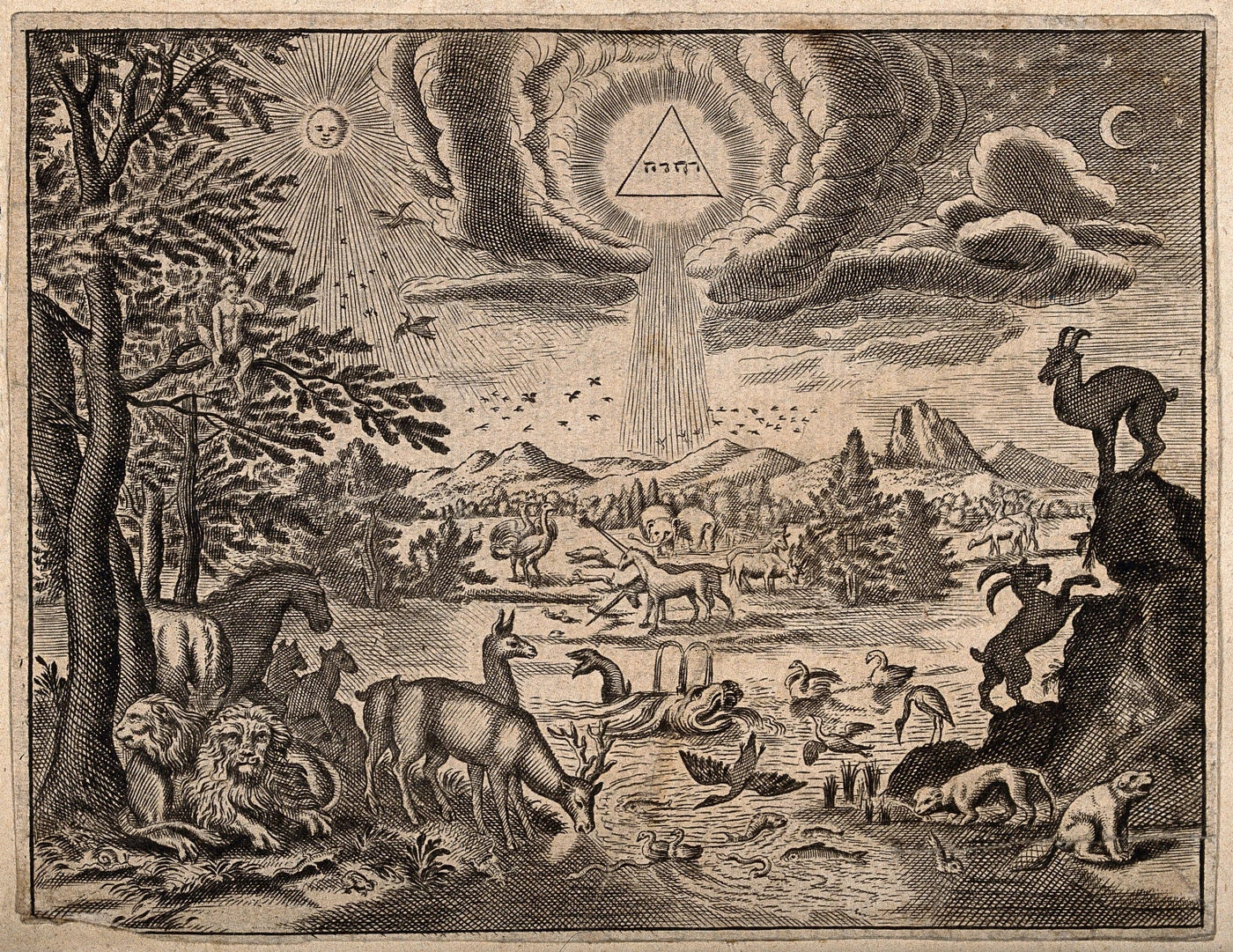
The Hebrew divine name inside a radiant triangle over Eden. Wellcome identifies the triangle as Christian Trinitarian imagery.
Wellcome Collection, 15475i. Engraving and etching; creator and date unverified. Public Domain Mark. · Image source ↗ · Public Domain
On the Mysteries by Iamblichus
In On the Mysteries, section VII, chapters 4–5, Iamblichus argues that gods understand sacred names even where worshippers cannot explain them. Translation can alter what he takes to be a name’s distinctive power. He favours preserving the forms received in prayer and ritual. [2]
Three Books of Occult Philosophy by Heinrich Cornelius Agrippa
In Three Books of Occult Philosophy, Book III, chapter 11, Heinrich Cornelius Agrippa describes names as means of joining a person with God. He places their power in divine action through words and in the faith of the person using them. [3]
Magica Sexualis by Émile Laurent and Paul Nagour
In Magica Sexualis, Émile Laurent and Paul Nagour quote an interpretation attributed to Stanislas de Guaita that assigns creative meanings to the four letters of the divine tetragram. In discussing invocation, they also give an account attributed to Iamblichus in which the gods know the meaning of words the speaker may not understand. [10][11][5][12][6]
The compilers later ask what pronouncing God’s name might accomplish, then turn to numerical names associated with Venus. The sequence brings several uses of sacred language together, from naming a deity to identifying planetary agencies. [7][8][9][11][5][6]
See references (8)
- Magica Sexualis, Reader page 24
- Magica Sexualis, printed p. 125, Reader page 133
- Magica Sexualis, printed p. 167, Reader page 175
- Magica Sexualis, Reader page 176
- Magica Sexualis, printed p. 169, Reader page 177
- Magica Sexualis, Reader page 22
- Magica Sexualis, Reader page 23
- Magica Sexualis, printed p. 124, Reader page 132
Remembrance and ritual speech
Exodus makes a name part of a mission and a lasting remembrance. Iamblichus explains why worshippers preserve the forms of inherited names, while Agrippa puts emphasis on faith and divine action. Magica Sexualis gives both inherited words and their numerical associations a place in occult interpretation. [6][2][9][3][1]
See references (5)
- Exodus 3:13–15, King James Version: the name given to Moses
- Iamblichus, On the Mysteries, section VII, chapters IV–V, Thomas Taylor translation, second edition 1895
- Heinrich Cornelius Agrippa, Three Books of Occult Philosophy, Book III, chapter XI: divine names and their power
- Magica Sexualis, printed p. 125, Reader page 133
- Magica Sexualis, printed p. 169, Reader page 177
Read further in the library
Magica Sexualis
Reading note
The separately titled account draws on exact passages in the consulted Library edition.
Sources
See references (12)
- Exodus 3:13–15, King James Version: the name given to Moses ↗Directly consulted King James Version text, Exodus chapter 3, verses 13–15. Exact canonical verse references; no claim to a Library edition.Return to text ↑
- Iamblichus, On the Mysteries, section VII, chapters IV–V, Thomas Taylor translation, second edition 1895 ↗Iamblichus, On the Mysteries, Thomas Taylor’s translation as printed in the second edition of 1895. Directly consulted transcription of section VII, chapters IV–V; chapter headings are the citation locators. Taylor’s footnotes remain distinct from Iamblichus’s argument.Return to text ↑
- Heinrich Cornelius Agrippa, Three Books of Occult Philosophy, Book III, chapter XI: divine names and their power ↗Agrippa’s primary text in the 1651 English translation signed J. F., consulted in Joseph H. Peterson’s digital edition. Chapter XI, especially its concluding account of divine powers acting through words in faithful minds. No claim of independent verification for every earlier authority Agrippa cites.Return to text ↑
- Wellcome Collection 15475i: divine name within a triangle above Eden ↗Direct Wellcome object page and API record; DigitalLocation Public Domain Mark verified. Engraving/etching, creator and date not established by the consulted record. Actual image viewed. Christian Trinitarian interpretation identified by the museum.
- Magica Sexualis, Reader page 24Émile Laurent and Paul Nagour, Magica Sexualis, privately printed by Falstaff Press Inc., New York, undated inspected edition. Exact original Library edition IMJ-0105-E001. The work is a historical compilation; its quoted fiction, trial allegations and medical interpretations are not treated as independently verified facts. Current Reader positions are mapped separately from printed pagination.Read this page in Magica Sexualis ↗Return to text ↑
- Magica Sexualis, printed p. 125, Reader page 133Émile Laurent and Paul Nagour, Magica Sexualis, privately printed by Falstaff Press Inc., New York, undated inspected edition. Exact original Library edition IMJ-0105-E001. The work is a historical compilation; its quoted fiction, trial allegations and medical interpretations are not treated as independently verified facts. Current Reader positions are mapped separately from printed pagination.Read this page in Magica Sexualis ↗Return to text ↑
- Magica Sexualis, printed p. 167, Reader page 175Émile Laurent and Paul Nagour, Magica Sexualis, privately printed by Falstaff Press Inc., New York, undated inspected edition. Exact original Library edition IMJ-0105-E001. The work is a historical compilation; its quoted fiction, trial allegations and medical interpretations are not treated as independently verified facts. Current Reader positions are mapped separately from printed pagination.Read this page in Magica Sexualis ↗Return to text ↑
- Magica Sexualis, Reader page 176Émile Laurent and Paul Nagour, Magica Sexualis, privately printed by Falstaff Press Inc., New York, undated inspected edition. Exact original Library edition IMJ-0105-E001. The work is a historical compilation; its quoted fiction, trial allegations and medical interpretations are not treated as independently verified facts. Current Reader positions are mapped separately from printed pagination.Read this page in Magica Sexualis ↗Return to text ↑
- Magica Sexualis, printed p. 169, Reader page 177Émile Laurent and Paul Nagour, Magica Sexualis, privately printed by Falstaff Press Inc., New York, undated inspected edition. Exact original Library edition IMJ-0105-E001. The work is a historical compilation; its quoted fiction, trial allegations and medical interpretations are not treated as independently verified facts. Current Reader positions are mapped separately from printed pagination.Read this page in Magica Sexualis ↗Return to text ↑
- Magica Sexualis, Reader page 22Émile Laurent and Paul Nagour, Magica Sexualis, privately printed by Falstaff Press Inc., New York, undated inspected edition. Exact original Library edition IMJ-0105-E001. The work is a historical compilation; its quoted fiction, trial allegations and medical interpretations are not treated as independently verified facts. Current Reader positions are mapped separately from printed pagination.Read this page in Magica Sexualis ↗Return to text ↑
- Magica Sexualis, Reader page 23Émile Laurent and Paul Nagour, Magica Sexualis, privately printed by Falstaff Press Inc., New York, undated inspected edition. Exact original Library edition IMJ-0105-E001. The work is a historical compilation; its quoted fiction, trial allegations and medical interpretations are not treated as independently verified facts. Current Reader positions are mapped separately from printed pagination.Read this page in Magica Sexualis ↗Return to text ↑
- Magica Sexualis, printed p. 124, Reader page 132Émile Laurent and Paul Nagour, Magica Sexualis, privately printed by Falstaff Press Inc., New York, undated inspected edition. Exact original Library edition IMJ-0105-E001. The work is a historical compilation; its quoted fiction, trial allegations and medical interpretations are not treated as independently verified facts. Current Reader positions are mapped separately from printed pagination.Read this page in Magica Sexualis ↗Return to text ↑