Talismans
A talisman is an object believed to carry power. Compare Egyptian protective amulets with medieval, early modern and later occult accounts.
In this article
Meaning and historical use
Understanding talismans
A talisman is an object believed to carry power for a purpose, such as protection or good fortune. Its material, inscription or preparation can matter to the people who use it. A protective object is often called an amulet, and the two terms overlap in historical writing. [3][4][5][6][7][8][2]
See references (7)
- The Metropolitan Museum of Art, Amulet Plaque with Figure of Thoth, ca. 1000–945 BCE, 25.3.170a
- Magica Sexualis, Reader page 155
- Magica Sexualis, Reader page 156
- Magica Sexualis, Reader page 157
- Magica Sexualis, printed p. 150, Reader page 158
- Magica Sexualis, Reader page 159
- Magica Sexualis, printed p. 170, Reader page 178
An Egyptian protective object
The Metropolitan Museum of Art records that a plaque bearing Thoth was found on the left arm of a mummy with a wedjat-eye and a djed-pillar amulet. The placement and combination show how the objects were used together in the burial. [2]
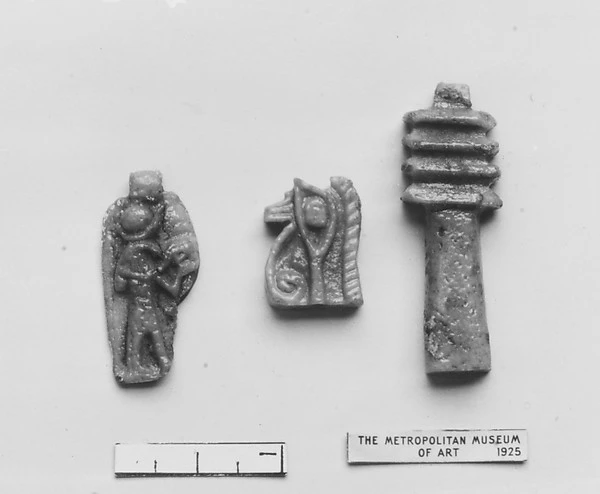
Thoth, wedjat-eye and djed-pillar amulets from the burial of Djedmutesankh, ca. 1000–945 BCE.
The Metropolitan Museum of Art, Rogers Fund, 1925. Thoth plaque 25.3.170a. Public Domain, CC0. · Image source ↗ · CC0
Accounts in the books
The Muqaddimah by Ibn Khaldun
In The Muqaddimah, chapter VI, section 27, Ibn Khaldun distinguishes sorcery without an external aid from talismanic work said to draw on celestial conditions, elements or numbers. He puts effects attributed to imagination in a separate category. His discussion places the distinctions within a religious assessment of magic. [1]
Planetary and scriptural talismans in Witchcraft Magic & Alchemy
In Witchcraft, Magic and Alchemy, Grillot de Givry reproduces eight designs from the Petit Albert. Seven are associated with the days of the week and their heavenly bodies. One design stands outside that series and carries a biblical verse about triumph over dangerous creatures. [16][17]
De Givry also reproduces a cross from Bibliothèque de l’Arsenal manuscript 2497. The surrounding words from a psalm speak of bonds being loosened. The text assigns the design to the Sun and gives its intended purpose as release from prison. [17][5][6][1][16]
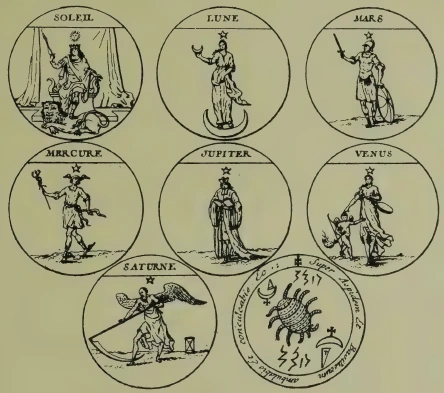
The Petit Albert designs for the seven days of the week, with a separate protective design at lower right. De Givry reproduces them together as figure 310.
Petit Albert, Cologne, 1722, as reproduced in Witchcraft Magic & Alchemy, printed p. 339. Historical figure only. · Image source ↗ · Public Domain
See references (5)
Magica Sexualis by Émile Laurent and Paul Nagour
In Magica Sexualis, Émile Laurent and Paul Nagour discuss rings, brooches and charms as everyday talismans. They call a single stone or ring simple, and combinations of materials or signs compound. They also distinguish objects intended to influence another person from those intended to protect. [9][3][4][5][6][7]
The compilers’ Venus example coordinates material, timing and sensory associations with the maker’s intent. A later discussion considers what belief in such an object can offer its owner, including confidence or consolation. [10][11][12][8][13]
See references (11)
- Magica Sexualis, Reader page 155
- Magica Sexualis, Reader page 156
- Magica Sexualis, Reader page 157
- Magica Sexualis, printed p. 150, Reader page 158
- Magica Sexualis, Reader page 159
- Magica Sexualis, printed p. 170, Reader page 178
- Magica Sexualis, Reader page 153
- Magica Sexualis, printed p. 165, Reader page 173
- Magica Sexualis, printed p. 166, Reader page 174
- Magica Sexualis, printed p. 167, Reader page 175
- Magica Sexualis, Reader page 179
What gives a talisman its purpose?
The Egyptian group has a protective role in burial. In De Givry’s prison design, the psalm names the release sought. Ibn Khaldun classifies operations by the assistance they are thought to use. In an object that also carries a message, such as jewellery that spells a word, the message follows its own convention. [5][7][11][8][13][1][2][14][15]
See references (9)
- Ibn Khaldun, The Muqaddimah, chapter VI, section 27: opening classification and three degrees
- The Metropolitan Museum of Art, Amulet Plaque with Figure of Thoth, ca. 1000–945 BCE, 25.3.170a
- Magica Sexualis, Reader page 157
- Magica Sexualis, Reader page 159
- Magica Sexualis, printed p. 170, Reader page 178
- Magica Sexualis, printed p. 166, Reader page 174
- Magica Sexualis, Reader page 179
- Magica Sexualis, Reader page 167
- Magica Sexualis, printed p. 160, Reader page 168
Read further in the library
Magica Sexualis
Reading note
The separately titled account draws on exact passages in the consulted Library edition.
Witchcraft Magic and Alchemy
Reading note
The separately titled account draws on exact passages in the consulted Library edition.
Sources
See references (17)
- Ibn Khaldun, The Muqaddimah, chapter VI, section 27: opening classification and three degrees ↗Ibn Khaldun, The Muqaddimah, Franz Rosenthal’s English translation, chapter VI, section 27. Directly consulted transcription: opening and the paragraphs distinguishing three degrees of magical activity. Section and paragraph content identify the passage; no newly verified printed pagination or Library edition claimed.Return to text ↑
- The Metropolitan Museum of Art, Amulet Plaque with Figure of Thoth, ca. 1000–945 BCE, 25.3.170a ↗Direct museum object record and Collection API object 551038. The record identifies find context, protective role, date and image order. API isPublicDomain true; actual image inspected. CC0 Open Access.Return to text ↑
- Magica Sexualis, Reader page 155Émile Laurent and Paul Nagour, Magica Sexualis, privately printed by Falstaff Press Inc., New York, undated inspected edition. Exact original Library edition IMJ-0105-E001. The work is a historical compilation; its quoted fiction, trial allegations and medical interpretations are not treated as independently verified facts. Current Reader positions are mapped separately from printed pagination.Read this page in Magica Sexualis ↗Return to text ↑
- Magica Sexualis, Reader page 156Émile Laurent and Paul Nagour, Magica Sexualis, privately printed by Falstaff Press Inc., New York, undated inspected edition. Exact original Library edition IMJ-0105-E001. The work is a historical compilation; its quoted fiction, trial allegations and medical interpretations are not treated as independently verified facts. Current Reader positions are mapped separately from printed pagination.Read this page in Magica Sexualis ↗Return to text ↑
- Magica Sexualis, Reader page 157Émile Laurent and Paul Nagour, Magica Sexualis, privately printed by Falstaff Press Inc., New York, undated inspected edition. Exact original Library edition IMJ-0105-E001. The work is a historical compilation; its quoted fiction, trial allegations and medical interpretations are not treated as independently verified facts. Current Reader positions are mapped separately from printed pagination.Read this page in Magica Sexualis ↗Return to text ↑
- Magica Sexualis, printed p. 150, Reader page 158Émile Laurent and Paul Nagour, Magica Sexualis, privately printed by Falstaff Press Inc., New York, undated inspected edition. Exact original Library edition IMJ-0105-E001. The work is a historical compilation; its quoted fiction, trial allegations and medical interpretations are not treated as independently verified facts. Current Reader positions are mapped separately from printed pagination.Read this page in Magica Sexualis ↗Return to text ↑
- Magica Sexualis, Reader page 159Émile Laurent and Paul Nagour, Magica Sexualis, privately printed by Falstaff Press Inc., New York, undated inspected edition. Exact original Library edition IMJ-0105-E001. The work is a historical compilation; its quoted fiction, trial allegations and medical interpretations are not treated as independently verified facts. Current Reader positions are mapped separately from printed pagination.Read this page in Magica Sexualis ↗Return to text ↑
- Magica Sexualis, printed p. 170, Reader page 178Émile Laurent and Paul Nagour, Magica Sexualis, privately printed by Falstaff Press Inc., New York, undated inspected edition. Exact original Library edition IMJ-0105-E001. The work is a historical compilation; its quoted fiction, trial allegations and medical interpretations are not treated as independently verified facts. Current Reader positions are mapped separately from printed pagination.Read this page in Magica Sexualis ↗Return to text ↑
- Magica Sexualis, Reader page 153Émile Laurent and Paul Nagour, Magica Sexualis, privately printed by Falstaff Press Inc., New York, undated inspected edition. Exact original Library edition IMJ-0105-E001. The work is a historical compilation; its quoted fiction, trial allegations and medical interpretations are not treated as independently verified facts. Current Reader positions are mapped separately from printed pagination.Read this page in Magica Sexualis ↗Return to text ↑
- Magica Sexualis, printed p. 165, Reader page 173Émile Laurent and Paul Nagour, Magica Sexualis, privately printed by Falstaff Press Inc., New York, undated inspected edition. Exact original Library edition IMJ-0105-E001. The work is a historical compilation; its quoted fiction, trial allegations and medical interpretations are not treated as independently verified facts. Current Reader positions are mapped separately from printed pagination.Read this page in Magica Sexualis ↗Return to text ↑
- Magica Sexualis, printed p. 166, Reader page 174Émile Laurent and Paul Nagour, Magica Sexualis, privately printed by Falstaff Press Inc., New York, undated inspected edition. Exact original Library edition IMJ-0105-E001. The work is a historical compilation; its quoted fiction, trial allegations and medical interpretations are not treated as independently verified facts. Current Reader positions are mapped separately from printed pagination.Read this page in Magica Sexualis ↗Return to text ↑
- Magica Sexualis, printed p. 167, Reader page 175Émile Laurent and Paul Nagour, Magica Sexualis, privately printed by Falstaff Press Inc., New York, undated inspected edition. Exact original Library edition IMJ-0105-E001. The work is a historical compilation; its quoted fiction, trial allegations and medical interpretations are not treated as independently verified facts. Current Reader positions are mapped separately from printed pagination.Read this page in Magica Sexualis ↗Return to text ↑
- Magica Sexualis, Reader page 179Émile Laurent and Paul Nagour, Magica Sexualis, privately printed by Falstaff Press Inc., New York, undated inspected edition. Exact original Library edition IMJ-0105-E001. The work is a historical compilation; its quoted fiction, trial allegations and medical interpretations are not treated as independently verified facts. Current Reader positions are mapped separately from printed pagination.Read this page in Magica Sexualis ↗Return to text ↑
- Magica Sexualis, Reader page 167Émile Laurent and Paul Nagour, Magica Sexualis, privately printed by Falstaff Press Inc., New York, undated inspected edition. Exact original Library edition IMJ-0105-E001. The work is a historical compilation; its quoted fiction, trial allegations and medical interpretations are not treated as independently verified facts. Current Reader positions are mapped separately from printed pagination.Read this page in Magica Sexualis ↗Return to text ↑
- Magica Sexualis, printed p. 160, Reader page 168Émile Laurent and Paul Nagour, Magica Sexualis, privately printed by Falstaff Press Inc., New York, undated inspected edition. Exact original Library edition IMJ-0105-E001. The work is a historical compilation; its quoted fiction, trial allegations and medical interpretations are not treated as independently verified facts. Current Reader positions are mapped separately from printed pagination.Read this page in Magica Sexualis ↗Return to text ↑
- Witchcraft Magic & Alchemy, printed p. 339, Reader page 335Grillot de Givry, Witchcraft Magic & Alchemy, translated by J. Courtenay Locke. Boston and New York, Houghton Mifflin Company, 1931.Read this page in Witchcraft Magic and Alchemy ↗Return to text ↑
- Witchcraft Magic & Alchemy, printed p. 341, Reader page 337Grillot de Givry, Witchcraft Magic & Alchemy, translated by J. Courtenay Locke. Boston and New York, Houghton Mifflin Company, 1931.Read this page in Witchcraft Magic and Alchemy ↗Return to text ↑