Sikhism
Explore Sikhism through Guru Nanak, the Guru Granth Sahib, divine oneness, the Khalsa, langar, the Five Ks and service in everyday life.
In this article
What is Sikhism?
Sikhism, also called Sikhi, is a religion that began with Guru Nanak in the Punjab region of South Asia in the late fifteenth century. Its teachings connect devotion to one divine reality with truthful conduct, equality and responsibility towards other people. The word Sikh identifies a learner, a person guided by the Guru. [1]
Ten human Gurus shaped the tradition, beginning with Nanak, born in 1469, and ending with Guru Gobind Singh, who died in 1708. The Guru Granth Sahib, the Sikh scripture, and the Guru Khalsa Panth, the initiated community, carry enduring authority. This gives Sikh life both a scriptural centre and a collective dimension. Its religious identity developed through its own teachers, institutions and practices, rather than remaining a subdivision of another South Asian faith. [1]
The Gurus and divine oneness
Guru Nanak and the first community
Nanak was born at Talwandi, now in Pakistan, and later worked at Sultanpur. Sikh tradition remembers a revelatory encounter that transformed his life and set him on a path of teaching through hymns. The janam sakhis, narratives of his life, convey religious meaning through stories of his travels, conversations and challenges to social convention. Their miraculous episodes belong to this sacred storytelling tradition. [2]
Nanak’s later community at Kartarpur brought worship together with work, hospitality and family life. He was a householder, and the path he taught could be followed amid ordinary responsibilities. Before his death he appointed Angad as his successor. The resulting line of Gurus allowed the community to continue developing beyond the lifetime of its first teacher. [2]
Divine oneness and the Name
Sikh teaching begins from the oneness of the divine. Ik Onkar, the expression at the opening of Sikh scripture, points to one creative reality. Remembering the divine Name directs attention towards this presence and away from the self’s preoccupation with status and possession. Devotion is expressed through hearing, singing and reflecting on the Guru’s word. [3]
The hymns include compositions of the Sikh Gurus and other South Asian religious voices. Their presence does not dissolve differences between religions; it recognises spiritual insight across social and inherited boundaries. In this setting, scripture becomes a shared field of praise and instruction. The aim is a transformed relation to God and the world, with religious understanding taking shape through the way a person lives. [3]
Reading the opening of the Guru Granth Sahib
The opening of the Guru Granth Sahib brings together divine oneness, truth, creative agency, freedom from fear and enmity, timelessness and the Guru’s grace. These qualities make the Mul Mantar a compact foundation for Sikh theology. Its language is devotional, but it also establishes a way of thinking about reality that exceeds ordinary divisions between people. [12]
The Japji that follows turns to the limits of thought, outward silence and accumulated worldly resources. Understanding cannot be secured simply by multiplying these activities. The movement from the opening declaration into questions about how to live helps explain why this text belongs at the beginning of the scripture: it joins a vision of the divine to the work of remaking human attention. [12]
Devotion in everyday life
Work, equality and the shared meal
Guru Nanak’s teaching places religious life within the world of work, family and relationships. Honest conduct matters because outward signs of devotion cannot excuse greed, injustice or hypocrisy. The tradition’s criticism of caste and inherited superiority follows from the equal possibility of approaching God. [4]
Langar, the shared community meal, gives this conviction a practical setting. People eat together as equals rather than receiving different treatment according to social rank. Preparing food, washing utensils and serving guests can all become forms of participation. Equality is therefore enacted through repeated, ordinary actions. The meal also makes hospitality visible to a visitor who may know little about the theology expressed in the hymns being sung nearby. [4]
Seva and the discipline of love
Seva means service, and in Sikh understanding it is an expression of gratitude and love for the divine. The Sikh Coalition describes devotion, truthful living and service to humanity as connected daily commitments. The recognition of divine presence in other people gives service its religious force. [8]
The ideal of the sant-sipahi, often rendered saint-soldier, joins inward spiritual discipline to an active responsibility in the world. It does not ask a person to choose between contemplation and concern for others. Service may take the form of community work, hospitality or responding to another person’s need. The point is the disposition that joins those actions: spiritual life should make a person more attentive to human dignity. [8]
Why the Guru Granth Sahib is the Guru
The Guru Granth Sahib is treated as the enduring Guru, not simply as a book about the lives of earlier teachers. Its hymns, called shabads, form the centre of congregational worship. Singing, recitation and attentive listening allow the congregation to receive guidance through the word. [5]
In the gurdwara it occupies an honoured place beneath a canopy, and the handling and daily care of the volume express reverence for its authority. An akhand path is an uninterrupted reading of the entire scripture, carried out by readers taking turns. The continuity of the reading makes the scripture’s communal role especially tangible. To understand this reverence, the text must be approached within Sikh devotion, where the Guru’s word guides worship of the divine. [5]
Inside a gurdwara
A gurdwara is a Sikh place of congregation organised around the Guru Granth Sahib. The gathering hears scripture, joins in shabad kirtan, the singing of hymns, and participates in communal prayer. A granthi attends to and reads the scripture; this role does not require membership in a hereditary priestly caste. [6]
The building also supports social life. Langar, educational activities and other forms of assistance make it a meeting place as well as a worship space. Congregations depend on people taking responsibility for music, reading, teaching, cooking and maintenance. These activities connect the service heard about in the prayer hall with the practical work that sustains the institution. A gurdwara’s communal character is part of its religious purpose. [6]
An early photograph of the Golden Temple
An albumen print dated 1864 shows the Golden Temple in Amritsar beside its reflecting pool. The Rijksmuseum attributes the photograph to Samuel Bourne. Seen here across the water, the building and its surroundings offer a nineteenth-century view of a sacred place discussed alongside Sikh worship and community life. [13]
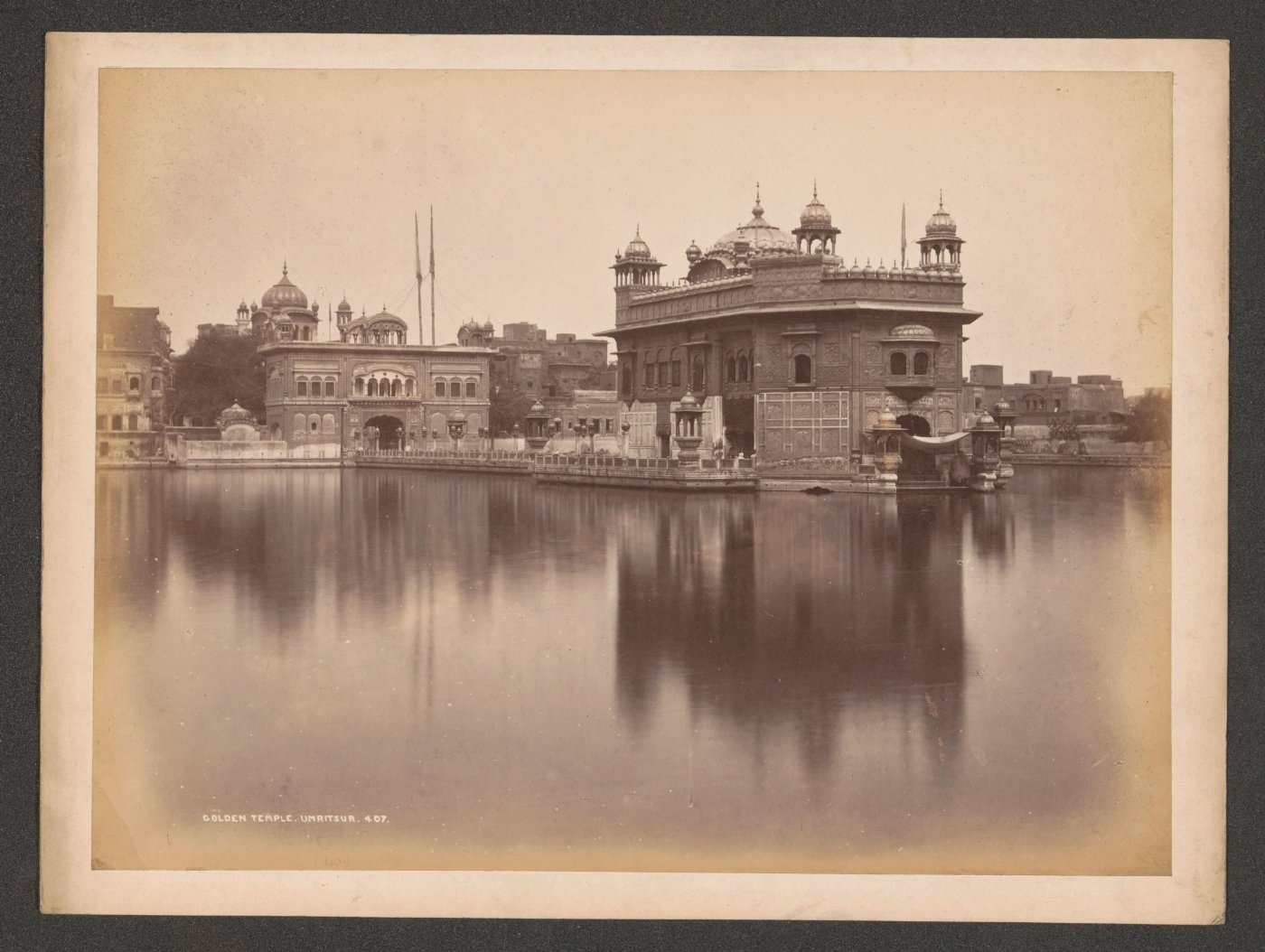
Golden Temple in Amritsar, attributed to Samuel Bourne, 1864. Albumen print.
Rijksmuseum, Amsterdam. RP-F-F02458. Public Domain. · Museum record ↗ · Public Domain
Commitment and community
The Khalsa and initiation
At Vaisakhi in 1699, Guru Gobind Singh established the Khalsa at Anandpur. Sikh tradition remembers the Panj Piare, the Five Beloved Ones, as the first to accept this commitment. Initiation through amrit expresses a disciplined belonging that carries both spiritual and communal obligations. [7]
The Khalsa gave the community a distinctive public form and challenged distinctions of inherited rank. The names Singh and Kaur became associated with this identity. Its history helps explain why courage, mutual responsibility and visible commitment stand beside prayer and devotion in Sikh self-understanding. The initiation is a particular undertaking within the wider Sikh community; describing it accurately does not require assuming that every Sikh has taken it. [7]
The Five Ks and the turban
The five articles of faith associated with initiation are kesh, unshorn hair; kangha, a comb; kara, a steel bracelet; kirpan, a blade worn as an article of faith; and kachera, a form of undergarment. Often called the Five Ks, they are cherished as gifts of the Guru and signs of commitment. [9]
Reducing each article to a practical use misses the relationship that gives it meaning. The turban is also an important public expression of Sikh identity and can be worn by men and women. It carries associations of dignity, sovereignty and responsibility. Visible identity makes a religious commitment recognisable in everyday settings, joining outward appearance to expectations of honesty, compassion and service. [9]
Belonging and varied observance
Sikh practice is not identical in every household. Some Sikhs are initiated into the Khalsa; others are not. Keeping uncut hair is a significant commitment, but Sikhs who cut their hair do not thereby cease to exist as members of the wider community. These distinctions matter when interpreting what a visitor can see. [10]
Dietary practice also varies. Langar is generally vegetarian so that people with different dietary commitments can share it, while Sikh identity itself does not impose one universal pattern of vegetarianism on every individual. Sikhism has its own religious foundations even though its historical setting includes interaction with Hindu and Muslim communities. Shared vocabulary or geography should not be mistaken for an absence of distinct identity. [10]
Sikh life beyond Punjab
Migration has carried Sikh institutions into new social settings. In the United States, immigration restrictions shaped the early community, while changes in immigration law after the Second World War and especially in 1965 enabled new growth. Gurdwaras became places where newcomers could establish worship, education and mutual support. [11]
The relationship between earlier settlers and later arrivals sometimes produced disagreements about language, worship arrangements and what counted as faithful practice. These negotiations show that diaspora life is an active process, not a frozen copy of a community elsewhere. Families transmit the Guru’s teachings while responding to new work, schools and public expectations. The gurdwara helps make that continuity possible by giving scattered households a durable communal centre. [11]
Sources
- Sikh History ↗The Sikh Coalition, a Sikh civil-rights organisationReturn to text ↑
- Guru Nanak ↗Harvard University, The Pluralism ProjectReturn to text ↑
- The Word of God ↗Harvard University, The Pluralism ProjectReturn to text ↑
- Guru Nanak’s Message ↗Harvard University, The Pluralism ProjectReturn to text ↑
- The Guru Granth Sahib ↗Harvard University, The Pluralism ProjectReturn to text ↑
- The Gurdwara ↗Harvard University, The Pluralism ProjectReturn to text ↑
- The Khalsa ↗Harvard University, The Pluralism ProjectReturn to text ↑
- Sikh Beliefs ↗The Sikh Coalition, a Sikh civil-rights organisationReturn to text ↑
- Sikh Identity ↗The Sikh Coalition, a Sikh civil-rights organisationReturn to text ↑
- Frequently Asked Questions ↗The Sikh Coalition, a Sikh civil-rights organisationReturn to text ↑
- The New Immigration: Reconstituting the Community ↗Harvard University, The Pluralism ProjectReturn to text ↑
- Guru Granth Sahib, ang 1 ↗SriGranth.org; English translation by Sant Singh KhalsaReturn to text ↑
- Golden Temple in Amritsar ↗Rijksmuseum, Amsterdam; object RP-F-F02458Return to text ↑
About this article & its sources
An introduction to Sikhi as a distinct living religion rooted in Punjab, with attention to scripture, institutions, initiated identity and varied community practice.
Passage attributions
What is Sikhism?
Passage 1: The Sikh Coalition, a Sikh civil-rights organisation.
Passage 2: The Sikh Coalition, a Sikh civil-rights organisation.
Guru Nanak and the first community
Passage 1: Harvard University, The Pluralism Project.
Passage 2: Harvard University, The Pluralism Project.
Divine oneness and the Name
Passage 1: Harvard University, The Pluralism Project.
Passage 2: Harvard University, The Pluralism Project.
Reading the opening of the Guru Granth Sahib
Passage 1: SriGranth.org; English translation by Sant Singh Khalsa.
Passage 2: SriGranth.org; English translation by Sant Singh Khalsa.
Work, equality and the shared meal
Passage 1: Harvard University, The Pluralism Project.
Passage 2: Harvard University, The Pluralism Project.
Seva and the discipline of love
Passage 1: The Sikh Coalition, a Sikh civil-rights organisation.
Passage 2: The Sikh Coalition, a Sikh civil-rights organisation.
Why the Guru Granth Sahib is the Guru
Passage 1: Harvard University, The Pluralism Project.
Passage 2: Harvard University, The Pluralism Project.
Inside a gurdwara
Passage 1: Harvard University, The Pluralism Project.
Passage 2: Harvard University, The Pluralism Project.
An early photograph of the Golden Temple
Passage 1: Rijksmuseum object record and inspected historical photograph.
The Khalsa and initiation
Passage 1: Harvard University, The Pluralism Project.
Passage 2: Harvard University, The Pluralism Project.
The Five Ks and the turban
Passage 1: The Sikh Coalition, a Sikh civil-rights organisation.
Passage 2: The Sikh Coalition, a Sikh civil-rights organisation.