Shinto
Explore Shinto through kami, shrines, purification, matsuri, Japanese myths, Ise Jingu and the changing relationship between religion, community and the state.
In this article
What is Shinto?
Shinto is a group of Japanese religious traditions centred on the veneration of kami. Its best-known settings are jinja, shrines where communities honour particular kami through offerings, prayers and festivals. Relationships with places, the changing year and the well-being of a community give shrine practice much of its shape. [1]
Shinto has no single founder, and its authority is not organised around one universally binding creed. Kami include beings associated with nature, ancestors and figures remembered in sacred narratives. The term can be translated as deities or sacred presences, but neither English expression captures every use. A particular mountain, a local protective kami and a deity in an ancient court narrative need to be understood in their own settings. [1]
Shrine life and purification
Jinja: sacred space and everyday visits
A jinja is more than its principal building. Its precinct forms a sacred place in which approaches, gates, trees and subsidiary structures can matter alongside the sanctuary itself. The torii marks an entrance into this space. Layouts differ, so the familiar image of one red gate should not be mistaken for a complete architectural description. [2]
People visit to pay respects, make requests or participate in a matsuri. They may receive ofuda, sacred tablets, or omamori, amulets associated with the kami’s protection. These objects carry religious significance in the lives of their recipients. A short visit can therefore connect a person’s household, work or hopes for the future to a shrine, even when it does not involve formal membership in a congregation. [2]
How a shrine visit takes shape
A visitor will often pause at the torii, cleanse the hands and mouth at a water basin, and approach a place for prayer outside the sanctuary. An offering, bows and handclaps can mark paying respects. Jinja Honcho describes two bows, two claps and a final bow as a widely accepted form; the instructions of a particular shrine remain the best guide to its local custom. [3]
The main sanctuary is usually not an open hall for visitors to wander through. Areas enclosed by ropes or fences also require respect. This arrangement makes the approach itself important: entering the precinct, preparing oneself and addressing the kami are part of a meaningful sequence. Courtesy towards people who are praying belongs to that sequence as much as familiarity with the gestures. [3]
Purification: misogi and harae
Purification prepares a person for religious encounter. Misogi refers to bodily ablution; harae is a related but historically distinct form of ritual purification. Their close association has led to the combined expression misogiharae. The brief cleansing at a shrine’s water basin belongs within a wider religious concern with approaching the kami appropriately. [10]
In sacred narrative, Izanagi cleanses himself after returning from the land of the dead. Terms such as kegare, pollution, and tsumi, offences or transgressions, operate within this ritual world. They should not be translated as if they were exact equivalents of Christian doctrines of sin. Purification concerns restoring a suitable condition for relationship with the sacred, while its forms and interpretations vary. [10]
Matsuri: offerings, celebration and community
Matsuri are occasions for welcoming, honouring and thanking the kami. Some emphasise solemn rites within a shrine, while others bring processions, music and large gatherings into the surrounding streets. Agricultural seasons and local commemorations help organise the calendar. An annual reisai can mark an event important to that shrine’s history. [5]
Offerings and norito, ritual prayers, form part of the ceremonies. Kagura, sacred performance, may be offered for the kami’s enjoyment. In a mikoshi procession, a portable shrine carries the kami through the community in religious understanding. Preparing, carrying and receiving the procession involve people in a shared task. Festive enjoyment and solemn worship can coexist, so the public celebration is part of the religious event rather than merely an attraction added outside it. [5]
Myths and religious learning
Myths and the earliest surviving records
The Kojiki, completed in 712, and the Nihon Shoki, completed in 720, preserve influential narratives about the kami and the origins of the imperial line. Their stories include Izanagi and Izanami, Amaterasu, Susanoo and the withdrawal of the sun deity into a cave. Such narratives convey a sacred account of relationships, place and authority. [6]
Other early works, including regional fudoki, preserve local stories that do not all fit into one central narrative. These texts were compiled in historical political settings and cannot be treated as straightforward eyewitness records of divine events. Their continuing importance lies in the ways communities, priests and interpreters have read and retold them. [6]
Why the myths do not form one fixed story
The Nihon Shoki explicitly preserves alternative accounts alongside its main narrative of the divine age. These versions may name different first kami or describe events differently. Their inclusion shows that plurality is present within the early written inheritance itself. [8]
This matters when a modern retelling presents one sequence of Japanese mythology as the only authentic version. A shrine’s tradition, a Kojiki-based narrative and an alternative account in the Nihon Shoki may each preserve a different emphasis. Attending to the source makes those differences intelligible. It also prevents the myths from being flattened into a single consistent system they were never required to be. [8]
Texts, ritual learning and interpretation
Shinto is sometimes described as having no scripture. That can usefully signal the absence of one exclusive, universally authoritative book, but it becomes misleading if taken to mean that texts do not matter. Court records, ritual formularies, prayers, shrine documents and centuries of commentary form an extensive written inheritance. [7]
The Engishiki preserves important ritual material, while the Great Purification liturgy attracted a large body of interpretation. Early modern scholars such as Motoori Norinaga returned closely to the Kojiki and other ancient sources. These different kinds of writing serve different purposes: a mythic account, instructions for a ceremony and a commentary are not interchangeable. Shinto learning includes the work of transmitting them as well as participating in rites. [7]
Ise Jingu and the continuity of rebuilding
Ise Jingu in Mie Prefecture is one of Shinto’s most important sacred complexes. Its Naiku is dedicated to Amaterasu-Omikami, the ancestral kami of the imperial family, while the Geku honours Toyouke-no-Omikami. The institutions and rites of Ise make the relationship between shrine worship and the imperial tradition particularly visible. [4]
The Shikinen Sengu renews the principal sanctuaries on a twenty-year cycle and transfers the kami to the newly built structures. Continuity here is expressed through rebuilding rather than preserving every material element indefinitely. Religious knowledge includes the skill of making, preparing and conducting that renewal. The complex therefore offers a distinctive example of how inherited form can be maintained through carefully ordered change. [4]
Images, institutions and historical change
Kami and buddhas in Japanese religious history
For many centuries, the worship of kami developed in close relationship with Buddhism. Shrine and temple institutions could overlap, and Buddhist clerics held roles at shrines. Shinbutsu shugo names this history of combining or relating kami and buddhas, although its local forms were diverse. [11]
The modern separation of Shinto and Buddhism changed these arrangements. It should not be projected backwards as if earlier worshippers always encountered two wholly separate institutional worlds. Religious categories, priestly offices and systems of patronage have histories of their own. A building or image that seems difficult to classify today may make sense within the combined institutions in which it was originally used. [11]
The modern state and shrine administration
After the Meiji Restoration of 1868, state policies reorganised shrine worship and linked it to national and imperial authority. State Shinto is used for this historical arrangement, especially the administration of shrines through state structures before 1945. Scholars differ over how broadly the term should include related ideology and institutions. [9]
The Shinto Directive of December 1945 dismantled the state shrine system. These changes are essential to understanding modern Japanese religion, but the historical relationship cannot stand as a complete definition of every form of Shinto. Local devotion, family practice and contemporary shrine institutions require attention in their own right. Distinguishing those settings makes it possible to discuss the political history accurately without reducing a living religion to one period of state policy. [9]
When kami take visible form
Kami are not always represented by human-shaped statues. Nevertheless, historical Shinto art includes images in which a deity appears in court dress or another recognisable form. The development of these images was influenced by the long interaction between kami worship and Buddhist visual culture. [12]
A sculpture can therefore tell us about a particular way sacred presence was imagined, without supplying a definitive portrait of what every kami looks like. Its date, material and original religious setting matter. Reading such objects alongside shrines and rites brings another dimension into view: Shinto’s visual history includes both what worshippers could see and the sacred presence they understood to remain concealed. [12]
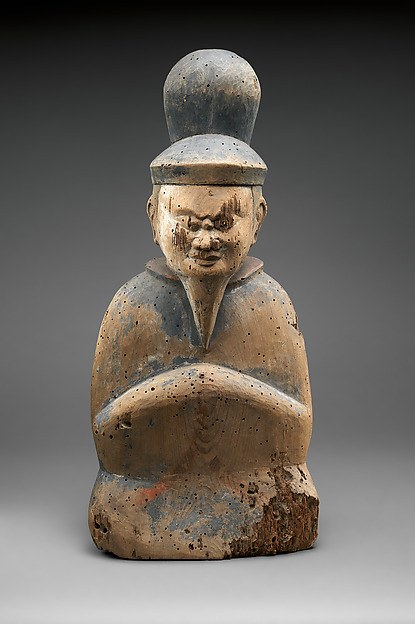
Shinto Deity as a Seated Courtier, eleventh–twelfth century. The figure presents a kami through the visual language of court rank. It records a historical form of sacred representation, rather than a universal appearance assigned to every kami.
The Metropolitan Museum of Art. Purchase, Friends of Asian Art Gifts, 2015. Accession 2015.5. Public Domain (CC0). · Museum record ↗ · CC0
Sources
- What is Shinto? ↗Jinja Honcho, Association of Shinto ShrinesReturn to text ↑
- At a Jinja ↗Jinja Honcho, Association of Shinto ShrinesReturn to text ↑
- Entering a Jinja ↗Jinja Honcho, Association of Shinto ShrinesReturn to text ↑
- Ise Jingu ↗Jinja Honcho, Association of Shinto ShrinesReturn to text ↑
- Matsuri: Japanese Traditional Festival ↗Jinja Honcho, Association of Shinto ShrinesReturn to text ↑
- Japanese Myths: Sources of Myths ↗Jinja Honcho, Association of Shinto ShrinesReturn to text ↑
- An Overview of Shinto Texts and of Trends in Research ↗Kokugakuin University, Encyclopedia of ShintoReturn to text ↑
- The Complexity of the Nihon Shoki ↗Kokugakuin University, Encyclopedia of ShintoReturn to text ↑
- State Shinto ↗Kokugakuin University, Encyclopedia of ShintoReturn to text ↑
- Misogi ↗Kokugakuin University, Encyclopedia of ShintoReturn to text ↑
- Introduction: Institutions and Administrative Practices ↗Kokugakuin University, Encyclopedia of ShintoReturn to text ↑
- Shinto ↗Department of Asian Art, The Metropolitan Museum of ArtReturn to text ↑
- Shinto Deity as a Seated Courtier ↗The Metropolitan Museum of Art, Open Access collection
About this article & its sources
An introduction centred on shrine practice and its history. Shinto has diverse institutions and interpretations; a single shrine association does not speak for every tradition.
Passage attributions
What is Shinto?
Passage 1: Jinja Honcho, Association of Shinto Shrines.
Passage 2: Jinja Honcho, Association of Shinto Shrines.
Jinja: sacred space and everyday visits
Passage 1: Jinja Honcho, Association of Shinto Shrines.
Passage 2: Jinja Honcho, Association of Shinto Shrines.
How a shrine visit takes shape
Passage 1: Jinja Honcho, Association of Shinto Shrines.
Passage 2: Jinja Honcho, Association of Shinto Shrines.
Purification: misogi and harae
Passage 1: Kokugakuin University, Encyclopedia of Shinto.
Passage 2: Kokugakuin University, Encyclopedia of Shinto.
Matsuri: offerings, celebration and community
Passage 1: Jinja Honcho, Association of Shinto Shrines.
Passage 2: Jinja Honcho, Association of Shinto Shrines.
Myths and the earliest surviving records
Passage 1: Jinja Honcho, Association of Shinto Shrines.
Passage 2: Jinja Honcho, Association of Shinto Shrines.
Why the myths do not form one fixed story
Passage 1: Kokugakuin University, Encyclopedia of Shinto.
Passage 2: Kokugakuin University, Encyclopedia of Shinto.
Texts, ritual learning and interpretation
Passage 1: Kokugakuin University, Encyclopedia of Shinto.
Passage 2: Kokugakuin University, Encyclopedia of Shinto.
Ise Jingu and the continuity of rebuilding
Passage 1: Jinja Honcho, Association of Shinto Shrines.
Passage 2: Jinja Honcho, Association of Shinto Shrines.
Kami and buddhas in Japanese religious history
Passage 1: Kokugakuin University, Encyclopedia of Shinto.
Passage 2: Kokugakuin University, Encyclopedia of Shinto.