Shapeshifting
Shapeshifting is a change of bodily form in myth, folklore and literature. Explore Circe’s transformations and Frank Hamel’s examples of animal forms and doubles.
In this article
What is shapeshifting?
Shapeshifting is a change of bodily form in myth, folklore and literature. The change might be voluntary, imposed by magic or bound to an object such as a skin or feather robe. The stories often turn on who can change back and on what survives the change. [1][2][3]
Someone in a new form may keep a voice, memory, promise or family bond recognisable to others. Other tales describe an appearance that deceives the eye or a double that appears while the original person stays elsewhere. [4][5][6][7][8]
See references (8)
- Human Animals, printed p. 5, Reader page 14
- Human Animals, printed p. 6, Reader page 15
- Human Animals, printed p. 7, Reader page 16
- Human Animals, printed p. 9, Reader page 18
- Human Animals, printed p. 13, Reader page 22
- Human Animals, printed p. 14, Reader page 23
- Human Animals, printed p. 68, Reader page 77
- Human Animals, printed p. 69, Reader page 78
Circe in Homer’s Odyssey
In book 10 of Homer’s Odyssey, Circe turns Odysseus’s companions into swine, but their understanding remains human. When she restores them, they recognise Odysseus. The vase painting shows Circe with the cup and wand associated with the transformation, and the men already have animal features. [19][18]
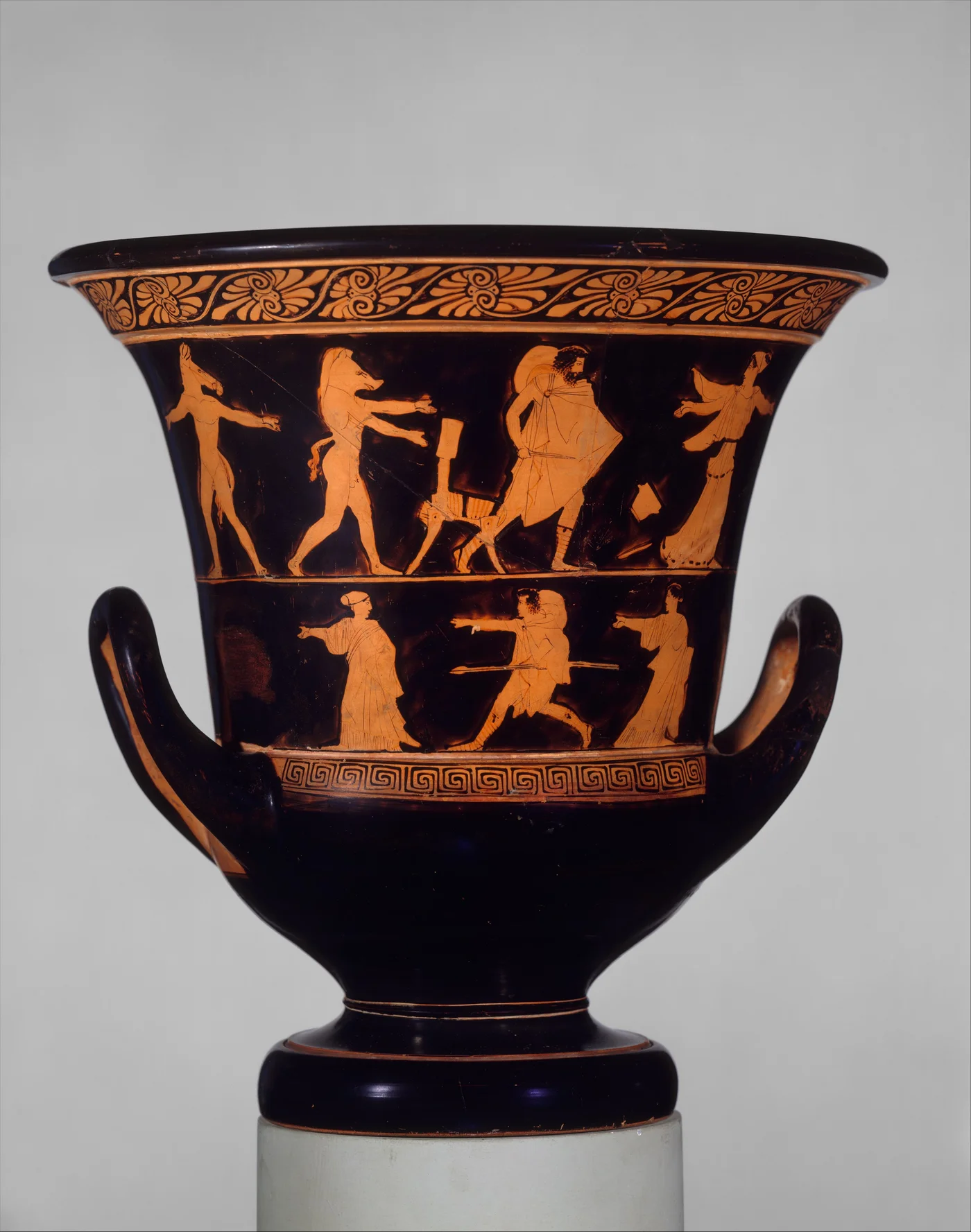
Attic calyx-krater attributed to the Persephone Painter, about 440 BCE. Odysseus confronts Circe amid men shown with animal features, an ancient visual treatment of human–animal transformation.
The Metropolitan Museum of Art. Gift of Amelia E. White, 1941. 41.83. Open Access; Public Domain. · Image source ↗ · Public Domain
Human Animals by Frank Hamel
Frank Hamel’s Human Animals gathers several explanations rather than one consistent mechanism. In its early chapters, a skin, belt or ointment can enable an animal form. Returning may require recovering clothes or removing the object. These conditions turn transformation into a problem of vulnerability: whoever controls the means of return can control the transformed person. [1][2][4][9]
Hamel’s account of the wolves of Ossory preserves the person beneath the animal appearance. A priest is asked to minister to a dying wolf, and the narrative reveals a human identity under the skin. The encounter makes compassion and religious obligation more important than the frightening exterior. [5][6]
The literary examples complicate the pattern. Lucius remains mentally human while living as an ass after a mistaken application of ointment. In the chase involving Taliesin, successive animal forms answer one another as predator and prey. One story traps a consciousness in an unwanted body; another makes changing shape a contest of ingenuity. [10][11][12]
See references (9)
- Human Animals, printed p. 5, Reader page 14
- Human Animals, printed p. 6, Reader page 15
- Human Animals, printed p. 9, Reader page 18
- Human Animals, printed p. 13, Reader page 22
- Human Animals, printed p. 14, Reader page 23
- Human Animals, printed p. 10, Reader page 19
- Human Animals, printed p. 139, Reader page 148
- Human Animals, printed p. 140, Reader page 149
- Human Animals, printed p. 141, Reader page 150
A change of body, disguise or double?
A werewolf changes into a wolf or seems to do so. An animal spouse may conceal a form or identity from their partner. An animal double can appear away from the person it resembles. The same outward change can raise three different questions about the body, recognition and identity. [7][8][12][13]
Hamel also reports court accusations and modern occult theories. Their presence alongside stories does not give them the same evidential status. A tale’s internal explanation tells us how its world works; an accusation tells us what someone alleged or was made to confess. [14][15][16][17]
See references (8)
- Human Animals, printed p. 68, Reader page 77
- Human Animals, printed p. 69, Reader page 78
- Human Animals, printed p. 141, Reader page 150
- Human Animals, printed p. 145, Reader page 154
- Human Animals, printed p. 54, Reader page 63
- Human Animals, printed p. 55, Reader page 64
- Human Animals, printed p. 60, Reader page 69
- Human Animals, printed p. 61, Reader page 70
Read further in the library

Human Animals
Reading note
Frank Hamel collects the particular stories and interpretations discussed here; the account identifies exact printed and Library Reader pages.
Sources
See references (19)
- Human Animals, printed p. 5, Reader page 14Frank Hamel, Human Animals. Frederick A. Stokes Co., New York, undated title page; preface dated London, 1915. Exact printed pages refer to the retained Library scan.Read this page in Human Animals ↗Return to text ↑
- Human Animals, printed p. 6, Reader page 15Frank Hamel, Human Animals. Frederick A. Stokes Co., New York, undated title page; preface dated London, 1915. Exact printed pages refer to the retained Library scan.Read this page in Human Animals ↗Return to text ↑
- Human Animals, printed p. 7, Reader page 16Frank Hamel, Human Animals. Frederick A. Stokes Co., New York, undated title page; preface dated London, 1915. Exact printed pages refer to the retained Library scan.Read this page in Human Animals ↗Return to text ↑
- Human Animals, printed p. 9, Reader page 18Frank Hamel, Human Animals. Frederick A. Stokes Co., New York, undated title page; preface dated London, 1915. Exact printed pages refer to the retained Library scan.Read this page in Human Animals ↗Return to text ↑
- Human Animals, printed p. 13, Reader page 22Frank Hamel, Human Animals. Frederick A. Stokes Co., New York, undated title page; preface dated London, 1915. Exact printed pages refer to the retained Library scan.Read this page in Human Animals ↗Return to text ↑
- Human Animals, printed p. 14, Reader page 23Frank Hamel, Human Animals. Frederick A. Stokes Co., New York, undated title page; preface dated London, 1915. Exact printed pages refer to the retained Library scan.Read this page in Human Animals ↗Return to text ↑
- Human Animals, printed p. 68, Reader page 77Frank Hamel, Human Animals. Frederick A. Stokes Co., New York, undated title page; preface dated London, 1915. Exact printed pages refer to the retained Library scan.Read this page in Human Animals ↗Return to text ↑
- Human Animals, printed p. 69, Reader page 78Frank Hamel, Human Animals. Frederick A. Stokes Co., New York, undated title page; preface dated London, 1915. Exact printed pages refer to the retained Library scan.Read this page in Human Animals ↗Return to text ↑
- Human Animals, printed p. 10, Reader page 19Frank Hamel, Human Animals. Frederick A. Stokes Co., New York, undated title page; preface dated London, 1915. Exact printed pages refer to the retained Library scan.Read this page in Human Animals ↗Return to text ↑
- Human Animals, printed p. 139, Reader page 148Frank Hamel, Human Animals. Frederick A. Stokes Co., New York, undated title page; preface dated London, 1915. Exact printed pages refer to the retained Library scan.Read this page in Human Animals ↗Return to text ↑
- Human Animals, printed p. 140, Reader page 149Frank Hamel, Human Animals. Frederick A. Stokes Co., New York, undated title page; preface dated London, 1915. Exact printed pages refer to the retained Library scan.Read this page in Human Animals ↗Return to text ↑
- Human Animals, printed p. 141, Reader page 150Frank Hamel, Human Animals. Frederick A. Stokes Co., New York, undated title page; preface dated London, 1915. Exact printed pages refer to the retained Library scan.Read this page in Human Animals ↗Return to text ↑
- Human Animals, printed p. 145, Reader page 154Frank Hamel, Human Animals. Frederick A. Stokes Co., New York, undated title page; preface dated London, 1915. Exact printed pages refer to the retained Library scan.Read this page in Human Animals ↗Return to text ↑
- Human Animals, printed p. 54, Reader page 63Frank Hamel, Human Animals. Frederick A. Stokes Co., New York, undated title page; preface dated London, 1915. Exact printed pages refer to the retained Library scan.Read this page in Human Animals ↗Return to text ↑
- Human Animals, printed p. 55, Reader page 64Frank Hamel, Human Animals. Frederick A. Stokes Co., New York, undated title page; preface dated London, 1915. Exact printed pages refer to the retained Library scan.Read this page in Human Animals ↗Return to text ↑
- Human Animals, printed p. 60, Reader page 69Frank Hamel, Human Animals. Frederick A. Stokes Co., New York, undated title page; preface dated London, 1915. Exact printed pages refer to the retained Library scan.Read this page in Human Animals ↗Return to text ↑
- Human Animals, printed p. 61, Reader page 70Frank Hamel, Human Animals. Frederick A. Stokes Co., New York, undated title page; preface dated London, 1915. Exact printed pages refer to the retained Library scan.Read this page in Human Animals ↗Return to text ↑
- Terracotta calyx-krater (bowl for mixing wine and water) ↗The Metropolitan Museum of Art, 41.83. Public-domain image and object metadata. Curatorial attribution retained.Return to text ↑
- Homer, Odyssey 10.233–243 and 10.388–399 ↗Homer, Odyssey, translated by A. T. Murray.Return to text ↑