Animal spouses
Animal-spouse tales follow marriages across animal and human forms. See how hidden skins, promises and discovery shape the stories Frank Hamel collected.
In this article
What are animal-spouse tales?
An animal-spouse tale follows a marriage or intimate relationship in which one partner appears as an animal or conceals an animal identity. A skin or feather garment may let the partner change form. A promise can determine whether they will stay. [1][2][3][4]
Finding the garment or discovering the animal can end the enchantment, end the marriage or change what the couple knows about each other. The outcome depends on whose choice the story makes decisive. [4][5][6][7][8]
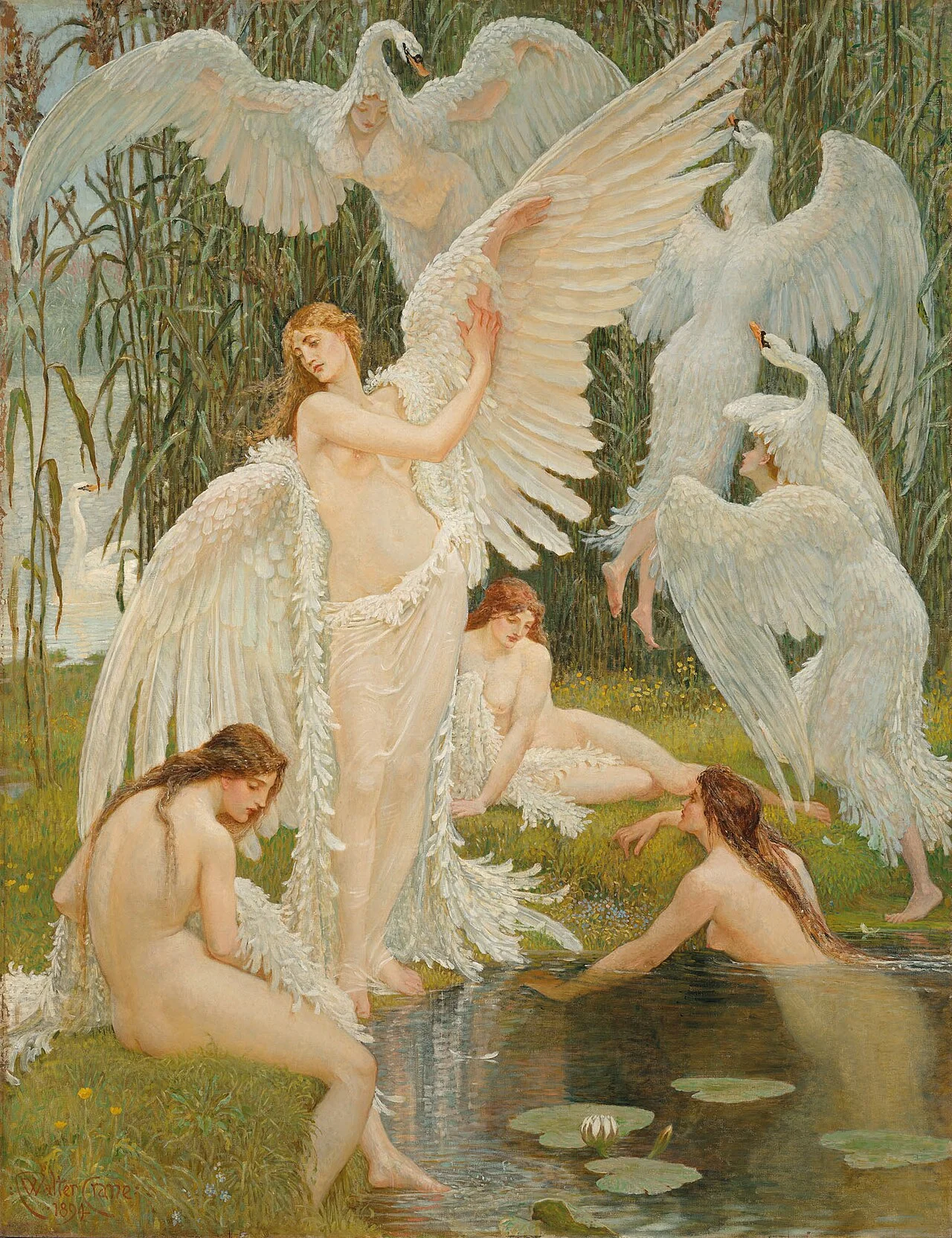
Walter Crane, The Swan Maidens, 1894. Crane shows the women and birds together, bringing the two forms into the same scene.
Walter Crane, 1845–1915. Faithful reproduction of a public-domain painting, via Wikimedia Commons. · Image source ↗ · Public Domain
See references (8)
- Human Animals, printed p. 141, Reader page 150
- Human Animals, printed p. 142, Reader page 151
- Human Animals, printed p. 143, Reader page 152
- Human Animals, printed p. 145, Reader page 154
- Human Animals, printed p. 175, Reader page 184
- Human Animals, printed p. 176, Reader page 185
- Human Animals, printed p. 179, Reader page 188
- Human Animals, printed p. 180, Reader page 189
Human Animals by Frank Hamel
Frank Hamel’s Human Animals collects dog, mouse, monkey, bird and serpent marriages. In one dog-bride story, outward form conceals a desirable human partner. The mouse’s jacket likewise makes an animal appearance removable. The transformation tests whether the human partner can recognise a person beneath an unexpected exterior. [1][2][3][9][4]
Burning the covering has different results in Hamel’s examples. It harms the transformed spouse in a monkey-skin story. Some serpent marriages make a destroyed covering the end of an enchantment, while another makes it the breach of a condition the marriage depended on. [4][5][6][7][8][10][11]
The bird-maiden stories make possession of a garment especially consequential. Concealment can secure a marriage, while recovery makes departure possible. Those narratives ask who controls the terms of the relationship as well as what body the spouse has. [4][12][13][14]
See references (14)
- Human Animals, printed p. 141, Reader page 150
- Human Animals, printed p. 142, Reader page 151
- Human Animals, printed p. 143, Reader page 152
- Human Animals, printed p. 145, Reader page 154
- Human Animals, printed p. 175, Reader page 184
- Human Animals, printed p. 176, Reader page 185
- Human Animals, printed p. 179, Reader page 188
- Human Animals, printed p. 180, Reader page 189
- Human Animals, printed p. 144, Reader page 153
- Human Animals, printed p. 181, Reader page 190
- Human Animals, printed p. 182, Reader page 191
- Human Animals, printed p. 146, Reader page 155
- Human Animals, printed p. 211, Reader page 220
- Human Animals, printed p. 212, Reader page 221
Recognition, promises and the freedom to leave
In the Japanese fox-wife tale, the husband welcomes his wife back after learning she is a fox. That outcome depends on his accepting a known identity. In a swan-maiden tale, recovering the garment can instead give a spouse back the freedom to leave. [15][4][12][13][14]
The tales vary in what makes the relationship possible. One may depend on keeping a promise, another on acknowledging an unfamiliar partner, and another on one person controlling the other’s means of departure. [15][4][12][5][6][8]
See references (8)
- Human Animals, printed p. 145, Reader page 154
- Human Animals, printed p. 175, Reader page 184
- Human Animals, printed p. 176, Reader page 185
- Human Animals, printed p. 180, Reader page 189
- Human Animals, printed p. 146, Reader page 155
- Human Animals, printed p. 211, Reader page 220
- Human Animals, printed p. 212, Reader page 221
- Human Animals, printed p. 89, Reader page 98
Read further in the library
Human Animals
Reading note
Frank Hamel collects the particular stories and interpretations discussed here; the account identifies exact printed and Library Reader pages.
Sources
See references (16)
- Human Animals, printed p. 141, Reader page 150Frank Hamel, Human Animals. Frederick A. Stokes Co., New York, undated title page; preface dated London, 1915. Exact printed pages refer to the retained Library scan.Read this page in Human Animals ↗Return to text ↑
- Human Animals, printed p. 142, Reader page 151Frank Hamel, Human Animals. Frederick A. Stokes Co., New York, undated title page; preface dated London, 1915. Exact printed pages refer to the retained Library scan.Read this page in Human Animals ↗Return to text ↑
- Human Animals, printed p. 143, Reader page 152Frank Hamel, Human Animals. Frederick A. Stokes Co., New York, undated title page; preface dated London, 1915. Exact printed pages refer to the retained Library scan.Read this page in Human Animals ↗Return to text ↑
- Human Animals, printed p. 145, Reader page 154Frank Hamel, Human Animals. Frederick A. Stokes Co., New York, undated title page; preface dated London, 1915. Exact printed pages refer to the retained Library scan.Read this page in Human Animals ↗Return to text ↑
- Human Animals, printed p. 175, Reader page 184Frank Hamel, Human Animals. Frederick A. Stokes Co., New York, undated title page; preface dated London, 1915. Exact printed pages refer to the retained Library scan.Read this page in Human Animals ↗Return to text ↑
- Human Animals, printed p. 176, Reader page 185Frank Hamel, Human Animals. Frederick A. Stokes Co., New York, undated title page; preface dated London, 1915. Exact printed pages refer to the retained Library scan.Read this page in Human Animals ↗Return to text ↑
- Human Animals, printed p. 179, Reader page 188Frank Hamel, Human Animals. Frederick A. Stokes Co., New York, undated title page; preface dated London, 1915. Exact printed pages refer to the retained Library scan.Read this page in Human Animals ↗Return to text ↑
- Human Animals, printed p. 180, Reader page 189Frank Hamel, Human Animals. Frederick A. Stokes Co., New York, undated title page; preface dated London, 1915. Exact printed pages refer to the retained Library scan.Read this page in Human Animals ↗Return to text ↑
- Human Animals, printed p. 144, Reader page 153Frank Hamel, Human Animals. Frederick A. Stokes Co., New York, undated title page; preface dated London, 1915. Exact printed pages refer to the retained Library scan.Read this page in Human Animals ↗Return to text ↑
- Human Animals, printed p. 181, Reader page 190Frank Hamel, Human Animals. Frederick A. Stokes Co., New York, undated title page; preface dated London, 1915. Exact printed pages refer to the retained Library scan.Read this page in Human Animals ↗Return to text ↑
- Human Animals, printed p. 182, Reader page 191Frank Hamel, Human Animals. Frederick A. Stokes Co., New York, undated title page; preface dated London, 1915. Exact printed pages refer to the retained Library scan.Read this page in Human Animals ↗Return to text ↑
- Human Animals, printed p. 146, Reader page 155Frank Hamel, Human Animals. Frederick A. Stokes Co., New York, undated title page; preface dated London, 1915. Exact printed pages refer to the retained Library scan.Read this page in Human Animals ↗Return to text ↑
- Human Animals, printed p. 211, Reader page 220Frank Hamel, Human Animals. Frederick A. Stokes Co., New York, undated title page; preface dated London, 1915. Exact printed pages refer to the retained Library scan.Read this page in Human Animals ↗Return to text ↑
- Human Animals, printed p. 212, Reader page 221Frank Hamel, Human Animals. Frederick A. Stokes Co., New York, undated title page; preface dated London, 1915. Exact printed pages refer to the retained Library scan.Read this page in Human Animals ↗Return to text ↑
- Human Animals, printed p. 89, Reader page 98Frank Hamel, Human Animals. Frederick A. Stokes Co., New York, undated title page; preface dated London, 1915. Exact printed pages refer to the retained Library scan.Read this page in Human Animals ↗Return to text ↑
- Walter Crane, The Swan Maidens, 1894 ↗Walter Crane, 1845–1915. Faithful reproduction of a public-domain painting, via Wikimedia Commons.