Selfless Service
Selfless service means acting for another’s good. Compare Vivekananda on giving, Steiner on developing useful capacities, and Claude’s story of helping.
In this article
Understanding the concept
Selfless service means acting for another person’s good without making their need a way to secure praise, gratitude or advancement. In Karma-Yoga, the act can change the person who gives. In Initiation and Its Results, the question is what a person will do with abilities they have acquired. [1][2][3]
Karma-Yoga by Swami Vivekananda
Swami Vivekananda’s Karma-Yoga examines the relation between helping another person and changing oneself. He argues that acts of charity, sympathy and assistance weaken self-importance. The other person’s presence gives the helper an occasion to practise generosity, rather than creating a debt of gratitude. [16][17][18][19][20][21]
He distinguishes physical, intellectual and spiritual help, ranking spiritual knowledge highest because he believes it can end the condition of want itself. Food and clothing meet needs that recur. This hierarchy belongs to his account of liberation; it is not evidence that material needs can safely be ignored or that teaching replaces necessary assistance. [22][23][24]
Vivekananda says the world does not depend on the particular person who happens to help. He still asks people to do good. The chance to help becomes something the giver can be grateful for, rather than a reason to expect gratitude. [16][17][18][19]
Vivekananda also acknowledges the relative good of assistance while denying that work can permanently perfect the world. Those claims distinguish an immediate benefit from final liberation. The recurring need for food illustrates why, in his argument, useful aid and the end of all bondage are different aims. [25][26][27]
His ideal allows an unselfish person to reach the goal without accepting a religious doctrine. What matters in that passage is the actual relinquishment of self-centred motive. Other passages formulate the same work devotionally as worship of God through helping another person. [19][28][29][25]
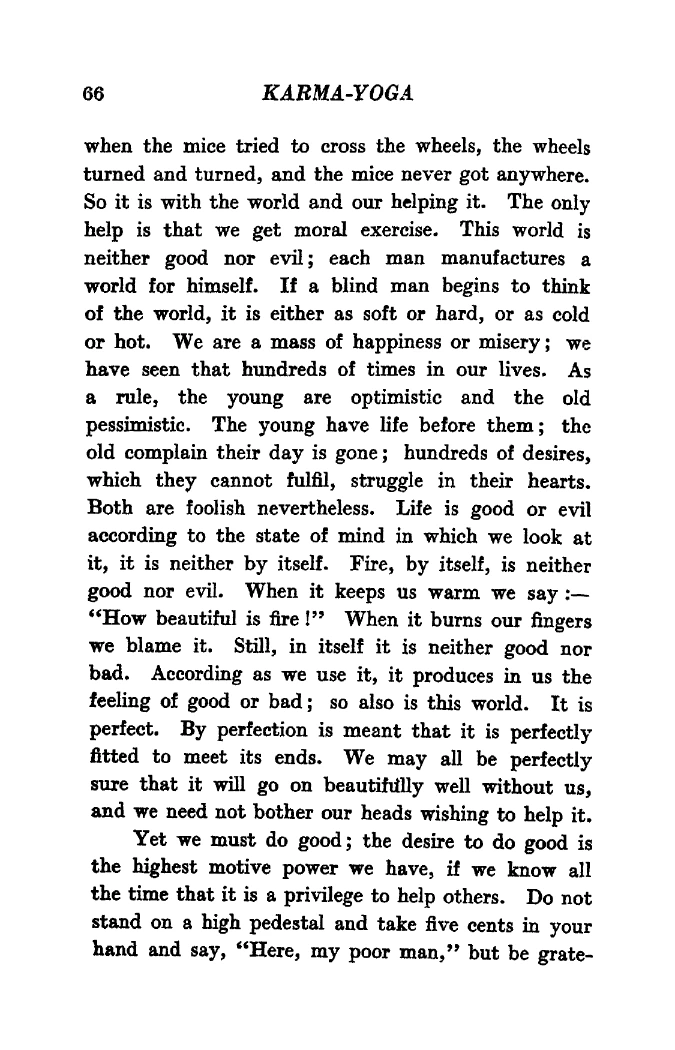
Karma-Yoga (1939), Library Reader page 68. Vivekananda places a duty to do good beside his criticism of the benefactor’s pride.
Swami Vivekananda, Karma-Yoga, English second printing in the 1939 combined volume. Historical public-domain text, exact checksum-verified Library scan. · Image source ↗ · Public Domain
See references (14)
- Karma-Yoga, Reader page 67
- Karma-Yoga, Reader page 68
- Karma-Yoga, Reader page 69
- Karma-Yoga, Reader page 70
- Karma-Yoga, Reader page 79
- Karma-Yoga, Reader page 80
- Karma-Yoga, Reader page 37
- Karma-Yoga, Reader page 38
- Karma-Yoga, printed p. 37, Reader page 39
- Karma-Yoga, Reader page 115
- Karma-Yoga, Reader page 116
- Karma-Yoga, Reader page 117
- Karma-Yoga, Reader page 82
- Karma-Yoga, Reader page 91
Initiation and Its Results by Rudolf Steiner
In Initiation and Its Results, Rudolf Steiner compares personal development with a rose growing more beautiful in a garden. The rose’s growth adds something to the whole garden. He uses the image to argue that a person can develop capacities in ways that make them more useful to others. [2][3]
The preceding discussion keeps this claim connected with ordinary action. Even a small deed has significance within the larger household of the world. Right valuation should therefore deepen attention to daily affairs instead of encouraging contempt for them. [1]
Steiner’s account also distinguishes inward agreement from self-coercion. In discussing the six-petalled lotus, he describes bodily life, feeling and thought coming into harmony. The spirit should not behave as a slave-owner imposing its demands. His ideal is a duty that a person can freely want to fulfil. [4][5]
The book then interprets religious founders as initiates who understood how moral teaching transforms human nature. This supports Steiner’s own account of humanity’s spiritual development. It should not be presented as an established explanation of every religion’s history or its reasons for valuing service. [2][3]
The closing encounter with the Greater Guardian gives service a decisive place in the book. The initiate is told that powers developed through a shared earthly life must now be used for the liberation of others. Further spiritual entrance is blocked while capacities remain unapplied to that work. [11][12]
The Greater Guardian poses a final difficulty. Someone may be tempted to keep even a welcome spiritual state for themselves. Steiner gives the encounter its force by asking whether the person will put what they gained to work for others. [13][14]
The final page makes selfless labour part of the purpose of instruction. The teachers described there are concerned with using powers in the common work, and with holding back an entry sought only for private benefit. This sharpens the earlier garden image: cultivation is judged through its relation to a wider life. [14][15]
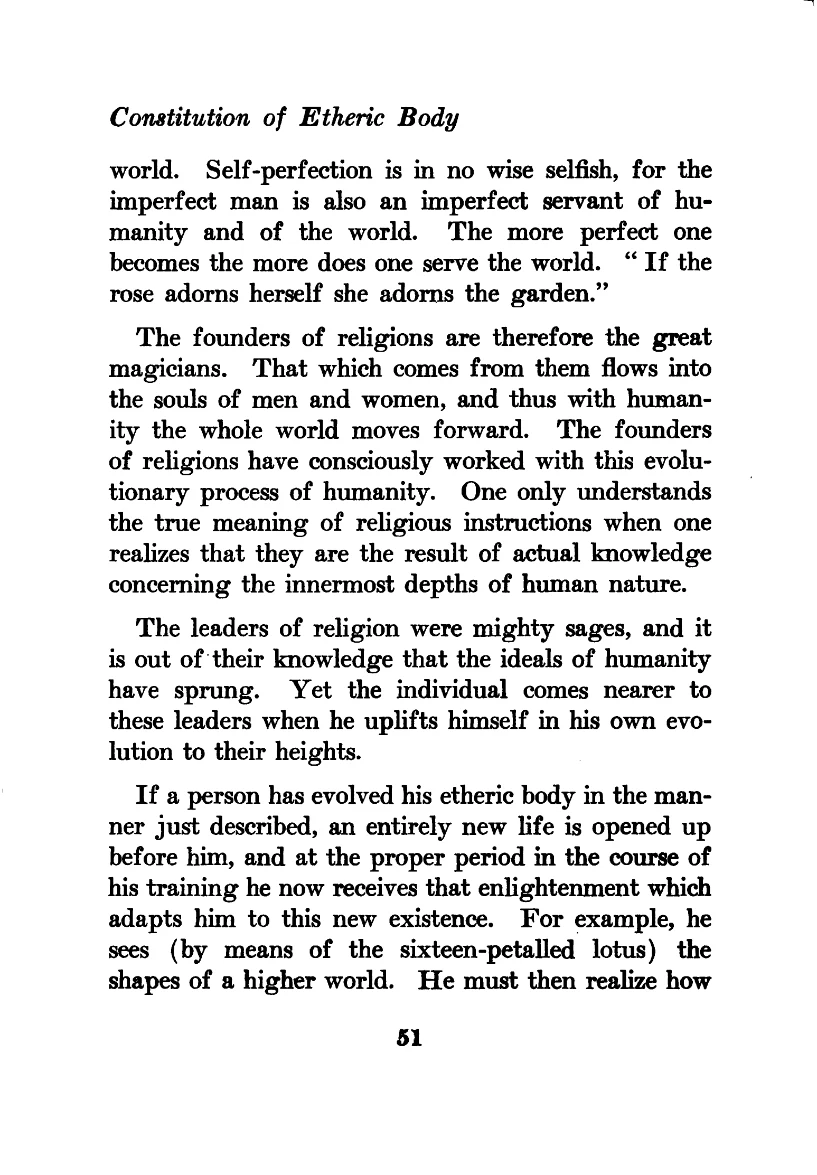
Initiation and Its Results (1909), printed p. 51, Library Reader page 50. Steiner asks what a person does for others with the capacities they develop.
Rudolf Steiner, Initiation and Its Results, Clifford Bax translation, First American Edition, 1909. Public-domain historical page from the checksum-verified Library PDF. · Image source ↗ · Public Domain
See references (10)
- Initiation and Its Results, printed p. 49, Reader page 48
- Initiation and Its Results, printed p. 50, Reader page 49
- Initiation and Its Results, printed p. 51, Reader page 50
- Initiation and Its Results, printed p. 35, Reader page 35
- Initiation and Its Results, printed p. 36, Reader page 36
- Initiation and Its Results, printed p. 130, Reader page 126
- Initiation and Its Results, Reader page 127
- Initiation and Its Results, printed p. 132, Reader page 128
- Initiation and Its Results, printed p. 133, Reader page 129
- Initiation and Its Results, Reader page 130
The Encyclopaedia of Death and Life in the Spirit-World, Volume I, compiled by J. R. Francis
In J. R. Francis’s anthology The Encyclopaedia of Death and Life in the Spirit-World, the dialogue called Thrilling Narrative of a Magdalen describes Claude returning from Summerland to assist women on earth. Her experience of exploitation and rejection is made part of her understanding of the people she hopes to help. A living friend’s promise of assistance extends the work across death. [6][7][8][9][10]
See references (5)
- The Encyclopaedia of Death and Life in Spirit-World, Volume I, printed p. 33, Reader page 32
- The Encyclopaedia of Death and Life in Spirit-World, Volume I, printed p. 34, Reader page 33
- The Encyclopaedia of Death and Life in Spirit-World, Volume I, printed p. 38, Reader page 37
- The Encyclopaedia of Death and Life in Spirit-World, Volume I, printed p. 39, Reader page 38
- The Encyclopaedia of Death and Life in Spirit-World, Volume I, printed p. 40, Reader page 39
What changes for the person who helps?
Steiner asks whether personal development makes someone more able to help. Vivekananda asks what happens when the helper lets go of being indispensable. The value of either aim becomes clearer when the reader also considers what the recipient actually needs. [1][2][3][16][17][18][19][25]
Claude starts from experiences of exploitation and rejection. In her story, those memories become a reason to understand and help people facing similar circumstances. That is a narrative of how someone comes to serve, beside Steiner’s account of cultivated capacity and Vivekananda’s account of giving. [6][7][8][9][10][1][2][3][18][21]
See references (14)
- Initiation and Its Results, printed p. 49, Reader page 48
- Initiation and Its Results, printed p. 50, Reader page 49
- Initiation and Its Results, printed p. 51, Reader page 50
- The Encyclopaedia of Death and Life in Spirit-World, Volume I, printed p. 33, Reader page 32
- The Encyclopaedia of Death and Life in Spirit-World, Volume I, printed p. 34, Reader page 33
- The Encyclopaedia of Death and Life in Spirit-World, Volume I, printed p. 38, Reader page 37
- The Encyclopaedia of Death and Life in Spirit-World, Volume I, printed p. 39, Reader page 38
- The Encyclopaedia of Death and Life in Spirit-World, Volume I, printed p. 40, Reader page 39
- Karma-Yoga, Reader page 67
- Karma-Yoga, Reader page 68
- Karma-Yoga, Reader page 69
- Karma-Yoga, Reader page 70
- Karma-Yoga, Reader page 80
- Karma-Yoga, Reader page 115
Read further in the library

Initiation and Its Results
Reading note
The separately titled account draws on exact passages in the consulted Library edition.

The Encyclopaedia of Death and Life in the Spirit-World, Volume I
Reading note
Separately attributed comparison with exact previously researched Library passages.

Karma Yoga
Reading note
The separately titled account draws on exact passages in the consulted Library edition.
Sources
See references (29)
- Initiation and Its Results, printed p. 49, Reader page 48Rudolf Steiner, Initiation and Its Results: A Sequel to The Way of Initiation, translated by Clifford Bax. First American Edition, 1909. Macoy Publishing and Masonic Supply Co., New York; Max Gysi, London. Claims of clairvoyant perception and subtle organs remain attributed. References identify the exact consulted Library edition.Read this page in Initiation and Its Results ↗Return to text ↑
- Initiation and Its Results, printed p. 50, Reader page 49Rudolf Steiner, Initiation and Its Results: A Sequel to The Way of Initiation, translated by Clifford Bax. First American Edition, 1909. Macoy Publishing and Masonic Supply Co., New York; Max Gysi, London. Claims of clairvoyant perception and subtle organs remain attributed. References identify the exact consulted Library edition.Read this page in Initiation and Its Results ↗Return to text ↑
- Initiation and Its Results, printed p. 51, Reader page 50Rudolf Steiner, Initiation and Its Results: A Sequel to The Way of Initiation, translated by Clifford Bax. First American Edition, 1909. Macoy Publishing and Masonic Supply Co., New York; Max Gysi, London. Claims of clairvoyant perception and subtle organs remain attributed. References identify the exact consulted Library edition.Read this page in Initiation and Its Results ↗Return to text ↑
- Initiation and Its Results, printed p. 35, Reader page 35Rudolf Steiner, Initiation and Its Results: A Sequel to The Way of Initiation, translated by Clifford Bax. First American Edition, 1909. Macoy Publishing and Masonic Supply Co., New York; Max Gysi, London. Claims of clairvoyant perception and subtle organs remain attributed. References identify the exact consulted Library edition.Read this page in Initiation and Its Results ↗Return to text ↑
- Initiation and Its Results, printed p. 36, Reader page 36Rudolf Steiner, Initiation and Its Results: A Sequel to The Way of Initiation, translated by Clifford Bax. First American Edition, 1909. Macoy Publishing and Masonic Supply Co., New York; Max Gysi, London. Claims of clairvoyant perception and subtle organs remain attributed. References identify the exact consulted Library edition.Read this page in Initiation and Its Results ↗Return to text ↑
- The Encyclopaedia of Death and Life in Spirit-World, Volume I, printed p. 33, Reader page 32J. R. Francis (compiler), The Encyclopaedia of Death and Life in Spirit-World, Volume I, fourth edition, Progressive Thinker Publishing House, Chicago, 1903. Individual contributors identified in the text.Read this page in The Encyclopaedia of Death and Life in the Spirit-World, Volume I ↗Return to text ↑
- The Encyclopaedia of Death and Life in Spirit-World, Volume I, printed p. 34, Reader page 33J. R. Francis (compiler), The Encyclopaedia of Death and Life in Spirit-World, Volume I, fourth edition, Progressive Thinker Publishing House, Chicago, 1903. Individual contributors identified in the text.Read this page in The Encyclopaedia of Death and Life in the Spirit-World, Volume I ↗Return to text ↑
- The Encyclopaedia of Death and Life in Spirit-World, Volume I, printed p. 38, Reader page 37J. R. Francis (compiler), The Encyclopaedia of Death and Life in Spirit-World, Volume I, fourth edition, Progressive Thinker Publishing House, Chicago, 1903. Individual contributors identified in the text.Read this page in The Encyclopaedia of Death and Life in the Spirit-World, Volume I ↗Return to text ↑
- The Encyclopaedia of Death and Life in Spirit-World, Volume I, printed p. 39, Reader page 38J. R. Francis (compiler), The Encyclopaedia of Death and Life in Spirit-World, Volume I, fourth edition, Progressive Thinker Publishing House, Chicago, 1903. Individual contributors identified in the text.Read this page in The Encyclopaedia of Death and Life in the Spirit-World, Volume I ↗Return to text ↑
- The Encyclopaedia of Death and Life in Spirit-World, Volume I, printed p. 40, Reader page 39J. R. Francis (compiler), The Encyclopaedia of Death and Life in Spirit-World, Volume I, fourth edition, Progressive Thinker Publishing House, Chicago, 1903. Individual contributors identified in the text.Read this page in The Encyclopaedia of Death and Life in the Spirit-World, Volume I ↗Return to text ↑
- Initiation and Its Results, printed p. 130, Reader page 126Rudolf Steiner, Initiation and Its Results: A Sequel to The Way of Initiation, translated by Clifford Bax. First American Edition, 1909. Macoy Publishing and Masonic Supply Co., New York; Max Gysi, London. Claims of clairvoyant perception and subtle organs remain attributed. References identify the exact consulted Library edition.Read this page in Initiation and Its Results ↗Return to text ↑
- Initiation and Its Results, Reader page 127Rudolf Steiner, Initiation and Its Results: A Sequel to The Way of Initiation, translated by Clifford Bax. First American Edition, 1909. Macoy Publishing and Masonic Supply Co., New York; Max Gysi, London. Claims of clairvoyant perception and subtle organs remain attributed. References identify the exact consulted Library edition.Read this page in Initiation and Its Results ↗Return to text ↑
- Initiation and Its Results, printed p. 132, Reader page 128Rudolf Steiner, Initiation and Its Results: A Sequel to The Way of Initiation, translated by Clifford Bax. First American Edition, 1909. Macoy Publishing and Masonic Supply Co., New York; Max Gysi, London. Claims of clairvoyant perception and subtle organs remain attributed. References identify the exact consulted Library edition.Read this page in Initiation and Its Results ↗Return to text ↑
- Initiation and Its Results, printed p. 133, Reader page 129Rudolf Steiner, Initiation and Its Results: A Sequel to The Way of Initiation, translated by Clifford Bax. First American Edition, 1909. Macoy Publishing and Masonic Supply Co., New York; Max Gysi, London. Claims of clairvoyant perception and subtle organs remain attributed. References identify the exact consulted Library edition.Read this page in Initiation and Its Results ↗Return to text ↑
- Initiation and Its Results, Reader page 130Rudolf Steiner, Initiation and Its Results: A Sequel to The Way of Initiation, translated by Clifford Bax. First American Edition, 1909. Macoy Publishing and Masonic Supply Co., New York; Max Gysi, London. Claims of clairvoyant perception and subtle organs remain attributed. References identify the exact consulted Library edition.Read this page in Initiation and Its Results ↗Return to text ↑
- Karma-Yoga, Reader page 67Swami Vivekananda, Karma-Yoga, in Karma-Yoga & Bhakti-Yoga, English second printing, Ramakrishna-Vivekananda Center of New York, Inc., 1939. Exact Library edition IMJ-0097-E002. Only the Karma-Yoga part is used in this crawl; the old Work slug mentioning Hindi does not identify this edition’s language.Read this page in Karma Yoga ↗Return to text ↑
- Karma-Yoga, Reader page 68Swami Vivekananda, Karma-Yoga, in Karma-Yoga & Bhakti-Yoga, English second printing, Ramakrishna-Vivekananda Center of New York, Inc., 1939. Exact Library edition IMJ-0097-E002. Only the Karma-Yoga part is used in this crawl; the old Work slug mentioning Hindi does not identify this edition’s language.Read this page in Karma Yoga ↗Return to text ↑
- Karma-Yoga, Reader page 69Swami Vivekananda, Karma-Yoga, in Karma-Yoga & Bhakti-Yoga, English second printing, Ramakrishna-Vivekananda Center of New York, Inc., 1939. Exact Library edition IMJ-0097-E002. Only the Karma-Yoga part is used in this crawl; the old Work slug mentioning Hindi does not identify this edition’s language.Read this page in Karma Yoga ↗Return to text ↑
- Karma-Yoga, Reader page 70Swami Vivekananda, Karma-Yoga, in Karma-Yoga & Bhakti-Yoga, English second printing, Ramakrishna-Vivekananda Center of New York, Inc., 1939. Exact Library edition IMJ-0097-E002. Only the Karma-Yoga part is used in this crawl; the old Work slug mentioning Hindi does not identify this edition’s language.Read this page in Karma Yoga ↗Return to text ↑
- Karma-Yoga, Reader page 79Swami Vivekananda, Karma-Yoga, in Karma-Yoga & Bhakti-Yoga, English second printing, Ramakrishna-Vivekananda Center of New York, Inc., 1939. Exact Library edition IMJ-0097-E002. Only the Karma-Yoga part is used in this crawl; the old Work slug mentioning Hindi does not identify this edition’s language.Read this page in Karma Yoga ↗Return to text ↑
- Karma-Yoga, Reader page 80Swami Vivekananda, Karma-Yoga, in Karma-Yoga & Bhakti-Yoga, English second printing, Ramakrishna-Vivekananda Center of New York, Inc., 1939. Exact Library edition IMJ-0097-E002. Only the Karma-Yoga part is used in this crawl; the old Work slug mentioning Hindi does not identify this edition’s language.Read this page in Karma Yoga ↗Return to text ↑
- Karma-Yoga, Reader page 37Swami Vivekananda, Karma-Yoga, in Karma-Yoga & Bhakti-Yoga, English second printing, Ramakrishna-Vivekananda Center of New York, Inc., 1939. Exact Library edition IMJ-0097-E002. Only the Karma-Yoga part is used in this crawl; the old Work slug mentioning Hindi does not identify this edition’s language.Read this page in Karma Yoga ↗Return to text ↑
- Karma-Yoga, Reader page 38Swami Vivekananda, Karma-Yoga, in Karma-Yoga & Bhakti-Yoga, English second printing, Ramakrishna-Vivekananda Center of New York, Inc., 1939. Exact Library edition IMJ-0097-E002. Only the Karma-Yoga part is used in this crawl; the old Work slug mentioning Hindi does not identify this edition’s language.Read this page in Karma Yoga ↗Return to text ↑
- Karma-Yoga, printed p. 37, Reader page 39Swami Vivekananda, Karma-Yoga, in Karma-Yoga & Bhakti-Yoga, English second printing, Ramakrishna-Vivekananda Center of New York, Inc., 1939. Exact Library edition IMJ-0097-E002. Only the Karma-Yoga part is used in this crawl; the old Work slug mentioning Hindi does not identify this edition’s language.Read this page in Karma Yoga ↗Return to text ↑
- Karma-Yoga, Reader page 115Swami Vivekananda, Karma-Yoga, in Karma-Yoga & Bhakti-Yoga, English second printing, Ramakrishna-Vivekananda Center of New York, Inc., 1939. Exact Library edition IMJ-0097-E002. Only the Karma-Yoga part is used in this crawl; the old Work slug mentioning Hindi does not identify this edition’s language.Read this page in Karma Yoga ↗Return to text ↑
- Karma-Yoga, Reader page 116Swami Vivekananda, Karma-Yoga, in Karma-Yoga & Bhakti-Yoga, English second printing, Ramakrishna-Vivekananda Center of New York, Inc., 1939. Exact Library edition IMJ-0097-E002. Only the Karma-Yoga part is used in this crawl; the old Work slug mentioning Hindi does not identify this edition’s language.Read this page in Karma Yoga ↗Return to text ↑
- Karma-Yoga, Reader page 117Swami Vivekananda, Karma-Yoga, in Karma-Yoga & Bhakti-Yoga, English second printing, Ramakrishna-Vivekananda Center of New York, Inc., 1939. Exact Library edition IMJ-0097-E002. Only the Karma-Yoga part is used in this crawl; the old Work slug mentioning Hindi does not identify this edition’s language.Read this page in Karma Yoga ↗Return to text ↑
- Karma-Yoga, Reader page 82Swami Vivekananda, Karma-Yoga, in Karma-Yoga & Bhakti-Yoga, English second printing, Ramakrishna-Vivekananda Center of New York, Inc., 1939. Exact Library edition IMJ-0097-E002. Only the Karma-Yoga part is used in this crawl; the old Work slug mentioning Hindi does not identify this edition’s language.Read this page in Karma Yoga ↗Return to text ↑
- Karma-Yoga, Reader page 91Swami Vivekananda, Karma-Yoga, in Karma-Yoga & Bhakti-Yoga, English second printing, Ramakrishna-Vivekananda Center of New York, Inc., 1939. Exact Library edition IMJ-0097-E002. Only the Karma-Yoga part is used in this crawl; the old Work slug mentioning Hindi does not identify this edition’s language.Read this page in Karma Yoga ↗Return to text ↑