Six-Petalled Lotus
Steiner’s six-petalled lotus is a proposed centre for the cooperation of body, feeling and thought. Read why he gives freely chosen conduct a central role.
In this article
Understanding the concept
The six-petalled lotus is a proposed centre in the middle of the body in Rudolf Steiner’s account of spiritual perception. He links it with bodily habits, feeling and thought becoming able to work together. [1][2][3]
Steiner says this harmony prepares the student to encounter beings of higher worlds. The account gives the ability to judge an encounter a place alongside the ability to perceive it. [2][3]
Initiation and Its Results by Rudolf Steiner
In Initiation and Its Results, Rudolf Steiner describes cooperation between body, soul and spirit. He wants a duty to become something the person can freely wish to do. That change matters more to his account than compliance forced by constant self-punishment. [1]
The book considers how restraint can become a continuing struggle. An attainment may need to wait if pursuing it in the prescribed way harms the body. [2]
The example belongs to Steiner’s discussion of how willing cooperation develops. It shows why he distinguishes a settled disposition from the effort needed to suppress a desire. [2]
Steiner makes the same distinction between seeing and knowing how to respond to what is seen. He says the six-petalled organ makes a further kind of encounter possible and leaves further work in learning to understand it. [3]
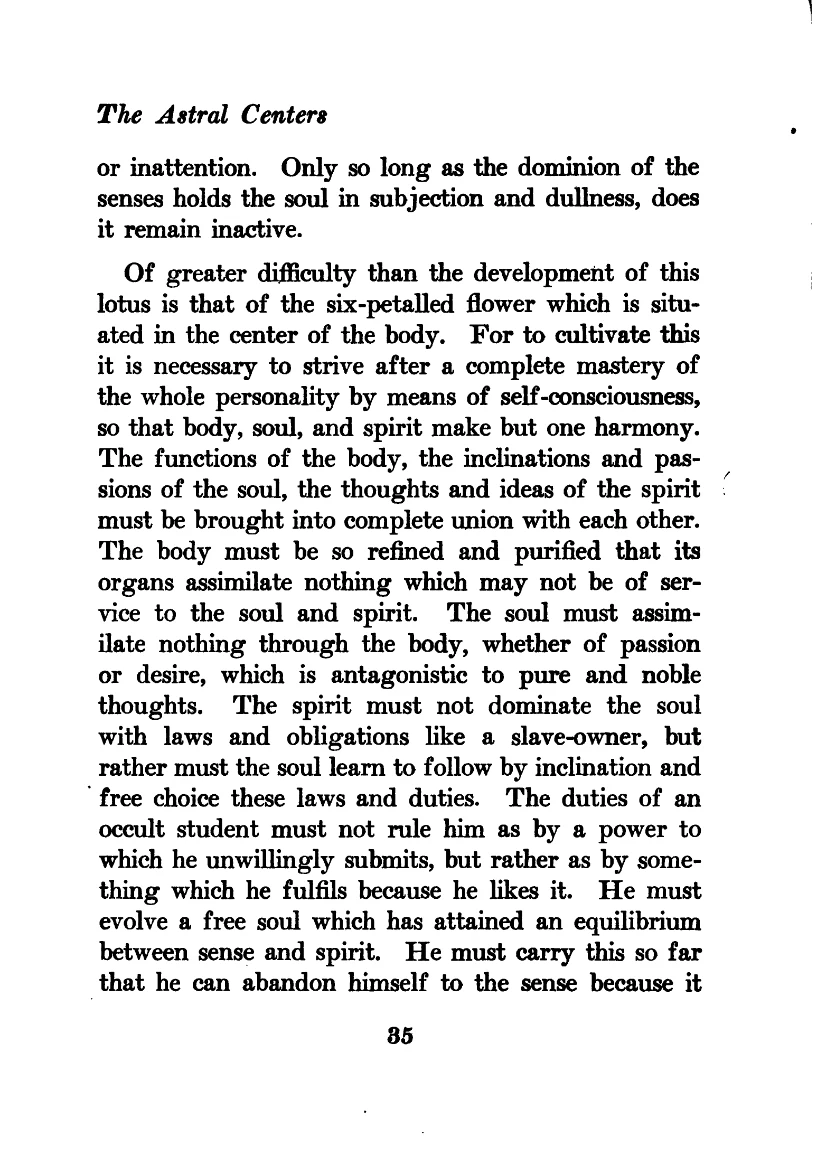
Initiation and Its Results (1909), printed p. 35, Library Reader page 35. Steiner introduces the six-petalled centre through the cooperation of body, soul and spirit.
Rudolf Steiner, Initiation and Its Results, Clifford Bax translation, First American Edition, 1909. Public-domain historical page from the checksum-verified Library PDF. · Image source ↗ · Public Domain
Heaven and Its Wonders and Hell by Emanuel Swedenborg
Emanuel Swedenborg calls the maintained relation between heavenly and infernal influence a spiritual equilibrium which makes free response possible. The Lord preserves that relation; it is not a person independently balancing two equal divine powers. [4][5][6]
Two kinds of balance
Steiner asks how bodily life, feeling and thought can act together within a person. Swedenborg asks how heaven and hell can exert opposing influences while a person remains free to choose. Coordination is inward in the first account and part of a larger divine order in the second. [1][3][4][5][6][2]
See references (6)
- Initiation and Its Results, printed p. 35, Reader page 35
- Initiation and Its Results, printed p. 36, Reader page 36
- Initiation and Its Results, printed p. 37, Reader page 37
- Heaven and Its Wonders and Hell, printed p. 560, Reader page 567
- Heaven and Its Wonders and Hell, printed p. 563, Reader page 570
- Heaven and Its Wonders and Hell, printed p. 568, Reader page 575
Read further in the library

Initiation and Its Results
Reading note
The separately titled account draws on exact passages in the consulted Library edition.

Heaven and Its Wonders and Hell
Reading note
Separately attributed comparison with exact previously researched Library passages.
Sources
See references (6)
- Initiation and Its Results, printed p. 35, Reader page 35Rudolf Steiner, Initiation and Its Results: A Sequel to The Way of Initiation, translated by Clifford Bax. First American Edition, 1909. Macoy Publishing and Masonic Supply Co., New York; Max Gysi, London. Claims of clairvoyant perception and subtle organs remain attributed. References identify the exact consulted Library edition.Read this page in Initiation and Its Results ↗Return to text ↑
- Initiation and Its Results, printed p. 36, Reader page 36Rudolf Steiner, Initiation and Its Results: A Sequel to The Way of Initiation, translated by Clifford Bax. First American Edition, 1909. Macoy Publishing and Masonic Supply Co., New York; Max Gysi, London. Claims of clairvoyant perception and subtle organs remain attributed. References identify the exact consulted Library edition.Read this page in Initiation and Its Results ↗Return to text ↑
- Initiation and Its Results, printed p. 37, Reader page 37Rudolf Steiner, Initiation and Its Results: A Sequel to The Way of Initiation, translated by Clifford Bax. First American Edition, 1909. Macoy Publishing and Masonic Supply Co., New York; Max Gysi, London. Claims of clairvoyant perception and subtle organs remain attributed. References identify the exact consulted Library edition.Read this page in Initiation and Its Results ↗Return to text ↑
- Heaven and Its Wonders and Hell, printed p. 560, Reader page 567Emanuel Swedenborg, Heaven and Its Wonders and Hell, From Things Heard and Seen, translated by J. C. Ager. American Swedenborg Printing and Publishing Society, New York, 1916. Latin original first published in 1758. Numbered sections and exact pages refer to this consulted edition. Claims of spiritual experience remain attributed.Read this page in Heaven and Its Wonders and Hell ↗Return to text ↑
- Heaven and Its Wonders and Hell, printed p. 563, Reader page 570Emanuel Swedenborg, Heaven and Its Wonders and Hell, From Things Heard and Seen, translated by J. C. Ager. American Swedenborg Printing and Publishing Society, New York, 1916. Latin original first published in 1758. Numbered sections and exact pages refer to this consulted edition. Claims of spiritual experience remain attributed.Read this page in Heaven and Its Wonders and Hell ↗Return to text ↑
- Heaven and Its Wonders and Hell, printed p. 568, Reader page 575Emanuel Swedenborg, Heaven and Its Wonders and Hell, From Things Heard and Seen, translated by J. C. Ager. American Swedenborg Printing and Publishing Society, New York, 1916. Latin original first published in 1758. Numbered sections and exact pages refer to this consulted edition. Claims of spiritual experience remain attributed.Read this page in Heaven and Its Wonders and Hell ↗Return to text ↑