Segaki
Segaki, also called sejiki, is a Japanese Buddhist offering rite for hungry ghosts and the dead. Learn about its food offerings, merit and remembrance.
In this article
What is segaki?
Segaki is a Japanese Buddhist rite of offering nourishment to hungry ghosts and dedicating merit to the dead. Some Zen communities use the name sejiki, or food offerings. The ceremony expresses care for beings without family to remember them and can also commemorate loved ones. [1][4][2][5]
An early image of the rite
A late twelfth-century handscroll in Kyoto traces the offerings to Ānanda. In section six, he hears of a hungry ghost in torment and teaches it a formula from the Buddha. In section seven, monks offer food and drink after Ānanda passes on what he learned. [7][8]

In the scroll’s seventh section, monks set out food and drink for the spirits of the dead.
Unknown artist, Kyoto National Museum AK229, via Wikimedia Commons · Image source ↗ · Public Domain
In Ghostly Japan by Lafcadio Hearn
In his Peony Lantern tale, Lafcadio Hearn has Shinzaburō seek a priest’s help after learning that his visitor is dead. The priest proposes a segaki service for her repose. Hearn’s note describes offerings for the dead who have nobody to care for them and calls this particular use exceptional. [5][4][6]
The priest also supplies a protective image and scripture. Ritual care for the dead and protection for the living man both matter in the story, and the priest gives each its own means. [4][6]
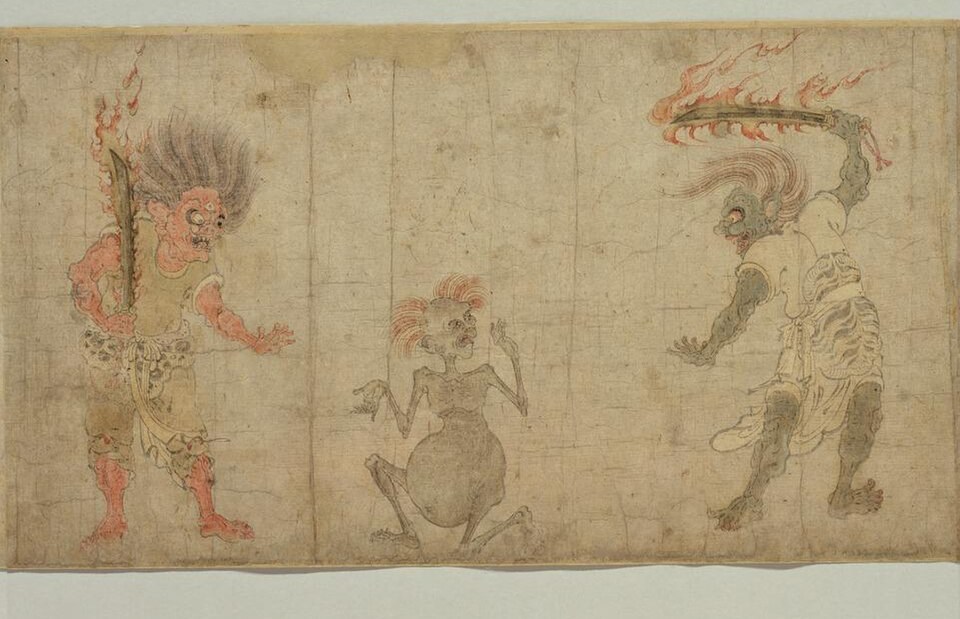
The Tokyo Hungry Ghosts Scroll depicts the suffering of the beings for whom such rites offer care.
Tokyo National Museum, A-10476. Public domain reproduction via Wikimedia Commons; resized and converted to JPEG. · Image source ↗ · Public Domain
Segaki in Shasta Abbey’s glossary
Shasta Abbey describes its Segaki as a memorial festival that transfers merit to the dead. Its glossary also says a ceremony may be held after a funeral. [1]
Sejiki in Brooklyn Zen Center’s account
Brooklyn Zen Center describes Sejiki as an offering to nourish hungry ghosts and an occasion to remember loved ones. Its account also connects insatiable hunger with the feeling of never having enough. [2]
Care and protection in the same story
The Kyoto scroll centres on relief for the hungry. The Zen communities link the rite with remembrance, while Hearn gives it a place in a story where the living fear the person who needs care. [4][1][2]
Read further in the library
In Ghostly Japan
Reading note
The separately titled account draws on exact passages in the consulted Library edition.
Sources
See references (8)
- Shasta Abbey glossary: Segaki ↗The monastery’s own description of its memorial ceremony and transfer of merit, directly read. Its calendar is not imposed on every community.Return to text ↑
- Brooklyn Zen Center: Sejiki ceremony announcement, 28 October 2026 ↗The community’s own account of offerings, care and reflective meanings, directly read. This is a dated announcement, not a claim that the event is still forthcoming.Return to text ↑
- Unknown artist, Hungry Ghosts Scroll, Tokyo, part 8, late 12th century ↗Tokyo National Museum, A-10476. Public domain reproduction via Wikimedia Commons; resized and converted to JPEG.
- In Ghostly Japan, Reader page 96Lafcadio Hearn, In Ghostly Japan, Little, Brown, and Company, Boston, 1899. Exact consulted Library edition IMJ-0654-E001, with title page visually checked. Persistent PageIDs and current Reader positions are verified from the supplied edition. Embedded stories, translations and quotations are attributed to Hearn’s presentation unless an original source has separately been consulted.Read this page in In Ghostly Japan ↗Return to text ↑
- In Ghostly Japan, Reader page 95Lafcadio Hearn, In Ghostly Japan, Little, Brown, and Company, Boston, 1899. Exact consulted Library edition IMJ-0654-E001, with title page visually checked. Persistent PageIDs and current Reader positions are verified from the supplied edition. Embedded stories, translations and quotations are attributed to Hearn’s presentation unless an original source has separately been consulted.Read this page in In Ghostly Japan ↗Return to text ↑
- In Ghostly Japan, Reader page 97Lafcadio Hearn, In Ghostly Japan, Little, Brown, and Company, Boston, 1899. Exact consulted Library edition IMJ-0654-E001, with title page visually checked. Persistent PageIDs and current Reader positions are verified from the supplied edition. Embedded stories, translations and quotations are attributed to Hearn’s presentation unless an original source has separately been consulted.Read this page in In Ghostly Japan ↗Return to text ↑
- Kyoto National Museum, Tales of Hungry Ghosts, AK229, sections six and seven ↗Kyoto National MuseumReturn to text ↑
- Tales of Hungry Ghosts, section seven, late twelfth century, Kyoto National Museum AK229 ↗Unknown artist, Kyoto National Museum AK229, via Wikimedia CommonsReturn to text ↑