Repentance
Repentance is a change of heart and direction after wrongdoing. Compare Catholic teaching, Dante, Franchezzo and Swedenborg.
In this article
What is repentance?
Repentance is turning away from wrongdoing and choosing a different course. In Catholic teaching, it means turning towards God and trusting in mercy. Regret may accompany repentance. The change is visible in what a person acknowledges, intends and does next. [1]
A change that finds expression
The Catholic Catechism calls for conversion of heart. Fasting, tears or other outward acts have meaning when they express that change. The Catechism also connects the possibility of beginning again with grace. [1]
The Divine Comedy by Dante Alighieri
In Purgatory III, Dante meets Manfredi, who says he turned towards divine mercy at the end of a violent life. His place surprises the pilgrim. Ecclesiastical condemnation had supplied one judgment, while the poem gives his final turning a consequence the living could not see. [2][3]
The late penitents also show that mercy and delay have consequences within the story. Belacqua has postponed repentance and now waits before beginning the ascent, while allowing that prayer can help him. Buonconte recounts a final invocation of Mary and a tear of repentance: an angel receives his soul, while a devil rages over the lost claim. A tiny visible sign carries a decisive change in the narrative. [4][5]
Inferno XXVII supplies a severe counterexample. Guido da Montefeltro relies on an offer of absolution before giving fraudulent counsel. At death, the devil argues that a person cannot repent while simultaneously willing the wrong. The episode exposes the imagined bargain: a promise of pardon cannot make an intended future offence innocent. The poem does not turn a spoken religious formula into automatic protection. [8][9]
Dante’s own encounter with Beatrice makes acknowledgment unavoidable. He struggles to answer her charges, confesses the false pleasures that diverted him, and collapses under the recognition. His immersion in Lethe follows this reckoning. Within the sequence of Purgatory XXXI, the removal of remembered offences is part of renewal after confession, rather than a way to avoid recognising them. [6][7]
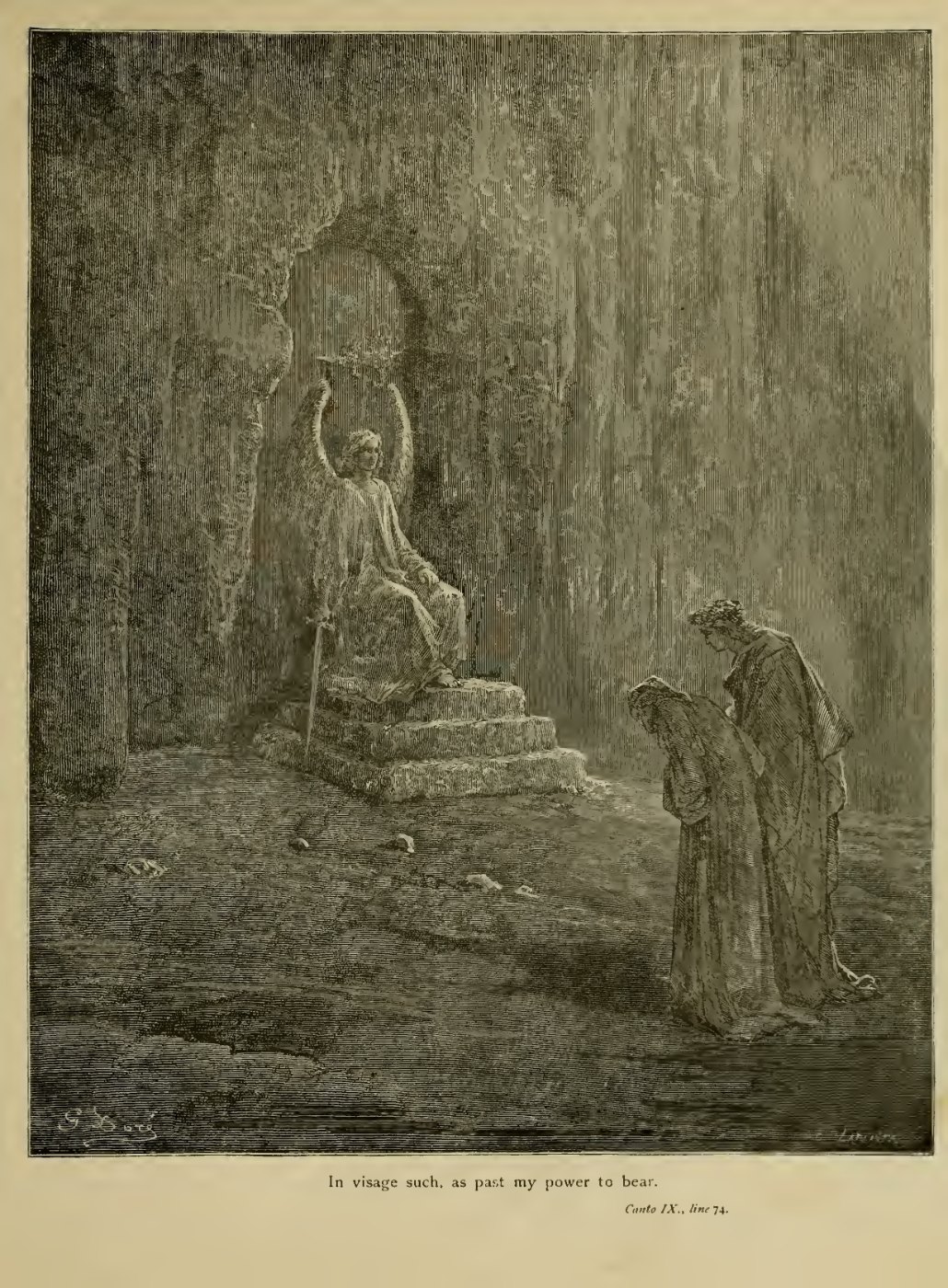
The angel at the gate of Purgatory, in Doré’s design for Canto IX. The gate opens a path of purification for penitents; it illustrates the poem’s religious journey, rather than a historical record of the ritual.
Design by Gustave Doré. Purgatory and Paradise, Henry Francis Cary translation, Thompson & Thomas, Chicago, 1901. Public Domain. · Image source ↗ · Public Domain
See references (8)
- Purgatory and Paradise, Purgatory III, Reader page 21
- Purgatory and Paradise, Purgatory III, Reader page 22
- Purgatory and Paradise, Purgatory IV, Reader page 28
- Purgatory and Paradise, Purgatory V, Reader page 34
- Purgatory and Paradise, Purgatory XXXI, Reader page 187
- Purgatory and Paradise, Purgatory XXXI, Reader page 188
- Dante’s Inferno, Inferno XXVII, Reader page 182
- Dante’s Inferno, Inferno XXVII, Reader page 183
A Wanderer in the Spirit Lands
A Wanderer in the Spirit Lands, attributed to Franchezzo and transcribed by A. Farnese, repeatedly separates wanting relief from wanting to change. A man who abandoned a companion welcomes the possibility of leaving his miserable surroundings, yet refuses to make reparation and still imagines robbing someone else. Franchezzo cannot help him progress merely by removing the immediate discomfort. [15][16]
Other encounters show the first movement towards repentance through concern for someone else. A penitent at the imperial court tries to protect the apparent stranger who has actually come to rescue him. A former pirate responds to being helped by offering his own help, and his experience as a sailor becomes useful in rescuing others. Changed intentions take a practical form. [11][12][13][14][17][18][19][20]
Franchezzo’s own progress also remains unfinished after his rescue work. In the Land of Remorse, he recognises cruelty in his criticism of less accomplished artists. Helping a weaker traveller gives him a way to answer that discovery. The narrative treats sorrow as fruitful when it alters conduct, while allowing different people to learn at different rates. [21][22][23][24][25]
Its concluding appeal offers hope even for people who died by suicide. This qualification matters beside the book’s earlier distressing descriptions of such deaths. Its argument is that mercy and further development remain possible; those descriptions are historical spiritual claims, not verified accounts of what happens to particular people. [26]
See references (16)
- A Wanderer in the Spirit Lands, Reader page 151
- A Wanderer in the Spirit Lands, Reader page 152
- A Wanderer in the Spirit Lands, Reader page 153
- A Wanderer in the Spirit Lands, Reader page 154
- A Wanderer in the Spirit Lands, Reader page 168
- A Wanderer in the Spirit Lands, Reader page 169
- A Wanderer in the Spirit Lands, Reader page 172
- A Wanderer in the Spirit Lands, Reader page 173
- A Wanderer in the Spirit Lands, Reader page 176
- A Wanderer in the Spirit Lands, Reader page 180
- A Wanderer in the Spirit Lands, Reader page 242
- A Wanderer in the Spirit Lands, Reader page 243
- A Wanderer in the Spirit Lands, Reader page 248
- A Wanderer in the Spirit Lands, Reader page 249
- A Wanderer in the Spirit Lands, Reader page 250
- A Wanderer in the Spirit Lands, Reader page 315
Heaven and Its Wonders and Hell
In Heaven and Its Wonders and Hell, Emanuel Swedenborg places reformation within freely chosen earthly life. A person can notice a dishonest impulse, recognise it as contrary to Divine precepts and refrain from acting on it. Repeating that response gradually opens a clearer recognition of evil. His account joins inward acknowledgment to changed willing and conduct. [33][34][36][37][38]
He makes a different claim about the condition after death. The ruling love then remains, and instruction cannot reform it into its opposite. In a passage describing attempted postmortem change, some spirits accept truths temporarily but reject them when they return to their own love. Replacing that love is represented as taking away the spirit’s life itself. [27][28][31][32]
Swedenborg explicitly concludes that repentance is not possible after death. This claim limits what heavenly teaching and continuing mercy accomplish in his model. Good spirits can learn and have mistaken ideas removed, but a settled infernal life does not thereby become an angelic one. The disagreement with accounts of repentance and ascent from hell should remain visible when the books are read together. [29][30][31][32][35]
See references (12)
- Heaven and Its Wonders and Hell, printed p. 426, Reader page 433
- Heaven and Its Wonders and Hell, printed p. 427, Reader page 434
- Heaven and Its Wonders and Hell, printed p. 468, Reader page 475
- Heaven and Its Wonders and Hell, printed p. 469, Reader page 476
- Heaven and Its Wonders and Hell, printed p. 485, Reader page 492
- Heaven and Its Wonders and Hell, printed p. 486, Reader page 493
- Heaven and Its Wonders and Hell, printed p. 495, Reader page 502
- Heaven and Its Wonders and Hell, printed p. 496, Reader page 503
- Heaven and Its Wonders and Hell, printed p. 566, Reader page 573
- Heaven and Its Wonders and Hell, printed p. 568, Reader page 575
- Heaven and Its Wonders and Hell, printed p. 569, Reader page 576
- Heaven and Its Wonders and Hell, printed p. 570, Reader page 577
A decisive limit after death
Dante’s Manfredi turns towards mercy at the end of life. Franchezzo allows someone to change and make repair after death. Swedenborg places fundamental reformation during earthly life, even though good spirits can continue to learn afterwards. [2][3][6][7][15][16][29][30][31][32][35]
Franchezzo gives wanting relief and wanting to repair harm different outcomes. Swedenborg likewise gives the will a decisive place, while putting the chance for a fundamental change on the other side of death. [15][16][29][30][31][32][35]
See references (11)
- Purgatory and Paradise, Purgatory III, Reader page 21
- Purgatory and Paradise, Purgatory III, Reader page 22
- Purgatory and Paradise, Purgatory XXXI, Reader page 187
- Purgatory and Paradise, Purgatory XXXI, Reader page 188
- A Wanderer in the Spirit Lands, Reader page 168
- A Wanderer in the Spirit Lands, Reader page 169
- Heaven and Its Wonders and Hell, printed p. 468, Reader page 475
- Heaven and Its Wonders and Hell, printed p. 469, Reader page 476
- Heaven and Its Wonders and Hell, printed p. 485, Reader page 492
- Heaven and Its Wonders and Hell, printed p. 486, Reader page 493
- Heaven and Its Wonders and Hell, printed p. 566, Reader page 573
Read further in the library
Purgatory and Paradise: The Vision of Dante
Reading note
A separately attributed account in the consulted Cary translation, with exact current Library Reader leaves.
Dante's Inferno
Reading note
A separately attributed account in the consulted Cary translation, with exact current Library Reader leaves.

A Wanderer in the Spirit Lands
Reading note
Rescue episodes distinguish a desire for relief from a willingness to change and make reparation.

Heaven and Its Wonders and Hell
Reading note
Earthly reformation is distinguished from the book’s explicit denial of repentance after death.
Sources
See references (38)
- Catechism of the Catholic Church, 1430–1433: interior penance ↗Catholic Church, official account of conversion of heart, repentance and grace.Return to text ↑
- Purgatory and Paradise, Purgatory III, Reader page 21Dante Alighieri, The Divine Comedy, translated by Henry Francis Cary. Inferno: undated New Edition, Thompson & Thomas, Chicago. Purgatory and Paradise: New Edition, Thompson & Thomas, Chicago, 1901. Designs by Gustave Doré.Read this page in Purgatory and Paradise: The Vision of Dante ↗Return to text ↑
- Purgatory and Paradise, Purgatory III, Reader page 22Dante Alighieri, The Divine Comedy, translated by Henry Francis Cary. Inferno: undated New Edition, Thompson & Thomas, Chicago. Purgatory and Paradise: New Edition, Thompson & Thomas, Chicago, 1901. Designs by Gustave Doré.Read this page in Purgatory and Paradise: The Vision of Dante ↗Return to text ↑
- Purgatory and Paradise, Purgatory IV, Reader page 28Dante Alighieri, The Divine Comedy, translated by Henry Francis Cary. Inferno: undated New Edition, Thompson & Thomas, Chicago. Purgatory and Paradise: New Edition, Thompson & Thomas, Chicago, 1901. Designs by Gustave Doré.Read this page in Purgatory and Paradise: The Vision of Dante ↗Return to text ↑
- Purgatory and Paradise, Purgatory V, Reader page 34Dante Alighieri, The Divine Comedy, translated by Henry Francis Cary. Inferno: undated New Edition, Thompson & Thomas, Chicago. Purgatory and Paradise: New Edition, Thompson & Thomas, Chicago, 1901. Designs by Gustave Doré.Read this page in Purgatory and Paradise: The Vision of Dante ↗Return to text ↑
- Purgatory and Paradise, Purgatory XXXI, Reader page 187Dante Alighieri, The Divine Comedy, translated by Henry Francis Cary. Inferno: undated New Edition, Thompson & Thomas, Chicago. Purgatory and Paradise: New Edition, Thompson & Thomas, Chicago, 1901. Designs by Gustave Doré.Read this page in Purgatory and Paradise: The Vision of Dante ↗Return to text ↑
- Purgatory and Paradise, Purgatory XXXI, Reader page 188Dante Alighieri, The Divine Comedy, translated by Henry Francis Cary. Inferno: undated New Edition, Thompson & Thomas, Chicago. Purgatory and Paradise: New Edition, Thompson & Thomas, Chicago, 1901. Designs by Gustave Doré.Read this page in Purgatory and Paradise: The Vision of Dante ↗Return to text ↑
- Dante’s Inferno, Inferno XXVII, Reader page 182Dante Alighieri, The Divine Comedy, translated by Henry Francis Cary. Inferno: undated New Edition, Thompson & Thomas, Chicago. Purgatory and Paradise: New Edition, Thompson & Thomas, Chicago, 1901. Designs by Gustave Doré.Read this page in Dante's Inferno ↗Return to text ↑
- Dante’s Inferno, Inferno XXVII, Reader page 183Dante Alighieri, The Divine Comedy, translated by Henry Francis Cary. Inferno: undated New Edition, Thompson & Thomas, Chicago. Purgatory and Paradise: New Edition, Thompson & Thomas, Chicago, 1901. Designs by Gustave Doré.Read this page in Dante's Inferno ↗Return to text ↑
- Purgatory and Paradise, Purgatory IX, Reader page 63Dante Alighieri, The Divine Comedy, translated by Henry Francis Cary. Inferno: undated New Edition, Thompson & Thomas, Chicago. Purgatory and Paradise: New Edition, Thompson & Thomas, Chicago, 1901. Designs by Gustave Doré.Read this page in Purgatory and Paradise: The Vision of Dante ↗
- A Wanderer in the Spirit Lands, Reader page 151Franchezzo (source attribution), A Wanderer in the Spirit Lands, transcribed by A. Farnese. W. J. Sinkins, London, 1896. Date confirmed on the consulted title-page facsimile.Read this page in A Wanderer in the Spirit Lands ↗Return to text ↑
- A Wanderer in the Spirit Lands, Reader page 152Franchezzo (source attribution), A Wanderer in the Spirit Lands, transcribed by A. Farnese. W. J. Sinkins, London, 1896. Date confirmed on the consulted title-page facsimile.Read this page in A Wanderer in the Spirit Lands ↗Return to text ↑
- A Wanderer in the Spirit Lands, Reader page 153Franchezzo (source attribution), A Wanderer in the Spirit Lands, transcribed by A. Farnese. W. J. Sinkins, London, 1896. Date confirmed on the consulted title-page facsimile.Read this page in A Wanderer in the Spirit Lands ↗Return to text ↑
- A Wanderer in the Spirit Lands, Reader page 154Franchezzo (source attribution), A Wanderer in the Spirit Lands, transcribed by A. Farnese. W. J. Sinkins, London, 1896. Date confirmed on the consulted title-page facsimile.Read this page in A Wanderer in the Spirit Lands ↗Return to text ↑
- A Wanderer in the Spirit Lands, Reader page 168Franchezzo (source attribution), A Wanderer in the Spirit Lands, transcribed by A. Farnese. W. J. Sinkins, London, 1896. Date confirmed on the consulted title-page facsimile.Read this page in A Wanderer in the Spirit Lands ↗Return to text ↑
- A Wanderer in the Spirit Lands, Reader page 169Franchezzo (source attribution), A Wanderer in the Spirit Lands, transcribed by A. Farnese. W. J. Sinkins, London, 1896. Date confirmed on the consulted title-page facsimile.Read this page in A Wanderer in the Spirit Lands ↗Return to text ↑
- A Wanderer in the Spirit Lands, Reader page 172Franchezzo (source attribution), A Wanderer in the Spirit Lands, transcribed by A. Farnese. W. J. Sinkins, London, 1896. Date confirmed on the consulted title-page facsimile.Read this page in A Wanderer in the Spirit Lands ↗Return to text ↑
- A Wanderer in the Spirit Lands, Reader page 173Franchezzo (source attribution), A Wanderer in the Spirit Lands, transcribed by A. Farnese. W. J. Sinkins, London, 1896. Date confirmed on the consulted title-page facsimile.Read this page in A Wanderer in the Spirit Lands ↗Return to text ↑
- A Wanderer in the Spirit Lands, Reader page 176Franchezzo (source attribution), A Wanderer in the Spirit Lands, transcribed by A. Farnese. W. J. Sinkins, London, 1896. Date confirmed on the consulted title-page facsimile.Read this page in A Wanderer in the Spirit Lands ↗Return to text ↑
- A Wanderer in the Spirit Lands, Reader page 180Franchezzo (source attribution), A Wanderer in the Spirit Lands, transcribed by A. Farnese. W. J. Sinkins, London, 1896. Date confirmed on the consulted title-page facsimile.Read this page in A Wanderer in the Spirit Lands ↗Return to text ↑
- A Wanderer in the Spirit Lands, Reader page 242Franchezzo (source attribution), A Wanderer in the Spirit Lands, transcribed by A. Farnese. W. J. Sinkins, London, 1896. Date confirmed on the consulted title-page facsimile.Read this page in A Wanderer in the Spirit Lands ↗Return to text ↑
- A Wanderer in the Spirit Lands, Reader page 243Franchezzo (source attribution), A Wanderer in the Spirit Lands, transcribed by A. Farnese. W. J. Sinkins, London, 1896. Date confirmed on the consulted title-page facsimile.Read this page in A Wanderer in the Spirit Lands ↗Return to text ↑
- A Wanderer in the Spirit Lands, Reader page 248Franchezzo (source attribution), A Wanderer in the Spirit Lands, transcribed by A. Farnese. W. J. Sinkins, London, 1896. Date confirmed on the consulted title-page facsimile.Read this page in A Wanderer in the Spirit Lands ↗Return to text ↑
- A Wanderer in the Spirit Lands, Reader page 249Franchezzo (source attribution), A Wanderer in the Spirit Lands, transcribed by A. Farnese. W. J. Sinkins, London, 1896. Date confirmed on the consulted title-page facsimile.Read this page in A Wanderer in the Spirit Lands ↗Return to text ↑
- A Wanderer in the Spirit Lands, Reader page 250Franchezzo (source attribution), A Wanderer in the Spirit Lands, transcribed by A. Farnese. W. J. Sinkins, London, 1896. Date confirmed on the consulted title-page facsimile.Read this page in A Wanderer in the Spirit Lands ↗Return to text ↑
- A Wanderer in the Spirit Lands, Reader page 315Franchezzo (source attribution), A Wanderer in the Spirit Lands, transcribed by A. Farnese. W. J. Sinkins, London, 1896. Date confirmed on the consulted title-page facsimile.Read this page in A Wanderer in the Spirit Lands ↗Return to text ↑
- Heaven and Its Wonders and Hell, printed p. 426, Reader page 433Emanuel Swedenborg, Heaven and Its Wonders and Hell, translated by J. C. Ager. The American Swedenborg Printing and Publishing Society, New York, 1916. Original Latin work first published in 1758.Read this page in Heaven and Its Wonders and Hell ↗Return to text ↑
- Heaven and Its Wonders and Hell, printed p. 427, Reader page 434Emanuel Swedenborg, Heaven and Its Wonders and Hell, translated by J. C. Ager. The American Swedenborg Printing and Publishing Society, New York, 1916. Original Latin work first published in 1758.Read this page in Heaven and Its Wonders and Hell ↗Return to text ↑
- Heaven and Its Wonders and Hell, printed p. 468, Reader page 475Emanuel Swedenborg, Heaven and Its Wonders and Hell, translated by J. C. Ager. The American Swedenborg Printing and Publishing Society, New York, 1916. Original Latin work first published in 1758.Read this page in Heaven and Its Wonders and Hell ↗Return to text ↑
- Heaven and Its Wonders and Hell, printed p. 469, Reader page 476Emanuel Swedenborg, Heaven and Its Wonders and Hell, translated by J. C. Ager. The American Swedenborg Printing and Publishing Society, New York, 1916. Original Latin work first published in 1758.Read this page in Heaven and Its Wonders and Hell ↗Return to text ↑
- Heaven and Its Wonders and Hell, printed p. 485, Reader page 492Emanuel Swedenborg, Heaven and Its Wonders and Hell, translated by J. C. Ager. The American Swedenborg Printing and Publishing Society, New York, 1916. Original Latin work first published in 1758.Read this page in Heaven and Its Wonders and Hell ↗Return to text ↑
- Heaven and Its Wonders and Hell, printed p. 486, Reader page 493Emanuel Swedenborg, Heaven and Its Wonders and Hell, translated by J. C. Ager. The American Swedenborg Printing and Publishing Society, New York, 1916. Original Latin work first published in 1758.Read this page in Heaven and Its Wonders and Hell ↗Return to text ↑
- Heaven and Its Wonders and Hell, printed p. 495, Reader page 502Emanuel Swedenborg, Heaven and Its Wonders and Hell, translated by J. C. Ager. The American Swedenborg Printing and Publishing Society, New York, 1916. Original Latin work first published in 1758.Read this page in Heaven and Its Wonders and Hell ↗Return to text ↑
- Heaven and Its Wonders and Hell, printed p. 496, Reader page 503Emanuel Swedenborg, Heaven and Its Wonders and Hell, translated by J. C. Ager. The American Swedenborg Printing and Publishing Society, New York, 1916. Original Latin work first published in 1758.Read this page in Heaven and Its Wonders and Hell ↗Return to text ↑
- Heaven and Its Wonders and Hell, printed p. 566, Reader page 573Emanuel Swedenborg, Heaven and Its Wonders and Hell, translated by J. C. Ager. The American Swedenborg Printing and Publishing Society, New York, 1916. Original Latin work first published in 1758.Read this page in Heaven and Its Wonders and Hell ↗Return to text ↑
- Heaven and Its Wonders and Hell, printed p. 568, Reader page 575Emanuel Swedenborg, Heaven and Its Wonders and Hell, translated by J. C. Ager. The American Swedenborg Printing and Publishing Society, New York, 1916. Original Latin work first published in 1758.Read this page in Heaven and Its Wonders and Hell ↗Return to text ↑
- Heaven and Its Wonders and Hell, printed p. 569, Reader page 576Emanuel Swedenborg, Heaven and Its Wonders and Hell, translated by J. C. Ager. The American Swedenborg Printing and Publishing Society, New York, 1916. Original Latin work first published in 1758.Read this page in Heaven and Its Wonders and Hell ↗Return to text ↑
- Heaven and Its Wonders and Hell, printed p. 570, Reader page 577Emanuel Swedenborg, Heaven and Its Wonders and Hell, translated by J. C. Ager. The American Swedenborg Printing and Publishing Society, New York, 1916. Original Latin work first published in 1758.Read this page in Heaven and Its Wonders and Hell ↗Return to text ↑