Proprium
Proprium means what is one’s own. Swedenborg uses it for life turned towards the self and explains how divine good can still be received in freedom.
In this article
Understanding the concept
Proprium is Latin for what is one’s own. Emanuel Swedenborg uses it for the tendency to take the self as the source of goodness and make its advantage the point of an action. [1][2][3]
A person can still choose freely in Swedenborg’s account. The distinction is between experiencing freedom as one’s own and claiming to be its independent source. [2][4][5][6]
See references (6)
- Heaven and Its Wonders and Hell, printed p. 118, Reader page 125
- Heaven and Its Wonders and Hell, printed p. 240, Reader page 247
- Heaven and Its Wonders and Hell, printed p. 523, Reader page 530
- Heaven and Its Wonders and Hell, printed p. 568, Reader page 575
- Heaven and Its Wonders and Hell, printed p. 569, Reader page 576
- Heaven and Its Wonders and Hell, printed p. 570, Reader page 577
Heaven and Its Wonders and Hell by Emanuel Swedenborg
In Heaven and Its Wonders and Hell, Swedenborg says even angels have a proprium. Their capacity to receive love and wisdom can vary because the appeal of self-love varies. The source of what they receive keeps giving. [7][1]
His account of human affiliation with heaven makes a related distinction. People become angels, yet heaven is made by the Divine received in them, rather than by their proprium. An individual can participate without becoming the original source of what is shared. [2]
Swedenborg gives the idea a practical edge in his discussion of self-love. Someone can do good for the sake of being admired. The action looks generous, but the person’s image has become its end. [3]
The final account of freedom prevents a simple conclusion that personal agency must disappear. Freedom comes from the Lord but is given as if it belonged to the person, so that reform can be freely received. What one comes to love and will can become inwardly appropriated without ceasing to depend on a divine source. [4][5][6]
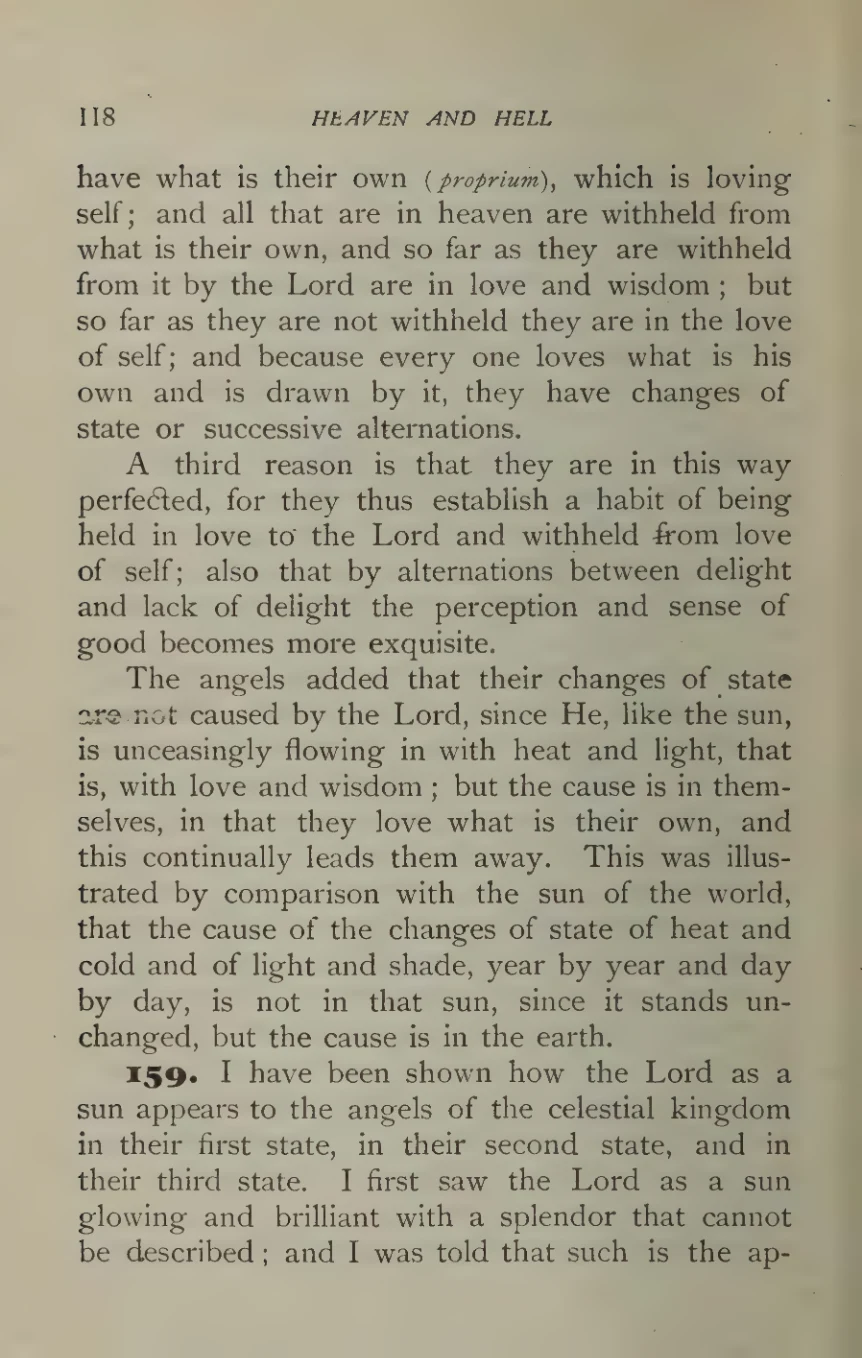
Heaven and Its Wonders and Hell (1916), printed p. 118, Library Reader page 125. Swedenborg connects proprium with changes in what angels can receive.
Emanuel Swedenborg, Heaven and Its Wonders and Hell, J. C. Ager translation, New York, 1916. Public-domain historical page from the checksum-verified Library PDF. · Image source ↗ · Public Domain
See references (7)
- Heaven and Its Wonders and Hell, printed p. 118, Reader page 125
- Heaven and Its Wonders and Hell, printed p. 240, Reader page 247
- Heaven and Its Wonders and Hell, printed p. 523, Reader page 530
- Heaven and Its Wonders and Hell, printed p. 568, Reader page 575
- Heaven and Its Wonders and Hell, printed p. 569, Reader page 576
- Heaven and Its Wonders and Hell, printed p. 570, Reader page 577
- Heaven and Its Wonders and Hell, printed p. 117, Reader page 124
Evolution of Immortality by Rosicruciæ, catalogued as F. B. Dowd
Freeman Benjamin Dowd, writing as Rosicruciæ, describes a self-poised centre which distinguishes and coordinates opposing powers. He joins that self-possession with sympathy and refusal to dominate. The developed person is not meant to abandon selfhood or leave the functions of body and mind unused. [8][9][10][11]
Freedom and the purpose of a good act
The distinction becomes clear when the same useful action can be done out of care or to advertise the person doing it. Swedenborg’s angels remain distinct in affection and judgment. What matters is what they receive and whose good directs their choices. [1][3][7][2]
Dowd gives self-poise a positive role as the capacity to balance competing forces and care about others without ruling them. Swedenborg gives freedom a positive role and traces its source to the Lord. The two accounts ask different questions about what a person can call their own. [8][9][10][11][1][2][3][4][6]
James Ensor’s etching Pride surrounds its central figure with a crowd of caricatured heads. The image offers one way to picture self-exaltation, a motive Swedenborg asks the reader to look for even in outwardly generous conduct. [12][1][3]
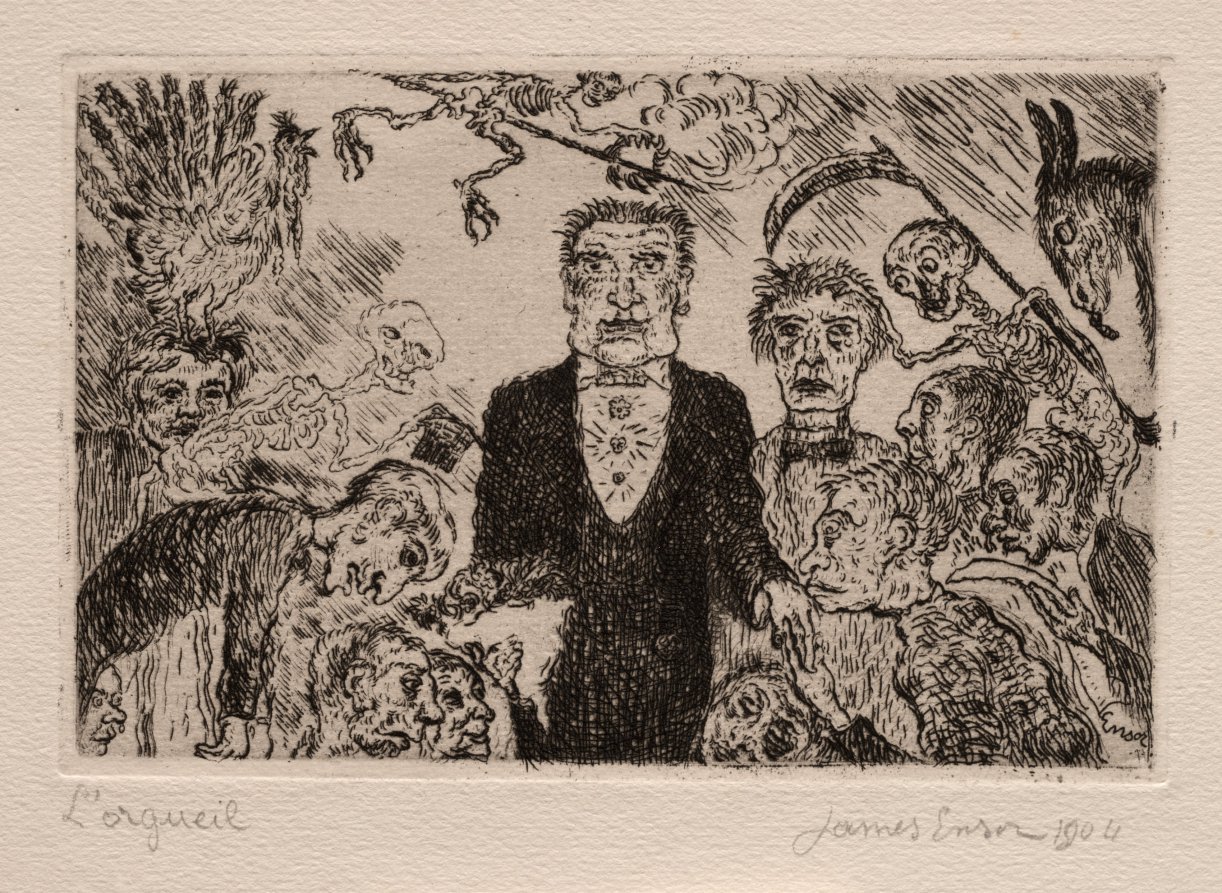
James Ensor, Pride, 1904. The etching belongs to his Seven Deadly Sins series.
The Cleveland Museum of Art. Purchase from the J. H. Wade Fund. 1971.108.4. CC0. · Image source ↗ · CC0
See references (11)
- Heaven and Its Wonders and Hell, printed p. 118, Reader page 125
- Heaven and Its Wonders and Hell, printed p. 240, Reader page 247
- Heaven and Its Wonders and Hell, printed p. 523, Reader page 530
- Heaven and Its Wonders and Hell, printed p. 568, Reader page 575
- Heaven and Its Wonders and Hell, printed p. 570, Reader page 577
- Heaven and Its Wonders and Hell, printed p. 117, Reader page 124
- Evolution of Immortality, printed p. 57, Reader page 54
- Evolution of Immortality, printed p. 58, Reader page 55
- Evolution of Immortality, printed p. 104, Reader page 101
- Evolution of Immortality, printed p. 142, Reader page 141
- The Seven Deadly Sins: Pride, 1904
Read further in the library

Heaven and Its Wonders and Hell
Reading note
The separately titled account draws on exact passages in the consulted Library edition.
Evolution of Immortality
Reading note
Separately attributed comparison with exact previously researched Library passages.
Sources
See references (13)
- Heaven and Its Wonders and Hell, printed p. 118, Reader page 125Emanuel Swedenborg, Heaven and Its Wonders and Hell, From Things Heard and Seen, translated by J. C. Ager. American Swedenborg Printing and Publishing Society, New York, 1916. Latin original first published in 1758. Numbered sections and exact pages refer to this consulted edition. Claims of spiritual experience remain attributed.Read this page in Heaven and Its Wonders and Hell ↗Return to text ↑
- Heaven and Its Wonders and Hell, printed p. 240, Reader page 247Emanuel Swedenborg, Heaven and Its Wonders and Hell, From Things Heard and Seen, translated by J. C. Ager. American Swedenborg Printing and Publishing Society, New York, 1916. Latin original first published in 1758. Numbered sections and exact pages refer to this consulted edition. Claims of spiritual experience remain attributed.Read this page in Heaven and Its Wonders and Hell ↗Return to text ↑
- Heaven and Its Wonders and Hell, printed p. 523, Reader page 530Emanuel Swedenborg, Heaven and Its Wonders and Hell, From Things Heard and Seen, translated by J. C. Ager. American Swedenborg Printing and Publishing Society, New York, 1916. Latin original first published in 1758. Numbered sections and exact pages refer to this consulted edition. Claims of spiritual experience remain attributed.Read this page in Heaven and Its Wonders and Hell ↗Return to text ↑
- Heaven and Its Wonders and Hell, printed p. 568, Reader page 575Emanuel Swedenborg, Heaven and Its Wonders and Hell, From Things Heard and Seen, translated by J. C. Ager. American Swedenborg Printing and Publishing Society, New York, 1916. Latin original first published in 1758. Numbered sections and exact pages refer to this consulted edition. Claims of spiritual experience remain attributed.Read this page in Heaven and Its Wonders and Hell ↗Return to text ↑
- Heaven and Its Wonders and Hell, printed p. 569, Reader page 576Emanuel Swedenborg, Heaven and Its Wonders and Hell, From Things Heard and Seen, translated by J. C. Ager. American Swedenborg Printing and Publishing Society, New York, 1916. Latin original first published in 1758. Numbered sections and exact pages refer to this consulted edition. Claims of spiritual experience remain attributed.Read this page in Heaven and Its Wonders and Hell ↗Return to text ↑
- Heaven and Its Wonders and Hell, printed p. 570, Reader page 577Emanuel Swedenborg, Heaven and Its Wonders and Hell, From Things Heard and Seen, translated by J. C. Ager. American Swedenborg Printing and Publishing Society, New York, 1916. Latin original first published in 1758. Numbered sections and exact pages refer to this consulted edition. Claims of spiritual experience remain attributed.Read this page in Heaven and Its Wonders and Hell ↗Return to text ↑
- Heaven and Its Wonders and Hell, printed p. 117, Reader page 124Emanuel Swedenborg, Heaven and Its Wonders and Hell, From Things Heard and Seen, translated by J. C. Ager. American Swedenborg Printing and Publishing Society, New York, 1916. Latin original first published in 1758. Numbered sections and exact pages refer to this consulted edition. Claims of spiritual experience remain attributed.Read this page in Heaven and Its Wonders and Hell ↗Return to text ↑
- Evolution of Immortality, printed p. 57, Reader page 54Rosicruciæ, catalogued as Freeman Benjamin Dowd, Evolution of Immortality. Eulian Publishing Company, Salem, Mass., copyright 1900; title page undated. The book’s metaphysical and scientific assertions remain attributed. The separately reproduced Higher Thought of Sex address has no speaker named in this edition.Read this page in Evolution of Immortality ↗Return to text ↑
- Evolution of Immortality, printed p. 58, Reader page 55Rosicruciæ, catalogued as Freeman Benjamin Dowd, Evolution of Immortality. Eulian Publishing Company, Salem, Mass., copyright 1900; title page undated. The book’s metaphysical and scientific assertions remain attributed. The separately reproduced Higher Thought of Sex address has no speaker named in this edition.Read this page in Evolution of Immortality ↗Return to text ↑
- Evolution of Immortality, printed p. 104, Reader page 101Rosicruciæ, catalogued as Freeman Benjamin Dowd, Evolution of Immortality. Eulian Publishing Company, Salem, Mass., copyright 1900; title page undated. The book’s metaphysical and scientific assertions remain attributed. The separately reproduced Higher Thought of Sex address has no speaker named in this edition.Read this page in Evolution of Immortality ↗Return to text ↑
- Evolution of Immortality, printed p. 142, Reader page 141Rosicruciæ, catalogued as Freeman Benjamin Dowd, Evolution of Immortality. Eulian Publishing Company, Salem, Mass., copyright 1900; title page undated. The book’s metaphysical and scientific assertions remain attributed. The separately reproduced Higher Thought of Sex address has no speaker named in this edition.Read this page in Evolution of Immortality ↗Return to text ↑
- The Seven Deadly Sins: Pride, 1904 ↗The Seven Deadly Sins: Pride, 1904. James Ensor (Belgian, 1860–1949). Etching. The Cleveland Museum of Art, Purchase from the J. H. Wade Fund, 1971.108.4. CC0 open-access image.Return to text ↑
- Heaven and Its Wonders and Hell, printed p. 421, Reader page 428Emanuel Swedenborg, Heaven and Its Wonders and Hell, translated by J. C. Ager. The American Swedenborg Printing and Publishing Society, New York, 1916. Original Latin work first published in 1758.Read this page in Heaven and Its Wonders and Hell ↗