Pandora’s Box Was a Jar: The Story and Its Retellings
Pandora opens a storage jar in Hesiod. Follow the story from the Greek pithos to the later box, and see why the fate of Hope changes in retellings.
In this article
Read the two openings side by side
The vessel, the warning and the final state of Hope all change between the Greek poem and the children’s story.
Pandora in Hesiod and Hawthorne
Follow the lid from the first warning to the end of each version.
What kind of vessel is it?
- Hesiod
- A pithos, or large storage jar, with a lid.
- Nathaniel Hawthorne
- An ornate chest tied with a cord and left in the cottage.
Who receives a warning?
- Hesiod
- Prometheus warns Epimetheus against accepting gifts from Zeus.
- Nathaniel Hawthorne
- Epimetheus tells Pandora that the box was left for safekeeping.
What escapes?
- Hesiod
- Troubles scatter among people. Sickness comes by day and night.
- Nathaniel Hawthorne
- Winged troubles fly from the box and hurt the children.
Where is Hope when it ends?
- Hesiod
- Elpis remains beneath the rim after the opening.
- Nathaniel Hawthorne
- Both children agree to open the lid again, and Hope comes out.
Was Pandora’s box really a jar?
In Hesiod’s Works and Days, Pandora lifts the lid of a pithos, a large ceramic storage jar. Troubles spread among human beings and Elpis, usually rendered as Hope, stays inside. The familiar box belongs to the story’s later history. Changing the vessel is only one of the changes. A later storyteller such as Nathaniel Hawthorne also lets Hope come out, giving the story an ending that is difficult to mistake. [1][3][8]
The Greek account follows a dispute over how people are to live. Zeus hides fire and the means of making a living, Prometheus steals the fire, and Zeus answers with a gift. That sequence matters to the jar’s scene. The trouble starts with a plan on Olympus, several decisions before Pandora ever puts her hands on the lid. [1][2]
Who gives Pandora the jar, and why does she open it?
Hesiod names the makers and the recipient of the divine gift. Hephaestus shapes the woman at Zeus’s bidding, and several gods supply skills, adornments and traits. Hermes brings Pandora to Epimetheus, who accepts her despite his brother’s warning about gifts from Zeus. The poem then turns to the opening of the jar without telling us who brought the jar to the household or why she chose to lift its lid. [1][2][4]
Many readers remember a prohibition addressed to Pandora. The explicit warning in this passage is addressed to Epimetheus. The poem supplies a reason for Zeus’s choice of gift and says what Epimetheus understands too late. When a retelling adds a forbidden container or explains Pandora’s curiosity, it gives new motives to the characters. Hawthorne makes curiosity and repeated questions part of the action. [1][8]
The Theogony offers a useful control when the two versions begin to blur. There too Zeus answers the theft with a fashioned and adorned woman. The poem leaves her unnamed and gives no scene with a container. The jar, the fate of Elpis and the named Pandora come together in Works and Days. [2][1]
What did a Greek pithos look like?
A pithos could hold household stores such as grain, oil or wine. The word covers vessels of varying sizes. The example pictured here, from the Cyclades and found at Thebes, gives a sense of the largest scale. The Louvre records a height of 130 centimetres and a diameter of 90. Imagine raising the cover at the mouth of a vessel that tall, then compare how easily a hinged lid can face both the opener and the painter. [3][5][10]
The jar’s reliefs also show how to read an object without confusing it with an illustration of a text. The figures identified on the neck are Perseus and a Gorgon. Archaeological evidence gives the vessel its material form and scale, while Hesiod supplies the literary incident. Waterhouse’s painting offers evidence of a much later image of the incident, with Pandora opening a low decorated chest. [5][9][10][1]
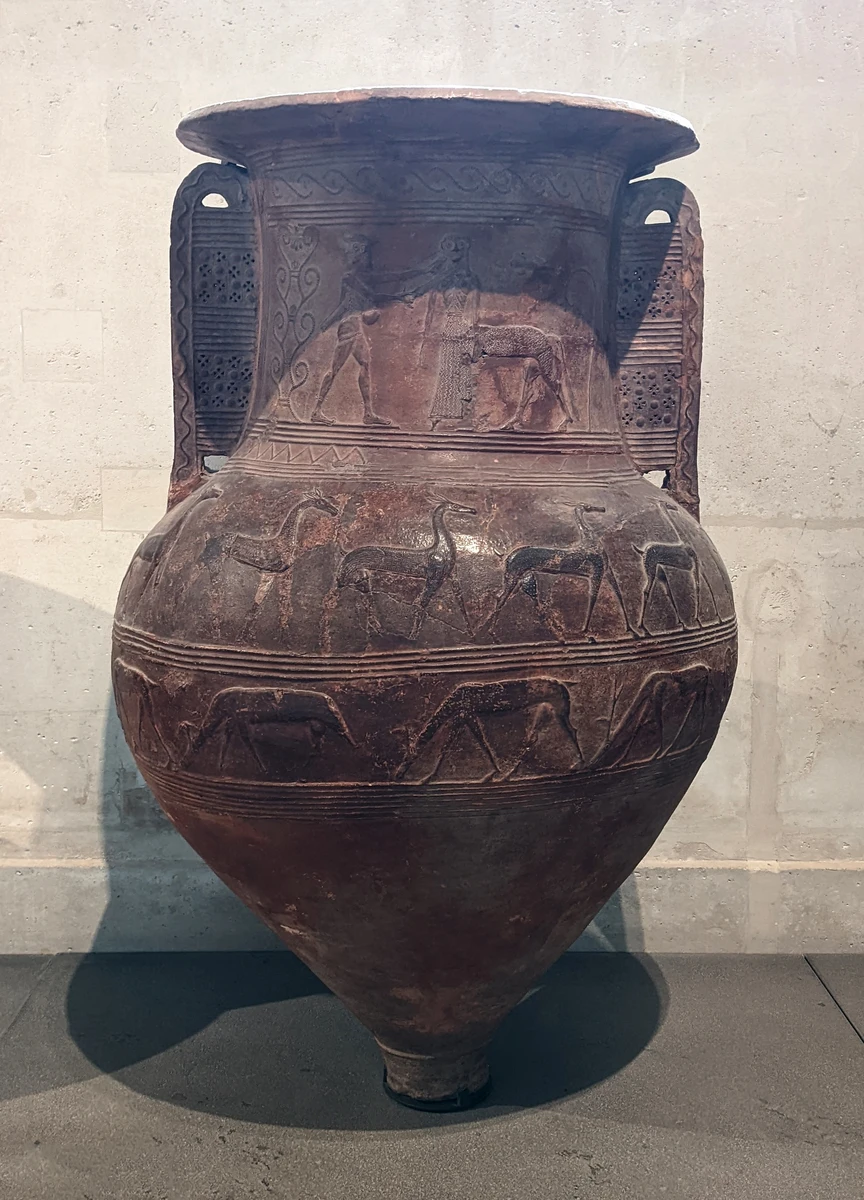
The Louvre pithos stands about 1.30 metres tall. It gives an idea of the scale the Greek vessel could reach. The raised scene on its neck depicts Perseus and a Gorgon.
Cycladic pithos, ca. 670 BCE, Musée du Louvre, CA 795. Photograph by Shonagon, Wikimedia Commons, CC0 1.0. Resized and converted to WebP. · Image source ↗ · CC0
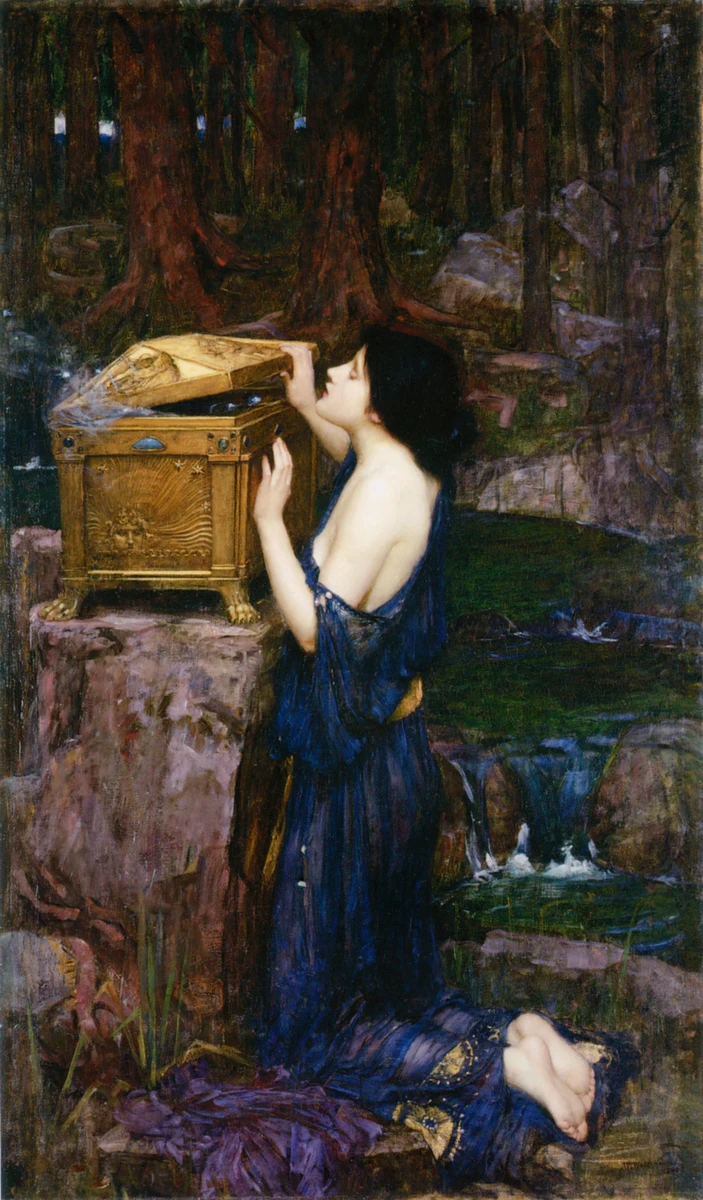
Waterhouse puts the moment of opening at eye level with a kneeling Pandora. The chest’s broad hinged lid makes a different gesture possible from lifting the lid of a tall ceramic jar.
John William Waterhouse, Pandora, 1896, oil on canvas. Public-domain reproduction via Wikimedia Commons. · Image source ↗ · Public Domain
How did the jar become a box?
One influential step is documented in Erasmus’s Adagia. In the commentary on the proverb about a fool learning through misfortune, the 1536 edition retells the story using forms of the Latin word pyxis, a box. Francesca Vivenza records that wording and notes that an earlier Latin translation by Niccolò della Valle used urna, a jar or urn. The comparison shows a change between specific retellings. It also leaves room for uncertainty about the first edition in which Erasmus used the word. [7][3]
The retold action changes with the noun. Vivenza’s transcription has Pandora hand the box to Epimetheus, while the Greek poem moves straight to the woman lifting the lid. It is difficult to establish Erasmus’s private reason for choosing the word. We can see the effect on readers centuries later, though, when a chest sitting in a cottage can be introduced at the start of a version such as Hawthorne’s. [7][1][8]
Why did Hope stay inside?
The poem says Elpis stays beneath the rim and cannot fly out before the lid is put back, by Zeus’s design. Elpis can carry the sense of expectation as well as hope. The scene leaves an important question open. Is a good thing being kept safe for people, being kept out of their reach, or is a potentially deceptive expectation itself being confined? Each reading must explain why the lid stops Elpis while troubles have already got out. [1][4]
Babrius tells a related story with the contents reversed. Zeus fills a jar with good things, a person opens it, and the good things fly away. Hope stays and promises future good. That fable explains why a surviving Hope can be helpful. Its clearer ending also shows what an interpreter would have to add to Hesiod’s briefer statement to obtain the same result. [1][6][4]
What changes in Hawthorne’s version?
The Paradise of Children makes Pandora and Epimetheus children living in an age before trouble. In the cottage, the chest’s attractive appearance and its mysterious delivery draw Pandora’s attention. The first time it opens, winged troubles get out. Later a small voice pleads from inside, and both children agree to open the lid again. Hope emerges and offers comfort. The second opening transforms the earlier disaster into a story about sharing the risk of helping someone. [8]
Rackham’s illustration presents the scene as part of an illustrated book for younger readers. Read the two endings in order. Hesiod closes the jar and leaves the consequences among the living. Hawthorne opens the box again, lets the children speak to Hope, and gives readers someone who can help with what escaped. [8][11][1]
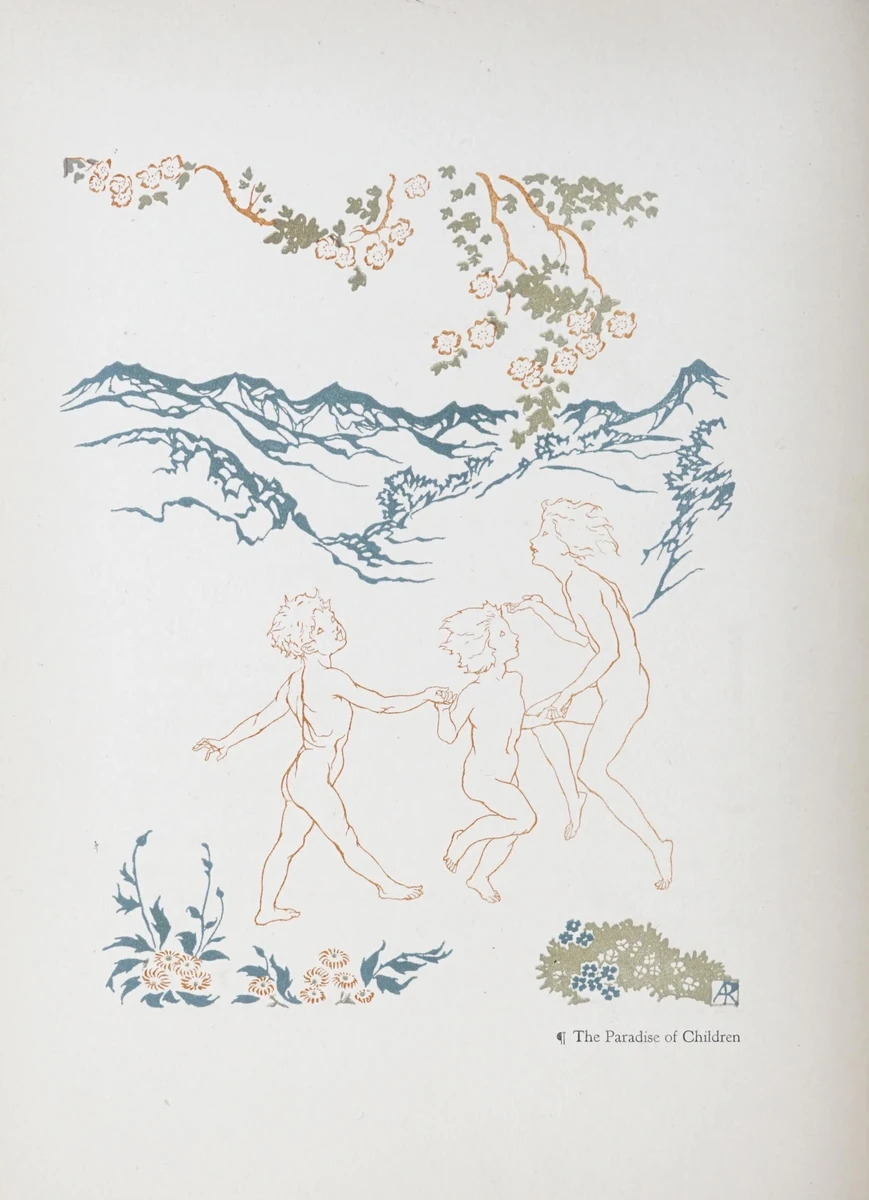
Rackham’s opening plate pictures the children’s world outdoors. His design gives readers a glimpse of the childhood paradise that Hawthorne’s story is about to disturb.
Arthur Rackham, illustration for The Paradise of Children in Nathaniel Hawthorne’s A Wonder Book, 1922. Public-domain reproduction via Wikimedia Commons and Internet Archive. · Image source ↗ · Public Domain
Sources
See references (11)
- Hesiod, Works and Days 42–105 · Pandora and the jar ↗Center for Hellenic Studies, Harvard University. English text with standard line numbers.Return to text ↑
- Hesiod, Works and Days and Theogony · Two accounts in translation ↗Toronto Metropolitan University Pressbooks, Myths of the Greek and Roman Gods.Return to text ↑
- Andrew Bevan, Pandora’s Pithos ↗University College London Discovery, author’s postprint of the study of the vessel.Return to text ↑
- Lilah-Grace Fraser, A Woman of Consequence: Pandora in Hesiod’s Works and Days ↗University of Edinburgh Research Explorer, author’s study including the debate about Elpis.Return to text ↑
- Louvre · Cycladic pithos CA 795 ↗Musée du Louvre collection record, date, measurements, findspot and decoration.Return to text ↑
- Babrius 58 · Zeus and the Jar of Good Things ↗Laura Gibbs’s translation of Babrius 58, Perry 312, hosted by the translator.Return to text ↑
- Francesca Vivenza · Erasmus’s Latin wording and Pandora ↗Author’s study citing the 1536 Adagia, I.1.31, with the Latin wording and earlier translation evidence.Return to text ↑
- Nathaniel Hawthorne, The Paradise of Children ↗Wikisource transcription from the Rackham edition of A Wonder Book. Hawthorne’s retelling was first published in 1851.Return to text ↑
- Cycladic pithos, Louvre CA 795 ↗Cycladic pithos, ca. 670 BCE, Musée du Louvre, CA 795. Photograph by Shonagon, Wikimedia Commons, CC0 1.0. Resized and converted to WebP.Return to text ↑
- John William Waterhouse, Pandora ↗John William Waterhouse, Pandora, 1896, oil on canvas. Public-domain reproduction via Wikimedia Commons.Return to text ↑
- Arthur Rackham, The Paradise of Children ↗Arthur Rackham, illustration for The Paradise of Children in Nathaniel Hawthorne’s A Wonder Book, 1922. Public-domain reproduction via Wikimedia Commons and Internet Archive.Return to text ↑