Medusa’s Original Myth: Hesiod, Ovid and the Images Between
What is Medusa’s original myth? Compare Hesiod and Ovid, trace Perseus and the shield, and see how Greek artists depicted Medusa centuries before Ovid.
In this article
Read the two versions side by side
The Greek genealogy and the Roman story answer different questions about the same figure. Use the comparison to find the passage you want to read.
Medusa in Hesiod and Ovid
Hesiod introduces Medusa among her relatives. Ovid has Perseus recall her death and answer a question about her hair.
What sets Medusa apart?
- Hesiod’s Theogony
- Medusa alone is mortal. Stheno and Euryale are immortal and ageless.
- Ovid’s Metamorphoses
- A guest asks why Medusa alone among her sisters had snakes in her hair.
Where does the encounter with the sea god occur?
- Hesiod’s Theogony
- Poseidon lies with her in a meadow among spring flowers.
- Ovid’s Metamorphoses
- Perseus reports that Neptune violated her in Minerva’s temple.
What does Perseus do?
- Hesiod’s Theogony
- His beheading of Medusa leads immediately to the birth of Pegasus and Chrysaor.
- Ovid’s Metamorphoses
- He tells how he used the reflection in his shield and later gives the reason for the snakes.
What is Medusa’s original myth?
Medusa is the mortal one of three Gorgon sisters in Hesiod’s Theogony, one of the earliest surviving Greek accounts to name her. Perseus cuts off her head, and Pegasus and Chrysaor spring from her. The story in which Minerva changes Medusa’s hair into snakes comes from a much later surviving account, Ovid’s Metamorphoses. These texts tell different parts of her story. Hesiod explains where the Gorgons and Medusa’s children belong in a genealogy. Ovid gives the serpents a cause through a story Perseus tells at a feast. [1][2]
There is a third kind of evidence between those poems. Greek artists had already painted a beautiful, winged Medusa and put Gorgon faces on shields centuries before Ovid wrote. The objects help answer when a look or motif was in use. To find an explanation such as the temple story, turn to the passage that actually tells it. [5][6][2]
Hesiod’s Theogony: the mortal sister
In lines 270–286, Hesiod places the Gorgons beyond Ocean, towards the country of the Hesperides. Phorcys and Ceto are their parents. Stheno and Euryale are ageless and immortal, whereas Medusa can die. Hesiod mentions the sea god lying with her in a flowery meadow. The passage moves quickly to her death and the birth of Chrysaor and Pegasus. It leaves the method of the killing, the petrifying gaze and the origin of her hair unexplained. [1]
The children matter in a poem that follows descent. Chrysaor comes out with a golden sword and later fathers Geryon. Pegasus rises to the gods and carries thunder and lightning for Zeus. Medusa’s death is therefore also a point of departure in the poem. The account follows the new lines of kinship and service instead of dwelling on the hero’s equipment or supplying a childhood for Medusa. [1]
How did Perseus kill Medusa?
The Library attributed to Apollodorus gives a much fuller expedition. Perseus gets directions by taking the shared eye and tooth of the old women known as the Graeae, then obtains equipment from the nymphs. They provide winged sandals, a bag for the head and the cap of Hades for concealment. Hermes provides a cutting weapon. Perseus reaches the Gorgons while they are asleep, and Athena guides his hand as he looks at the reflection in a bronze shield. [4]
That shield has a different job from the one on Achilles’ arm in the relief. Perseus uses a surface that lets him see without looking at Medusa directly. The warrior on the relief shows the Gorgon face to the person looking at him. Pseudo-Apollodorus eventually has Athena place Medusa’s head on the centre of her shield. The story thereby explains one way a force first encountered as a threat can become a defence. [4][6][7]
Ovid’s Metamorphoses: why did Medusa have snakes for hair?
In Book 4, the question comes after the rescue of Andromeda. At a feast, Perseus tells of seeing Medusa in his shield and taking her head. A listener asks why she alone among her sisters had snakes mixed into her hair. Perseus answers that her hair had been the feature for which she was most admired, and says he heard from someone who had seen it. The change of hair is a story nested inside another story, spoken by the man who killed her. [2][3]
Perseus says that Neptune was reported to have violated Medusa in Minerva’s temple. Minerva turns away, covers her face with her aegis and changes Medusa’s hair into snakes. The Latin uses vitiasse for what Neptune is said to have done. Brookes More’s older English rendering uses a more courtly phrase, so it is worth opening the Latin alongside it. The passage gives no account of Medusa taking priestly vows and gives her no speech. The hair change is explicit, while the acquisition of the petrifying gaze is left unexplained. [2][3]
The poem closes the explanation with Minerva wearing the snakes to frighten her enemies. That ending returns the focus from Medusa’s experience to the goddess’s use of her image. Readers can ask why a narrative concerned with punishing an act describes the visible change to the woman’s body and offers no comparable consequence for Neptune in this passage. The question follows directly from the way Perseus tells the story. [2][3]
A Gorgon shield and a sleeping Medusa
On the relief of Achilles, dated to about 600 BCE, the Gorgon's wide eyes and open mouth face outward. Achilles’ head turns in profile. That difference in direction matters because the shield face confronts whoever is in front of it. The Met’s exhibition curator describes the threatening face as an image that can frighten an enemy. The term gorgoneion names this kind of Gorgon face or head used as a motif. [6][7]
On the jar attributed to Polygnotos, dated about 450–440 BCE, start with Athena at the left and follow Perseus’ turned head. His hands reach towards the sleeping figure on the right while his face points the other way. Medusa has wings and the face of a young woman. The image is especially valuable because it shows a beautiful Medusa well before Ovid’s written explanation of her hair. A picture can establish that an artist knew a visual type without establishing that they knew a particular origin story. [5][2]
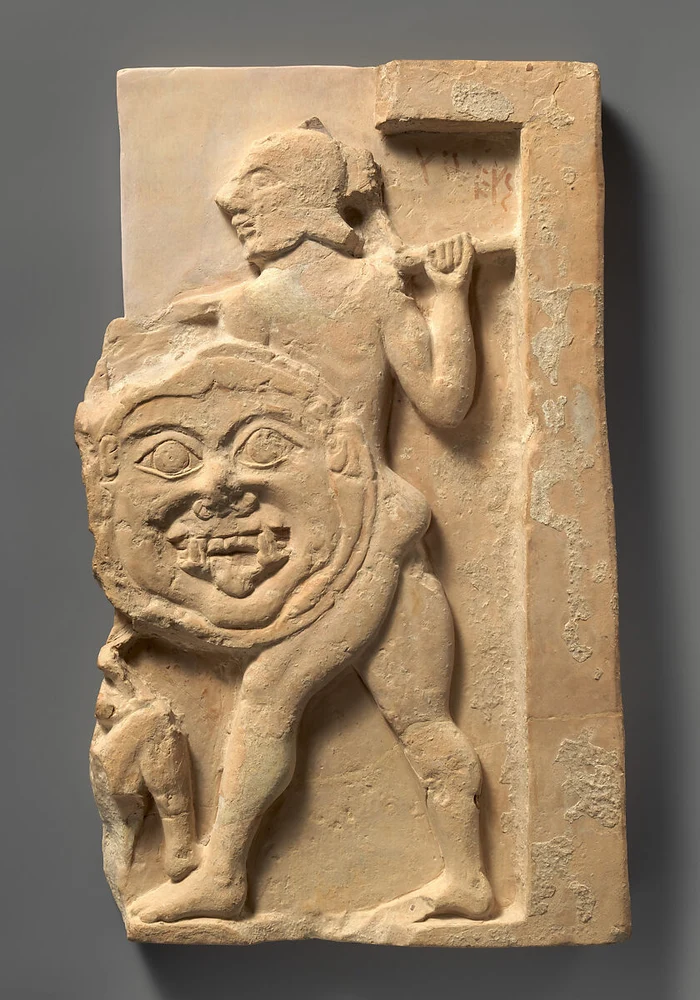
A Gorgon confronts the viewer from Achilles’ shield. Attic terracotta relief, about 600 BCE.
The Metropolitan Museum of Art, Samuel D. Lee Fund, 1942, 42.11.33. · Image source ↗ · Public Domain
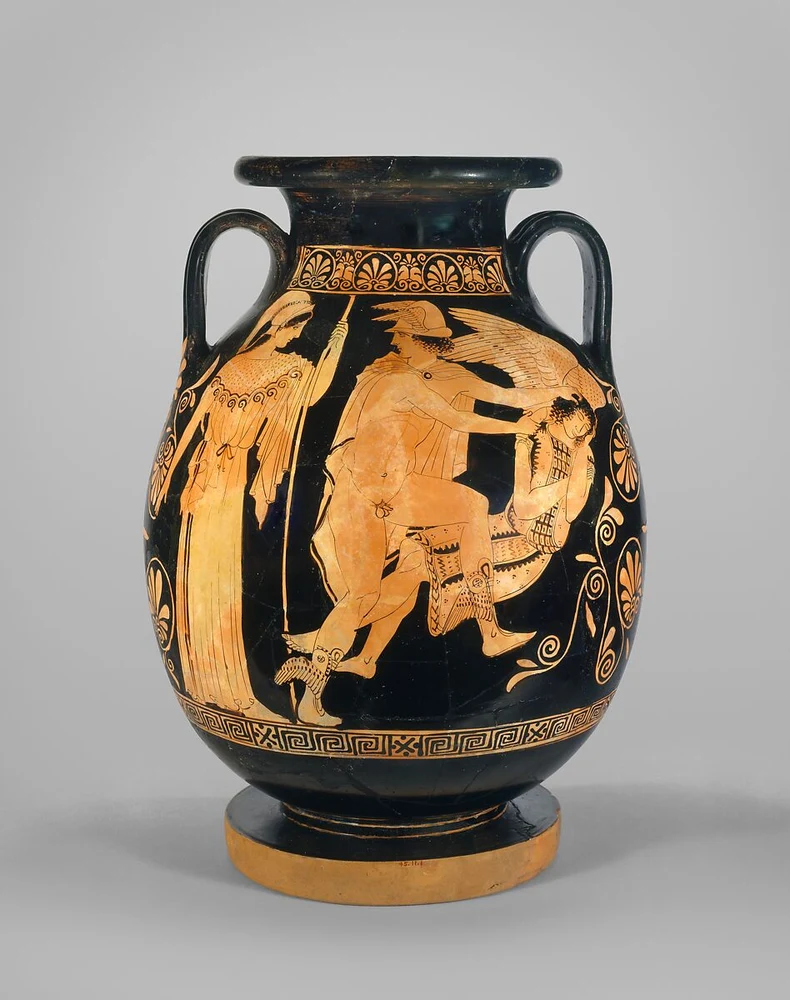
Perseus reaches towards the sleeping Medusa and turns his face towards Athena. Attic red-figure pelike attributed to Polygnotos, about 450–440 BCE.
The Metropolitan Museum of Art, Rogers Fund, 1945, 45.11.1. · Image source ↗ · Public Domain
Why do the Furies call for Medusa in Dante’s Inferno?
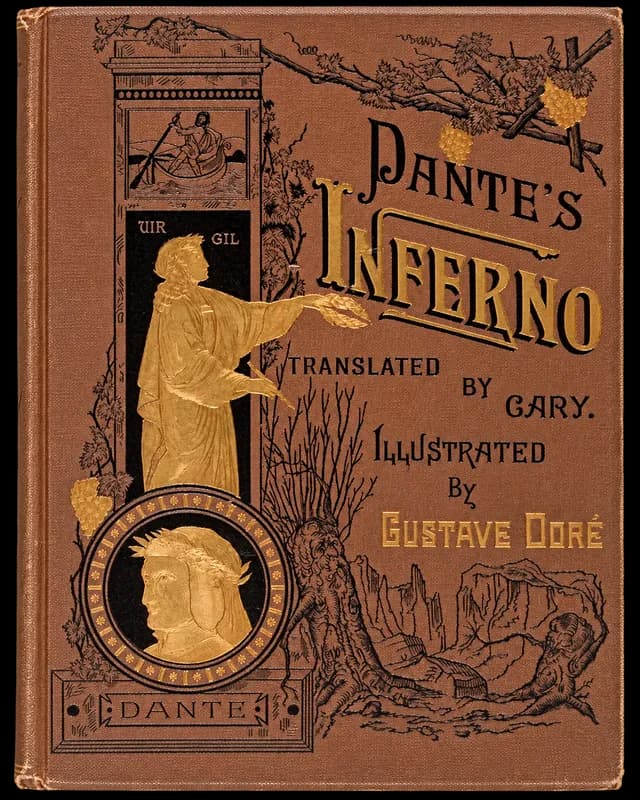
At the gate of Dis in Inferno IX, the Furies call for Medusa to turn Dante to stone. The scene depends on the threat of seeing her. Virgil makes Dante turn and covers his eyes with his own hands, then eventually tells him to look again. Dante never sees the Gorgon. In this episode a guide protects a traveller by preventing a look, recalling how the Greek and Roman stories make a person’s line of sight decisive. The two Cary Reader leaves show the threat and the moment his eyes are released. [8][9][4]
For the threat of Medusa’s gaze in the context of the gate and its defenders, continue to the separate Dante entry. The original Cary pages are linked here so the two accounts can be read alongside Hesiod and Ovid. [8][9]
Read further in the library
Dante's Inferno
Reading note
Read the Furies’ invocation and Virgil’s response in the Cary translation of Inferno IX.
Sources
See references (9)
- Hesiod, Theogony 270–294 · Medusa, her sisters and her children ↗Center for Hellenic Studies, Harvard University.Return to text ↑
- Ovid, Metamorphoses 4.772–803 · Perseus tells the story ↗Latin text edited by Hugo Magnus, Perseus Digital Library.Return to text ↑
- Ovid, Metamorphoses, Book 4 · Perseus and the Gorgon ↗Translated by Brookes More, 1922, Perseus Digital Library. The translation has its own line numbers.Return to text ↑
- Pseudo-Apollodorus, Library 2.4.2–3 · The shield and the Gorgon’s head ↗Translated by Sir James George Frazer, Perseus Digital Library.Return to text ↑
- Attic red-figure pelike attributed to Polygnotos, The Met 45.11.1 ↗The Metropolitan Museum of Art. Public-domain photograph.Return to text ↑
- Attic terracotta relief with Achilles, The Met 42.11.33 ↗The Metropolitan Museum of Art. Public-domain photograph.Return to text ↑
- Dangerous Beauty in the Ancient World · A conversation with Kiki Karoglou ↗The Metropolitan Museum of Art, interview with the exhibition curator.Return to text ↑
- Inferno IX · The Furies call for Medusa and Virgil shields DanteDante Alighieri, Inferno, H. F. Cary translation, Thompson & Thomas edition.Read this page in Dante's Inferno ↗Return to text ↑
- Inferno IX · Virgil tells Dante to look againDante Alighieri, Inferno, H. F. Cary translation, Thompson & Thomas edition.Read this page in Dante's Inferno ↗Return to text ↑