Why Prometheus Stole Fire
Why did Prometheus steal fire for humans? Compare Hesiod’s two accounts, discover why Zeus sent the eagle, and follow the myth into Frankenstein.
In this article
Follow the two accounts of the theft
Start with the shared fennel stalk, then see where each poem takes the story after fire reaches human hands.
Prometheus in Theogony and Works and Days
Both poems are attributed to Hesiod. The columns compare what sets the theft in motion and what each poem gives most attention.
Why was fire withheld?
- Theogony
- Zeus responds to the deceptive division of a sacrificial ox at Mecone.
- Works and Days
- Zeus hides fire and the means of making a living in anger at Prometheus’s deceit.
How does fire reach people?
- Theogony
- Prometheus steals fire and hides it in a hollow fennel stalk. Zeus sees the flame in human hands.
- Works and Days
- Prometheus carries the stolen fire in a hollow fennel stalk, evading Zeus’s notice.
What does Zeus send in return?
- Theogony
- The gods make and adorn an unnamed woman in response to the theft.
- Works and Days
- The gods make Pandora. Epimetheus accepts her, and she opens the jar.
Where is the attack by the eagle?
- Theogony
- It comes before the Mecone episode in the poem’s telling. Heracles kills the bird.
- Works and Days
- This passage follows what happens to human beings after the theft and the opening of the jar.
Why did Prometheus steal fire for humans?
In Hesiod’s Theogony, Zeus withholds fire from mortals after a dispute over the division of a sacrificial ox. Prometheus steals it back and carries it in a hollow fennel stalk. The poem shows why recovering fire matters through what Zeus can now see again on earth: a flame in human hands. In Works and Days the theft follows Zeus’s decision to hide the means of making a living, and the story moves quickly from the fire to Pandora. [1][2]
Prometheus Bound gives its captive a more explicit defence. Prometheus calls himself a benefactor of mortals and describes fire as the source from which people learn many crafts. The difference is worth hearing in the speaker’s voice. In Hesiod a narrator recounts how a dispute unfolds between two clever adversaries. In the drama Prometheus has to defend the gift before others, while he is still paying for it. [1][3]
What happens at Mecone?
Prometheus divides a slaughtered ox into two portions and arranges each to conceal what lies beneath. He hides the meat and entrails under the stomach, then covers the white bones in shining fat. Zeus chooses the bones. Hesiod connects the choice to later sacrifice, when people burn white bones on altars for the gods. The dispute is part of the poem’s account of how gods and humans came to occupy different places around a shared offering. [1]
The narrative insists that Zeus recognises the deception. It also shows him becoming angry when the bones are exposed. Both details matter. He can see the trick and still claim the choice as a provocation. Fire links the two exchanges materially: once people possess it again, the same element they need for their own lives carries the smoke of offerings up from the altar. [1]
What does Pandora have to do with the theft?
Works and Days introduces Pandora as part of Zeus’s response to the stolen fire. The gods furnish her with gifts and Hermes takes her to Epimetheus. Prometheus has warned his brother against accepting a gift from Zeus, but Epimetheus takes her in. The tale moves from theft to an exchange in which a gift becomes the means of punishment. [2]
Pandora lifts the lid of a storage jar and its contents spread among human beings. Hope stays inside. The Theogony describes the making and adornment of a woman as the answer to the theft too, but it leaves her unnamed and gives no jar scene. Reading the accounts side by side lets the jar and the warning to Epimetheus stay with the poem that tells them. [1][2]
Why does the eagle attack Prometheus, and who frees him?
The Theogony describes Zeus binding Prometheus and setting an eagle on him. It eats his liver by day and the liver grows back at night. Hesiod also relates how Heracles kills the bird and ends the torment with Zeus’s consent. The poem tells the punishment and its end before it narrates the quarrel at Mecone. Reading in the order of the verses makes the duration of the pain and the fact of release clear before the poem turns to the theft. [1]
Rubens and Snyders show the eagle attacking at close quarters. The painting makes the torment occupy nearly all the space and leaves the repetition to the viewer’s knowledge of the story. Jacques Belly’s engraving after Carracci chooses the reversal. Seeing the two images together brings out why a scene of the attack and a scene of the rescue make such different pictures even when both come from the same few lines. [8][4][9][1]
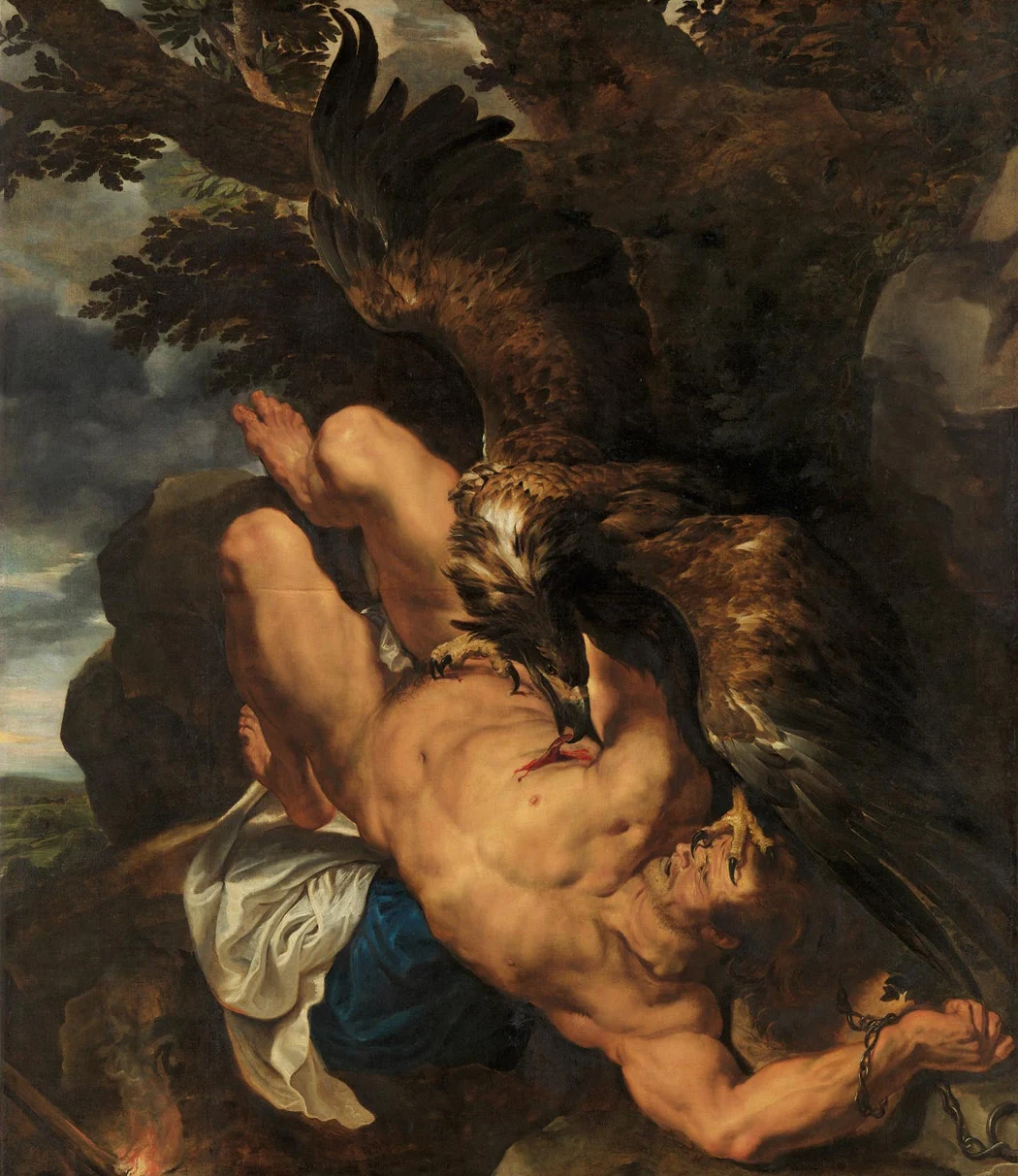
Snyders’s eagle fills the upper half of the composition. Rubens turns the captive’s body towards the viewer and lets it fall diagonally. Compare Hesiod’s short description with the way the painters fill the canvas with a single instant.
Peter Paul Rubens and Frans Snyders, Prometheus Bound, begun ca. 1611–12 and completed by 1618. Philadelphia Museum of Art, W1950-3-1. Public-domain reproduction via Wikimedia Commons. · Image source ↗ · Public Domain
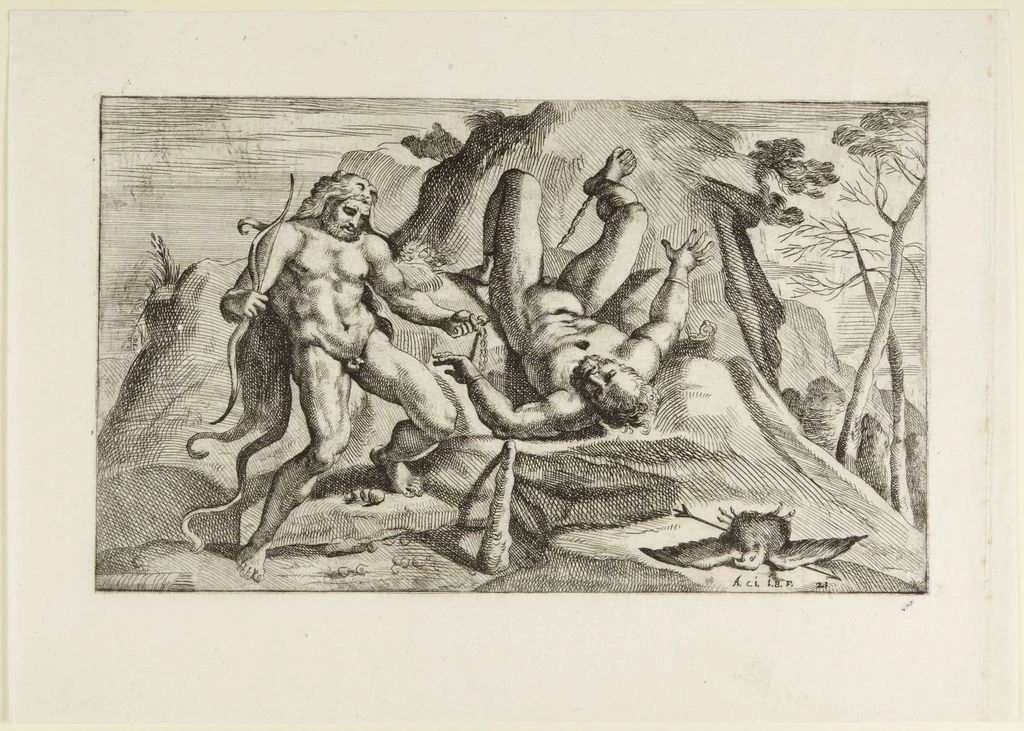
Jacques Belly’s engraving after Annibale Carracci chooses the intervention of Hercules, the Roman name for Heracles. Compare this scene of rescue with the uninterrupted suffering pictured by Rubens and Snyders.
Jacques Belly, Hercules freeing Prometheus, engraving after Annibale Carracci, plate 21. Gift of Nathan Chaikin, Princeton University Art Museum, x1968-178. Public domain. · Image source ↗ · Public Domain
Why does Prometheus Bound connect fire with the arts?
The chained speaker says mortals once saw without understanding what they saw. He lists the knowledge he taught them, including the seasons, numbers, writing, navigation and ways of treating illness. Fire makes sense within this list as one capacity that can give rise to many others. The play’s account of human life therefore extends from something a person can hold to skills that can be discovered, taught and handed down. [3]
The surviving play opens as the captive is being secured and closes while he still defies Zeus. The eagle is foretold. That arrangement gives the drama a different shape from the passage in Hesiod that already includes Heracles’s intervention. Start with the captive’s first admission about the fire, then compare it with the much fuller speech he makes about mortal knowledge. [3][1]
From Prometheus Bound to Frankenstein
Mary Shelley’s 1818 title page calls Frankenstein the Modern Prometheus. Victor’s account of trying to animate a body supplies one place to test the comparison. He imagines breaking through the bounds of life and death and uses the image of bringing light into darkness. The title invites readers to ask who benefits from the new power and what responsibility comes with making it available. [5][3]
Percy Bysshe Shelley addresses the ancient drama directly in his preface to Prometheus Unbound. He says he chose to avoid the reconciliation that he understood the ancient continuation to have contained. His reason concerns the character he wanted to write. Keeping the two Shelleys’ works separate makes the comparison clearer: Mary places the name in the title of a novel about creation, while Percy rewrites the outcome of the drama. [5][6]
- Ancient Greek drama
Prometheus Bound
The chained speaker gives fire and the arts a public defence. [3]
- By 1618
Rubens and Snyders, Prometheus Bound
The eagle and the captive fill a large canvas with the torment. [4]
- 1818
Mary Shelley, Frankenstein
The subtitle carries the name of Prometheus into a novel about making life. [5]
- 1820
Percy Bysshe Shelley, Prometheus Unbound
The preface explains the decision to give the ancient drama a different resolution. [6]
- 1888
See references (8)
- Prometheus Bound · The charge and the gifts to mortals
- Philadelphia Museum of Art · Prometheus Bound
- Mary Shelley, Frankenstein; or, The Modern Prometheus · 1818 title page and Vol. I, ch. 3
- Percy Bysshe Shelley, Prometheus Unbound · Preface
- Richard Garnett, The Twilight of the Gods · Prometheus and Elenko
- Garnett, page 9 · The eagle returns
- Garnett, page 10 · The bonds give way
- Garnett, page 16 · Prometheus tells Elenko who he is
Richard Garnett’s Prometheus in the Library
Garnett puts a mortal woman named Elenko on the road to the mountain. At the opening, the eagle drops lifeless and the bonds snap, leaving Prometheus to descend the mountain. Elenko meets him without recognising him. She later explains that she set out to find him after worship of the gods was outlawed, and her listener finally tells her who he is. Compare the way the two Reader pages handle recognition: the opening lets us see what the captive has endured, and the later encounter lets us hear him choose what to say about it. [7][10][11][12]
Read further in the library
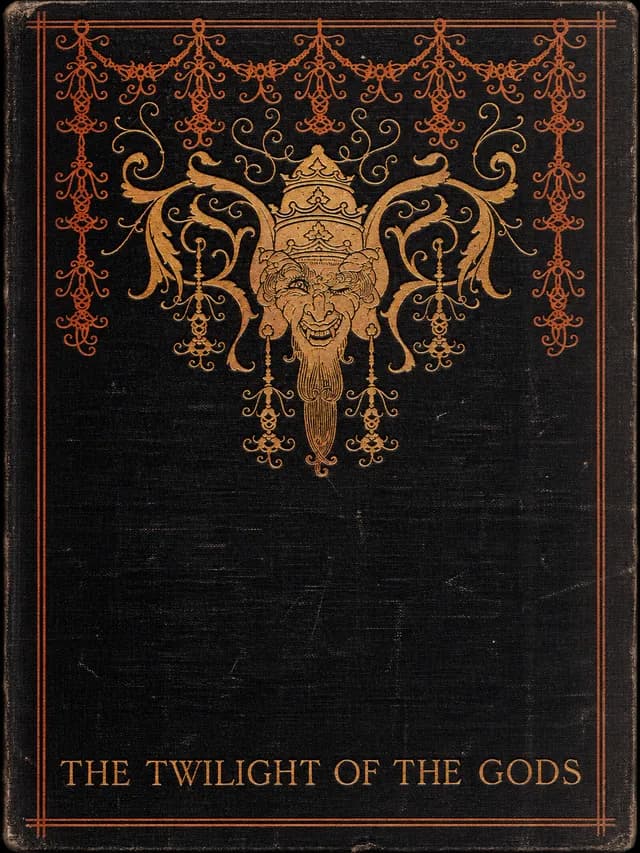
The Twilight of the Gods and Other Tales
Reading note
Explore Richard Garnett’s retelling of Prometheus’s release with Elenko.
Sources
See references (12)
- Hesiod, Theogony 507–616 · Mecone, fire and the eagle ↗Toronto Metropolitan University Pressbooks, Hesiod translations in Myths of the Greek and Roman Gods.Return to text ↑
- Hesiod, Works and Days 42–105 · The hidden livelihood and Pandora ↗Toronto Metropolitan University Pressbooks, Hesiod translations in Myths of the Greek and Roman Gods.Return to text ↑
- Prometheus Bound · The charge and the gifts to mortals ↗Drama traditionally attributed to Aeschylus, Toronto Metropolitan University Pressbooks. See lines 107–111 and 436–506.Return to text ↑
- Philadelphia Museum of Art · Prometheus Bound ↗Philadelphia Museum of Art, collection record W1950-3-1.Return to text ↑
- Mary Shelley, Frankenstein; or, The Modern Prometheus · 1818 title page and Vol. I, ch. 3 ↗Wikisource, transcription of volume I, chapter 3 of the 1818 edition.Return to text ↑
- Percy Bysshe Shelley, Prometheus Unbound · Preface ↗Wikisource, preface from the scanned edition.Return to text ↑
- Richard Garnett, The Twilight of the Gods · Prometheus and Elenko ↗T. Fisher Unwin, 1888. Google Books catalogue and scan. The Reader links lead to the verified leaves.Return to text ↑
- Prometheus Bound, Rubens and Snyders ↗Peter Paul Rubens and Frans Snyders, Prometheus Bound, begun ca. 1611–12 and completed by 1618. Philadelphia Museum of Art, W1950-3-1. Public-domain reproduction via Wikimedia Commons.Return to text ↑
- Hercules freeing Prometheus ↗Jacques Belly, Hercules freeing Prometheus, engraving after Annibale Carracci, plate 21. Gift of Nathan Chaikin, Princeton University Art Museum, x1968-178. Public domain.Return to text ↑
- Garnett, page 9 · The eagle returnsRichard Garnett, The Twilight of the Gods and Other Tales. T. Fisher Unwin, 1888. Lumitheca source leaf 14.Read this page in The Twilight of the Gods and Other Tales ↗Return to text ↑
- Garnett, page 10 · The bonds give wayRichard Garnett, The Twilight of the Gods and Other Tales. T. Fisher Unwin, 1888. Lumitheca source leaf 15.Read this page in The Twilight of the Gods and Other Tales ↗Return to text ↑
- Garnett, page 16 · Prometheus tells Elenko who he isRichard Garnett, The Twilight of the Gods and Other Tales. T. Fisher Unwin, 1888. Lumitheca source leaf 21.Read this page in The Twilight of the Gods and Other Tales ↗Return to text ↑