If All Souls Are One, What Happens to the Individual?
Compare Emerson’s Over-Soul with Plotinus’s account of one soul. See how each writer explains individuality, shared understanding and separate experience.
In this article
Compare Emerson and Plotinus in four passages
Follow the question from shared conversation to private sensation and a common source.
- Emerson · pp. 222 and 229
A thought shared in conversation
Emerson’s common nature
Follow his movement from sincere speech to a truth that belongs to everyone in the discussion. - Emerson · p. 231
A parent and child
The practical test
Compare imposing a decision with appealing to a principle both people recognise. - Plotinus · IV.9.1–3
One person’s pain
Plotinus’s strongest objection
Ask whether shared soul would entail shared sensation. - Plotinus · IV.9.4–5
One ring and many impressions
Two accounts of unity in variety
Compare the common origin of impressions with how a field of knowledge stays available in a particular case.
Can one soul leave room for different lives?
For Emerson, the Over-Soul is the common nature in which particular people participate. He makes the idea tangible through moments of sincere conversation and right action. Plotinus asks a different question. If soul is present as a whole in a living being, could many living beings share one incorporeal source? Both writers keep individual lives in view, but they explain the relationship in different ways. [2][3][7]
The clearest test is to ask what would have to be shared. Two people can recognise a truth together while having different memories and feelings. Plotinus presses on the second part of that example. Emerson is especially interested in the first, and in how recognising something in common can change what each person does. [3][8]
Emerson’s Over-Soul and the common heart
The essay opens with differences between the moments of one life. Emerson asks why brief moments of insight or hope can seem more authoritative than settled habits. The move to the Over-Soul follows that observation. He gives the shared source moral force by connecting it to sincerity and the way a person acts. [1][2]
His conversation example is more concrete. Someone gives voice to a thought, the listeners recognise its force, and the group finds it belongs to the discussion as a whole. The person who spoke still had a part in what happened. Emerson’s interest lies in the thought becoming available to everybody present, including people whose experience and education differ. [3][5]
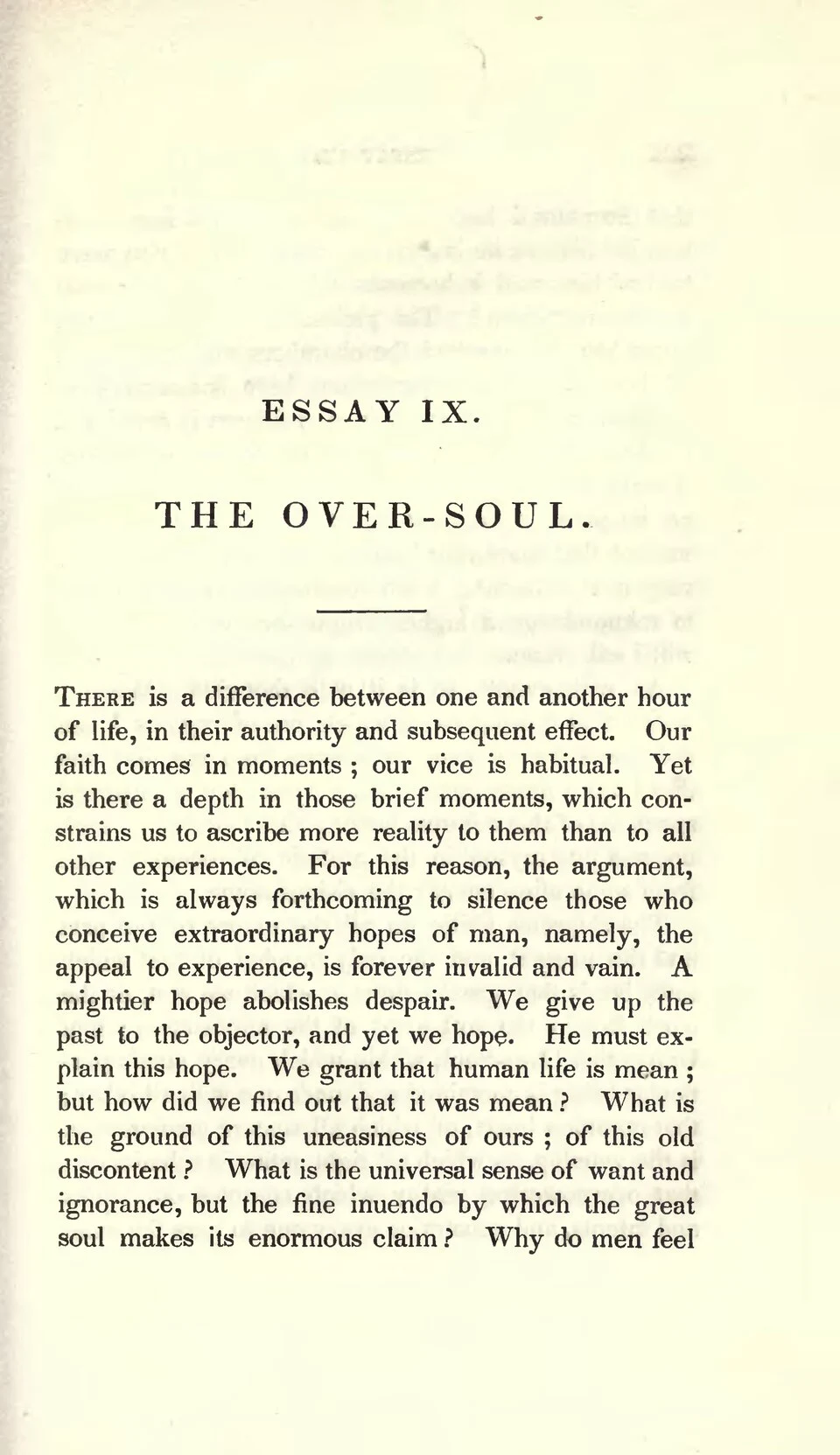
Essay IX begins by asking why certain brief moments seem to carry more authority than the rest of experience. First edition, printed p. 221.
Ralph Waldo Emerson, Essays, Boston: James Munroe and Company, 1841, essay IX. Facsimile via the Internet Archive and Wikimedia Commons. · Image source ↗ · Public Domain
What changes when two people disagree?
Emerson shifts from conversation to the relation between a parent and a child. The parent can win by being stronger. A different response begins when the parent gives up simply imposing their will and appeals to a principle both can recognise. In the essay the child’s response is the test of that appeal. Each person still has a distinct role, and the adult has a choice about how to exercise power. [4]
This episode shows why reading the Over-Soul as a large personality misses something central to the essay. Emerson uses the idea to account for why another person can bring a truth into view and why you may have to change your own conduct in response. [3][4]
Plotinus’s objection about private feeling
Plotinus opens with the living body. If the soul were divided into pieces in the way a body is, he reasons, each piece would occupy a place of its own. He takes the soul’s presence throughout the organism as evidence of unity and asks whether an analogous claim could hold across several organisms. [7]
He gives the objection its full force. If your soul and mine are one, why does it seem possible for me to feel pain without you feeling it too? His reply distinguishes the soul’s unity from the conditions under which a particular sensation becomes evident to a particular subject. He uses uneven awareness within one body as a more familiar case. Sections 2 and 3 go on to consider sympathy and different powers of living things. [8][11]
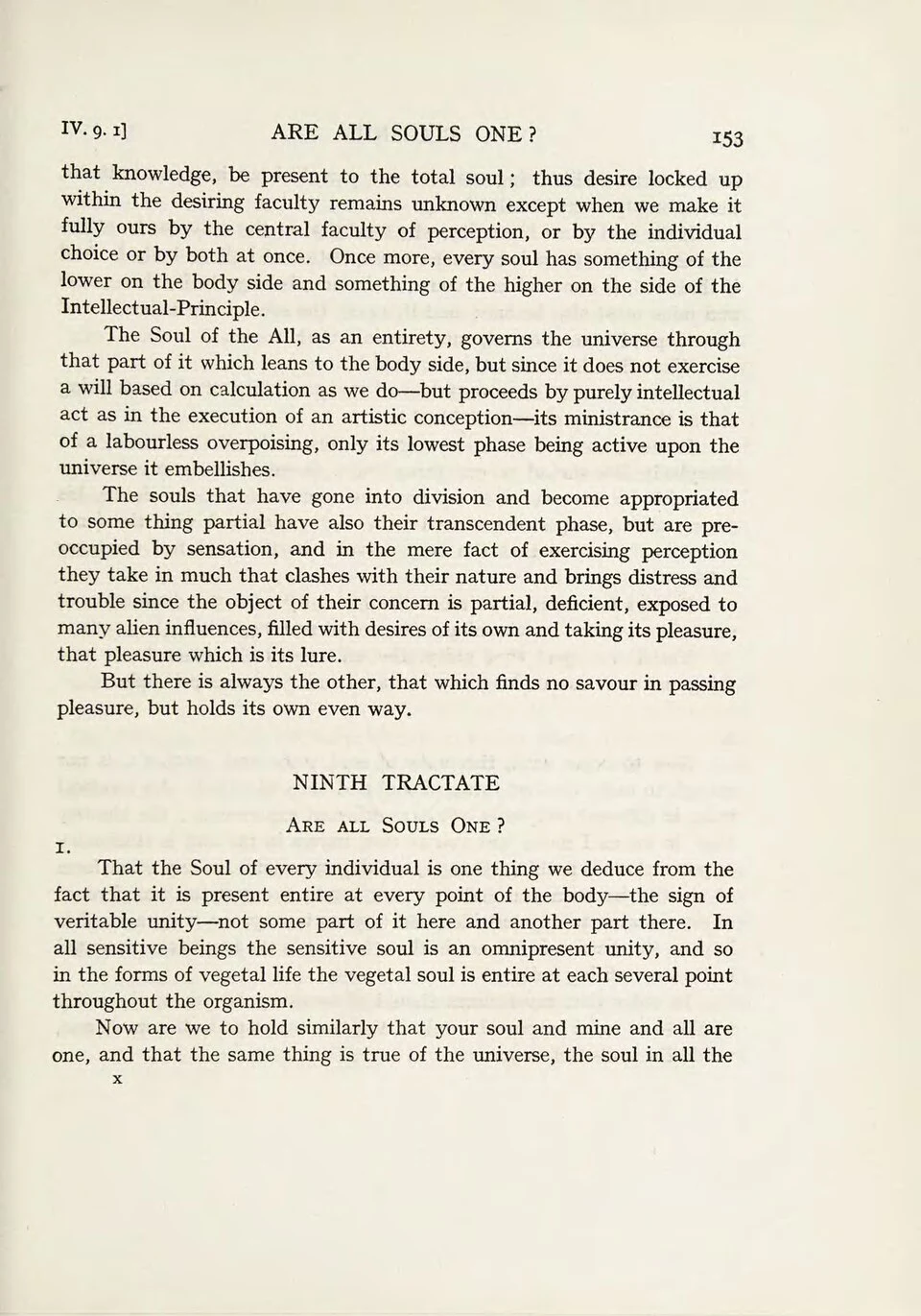
The opening of IV.9 begins with soul in a single body, then asks whether the same kind of unity could hold across living beings. Printed p. 153.
Plotinus, On the Nature of the Soul, trans. Stephen MacKenna, vol. III, London: Medici Society, 1924, Ennead IV.9. Facsimile via the Internet Archive and Wikimedia Commons. · Image source ↗ · Public Domain
Two analogies for one source and many lives
In section 4 a single seal ring can leave impressions in many places. The repeated pattern makes a common origin imaginable, while each impression has a location of its own. Plotinus proceeds beyond the physical image by asking what it would mean for a source without a body to be present without being cut into copies. [9][11]
Section 5 turns to a field of knowledge. A practitioner brings one part of the field to bear on the problem at hand. The other parts still provide the connections that make that detail intelligible. Plotinus treats this as a way to understand how the whole can be available while attention singles out one element. The ring helps with common origin, and the example of knowledge helps with the active relation of a part to a whole. [10][11]
What does either argument tell us about death?
To ask whether a source endures is to ask about a different kind of continuity from the survival of a person’s memories. Plotinus proposes ways a single source could underlie distinct experiences. Anyone drawing a conclusion about who remembers a particular life after death would also need an account of how that memory persists. [8][11]
Emerson’s examples supply a different test. Look for a change in understanding or conduct between particular people, then ask what makes their recognition possible. That is why the passage on parent and child deserves to be read beside his statements about unity. It puts the shared nature to work within an encounter in which each person can answer the other. [2][4]
Sources
See references (12)
- Emerson’s opening, printed p. 221 ↗Ralph Waldo Emerson, Essays, Boston: James Munroe and Company, 1841, essay IX. Printed p. 221.Return to text ↑
- The common heart, printed p. 222 ↗Ralph Waldo Emerson, Essays, Boston: James Munroe and Company, 1841, essay IX. Printed p. 222.Return to text ↑
- Common nature in conversation, printed p. 229 ↗Ralph Waldo Emerson, Essays, Boston: James Munroe and Company, 1841, essay IX. Printed p. 229.Return to text ↑
- The encounter between parent and child, printed p. 231 ↗Ralph Waldo Emerson, Essays, Boston: James Munroe and Company, 1841, essay IX. Printed p. 231.Return to text ↑
- Read the whole essay in transcription ↗Wikisource transcription of “The Over-Soul”. Check exact first-edition wording against the scan.Return to text ↑
- Emerson facsimile and rights record ↗Ralph Waldo Emerson, Essays, Boston: James Munroe and Company, 1841, essay IX. Public-domain mechanical reproduction.
- The question of one soul, printed p. 153 ↗Plotinus, On the Nature of the Soul, trans. Stephen MacKenna, vol. III, London: Medici Society, 1924, Ennead IV.9. Printed p. 153.Return to text ↑
- The objection from shared experience, printed p. 154 ↗Plotinus, On the Nature of the Soul, trans. Stephen MacKenna, vol. III, London: Medici Society, 1924, Ennead IV.9. Printed p. 154.Return to text ↑
- A single ring and multiple impressions, printed p. 157 ↗Plotinus, On the Nature of the Soul, trans. Stephen MacKenna, vol. III, London: Medici Society, 1924, Ennead IV.9. Printed p. 157.Return to text ↑
- How an entire field of knowledge relates to a part, printed p. 158 ↗Plotinus, On the Nature of the Soul, trans. Stephen MacKenna, vol. III, London: Medici Society, 1924, Ennead IV.9. Printed p. 158.Return to text ↑
- Read all five sections of Ennead IV.9 ↗Plotinus, On the Nature of the Soul, trans. Stephen MacKenna, vol. III, London: Medici Society, 1924, Ennead IV.9. Sections 1–5.Return to text ↑
- MacKenna facsimile and rights record ↗Plotinus, On the Nature of the Soul, trans. Stephen MacKenna, vol. III, London: Medici Society, 1924, Ennead IV.9. Public-domain mechanical reproduction.