World Soul
What is the World Soul? Compare Plato’s account of a living cosmos with Manly P. Hall’s interpretation of its crossed circles.
In this article
The cosmos as one living being
The World Soul is the soul or ordering life of the cosmos considered as a whole. In Plato’s Timaeus, the maker extends it through and around the body of the universe, giving the whole a living order. [2]
Plato also describes that order through geometry. Strips of the soul’s mixture cross and bend into circles. Their motions give later interpreters a place to begin when asking what the crossing signifies. [2][3][4]
Timaeus by Plato
In Plato’s Timaeus, the maker divides the soul’s mixture into strips, lays them across one another and bends them into circles. He gives the circles the motions of the Same and the Other. [2]
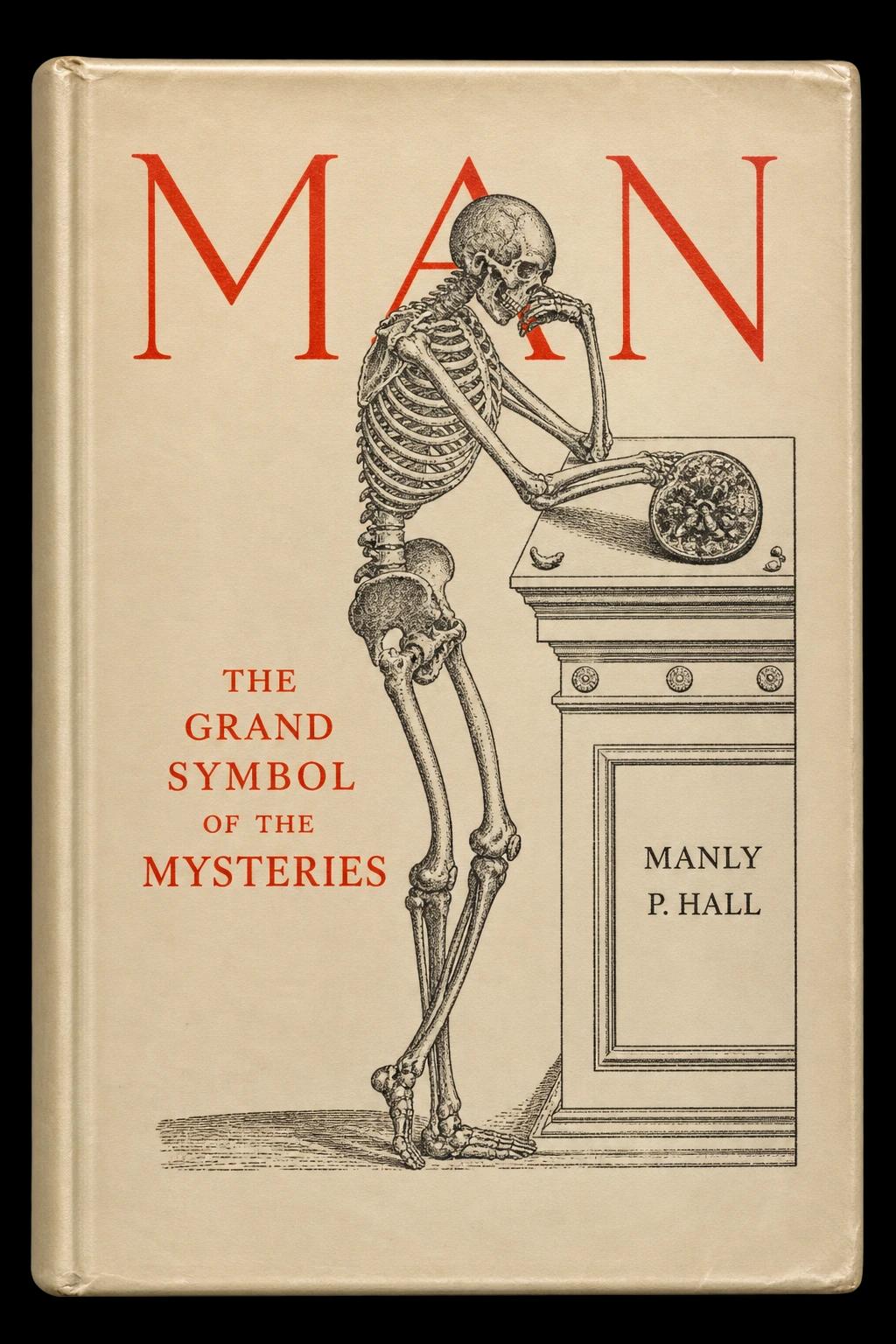
Man the Grand Symbol of the Mysteries by Manly P. Hall
In Man the Grand Symbol of the Mysteries, Manly P. Hall reads Plato’s crossed strips alongside passages about a soul extended across the universe. He cites William Stirling and Neoplatonic accounts and connects the crossing with celestial circles. [3][4][5]
Hall makes the World Soul a mediator between intellect and the world of appearances. He brings the cross into relation with the ecliptic, the poles and points in the solar year. [5][6]
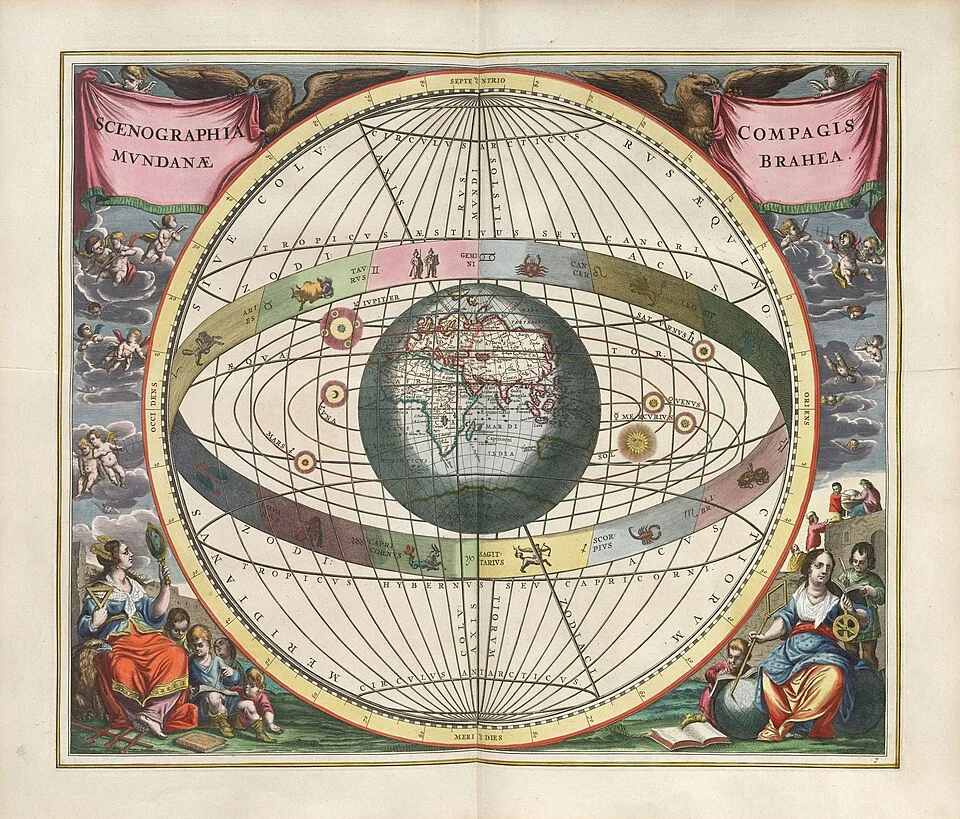
Cellarius’s seventeenth-century engraving shows the orbits of the Tychonic system. It gives a later example of how circles convey celestial order.
Andreas Cellarius, Scenographia Compagis Mundanae Brahea, Harmonia macrocosmica, 1660. Via Wikimedia Commons. · Image source ↗ · Public Domain
Two circles and a symbolic cross
In the Timaeus, the crossing is part of the making of two different motions. Hall takes the intersecting form as a starting point for comparisons with the celestial cross and images of crucifixion. [3][5][6][2]
In the library
Man the Grand Symbol of the Mysteries
Reading note
The separately titled account draws on exact passages in the consulted Library edition.
Sources
See references (6)
- The Tychonic system in Harmonia macrocosmica ↗Andreas Cellarius, Scenographia Compagis Mundanae Brahea, Harmonia macrocosmica, 1660. Via Wikimedia Commons.
- Timaeus 34b to 37a, the soul of the cosmos ↗Plato, Timaeus 34b to 37a, Greek text and English translation, Ad Fontes Library.
- Man the Grand Symbol of the Mysteries, printed p. 95, Reader page 93Manly P. Hall, Man the Grand Symbol of the Mysteries, Fourth Edition, The Philosophers Press, Los Angeles, 1937. Lumitheca Library edition IMJ-0603-E001.Read this page in Man the Grand Symbol of the Mysteries ↗
- Man the Grand Symbol of the Mysteries, printed p. 96, Reader page 94Manly P. Hall, Man the Grand Symbol of the Mysteries, Fourth Edition, The Philosophers Press, Los Angeles, 1937. Lumitheca Library edition IMJ-0603-E001.Read this page in Man the Grand Symbol of the Mysteries ↗
- Man the Grand Symbol of the Mysteries, printed p. 97, Reader page 95Manly P. Hall, Man the Grand Symbol of the Mysteries, Fourth Edition, The Philosophers Press, Los Angeles, 1937. Lumitheca Library edition IMJ-0603-E001.Read this page in Man the Grand Symbol of the Mysteries ↗
- Man the Grand Symbol of the Mysteries, printed p. 98, Reader page 96Manly P. Hall, Man the Grand Symbol of the Mysteries, Fourth Edition, The Philosophers Press, Los Angeles, 1937. Lumitheca Library edition IMJ-0603-E001.Read this page in Man the Grand Symbol of the Mysteries ↗