Nishkama Karma
Nishkama karma means acting without letting desire for the result govern the work. Read Krishna’s instruction and Vivekananda’s examples of giving.
In this article
Understanding the concept
Nishkama karma is action undertaken without making desire for its fruits the governing motive. In the Bhagavad Gita, Krishna connects this approach to karma with continuing to act. In Karma Yoga, it matters both what the worker does and what they expect to gain. [1][2]
Vivekananda gives the idea an everyday test. If someone feels cheated when a good deed earns no thanks, gratitude may have been part of the return they expected. The teaching asks whether the deed still seems worth doing. [4][5][6][7]
The Bhagavad Gita: work and its fruits
In Bhagavad Gita 2.47, Krishna distinguishes acting from a claim to the fruits of action and also warns Arjuna against attachment to inaction. Verse 3.19 asks for work without attachment. Verse 3.9 gives action the context of an offering. [1][2][3]
Karma-Yoga by Swami Vivekananda
Swami Vivekananda reads the Gita’s instruction through a simple act of help. Someone gives freely when they leave the recipient free to respond. Requiring the recipient to pay the giver in gratitude changes the character of the act. [8][4][5]
He describes this through the attitude of a parent who provides for children without presenting a bill for appreciation. He extends that attitude to work for a person, city or state. The example concerns freedom from a demand for return, rather than an absence of care for the people affected. [4][5]
For someone who believes in a personal God, the fruits can be offered to God. The worker then acts as a servant, declining a personal claim to praise or benefit. Elsewhere Vivekananda also allows an approach through will and discrimination without belief in divine assistance, so his account does not depend on one devotional formulation alone. [9][10]
He recognizes the difficulty of acting without a selfish motive and presents it as gradual work. A person begins with available duties, examines the motives that arise, and persists. A grand declaration that one has renounced results would not by itself establish the change he describes. [11][12][8][13]
The final chapter makes reward in heaven part of the same problem. If a good deed is performed in order to secure a private future benefit, it still produces a chain. By contrast, Vivekananda says a good act without an ulterior motive loosens existing bondage. The difference lies in the relation to reward, including a reward considered spiritual. [14][15]
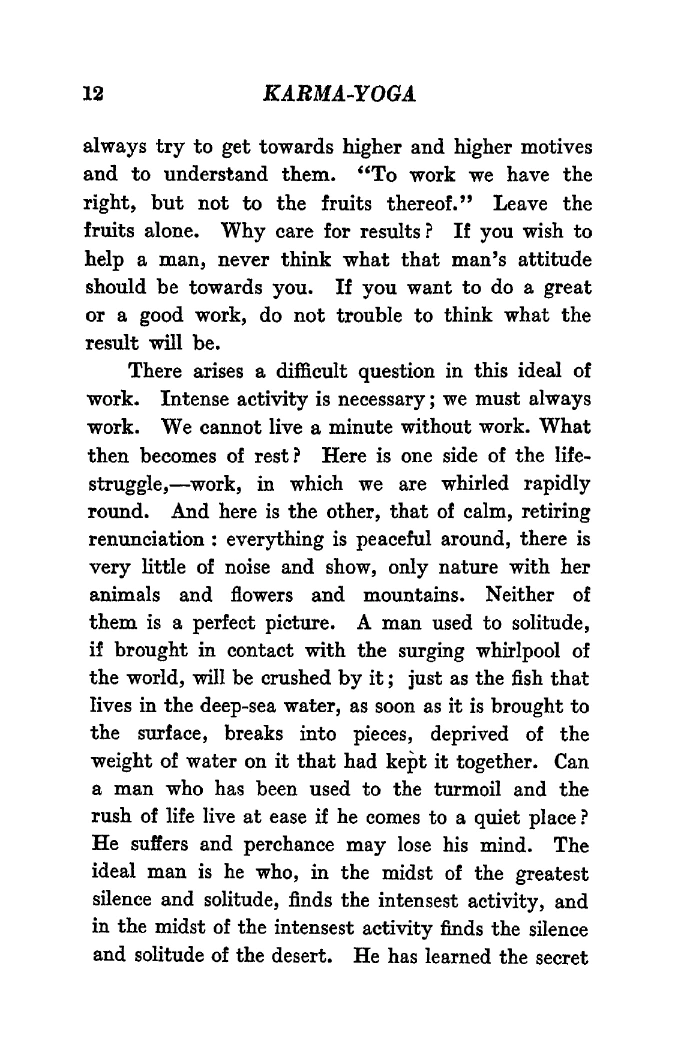
Karma-Yoga (1939), Library Reader page 14. The work continues after the worker lets go of a claim to its fruits.
Swami Vivekananda, Karma-Yoga, English second printing in the 1939 combined volume. Historical public-domain text, exact checksum-verified Library scan. · Image source ↗ · Public Domain
Giving the work attention without claiming its fruits
Krishna keeps Arjuna’s duty to act in view. Vivekananda asks the worker to give the work their attention while relinquishing a private claim on the results. What someone hopes to get from the work is a different question from how much care they give it. [1][8][14][16][9][10]
Read further in the library
Karma Yoga
Reading note
The separately titled account draws on exact passages in the consulted Library edition.
Sources
See references (16)
- Bhagavad Gita 2.47, translated by Swami Mukundananda ↗Bhagavad Gita 2.47. Swami Mukundananda’s translation and the Sanskrit verse distinguish acting from attachment to results and from attachment to inaction.Return to text ↑
- Bhagavad Gita 3.19, translated by Swami Mukundananda ↗Bhagavad Gita 3.19, in Swami Mukundananda’s translation. The term param is rendered as the Supreme.Return to text ↑
- Bhagavad Gita 3.9, translated by Swami Mukundananda ↗Bhagavad Gita 3.9. Swami Mukundananda’s translation presents action as an offering to God; this devotional interpretation is attributed.Return to text ↑
- Karma-Yoga, Reader page 46Swami Vivekananda, Karma-Yoga, in Karma-Yoga & Bhakti-Yoga, English second printing, Ramakrishna-Vivekananda Center of New York, Inc., 1939. Exact Library edition IMJ-0097-E002. Only the Karma-Yoga part is used in this crawl; the old Work slug mentioning Hindi does not identify this edition’s language.Read this page in Karma Yoga ↗Return to text ↑
- Karma-Yoga, Reader page 47Swami Vivekananda, Karma-Yoga, in Karma-Yoga & Bhakti-Yoga, English second printing, Ramakrishna-Vivekananda Center of New York, Inc., 1939. Exact Library edition IMJ-0097-E002. Only the Karma-Yoga part is used in this crawl; the old Work slug mentioning Hindi does not identify this edition’s language.Read this page in Karma Yoga ↗Return to text ↑
- Karma-Yoga, Reader page 69Swami Vivekananda, Karma-Yoga, in Karma-Yoga & Bhakti-Yoga, English second printing, Ramakrishna-Vivekananda Center of New York, Inc., 1939. Exact Library edition IMJ-0097-E002. Only the Karma-Yoga part is used in this crawl; the old Work slug mentioning Hindi does not identify this edition’s language.Read this page in Karma Yoga ↗Return to text ↑
- Karma-Yoga, Reader page 70Swami Vivekananda, Karma-Yoga, in Karma-Yoga & Bhakti-Yoga, English second printing, Ramakrishna-Vivekananda Center of New York, Inc., 1939. Exact Library edition IMJ-0097-E002. Only the Karma-Yoga part is used in this crawl; the old Work slug mentioning Hindi does not identify this edition’s language.Read this page in Karma Yoga ↗Return to text ↑
- Karma-Yoga, Reader page 14Swami Vivekananda, Karma-Yoga, in Karma-Yoga & Bhakti-Yoga, English second printing, Ramakrishna-Vivekananda Center of New York, Inc., 1939. Exact Library edition IMJ-0097-E002. Only the Karma-Yoga part is used in this crawl; the old Work slug mentioning Hindi does not identify this edition’s language.Read this page in Karma Yoga ↗Return to text ↑
- Karma-Yoga, printed p. 101, Reader page 103Swami Vivekananda, Karma-Yoga, in Karma-Yoga & Bhakti-Yoga, English second printing, Ramakrishna-Vivekananda Center of New York, Inc., 1939. Exact Library edition IMJ-0097-E002. Only the Karma-Yoga part is used in this crawl; the old Work slug mentioning Hindi does not identify this edition’s language.Read this page in Karma Yoga ↗Return to text ↑
- Karma-Yoga, Reader page 104Swami Vivekananda, Karma-Yoga, in Karma-Yoga & Bhakti-Yoga, English second printing, Ramakrishna-Vivekananda Center of New York, Inc., 1939. Exact Library edition IMJ-0097-E002. Only the Karma-Yoga part is used in this crawl; the old Work slug mentioning Hindi does not identify this edition’s language.Read this page in Karma Yoga ↗Return to text ↑
- Karma-Yoga, Reader page 12Swami Vivekananda, Karma-Yoga, in Karma-Yoga & Bhakti-Yoga, English second printing, Ramakrishna-Vivekananda Center of New York, Inc., 1939. Exact Library edition IMJ-0097-E002. Only the Karma-Yoga part is used in this crawl; the old Work slug mentioning Hindi does not identify this edition’s language.Read this page in Karma Yoga ↗Return to text ↑
- Karma-Yoga, Reader page 13Swami Vivekananda, Karma-Yoga, in Karma-Yoga & Bhakti-Yoga, English second printing, Ramakrishna-Vivekananda Center of New York, Inc., 1939. Exact Library edition IMJ-0097-E002. Only the Karma-Yoga part is used in this crawl; the old Work slug mentioning Hindi does not identify this edition’s language.Read this page in Karma Yoga ↗Return to text ↑
- Karma-Yoga, Reader page 15Swami Vivekananda, Karma-Yoga, in Karma-Yoga & Bhakti-Yoga, English second printing, Ramakrishna-Vivekananda Center of New York, Inc., 1939. Exact Library edition IMJ-0097-E002. Only the Karma-Yoga part is used in this crawl; the old Work slug mentioning Hindi does not identify this edition’s language.Read this page in Karma Yoga ↗Return to text ↑
- Karma-Yoga, Reader page 121Swami Vivekananda, Karma-Yoga, in Karma-Yoga & Bhakti-Yoga, English second printing, Ramakrishna-Vivekananda Center of New York, Inc., 1939. Exact Library edition IMJ-0097-E002. Only the Karma-Yoga part is used in this crawl; the old Work slug mentioning Hindi does not identify this edition’s language.Read this page in Karma Yoga ↗Return to text ↑
- Karma-Yoga, Reader page 122Swami Vivekananda, Karma-Yoga, in Karma-Yoga & Bhakti-Yoga, English second printing, Ramakrishna-Vivekananda Center of New York, Inc., 1939. Exact Library edition IMJ-0097-E002. Only the Karma-Yoga part is used in this crawl; the old Work slug mentioning Hindi does not identify this edition’s language.Read this page in Karma Yoga ↗Return to text ↑
- Karma-Yoga, Reader page 61Swami Vivekananda, Karma-Yoga, in Karma-Yoga & Bhakti-Yoga, English second printing, Ramakrishna-Vivekananda Center of New York, Inc., 1939. Exact Library edition IMJ-0097-E002. Only the Karma-Yoga part is used in this crawl; the old Work slug mentioning Hindi does not identify this edition’s language.Read this page in Karma Yoga ↗Return to text ↑