Nagualism and animal counterparts
Nagualism concerns transformation and animal counterparts in Mesoamerica. Explore how tonal and nahual differ in Alessandro Lupo’s Sierra de Puebla research.
In this article
What is nagualism?
Nagualism is a term used for Mesoamerican accounts of people with transformative powers or nonhuman counterparts. Nahual and tonal take different meanings in particular languages and communities. A story about one place can show how the ideas relate there. [7]
One recurring question is who has an animal counterpart. Another is who can act through an animal form. The first can concern one’s character or fate, while the second concerns a capacity attributed to certain people. [7][8]
See references (2)
Tonal and nahual in regional context
In Alessandro Lupo’s research with Nahua communities in the Sierra de Puebla, a tonal is an alter ego, often animal, linked with someone’s temperament and fate. Particular people known as nahualme are believed to act in an animal form. Some specialists describe a projection into the counterpart, a more specific claim than the body itself changing species. [7][8]
See references (2)
Human Animals by Frank Hamel
Frank Hamel’s Human Animals briefly describes a nagual as an animal counterpart or second soul. It may be obtained through a dream or a formative encounter, and the person and animal can be said to share a fate. His immediate interest is the link with human–animal transformation. [1][2]
This account occupies only a small part of a chapter comparing many kinds of animal relationship. Hamel moves quickly from Mesoamerican material to other regions and uses a general category of tutelary or second souls. That arrangement leaves local meanings and the distinction between a counterpart and a transforming specialist underdeveloped. [1][2][3]
Hamel later includes allegations from missionary sources. Those reports show how colonial writers described forms of worship they opposed. The regional account above offers a more precise basis for explaining the relation between a person, a tonal and a capacity to act through another form. [4]
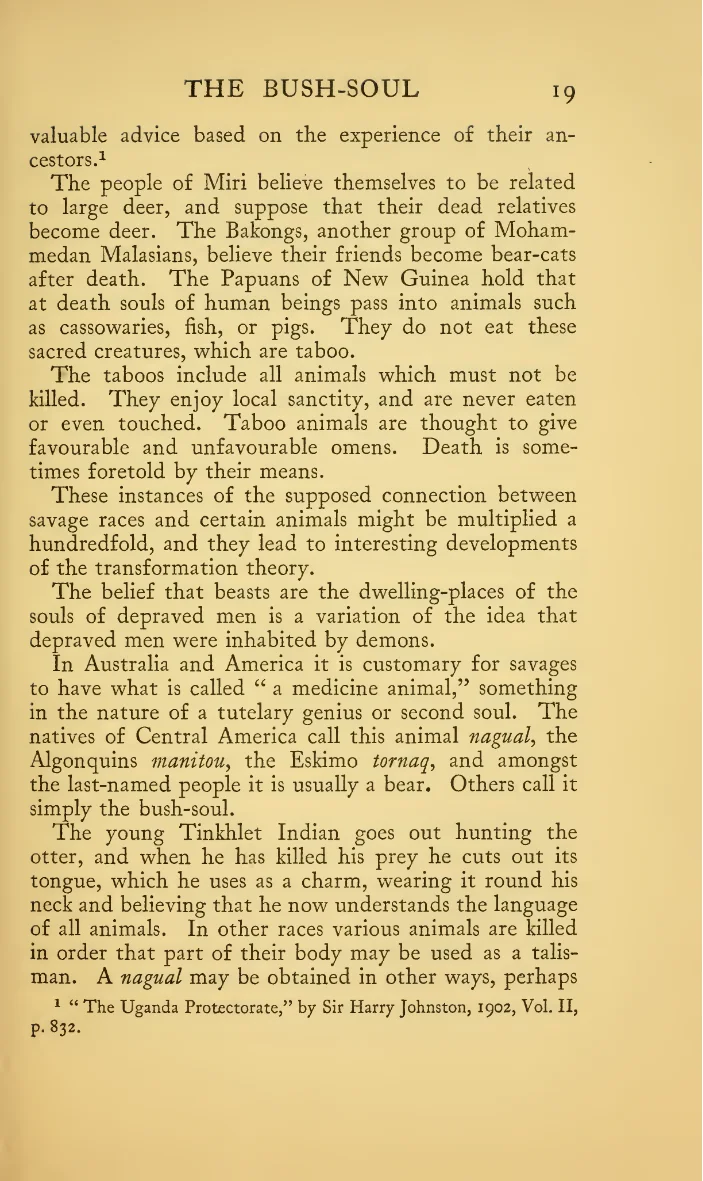
Human Animals, printed p. 19. Hamel places animal counterparts from several regions beside one another. The terminology and generalisations belong to the historical compiler.
Frank Hamel, Human Animals, undated Stokes edition; preface dated 1915. Public-domain text and facsimile. · Image source ↗ · Public Domain
Shared fate and acting through another form
Hamel’s bush-soul examples can be compared with his Mesoamerican material where both describe a person and an animal sharing a fate. Lupo’s Sierra de Puebla account then asks a narrower question: how does that shared fate relate to a capacity believed to belong to particular people? [1][2][3][7][8]
Animal doubles describe a wider field of appearances and counterparts. The question here includes socially situated knowledge and capacities, not merely a person seeing an animal-shaped version of themselves. Modern regional scholarship is therefore needed alongside this historical compilation. [1][2][5][6]
See references (7)
Read further in the library

Human Animals
Reading note
Frank Hamel collects the particular stories and interpretations discussed here; the account identifies exact printed and Library Reader pages.
Sources
See references (8)
- Human Animals, printed p. 19, Reader page 28Frank Hamel, Human Animals. Frederick A. Stokes Co., New York, undated title page; preface dated London, 1915. Exact printed pages refer to the retained Library scan.Read this page in Human Animals ↗Return to text ↑
- Human Animals, printed p. 20, Reader page 29Frank Hamel, Human Animals. Frederick A. Stokes Co., New York, undated title page; preface dated London, 1915. Exact printed pages refer to the retained Library scan.Read this page in Human Animals ↗Return to text ↑
- Human Animals, printed p. 21, Reader page 30Frank Hamel, Human Animals. Frederick A. Stokes Co., New York, undated title page; preface dated London, 1915. Exact printed pages refer to the retained Library scan.Read this page in Human Animals ↗Return to text ↑
- Human Animals, printed p. 153, Reader page 162Frank Hamel, Human Animals. Frederick A. Stokes Co., New York, undated title page; preface dated London, 1915. Exact printed pages refer to the retained Library scan.Read this page in Human Animals ↗Return to text ↑
- Human Animals, printed p. 261, Reader page 270Frank Hamel, Human Animals. Frederick A. Stokes Co., New York, undated title page; preface dated London, 1915. Exact printed pages refer to the retained Library scan.Read this page in Human Animals ↗Return to text ↑
- Human Animals, printed p. 262, Reader page 271Frank Hamel, Human Animals. Frederick A. Stokes Co., New York, undated title page; preface dated London, 1915. Exact printed pages refer to the retained Library scan.Read this page in Human Animals ↗Return to text ↑
- El tonal y el nahual ↗Alessandro Lupo, Arqueología Mexicana, no. 35. Regional scholarly context, distinct from Hamel’s brief comparative account.Return to text ↑
- Alessandro Lupo, Sostanze, attori e sensi, 2019 ↗Sapienza University of Rome research repository.Return to text ↑