Muhammad
Explore Muhammad’s life, the first-revelation account, the Hijra and community at Medina, the Quran, prophetic example and historical sources.
In this article
Who was Muhammad?
Muhammad was the seventh-century Arabian religious leader whom Muslims recognize as God’s messenger and a model of life shaped by revelation. In mainstream Islamic teaching, his mission completes the succession of prophets that includes Abraham, Moses and Jesus. [1]
Early life and its sources
Mecca, Khadija and the beginning of the mission
The conventional Islamic life account places Muhammad’s birth in Mecca around 570 CE. Orphaned in childhood, he was raised within his family and later worked in trade. His marriage to Khadija forms an important part of the story of his early adult life. [2]
Around the age of forty, his retreat at Hira becomes the setting for the first revelation. The narrative subsequently follows a growing community of believers in Mecca. [2]
How the biographical sources are read
The Quran, reports of Muhammad’s words and actions, and later biographical narratives provide different kinds of evidence. An account of his life needs to identify which kind of source is being used, as well as what it says. [3]
In the accessible introduction to their study of early biographical writings, Andreas Görke and Gregor Schoeler describe a long debate over the reliability of transmitted reports. Their framing directs attention towards assessing particular traditions or groups of traditions, rather than accepting or rejecting an entire body of transmission at once. [3]
A received life story and a historical reconstruction therefore need not have identical boundaries. Scholars investigate how reports reached their surviving forms; believers also read them as accounts of a prophetic mission and models for conduct. [3]
Hira in the report attributed to Aisha
A report attributed to Aisha in Sahih al-Bukhari describes an angel commanding Muhammad to recite at Hira. He returns frightened to Khadija, who reassures him by recalling his generosity and care for others. [4]
She takes him to Waraqa ibn Nawfal, who interprets the encounter through the revelation associated with Moses and anticipates hostility. The narrative gives recognition of the mission a human setting of alarm, reassurance and interpretation. [4]
Revelation and scripture
Revelation as recitation
Muslims understand the Quran as revelation received by Muhammad in Arabic and recited to his followers. Its name is closely connected with recitation. The scripture contains prayers, prophetic narratives, ethical instruction and passages concerning judgment, among other forms of address. [5]
Harvard’s Pluralism Project emphasizes that translations are understood as interpretations of the Arabic Quran. The text’s continuing life includes memorization and recitation, with established rules of pronunciation and intonation. Muhammad’s significance as messenger is therefore inseparable from words that Muslims continue to hear, learn and recite. [5]
A later manuscript makes the words visible
A folio from the Blue Quran gives that scriptural inheritance a striking material form. Gold lettering lies against indigo-dyed parchment, with silver markers dividing the verses. The Met dates the manuscript to the second half of the ninth through the mid-tenth century and associates it with North Africa. [11]
The page belongs to the later history of transmitting and honouring the Quran. It is separated from Muhammad’s lifetime by centuries. Its controlled lines and unusual colour show how a sacred text could become an object of demanding artistic work as well as recitation. [11]
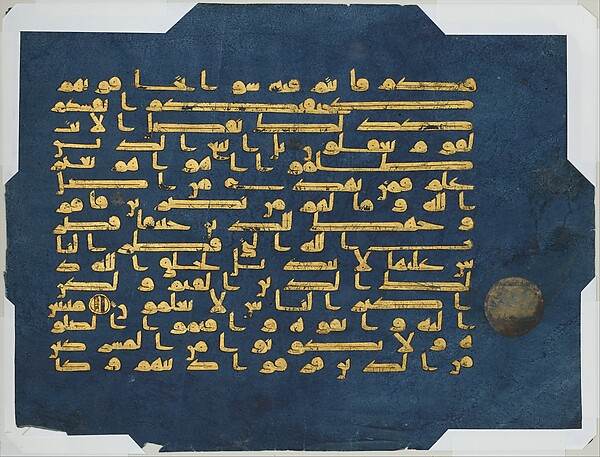
Folio from the Blue Qur’an, second half of the ninth–mid-tenth century, probably North Africa; the museum lists Tunisia, possibly Qairawan. Gold and silver on indigo-dyed parchment, 2004.88.
The Metropolitan Museum of Art. Purchase, Lila Acheson Wallace Gift, 2004. Public Domain, The Met Open Access. · Museum record ↗ · CC0
Community and guidance
The Hijra and the community at Medina
In 622 CE, Muhammad and his followers migrated from Mecca to Medina. The Hijra became the reference point for the Islamic calendar. At Medina his leadership acquired a communal and political setting as well as a religious one. [2]
The remaining years included conflict, negotiation and the continuing reception of revelation. The life account links the community’s survival with changing relationships among groups in Arabia. [2]
The agreements remembered as the Constitution of Medina
Documents associated with Muhammad’s leadership at Medina address the formation of a community and relations among its groups. Saïd Amir Arjomand reads the Constitution of Medina as a composite of agreements made between 622 and 627. His interpretation identifies a confederation of clans, changes in responsibility for punishment, protection for Jewish confederates and arrangements for the city’s defence. [14]
Michael Lecker’s study gives a different account of participation. He argues that most of Medina’s Jewish tribes, including major ones, had separate non-belligerency agreements rather than membership in this document. He also disputes a reading that makes each Jewish group a separate umma. [15]
These scholarly disagreements concern the membership, language and development of the agreements. They help explain why calling the text a constitution requires historical care: the term does not establish a modern state or a single uncontested account of Medina’s political life. [14][15]
Negotiation and disagreement at Hudaybiyyah
Sahih al-Bukhari’s Hudaybiyyah report places negotiations amid armed confrontation over access to the Kaaba. Muhammad accepts wording that names him as Muhammad ibn Abdullah when the other negotiator refuses his prophetic title. Pilgrimage is deferred until the following year. [13]
The concessions are difficult for his followers. A condition requiring return of people coming from the Meccan side becomes immediate when Abu Jandal arrives in fetters seeking refuge. Umar questions the agreement. The narrative presents leadership through negotiation, binding conditions and disagreement within the community, as well as confidence in a religious mission. [13]
Prophecy and the example of a human life
Islamic teaching places Muhammad within a history of divine guidance that includes earlier prophets. These figures convey revelation and exemplify a human response to God; they do not share in God’s divinity. [1]
This distinction shapes Muslim reverence for Muhammad. His authority comes from the mission entrusted to him, while worship is directed to God. The messenger’s exemplary life is understood through the revelation he communicates. [1]
Quran 33:40 calls Muhammad God’s messenger and the seal of the prophets. The phrase supports the mainstream Islamic understanding that the prophetic mission reaches its completion with him. [6]
Quran 33:21 presents God’s messenger as an example for those who hope in God and the Last Day. The passage helps explain why Muhammad’s conduct matters alongside the revelation he conveyed. Following the Prophet concerns the shape of a life, including its response to difficulty and responsibility. [7]
Death, succession and remembrance
Return to Mecca and death
The conventional account dates Muhammad’s return to Mecca to 630 CE, following military campaigns and negotiations. The Kaaba was rededicated to the worship of one God. Muhammad died in 632, leaving a community whose leadership and interpretation would develop through subsequent generations. [2]
Quran 3:144 speaks of Muhammad as a messenger preceded by other messengers and asks how believers would respond to his death. The mission’s religious significance is held together with the fact of a human life that ends. [9]
Why succession became a defining question
After Muhammad’s death, leadership of the community became a major point of divergence. Sunni accounts recognize Abu Bakr’s caliphate and the community’s role in choosing leadership. Shia accounts give distinctive authority to Ali, Muhammad’s cousin and son-in-law, and to the Prophet’s family. [10]
These differences concern how the community remains rightly guided after the messenger’s death. They developed into traditions with their own accounts of authority and transmission. The later histories of Sunni and Shia Islam extend well beyond a single dispute or an identical sequence of leaders. [10]
Mecca in a pilgrim’s manuscript
A sixteenth-century copy of the Futuh al-Haramayn preserves a different form of remembrance: sacred geography. The text, composed by Muhi al-Din Lari, describes Mecca and Medina and guides pilgrims through significant sites. The Met associates this copy with Bukhara. [12]
Its illustrated page places the Kaaba within a schematic enclosure, surrounded by architectural forms and inscriptions. Such images helped readers identify places connected with the Prophet and the pilgrimage. This is a later devotional representation of a sacred landscape, rather than a survey of seventh-century Mecca. [12]
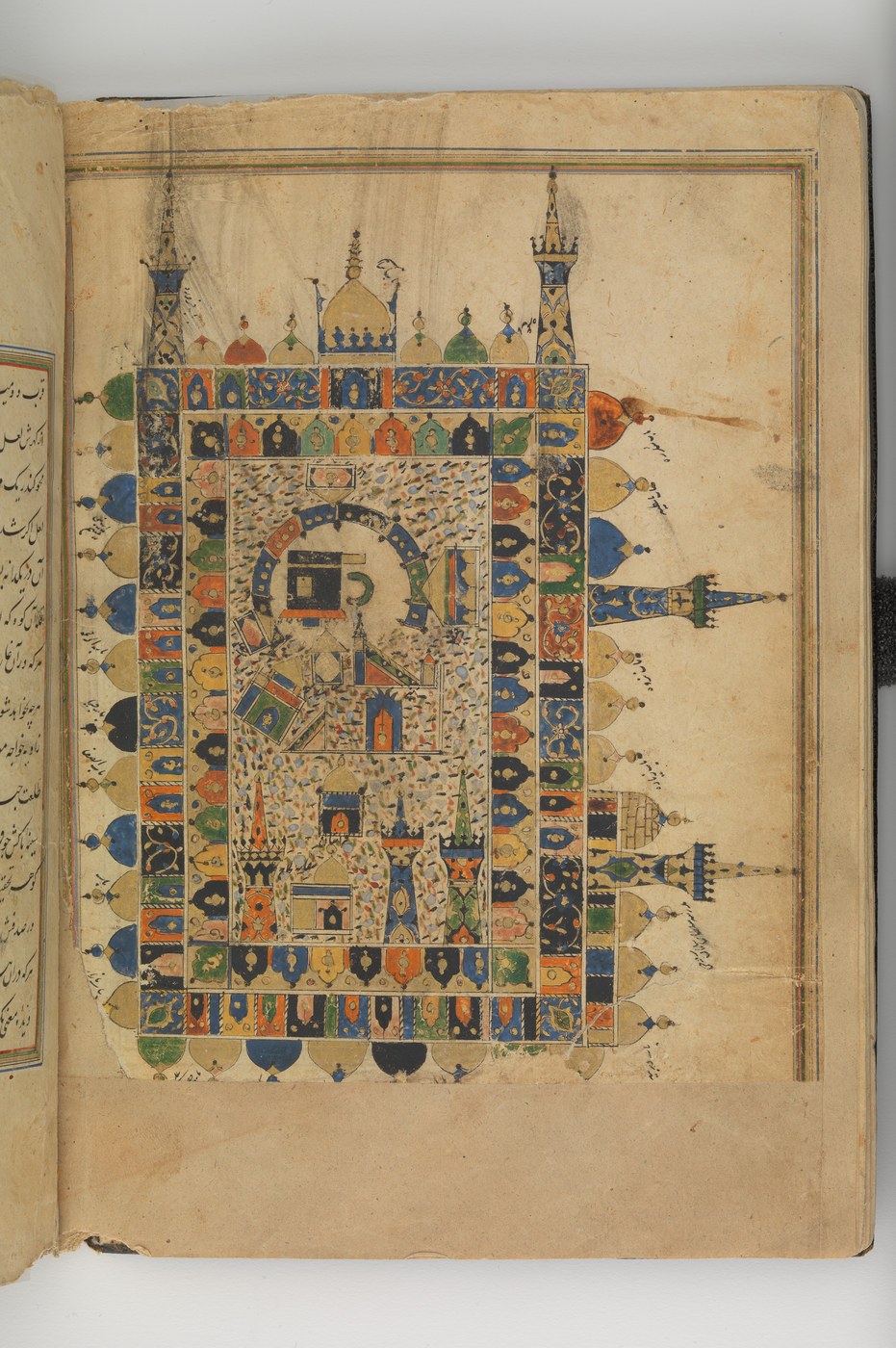
From Futuh al-Haramayn, text by Muhi al-Din Lari. Sixteenth-century copy, probably Bukhara. Ink, opaque watercolour and gold on paper.
The Metropolitan Museum of Art. Purchase, Patti Cadby Birch Gift, 2009. Accession 2009.343. Public Domain (CC0). · Museum record ↗ · CC0
Sources
- Islamic Beliefs ↗The Pluralism Project, Harvard UniversityReturn to text ↑
- Muhammad, the Messenger of God ↗The Pluralism Project, Harvard UniversityReturn to text ↑
- Introduction: The Earliest Writings on the Life of Muhammad ↗Andreas Görke and Gregor Schoeler, Cambridge University Press, 2025; accessible chapter summary onlyReturn to text ↑
- Sahih al-Bukhari 3: The beginning of revelation ↗Report attributed to Aisha; English translation on Sunnah.com; a named Sunni collectionReturn to text ↑
- Quran: The Word of God ↗The Pluralism Project, Harvard UniversityReturn to text ↑
- Quran 33:40 ↗The Clear Quran, Mustafa Khattab; Quran.comReturn to text ↑
- Quran 33:21 ↗The Clear Quran, Mustafa Khattab; Quran.comReturn to text ↑
- Quran 3:144 ↗The Clear Quran, Mustafa Khattab; Quran.comReturn to text ↑
- Sunni and Shia Interpretations ↗The Pluralism Project, Harvard University; early succession discussion onlyReturn to text ↑
- Folio from the Blue Quran ↗The Metropolitan Museum of Art; accession 2004.88Return to text ↑
- Futuh al-Haramayn: Description of the Holy Cities ↗The Metropolitan Museum of Art; accession 2009.343; Muhi al-Din Lari is the text’s authorReturn to text ↑
- Sahih al-Bukhari 2731, 2732: The Hudaybiyyah negotiations ↗Report attributed to al-Miswar ibn Makhrama and Marwan; English translation on Sunnah.comReturn to text ↑
- The Constitution of Medina: A Sociolegal Interpretation of Muhammad’s Acts of Foundation of the Umma ↗Saïd Amir Arjomand, International Journal of Middle East Studies, 2009; published abstract inspectedReturn to text ↑
- The Constitution of Medina: Muhammad’s First Legal Document ↗Michael Lecker, 2004; author’s book abstract in the Hebrew University research recordReturn to text ↑
About this article & its sources
A biographical reference entry distinguishing the conventional Islamic life narrative, Quranic teaching, a named Sunni hadith report, historical source criticism and later manuscript culture. Religious claims are attributed. Sunni and Shia perspectives on succession remain distinct. Historical manuscripts are not presented as contemporary portraits.
Passage attributions
Who was Muhammad?
Passage 1: The Pluralism Project, Harvard University.
Mecca, Khadija and the beginning of the mission
Passage 1: The Pluralism Project, Harvard University.
Passage 2: The Pluralism Project, Harvard University.
How the biographical sources are read
Passage 1: Andreas Görke and Gregor Schoeler, Cambridge University Press, 2025; accessible chapter summary only.
Passage 2: Andreas Görke and Gregor Schoeler, Cambridge University Press, 2025; accessible chapter summary only.
Passage 3: Andreas Görke and Gregor Schoeler, Cambridge University Press, 2025; accessible chapter summary only.
Hira in the report attributed to Aisha
Passage 1: Report attributed to Aisha; English translation on Sunnah.com; a named Sunni collection.
Passage 2: Report attributed to Aisha; English translation on Sunnah.com; a named Sunni collection.
Revelation as recitation
Passage 1: The Pluralism Project, Harvard University.
Passage 2: The Pluralism Project, Harvard University.
A later manuscript makes the words visible
Passage 1: The Metropolitan Museum of Art; accession 2004.88.
Passage 2: The Metropolitan Museum of Art; accession 2004.88.
The Hijra and the community at Medina
Passage 1: The Pluralism Project, Harvard University.
Passage 2: The Pluralism Project, Harvard University.
The agreements remembered as the Constitution of Medina
Passage 1: Saïd Amir Arjomand, International Journal of Middle East Studies, 2009; published abstract inspected.
Passage 2: Michael Lecker, 2004; author’s book abstract in the Hebrew University research record.
Passage 3: Editorial comparison of the two inspected scholarly abstracts.
Negotiation and disagreement at Hudaybiyyah
Passage 1: Report attributed to al-Miswar ibn Makhrama and Marwan; English translation on Sunnah.com.
Passage 2: Report attributed to al-Miswar ibn Makhrama and Marwan; English translation on Sunnah.com.
Prophecy and the example of a human life
Passage 1: The Pluralism Project, Harvard University.
Passage 2: The Pluralism Project, Harvard University.
Passage 3: The Clear Quran, Mustafa Khattab; Quran.com.
Passage 4: The Clear Quran, Mustafa Khattab; Quran.com.
Worship and care for vulnerable people
Passage 1: The Clear Quran, Mustafa Khattab; Quran.com.
Return to Mecca and death
Passage 1: The Pluralism Project, Harvard University.
Passage 2: The Clear Quran, Mustafa Khattab; Quran.com.
Worship and care for vulnerable people
Quran 107 connects denial of judgment with turning away an orphan and neglecting the feeding of poor people. It also criticizes prayer performed for display while ordinary help is withheld. The short chapter places care for others alongside the seriousness of worship. [8]