Moksha
Moksha means liberation from bondage. Compare release in the Bhagavad Gita, Jaini’s account of karmic matter, and Vivekananda’s image of the golden chain.
In this article
Understanding the concept
Moksha means liberation from bondage in Indian religious traditions. In the Hindu and Jain accounts here, liberation involves release from karma. They differ in what they understand to be bound and what must change for it to be free. [1][3]
Swami Vivekananda pictures a golden chain and an iron chain. The golden one may be worth more, but it still binds. He uses the image to ask how freedom differs from acquiring a more pleasant condition. [5][6]
The Bhagavad Gita: release from birth-bondage
In Bhagavad Gita 2.51, Krishna connects relinquishing the fruits of action with freedom from birth-bondage and attainment of a state beyond suffering. Swami Mukundananda’s translation makes that relation explicit. Verse 5.2 then compares renunciation with Karma Yoga, commending both while giving Karma Yoga precedence in that particular comparison. [1][2]
Karma-Yoga by Swami Vivekananda
Swami Vivekananda calls freedom of the soul the goal of the yogas. In Karma-Yoga, he first explains the establishment of good tendencies, then says that liberation must go beyond bondage to good as well as evil. The golden chain and iron chain represent that distinction: their value differs while their capacity to bind remains. [5][6]
Vivekananda extends the point with two thorns. One removes the other and both can then be discarded. Good tendencies do important work by countering harmful ones. Liberation involves a further change in how a person is held by either kind of tendency. [6]
The chapter on freedom widens the claim. A heaven imagined as a more pleasant version of familiar life would still be conditioned. Vivekananda locates ultimate freedom beyond the space, time and causation that shape the experienced universe. The contrast is between a favourable state within that order and freedom from the order’s limitations. [7][8][9]
He presents two broad approaches to relinquishing attachment: negative discrimination and a positive path through experience. Karma Yoga takes the latter route through work. The whirlpool image describes a current entering a circular movement and emerging again; he applies it to a human life becoming caught in ownership, status and personal identification. [9][10]
The final explanation joins liberation with continuing selfless action. Vivekananda says work done for a private reward adds a chain, while good work without an ulterior motive loosens one. The spiritual goal therefore changes the manner of involvement in the world, rather than supplying a simple instruction to stop working. [11][12]
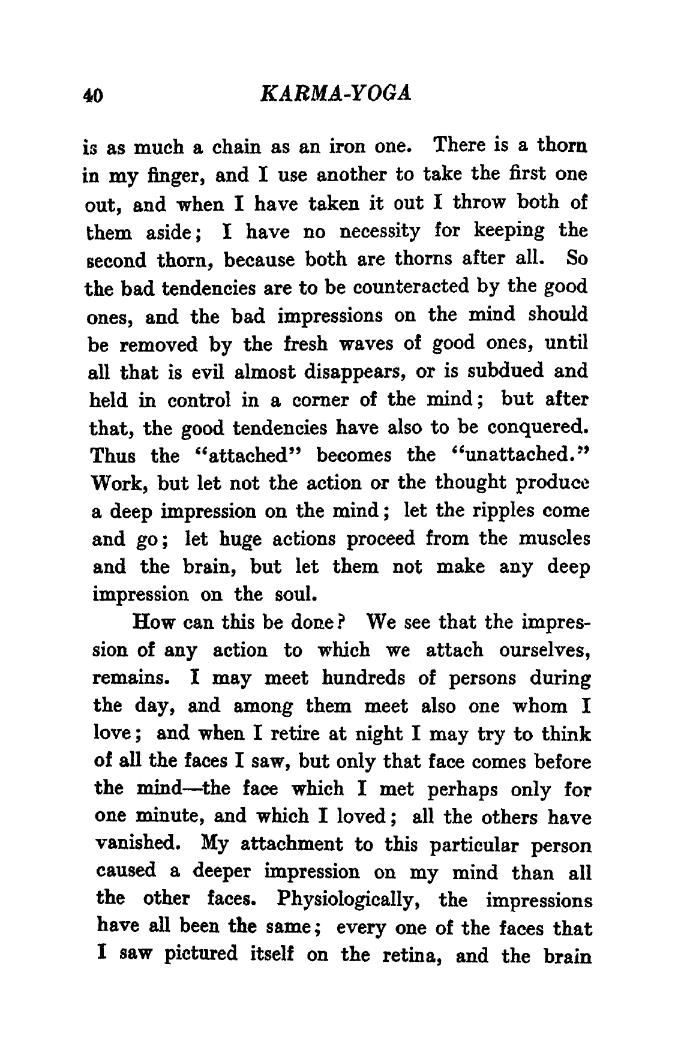
Karma-Yoga (1939), Library Reader page 42. Vivekananda uses chains and thorns to distinguish ethical formation from the final release he seeks.
Swami Vivekananda, Karma-Yoga, English second printing in the 1939 combined volume. Historical public-domain text, exact checksum-verified Library scan. · Image source ↗ · Public Domain
Outlines of Jainism by Jagmanderlal Jaini
Jagmanderlal Jaini’s Outlines of Jainism cites Tattvārthasūtra X.2 on two conditions of liberation. The causes that bind new karma come to an end, and existing karma falls away. Jaini then cites Dravyasaṃgraha 37, which distinguishes the transformation of the soul from its actual freedom from karmic matter. [3]
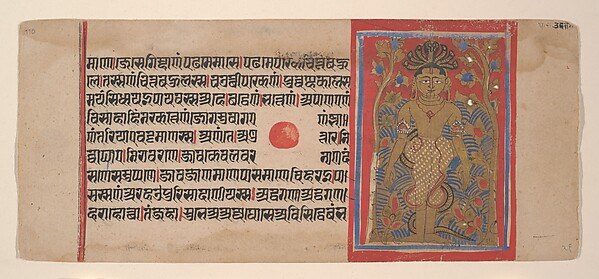
Pārśvanātha’s Austerities, fifteenth-century Gujarat. The Jina stands in meditation as the serpent king Dharaṇa shelters him.
The Metropolitan Museum of Art. Anonymous Gift, 1957. Accession 57.185.4. Public Domain (CC0). · Image source ↗ · CC0
What falls away in liberation
The Gita connects relinquishing the fruits of action with release from birth-bondage. Jaini describes freedom from karmic matter attached to the soul. Vivekananda considers freedom beyond space, time and causation. Each account gives release a different object. [1][3][7][8]
Vivekananda’s golden chain brings the difference down to a question about reward. Heaven, if it merely supplies a happier set of familiar experiences, can still be bound by the conditions of experience. The distinction is between a better circumstance and release from what holds it in place. [5][6][7][8][11][12]
See references (8)
- Bhagavad Gita 2.51, translated by Swami Mukundananda
- Jagmanderlal Jaini, Outlines of Jainism, Part II, chapter II: passages citing Tattvārthasūtra VI.1–2, VIII.1–2 and X.2
- Karma-Yoga, Reader page 41
- Karma-Yoga, Reader page 42
- Karma-Yoga, Reader page 96
- Karma-Yoga, Reader page 97
- Karma-Yoga, Reader page 121
- Karma-Yoga, Reader page 122
Read further in the library
Karma Yoga
Reading note
The separately titled account draws on exact passages in the consulted Library edition.
Sources
See references (12)
- Bhagavad Gita 2.51, translated by Swami Mukundananda ↗Bhagavad Gita 2.51, in Swami Mukundananda’s translation: relinquishing the fruits of action, release from birth-bondage and a state beyond suffering.Return to text ↑
- Bhagavad Gita 5.2, translated by Swami Mukundananda ↗Bhagavad Gita 5.2, in Swami Mukundananda’s devotional translation. The verse commends both renunciation and Karma Yoga, while preferring Karma Yoga in the comparison.Return to text ↑
- Jagmanderlal Jaini, Outlines of Jainism, Part II, chapter II: passages citing Tattvārthasūtra VI.1–2, VIII.1–2 and X.2 ↗Jagmanderlal Jaini, Outlines of Jainism (1916), edited with preliminary note by F. W. Thomas. Primary Jain exposition and translated scriptural selections; the quoted sutra numbers identify the particular teachings.Return to text ↑
- Parsvanatha's Austerities: Folio from a Kalpasutra Manuscript ↗The Metropolitan Museum of Art, Open Access collection
- Karma-Yoga, Reader page 41Swami Vivekananda, Karma-Yoga, in Karma-Yoga & Bhakti-Yoga, English second printing, Ramakrishna-Vivekananda Center of New York, Inc., 1939. Exact Library edition IMJ-0097-E002. Only the Karma-Yoga part is used in this crawl; the old Work slug mentioning Hindi does not identify this edition’s language.Read this page in Karma Yoga ↗Return to text ↑
- Karma-Yoga, Reader page 42Swami Vivekananda, Karma-Yoga, in Karma-Yoga & Bhakti-Yoga, English second printing, Ramakrishna-Vivekananda Center of New York, Inc., 1939. Exact Library edition IMJ-0097-E002. Only the Karma-Yoga part is used in this crawl; the old Work slug mentioning Hindi does not identify this edition’s language.Read this page in Karma Yoga ↗Return to text ↑
- Karma-Yoga, Reader page 96Swami Vivekananda, Karma-Yoga, in Karma-Yoga & Bhakti-Yoga, English second printing, Ramakrishna-Vivekananda Center of New York, Inc., 1939. Exact Library edition IMJ-0097-E002. Only the Karma-Yoga part is used in this crawl; the old Work slug mentioning Hindi does not identify this edition’s language.Read this page in Karma Yoga ↗Return to text ↑
- Karma-Yoga, Reader page 97Swami Vivekananda, Karma-Yoga, in Karma-Yoga & Bhakti-Yoga, English second printing, Ramakrishna-Vivekananda Center of New York, Inc., 1939. Exact Library edition IMJ-0097-E002. Only the Karma-Yoga part is used in this crawl; the old Work slug mentioning Hindi does not identify this edition’s language.Read this page in Karma Yoga ↗Return to text ↑
- Karma-Yoga, printed p. 96, Reader page 98Swami Vivekananda, Karma-Yoga, in Karma-Yoga & Bhakti-Yoga, English second printing, Ramakrishna-Vivekananda Center of New York, Inc., 1939. Exact Library edition IMJ-0097-E002. Only the Karma-Yoga part is used in this crawl; the old Work slug mentioning Hindi does not identify this edition’s language.Read this page in Karma Yoga ↗Return to text ↑
- Karma-Yoga, Reader page 99Swami Vivekananda, Karma-Yoga, in Karma-Yoga & Bhakti-Yoga, English second printing, Ramakrishna-Vivekananda Center of New York, Inc., 1939. Exact Library edition IMJ-0097-E002. Only the Karma-Yoga part is used in this crawl; the old Work slug mentioning Hindi does not identify this edition’s language.Read this page in Karma Yoga ↗Return to text ↑
- Karma-Yoga, Reader page 121Swami Vivekananda, Karma-Yoga, in Karma-Yoga & Bhakti-Yoga, English second printing, Ramakrishna-Vivekananda Center of New York, Inc., 1939. Exact Library edition IMJ-0097-E002. Only the Karma-Yoga part is used in this crawl; the old Work slug mentioning Hindi does not identify this edition’s language.Read this page in Karma Yoga ↗Return to text ↑
- Karma-Yoga, Reader page 122Swami Vivekananda, Karma-Yoga, in Karma-Yoga & Bhakti-Yoga, English second printing, Ramakrishna-Vivekananda Center of New York, Inc., 1939. Exact Library edition IMJ-0097-E002. Only the Karma-Yoga part is used in this crawl; the old Work slug mentioning Hindi does not identify this edition’s language.Read this page in Karma Yoga ↗Return to text ↑