Mjölnir, Thor’s Hammer in Myth and Archaeology
Why is Thor’s hammer short-handled, who stole it, and what did Viking Age hammer pendants mean? Read the Eddas beside three museum objects.
In this article
Look closely at the Birka ring
Use the three markers to examine how the little hammers hang, how the ring ends and what the museum scale tells you.
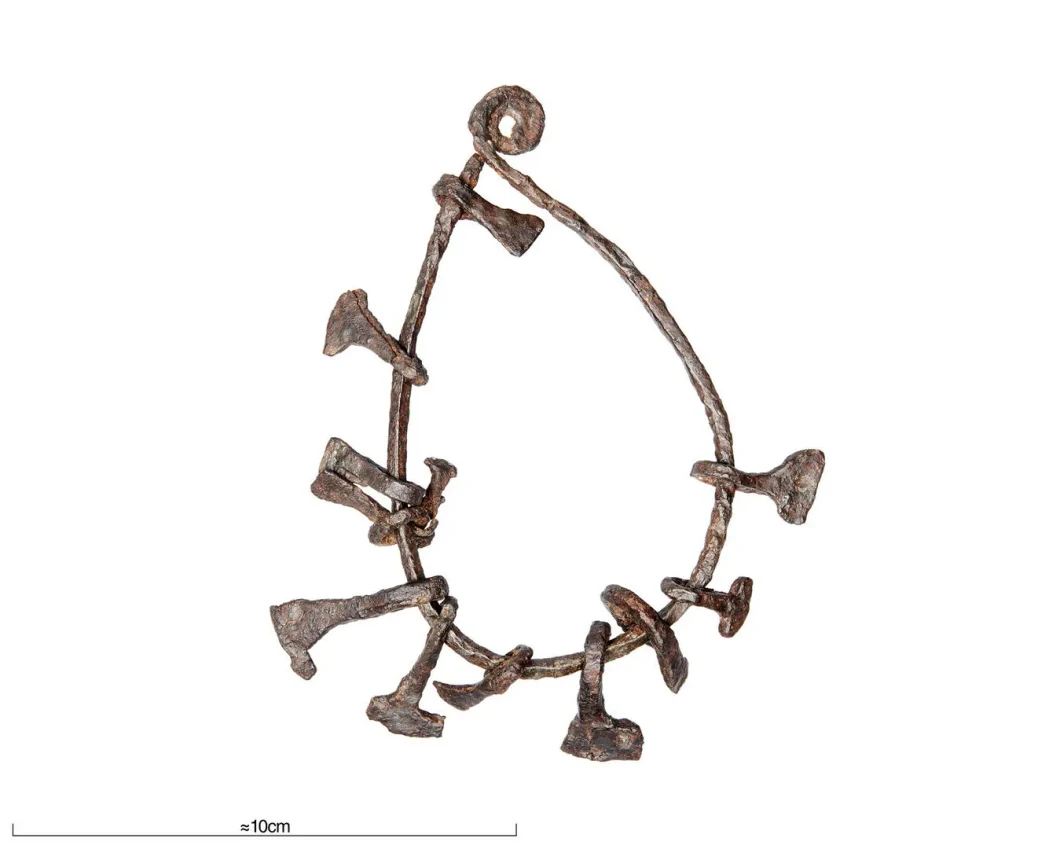
Curled top
The top ends in a small curl. Trace the long outer ring from here to see how the little pieces hang from it.
Hammer head
On this pendant the end widens into the head. Nearer the ring, a narrower part forms the means of suspension.
Photograph scale
The bar is marked approximately 10 cm. Use it to picture the ring’s size independently of how large it appears on screen.
What is Mjölnir?
Mjölnir is the hammer of Thor in Norse mythology. In the Prose Edda it is the gods’ best defence against the frost giants. In the poem Þrymskviða, the giant who steals it expects it to bless his wedding. That second scene turns on the surprise of a weapon being placed in the hands of the person it was stolen from. [5][3]
Archaeologists use ‘Thor’s hammer’ for a group of small objects shaped like hammers. Some hang from chains or have a means of suspension. Others hang in groups from an iron ring. Their resemblance to the god’s weapon explains the identification. An individual object’s find context is usually better evidence of how it was used than the resemblance alone. [6][7][8]
Who made the hammer, and why is its handle short?
The story begins when Loki cuts off Sif’s hair and promises Thor a replacement. The sons of Ívaldi make golden hair along with a ship and a spear. Loki then wagers his head that Sindri, Brokkr’s brother in the text here, cannot make three treasures as fine. The short handle is the result of this second contest. [4][5]
Brokkr must keep the bellows going while Sindri works. A fly bothers him during all three attempts. During the forging of the hammer it draws blood around his eyes, and the bellows slacken when he brushes it away. Brokkr later tells Thor that the hammer will return when thrown and can be carried under his shirt. Its short fore-handle is the one defect he names. [4][5]
The judges award the contest to the dwarfs because of the hammer’s value against the frost giants. The scene gives the short handle a reason within the story. A compact handle on a pendant can invite the comparison, but an archaeological specimen cannot show that its maker knew this telling. [5][6][7]
Who stole the hammer, and how did Thor get it back?
Þrymr has hidden the hammer underground and will return it only if Freyja is brought to him as a bride. Thor goes in her place, veiled and dressed for the wedding, with Loki as his attendant. The disguise gives the poem room for jokes about Thor’s appetite and his fierce eyes. Loki invents an explanation as each detail threatens to give them away. [1][2][3]
In stanza 30, Þrymr orders the hammer laid on the bride’s knees to hallow the union. In stanza 31, Thor recognises it and kills Þrymr first. The intended ritual brings the object back within reach. The verse is evidence that a poet could imagine consecration with a hammer. The surviving rings cannot tell us whether a Viking Age wedding used a real hammer in this way. [3][6]
Three Viking Age finds to compare
The Bredsättra silver hammer is a single pendant with a chain from Öland. Compare the suspending link with the broad head beneath it. At Birka, the iron ring in the photograph carries eleven hammer-shaped pieces. Those pieces attach to the larger circle. The catalogue places this object in Birka’s Black Earth area, so the museum’s wider discussion of cremation burials should be read separately from this object’s find record. [7][8][6]
The Viby Gård find brings the comparison back to a single hammer, this time on a 12.5-centimetre iron neck ring with three twisted sections. It was recovered in a settlement layer alongside ordinary objects such as nails, knife blades and pottery. The museum also reports fragmentary hammer rings from the nearby burial ground. The two settings leave room for more than one use of a similar form. [9][6]
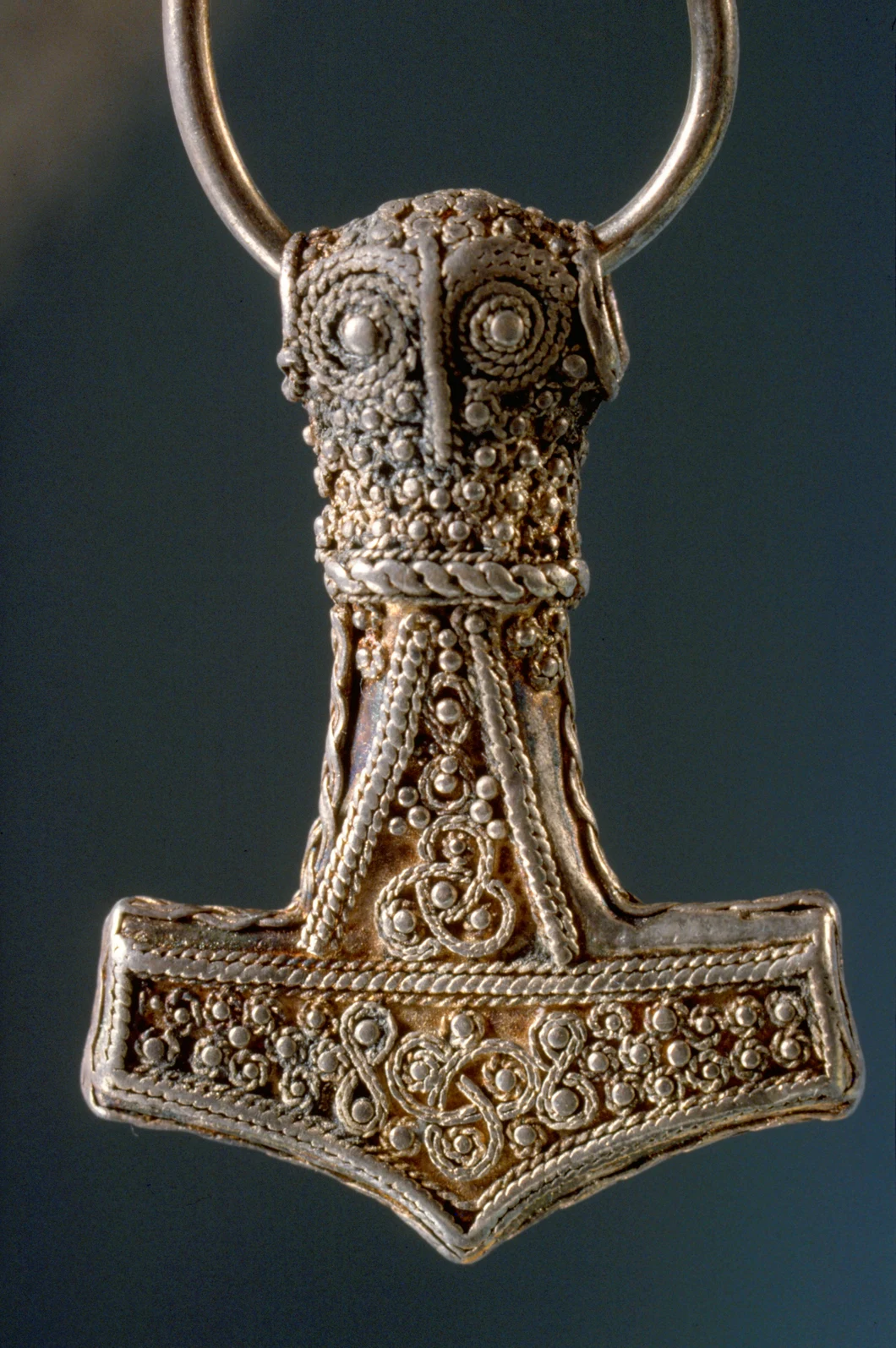
One silver hammer hangs from a chain on the Bredsättra piece from Öland. The museum dates it within AD 800–1100.
Photograph by an SHM staff member, Swedish History Museum, 106666_HST. CC BY 4.0. Resized. · Image source ↗ · CC BY 4.0
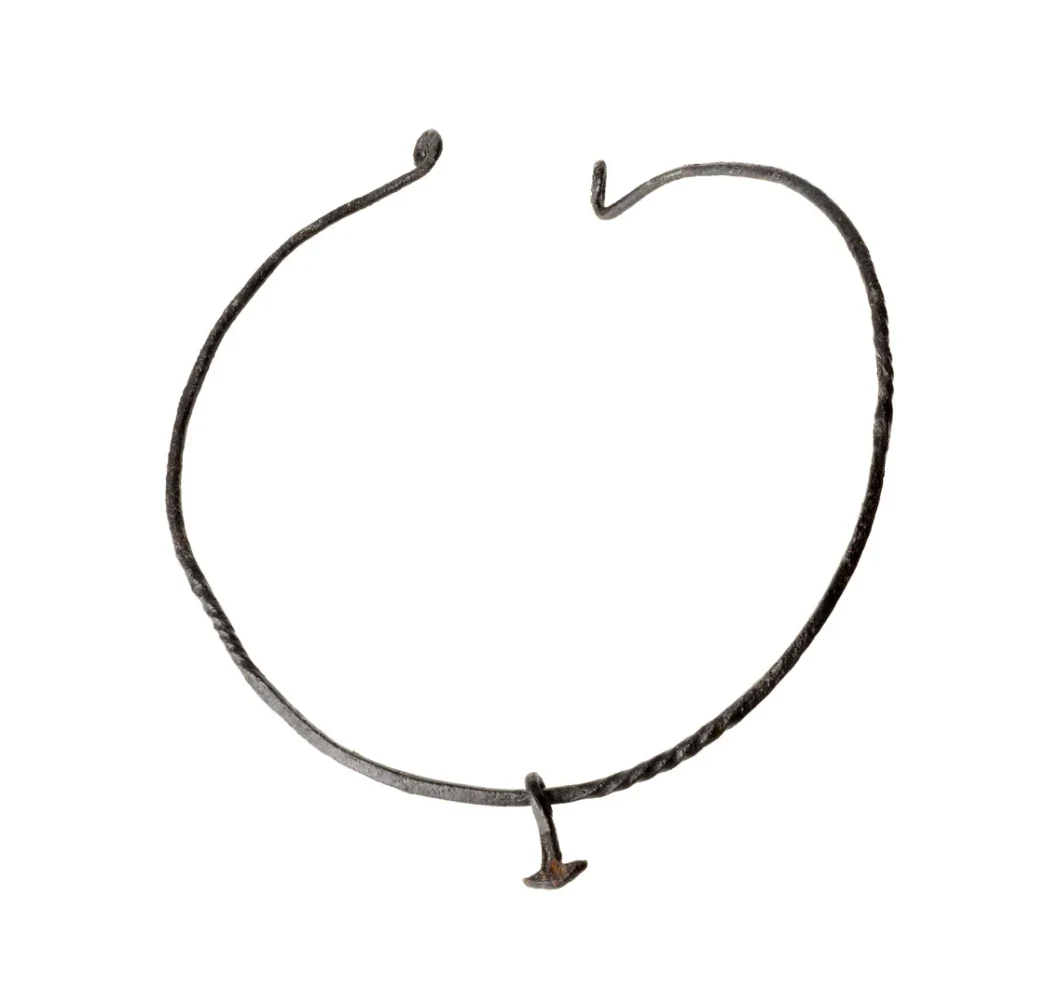
The Viby Gård ring carries one hammer. The museum describes its find layer as part of the settlement and dates the ring to the ninth or tenth century.
Ola Myrin, Swedish History Museum, 108686_HST. CC BY 4.0. Resized. · Image source ↗ · CC BY 4.0
What does the Købelev hammer actually say?
A small tinned bronze pendant from Købelev on Lolland carries a rune inscription. RuneS transcribes it as hmar : is, translated ‘[This] is (a) hammer.’ The word identifies the object’s shape directly. The inscription supplies no personal name or account of a ceremony. It is an unusually clear piece of evidence for what one object was understood to represent. [10][11]
The inscription comes from the Viking Age. Compare it with the substantially earlier Vimose comb in the Elder Futhark guide. Both are short inscriptions on portable objects, but they belong to different periods of runic writing. The Købelev wording is useful as an identification while the comb’s single name-like word leaves the relationship between the named person and the object open. [11]
What can a hammer amulet tell us about belief?
The protection associated with Mjölnir has direct support in the prose story. The Swedish History Museum also describes cases in the Mälaren Valley where rings with little hammers were found near the tops of cremation urns. Their placement makes an offering or funeral role plausible there. Settlement finds such as Viby show that an interpretation based only on graves would miss part of the record. [5][6][9]
When looking at a hammer-shaped object, start with its material, its means of suspension and the recorded place where it was found. These can establish how it was made and how it may have been attached or deposited. It takes a different kind of evidence to identify a particular owner’s intention, and most surviving objects give us little help with that question. [7][8][9][6]
Read the wedding and recovery in Colum
The illustrated chapter ‘How Thor and Loki Befooled Thrym the Giant’ begins on printed page 120. Colum describes Thor’s strength returning when he sees the hammer, then puts the moment when he grips it at the turn from page 127 to page 128. Watch what Thor does next. Colum describes a blow against the wall and the hall collapsing, while the poem names Þrymr as Thor’s first target. [15][16][17][3]
Read further in the library
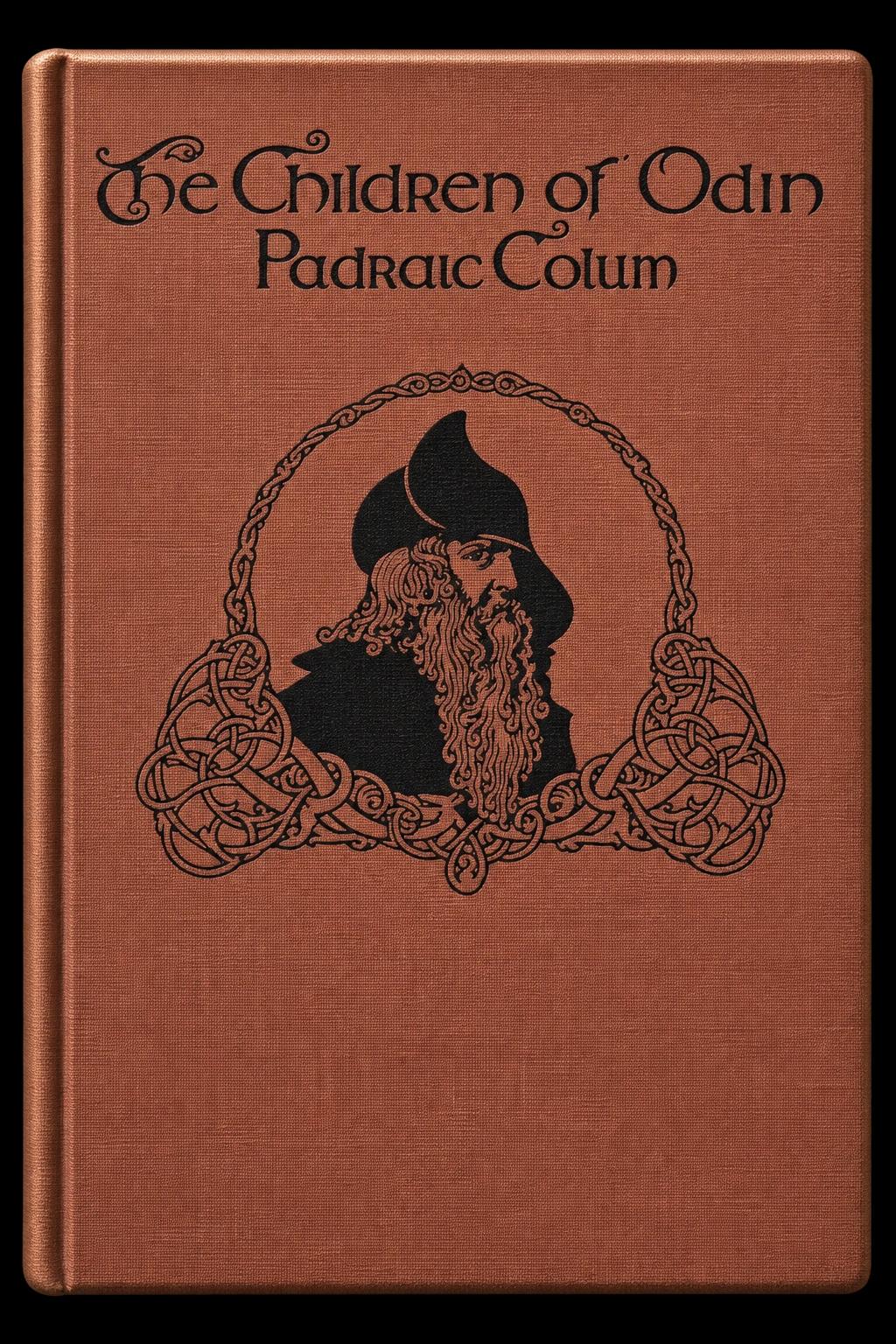
The Children of Odin
Reading note
Compare the wedding and recovery with Colum’s illustrated retelling.
Sources
See references (17)
- Þrymskviða, stanzas 1–2 · Thor loses his hammer ↗Old Norse text and Henry Adams Bellows’s 1923 translation in Open Edda.Return to text ↑
- Þrymskviða, stanza 8 · Þrymr’s demand ↗Old Norse text and Bellows’s translation.Return to text ↑
- Þrymskviða, stanzas 30–31 · the hammer at the wedding ↗Old Norse text and Bellows’s translation, with his note on hallowing.Return to text ↑
- Skáldskaparmál 43.1–2 · Sif’s hair and the forge ↗Old Norse text and Arthur Gilchrist Brodeur’s 1916 translation, chapter XXXV in that edition.Return to text ↑
- Skáldskaparmál 43.4–5 · Brokkr gives Thor the hammer ↗Old Norse text and Brodeur’s translation, including the short handle and the verdict.Return to text ↑
- Swedish History Museum · Thor’s hammer rings ↗Museum account of settlement and funerary contexts, with a description of the Viby Gård find.Return to text ↑
- Swedish History Museum · Bredsättra silver pendant ↗Catalogue 106666_HST. Öland, AD 800–1100.Return to text ↑
- Swedish History Museum · Birka iron ring ↗Catalogue 107837_HST. Black Earth, Birka, AD 800–1100.Return to text ↑
- Swedish History Museum · Viby Gård iron ring ↗Catalogue 108686_HST. See the museum’s interpretation for the narrower date and context.Return to text ↑
- National Museum of Denmark · Købelev inscribed hammer ↗Catalogue entry for the tinned bronze pendant found on Lolland.Return to text ↑
- RuneS research database · Købelev transcription ↗Find 1764, with transliteration, English translation and runic classification.Return to text ↑
- Silver pendant from Bredsättra ↗Photograph by an SHM staff member, Swedish History Museum, 106666_HST. CC BY 4.0. Resized.
- Iron hammer ring from Birka ↗Ola Myrin, Swedish History Museum, 107837_HST. CC BY 4.0. Resized.
- Iron neck ring from Viby Gård ↗Ola Myrin, Swedish History Museum, 108686_HST. CC BY 4.0. Resized.
- Colum, printed page 120 · Thor discovers the lossPadraic Colum, The Children of Odin, printed page 120.Read this page in The Children of Odin ↗Return to text ↑
- Colum, printed page 127 · Þrymr brings in the hammerPadraic Colum, The Children of Odin, printed page 127.Read this page in The Children of Odin ↗Return to text ↑
- Colum, printed page 128 · Thor closes his hands on the hammerPadraic Colum, The Children of Odin, printed page 128.Read this page in The Children of Odin ↗Return to text ↑