Memento Mori
Memento mori means remember that you must die. Explore skulls, hourglasses and flowers as reminders of mortality in art and Spiritualist writing.
In this article
What does memento mori mean?
Memento mori means “remember that you must die”. It can be a phrase, an object or an image. A skull gives mortality a visible form. An hourglass makes the time left to a person the subject. What the reminder asks of the viewer depends on where it appears. [1][2][5][7]
The same reminder can lead to different responses. Someone may turn from pleasure because life is brief, while another may value ordinary affection more intensely for the same reason. The Library account below makes this tension its subject. Mortality is the starting point of the reflection, rather than a complete answer about how to live. [3][4][5][7]
See references (6)
- Princeton University Art Museum: Memento Mori, Simon de Passe after Crispijn van de Passe I, 1612
- The Metropolitan Museum of Art: Memento Mori: a skeleton in a niche, Master IAM of Zwolle, late 15th century
- The Encyclopaedia of Death and Life in Spirit-World, Volume I, printed p. 348, Reader page 347
- The Encyclopaedia of Death and Life in Spirit-World, Volume I, printed p. 349, Reader page 348
- The Encyclopaedia of Death and Life in Spirit-World, Volume I, printed p. 350, Reader page 349
- The Encyclopaedia of Death and Life in Spirit-World, Volume I, printed p. 354, Reader page 353
A child, a skull and flowers
In Simon de Passe’s 1612 engraving after Crispijn van de Passe I, a child directs attention to a skull. An hourglass and a vase of flowers bring two different measures of passing time into the same small scene. [1]
The child’s gesture gives the image a direction: look here. The skull is placed among things that measure time or flourish briefly. The engraving asks the viewer to notice those relationships, rather than showing a journey into an afterlife. Its lesson is carried by ordinary objects made difficult to overlook. [1]
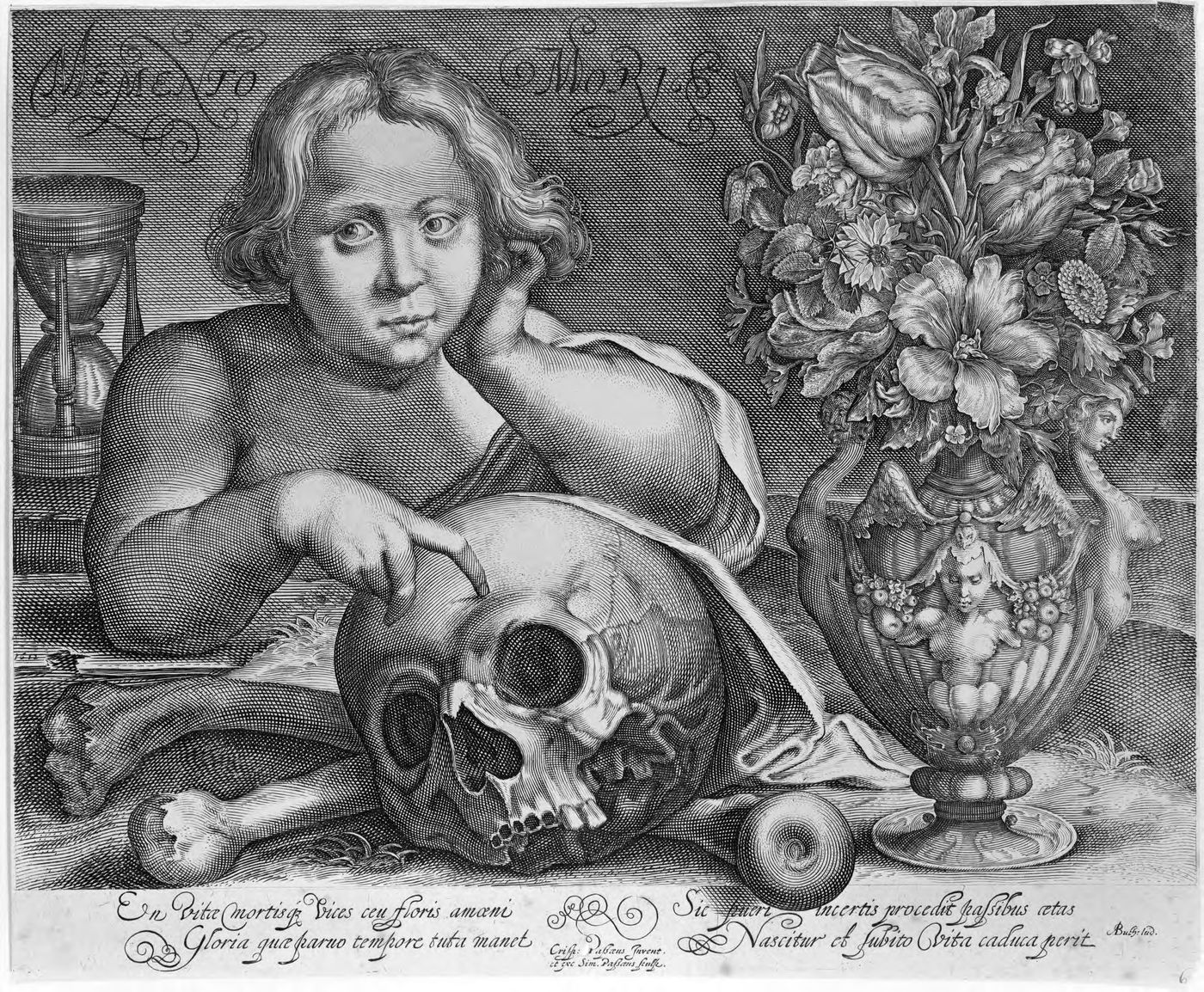
Simon de Passe after Crispijn van de Passe I, Memento Mori, 1612. A child directs attention to a skull; flowers and an hourglass place beauty beside passing time.
Princeton University Art Museum. Bequest of Junius S. Morgan, Class of 1888. Object x1934-1142.139. Public Domain. · Image source ↗ · Public Domain
The body as the reminder
In the late fifteenth-century engraving by Master IAM of Zwolle, a skeleton leans in a niche and supports its head with one hand. Drapery winds around the bones. The reminder has taken the place a living figure might occupy. [2]
Set beside the de Passe print, this image changes the encounter. One places mortality among objects in a living scene; the other allows the skeletal figure to fill the scene itself. Both make death available for contemplation without purporting to document a dead person returning to life. [1][2]
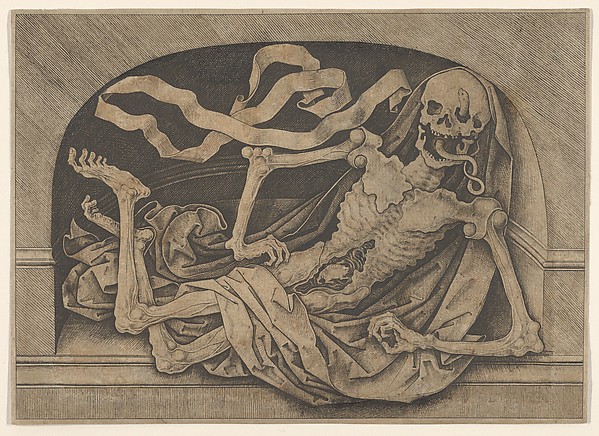
Master IAM of Zwolle, Memento Mori: a skeleton in a niche, late 15th century. The body itself becomes the reminder, with no living observer shown.
The Metropolitan Museum of Art. The Elisha Whittelsey Collection, The Elisha Whittelsey Fund, 1959. Accession 59.595.23. Public Domain. · Image source ↗ · Public Domain
The Encyclopaedia of Death and Life in Spirit-World, Volume I
J. R. Francis’s The Encyclopaedia of Death and Life in Spirit-World, Volume I, includes ‘A General View of Death’, credited to the initials G. T. C. M. in The Spiritualist, London. The essay reads an Egyptian banquet painting, identified at its close as Edwin Long’s. Its central reminder is a mummy passing among the guests. The writer is interested in how people look at it: one couple remains absorbed in love, another sees a threat of separation, and another finds a reason to love while time remains. [3][4][7]
For this contributor, the reminder should neither extinguish enjoyment nor encourage excess. The proposed response is to use the capacities of life while recognising that actions have consequences. Near its conclusion, the essay connects a better future existence with continuing activities that give happiness to others. It ends by transforming the reminder of death into a reminder of immortality. That final move belongs to this writer’s spiritual interpretation; it is not contained in every skull or hourglass. [5][6][7]
A separate extract, ‘The Dance of Death’, considers different representations of mortality, including banquet reminders, skeletal figures and the pageant in which death encounters people across social ranks. Its footnote names Holbein’s Dance of Death, but the anthology does not supply an expanded author credit there. The extract’s guesses about origins and its hostile judgments of medieval Christianity should not be mistaken for a settled history of the motif. Its useful contribution here is the variety of images it brings into the discussion. [8][9][10][11]
These are separate contributions within a compilation, not one continuous doctrine by Francis. The first essay turns attention towards affection, moral action and immortality; the later extract surveys and judges older representations. Their differences show how the reminder can be reinterpreted by the person placing it before an audience. [3][7][8][10]
See references (9)
- The Encyclopaedia of Death and Life in Spirit-World, Volume I, printed p. 348, Reader page 347
- The Encyclopaedia of Death and Life in Spirit-World, Volume I, printed p. 349, Reader page 348
- The Encyclopaedia of Death and Life in Spirit-World, Volume I, printed p. 350, Reader page 349
- The Encyclopaedia of Death and Life in Spirit-World, Volume I, printed p. 353, Reader page 352
- The Encyclopaedia of Death and Life in Spirit-World, Volume I, printed p. 354, Reader page 353
- The Encyclopaedia of Death and Life in Spirit-World, Volume I, printed p. 376, Reader page 375
- The Encyclopaedia of Death and Life in Spirit-World, Volume I, printed p. 377, Reader page 376
- The Encyclopaedia of Death and Life in Spirit-World, Volume I, printed p. 378, Reader page 377
- The Encyclopaedia of Death and Life in Spirit-World, Volume I, printed p. 381, Reader page 380
Remembering death and imagining what follows
The skull makes a claim about the end of an earthly life. The banquet essay also asks about immortality and what might follow death. The reminder of mortality can lead towards a belief in heaven, or it can turn attention to the time a person has now. [7][1][2]
This distinction makes the motif useful across the Codex. It can connect discussions of death, attachment and spiritual preparation while leaving each tradition’s answer about the afterlife intact. The question a reminder places before the viewer is immediate: given that time is finite, what deserves attention now? [5][6][1]
See references (5)
- Princeton University Art Museum: Memento Mori, Simon de Passe after Crispijn van de Passe I, 1612
- The Metropolitan Museum of Art: Memento Mori: a skeleton in a niche, Master IAM of Zwolle, late 15th century
- The Encyclopaedia of Death and Life in Spirit-World, Volume I, printed p. 350, Reader page 349
- The Encyclopaedia of Death and Life in Spirit-World, Volume I, printed p. 353, Reader page 352
- The Encyclopaedia of Death and Life in Spirit-World, Volume I, printed p. 354, Reader page 353
Read further in the library
The Encyclopaedia of Death and Life in the Spirit-World, Volume I
Reading note
Distinct contributions in the complete consulted 1903 Volume I, with exact printed pages and current Reader links.
Sources
See references (11)
- Princeton University Art Museum: Memento Mori, Simon de Passe after Crispijn van de Passe I, 1612 ↗Princeton University Art Museum, object x1934-1142.139. Object record and public-domain image statement consulted.Return to text ↑
- The Metropolitan Museum of Art: Memento Mori: a skeleton in a niche, Master IAM of Zwolle, late 15th century ↗The Metropolitan Museum of Art, accession 59.595.23, object 367226. Object record and Open Access public-domain image consulted.Return to text ↑
- The Encyclopaedia of Death and Life in Spirit-World, Volume I, printed p. 348, Reader page 347J. R. Francis (compiler), The Encyclopaedia of Death and Life in Spirit-World, Volume I, fourth edition, Progressive Thinker Publishing House, Chicago, 1903. Individual contributors identified in the article.Read this page in The Encyclopaedia of Death and Life in the Spirit-World, Volume I ↗Return to text ↑
- The Encyclopaedia of Death and Life in Spirit-World, Volume I, printed p. 349, Reader page 348J. R. Francis (compiler), The Encyclopaedia of Death and Life in Spirit-World, Volume I, fourth edition, Progressive Thinker Publishing House, Chicago, 1903. Individual contributors identified in the article.Read this page in The Encyclopaedia of Death and Life in the Spirit-World, Volume I ↗Return to text ↑
- The Encyclopaedia of Death and Life in Spirit-World, Volume I, printed p. 350, Reader page 349J. R. Francis (compiler), The Encyclopaedia of Death and Life in Spirit-World, Volume I, fourth edition, Progressive Thinker Publishing House, Chicago, 1903. Individual contributors identified in the article.Read this page in The Encyclopaedia of Death and Life in the Spirit-World, Volume I ↗Return to text ↑
- The Encyclopaedia of Death and Life in Spirit-World, Volume I, printed p. 353, Reader page 352J. R. Francis (compiler), The Encyclopaedia of Death and Life in Spirit-World, Volume I, fourth edition, Progressive Thinker Publishing House, Chicago, 1903. Individual contributors identified in the article.Read this page in The Encyclopaedia of Death and Life in the Spirit-World, Volume I ↗Return to text ↑
- The Encyclopaedia of Death and Life in Spirit-World, Volume I, printed p. 354, Reader page 353J. R. Francis (compiler), The Encyclopaedia of Death and Life in Spirit-World, Volume I, fourth edition, Progressive Thinker Publishing House, Chicago, 1903. Individual contributors identified in the article.Read this page in The Encyclopaedia of Death and Life in the Spirit-World, Volume I ↗Return to text ↑
- The Encyclopaedia of Death and Life in Spirit-World, Volume I, printed p. 376, Reader page 375J. R. Francis (compiler), The Encyclopaedia of Death and Life in Spirit-World, Volume I, fourth edition, Progressive Thinker Publishing House, Chicago, 1903. Individual contributors identified in the article.Read this page in The Encyclopaedia of Death and Life in the Spirit-World, Volume I ↗Return to text ↑
- The Encyclopaedia of Death and Life in Spirit-World, Volume I, printed p. 377, Reader page 376J. R. Francis (compiler), The Encyclopaedia of Death and Life in Spirit-World, Volume I, fourth edition, Progressive Thinker Publishing House, Chicago, 1903. Individual contributors identified in the article.Read this page in The Encyclopaedia of Death and Life in the Spirit-World, Volume I ↗Return to text ↑
- The Encyclopaedia of Death and Life in Spirit-World, Volume I, printed p. 378, Reader page 377J. R. Francis (compiler), The Encyclopaedia of Death and Life in Spirit-World, Volume I, fourth edition, Progressive Thinker Publishing House, Chicago, 1903. Individual contributors identified in the article.Read this page in The Encyclopaedia of Death and Life in the Spirit-World, Volume I ↗Return to text ↑
- The Encyclopaedia of Death and Life in Spirit-World, Volume I, printed p. 381, Reader page 380J. R. Francis (compiler), The Encyclopaedia of Death and Life in Spirit-World, Volume I, fourth edition, Progressive Thinker Publishing House, Chicago, 1903. Individual contributors identified in the article.Read this page in The Encyclopaedia of Death and Life in the Spirit-World, Volume I ↗Return to text ↑