Malleus Maleficarum and the Witch Trials
Read the Hammer of Witches through its original editions, a guide to its three parts and historical evidence about how witch trials were conducted.
In this article
Find your way through the Malleus
Choose a part to read a representative passage and see what the author takes as evidence.
- Part I · Question 6
How the argument is built
Theology and assumptions about women
Follow how the author turns an assumed difference into a question about women. - Part II · Question 2
How alleged harms are described
Stories and remedies
Read the opening question about the limits of permissible remedies. - Part III · Question 2
What was proposed for trials
Judges, suspects and witnesses
Compare the reasoning about witnesses with a later contemporary critique.
What is the Malleus Maleficarum?
The Malleus Maleficarum, usually called the Hammer of Witches, is a late fifteenth-century Latin treatise. It argues for the reality of witchcraft, describes supposed cases and remedies, and proposes ways to prosecute the accused. Its most consequential move is to connect a theory about the Devil to a court’s handling of human testimony. [6][11]
The early Speyer impression in Basel and its later printed counterparts help show how the book travelled. The sources for particular trials answer a separate question. To establish what happened in a courtroom, examine the record of the hearing or the law under which the court acted, then look for evidence of any connection with the book. [1][5][15]
Helena Scheuberin and the Innsbruck proceedings
Heinrich Kramer, also called Institoris, investigated Helena Scheuberin and other women at Innsbruck in 1485. The failure of that investigation helps explain the later treatise’s concern with the scope of an inquisitor’s authority and with what a judge should accept as evidence. The proceedings predate the Speyer printing, making them evidence for the book’s origin. [10][11][1]
Basel’s catalogue records the traditional association of Kramer and Jakob Sprenger. The 1580 Frankfurt title names Sprenger. Those records show how different editions presented the work. When tracing who wrote a particular passage or how much Sprenger contributed, use an editor’s analysis of the text and its early transmission alongside the catalogue records. [1][5][11]
Part I · theology and the argument about women
Part I uses a question-and-answer form familiar from scholastic writing. It brings together the supposed action of witches, the work of demons and the permission of God. The question headings give the reader a way to see where the author is establishing a premise and where he is drawing a conclusion from it. [6][11]
Question 6 begins by assuming that more women than men were involved and then looks for an explanation. Watch the order of that argument. The supposed difference is treated as already established, and appeals to experience and learned authority are brought in to explain it. The question is valuable evidence of how the author’s assumptions about gender shaped his theory. [7][6]
Part II · alleged cases and proposed remedies
The opening of Part II shifts from argument to claimed experiences, reports from others and remedies. The author asks readers to accept probability once he considers the earlier argument sufficient. For any example, look for the path from the event to the author. A named observer, an unnamed report and an illustrative story give readers very different ways to check the claim. [6][8]
At the opening of the second principal question, the author considers the limits of permissible responses to alleged witchcraft. The distinction matters when reading across the three parts. There is a difference between arguing that harm occurred, proposing a remedy and establishing the legal responsibility of an accused person. [8][9]
Part III · witnesses and court procedure
The third part discusses the opening, continuation and conclusion of proceedings. The Basel contents leaf makes the change of subject visible. The large T begins the third part’s summary after the material on remedies. Use this heading to locate the change when browsing an early printing. [2][6]
Question 2 asks about the number of witnesses. The passage rehearses a familiar rule about the testimony of two or three people, then considers whether two agreeing witnesses suffice in a charge treated as especially grave. It asks what a judge should regard as sufficient evidence. Readers can compare that reasoning with the later objection that a procedure can itself produce the evidence it seeks. [9][13]
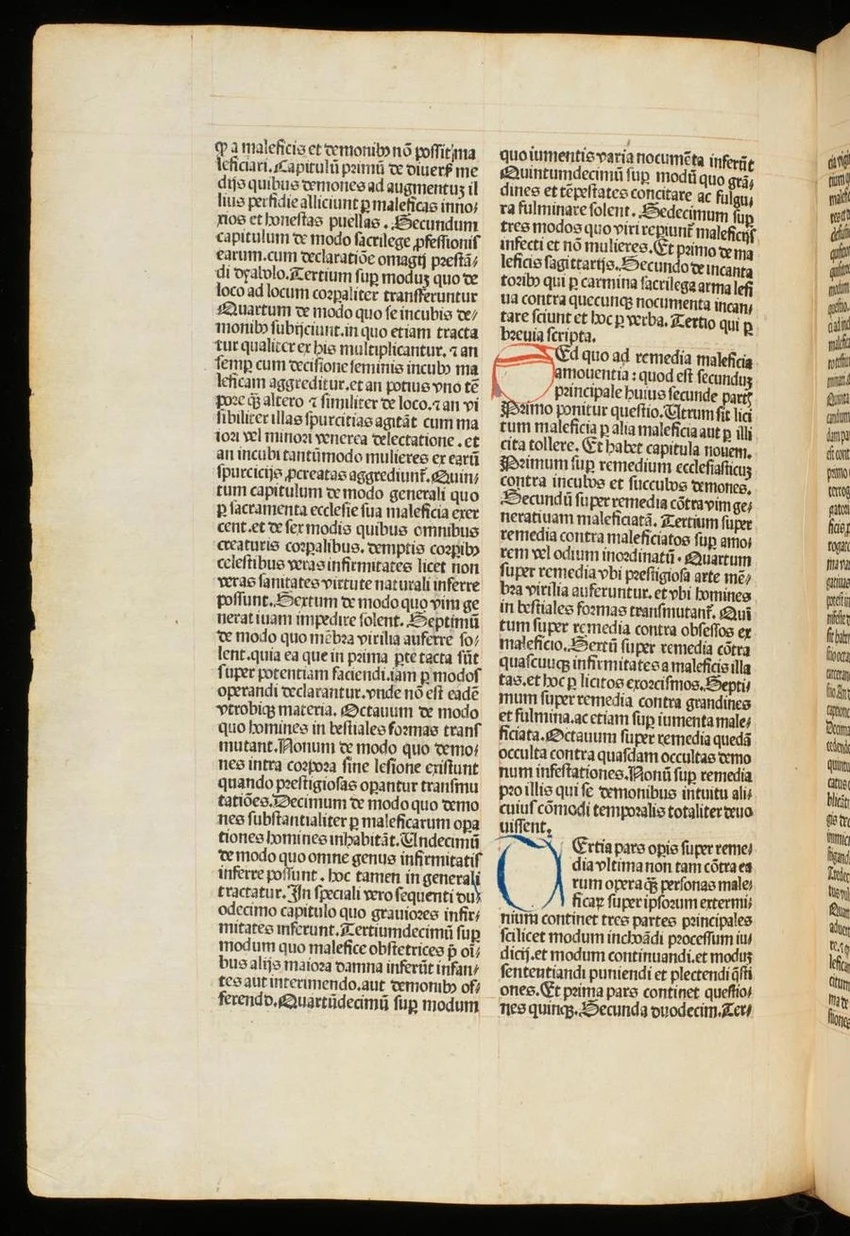
The large blue T begins the contents for the third part, where the discussion moves to courts and proceedings. Basel scan, leaf 4.
Universitätsbibliothek Basel, UBH Nq IX 1:4. Speyer, attributed to Peter Drach, before 15 April 1487. Digitised by e-rara. Public Domain Mark. · Image source ↗ · Public Domain
Bamberg, the imperial code and Spanish evidence
The 1507 Bamberg criminal ordinance and the 1532 imperial Carolina provide a comparison with actual legal texts. Article 131 of the former and Article 109 of the latter deal with harmful sorcery. The imperial text carries over much of the earlier wording, while dropping its explicit comparison to heresy. The surviving texts give a specific piece of evidence about how a rule travelled between jurisdictions. [15]
In a different legal setting, Gustav Henningsen traced provisions of the Spanish Inquisition’s 1614 instructions to memoranda by Alonso de Salazar Frías. Comparing the memoranda and instructions shows how a historian can demonstrate transmission. A similar claim about the Malleus requires a matching citation, record or other evidence of what a particular reader or court used. [16][15]
How Reginald Scot used the Malleus in 1584
An explicit citation survives in Reginald Scot’s Discoverie of Witchcraft. He attributes a catalogue of supposed powers to Sprenger and Institoris and names the Malleus in his text. Here the book has travelled into an English argument about witchcraft. Scot puts the claims on display for readers in order to question the authorities that endorse them. [12]
The citation provides the evidence missing from a loose comparison between two texts. It identifies the work, the named authorities and the claims under discussion. It documents how a critic used the Malleus in print. A court’s use of the book would need evidence inside or otherwise connected to its proceedings. [12][15]
Friedrich Spee and the problem with coerced testimony
In 1631 Friedrich Spee’s Cautio Criminalis challenged the operation of witch trials in German territories. Question 25 names the doctrine that silence could itself count against an accused person. In another passage, his example of a woman he calls Gaia follows a prosecution in which confession and refusal to confess are both read as signs of guilt. [14][13]
Spee also describes how questioning under coercion can generate names for the next round of accusations. His argument is about the reliability of the process. To read him beside the Malleus, compare the confidence each text places in a judge’s ability to turn testimony into proof. Spee’s account documents a contemporary critique of that practice. [13][9]
Title pages and the changing shape of the book
The title detail from Cologne in 1520 and the collected Lyon title of 1669 frame the work differently. Cologne introduces the hammer through forceful imagery. Lyon advertises a collection assembled from several authors and divided into four volumes. The volumes of a collection are distinct from the three parts of the original treatise. [3][4][6]
The Frankfurt edition of 1580 makes the change particularly clear. The catalogue transcribes a title which advertises four added works, naming Bernard Basin, Ulrich Molitor, Jean Gerson and Thomas Murner. A citation to the book should give the edition, part and question so readers can tell whether it points to the treatise or to an added text. [5][6]
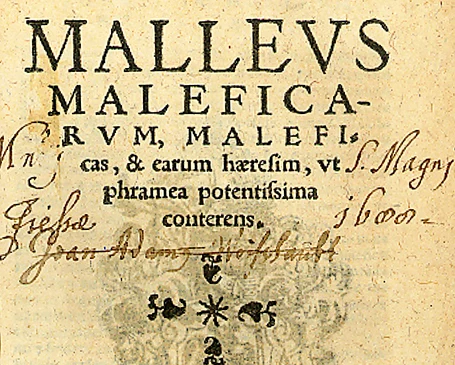
The title opening of the Cologne edition uses a spear image in its wording to describe the work’s purpose.
University of Sydney Library, Cologne edition, 1520. Public-domain title detail via Wikimedia Commons. · Image source ↗ · Public Domain
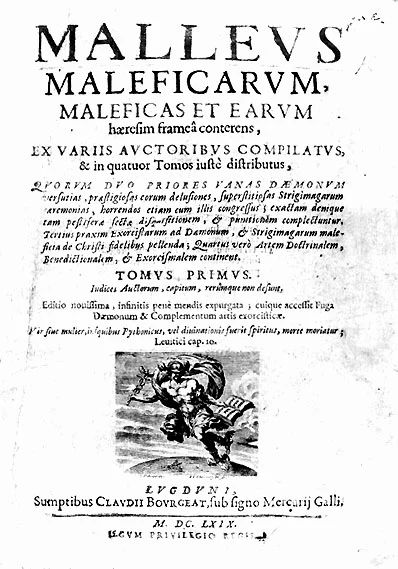
The Lyon title presents the work as a collection compiled from multiple authors and divided into four volumes.
Malleus Maleficarum, Lyon, 1669. Public-domain facsimile via Wikimedia Commons. · Image source ↗ · Public Domain
Continue with a documented case
The books and records for Salem give another way to ask how an accusation became evidence. The passage on the first examinations in Henrietta D. Kimball’s Witchcraft Illustrated belongs to a later printed account. Pair it with the Salem guide’s documents to see which claims come from the examinations and which are the author’s retrospective telling. [17]
Read further in the library
Witchcraft Illustrated
Reading note
Read a later account of examinations in Salem and compare the kinds of evidence it reports.
Letters on Demonology and Witchcraft
Reading note
Explore Walter Scott’s nineteenth-century treatment of witchcraft beliefs and prosecutions.
Witchcraft Magic and Alchemy
Reading note
Compare the treatise with a later illustrated history of witchcraft, magic and alchemy.
Sources
See references (17)
- Basel’s early Speyer impression ↗Universitätsbibliothek Basel, UBH Nq IX 1:4. Speyer, attributed to Peter Drach, before 15 April 1487.Return to text ↑
- Basel copy, opening of the third part’s contents ↗Universitätsbibliothek Basel, UBH Nq IX 1:4. Speyer, attributed to Peter Drach, before 15 April 1487. Public Domain Mark.Return to text ↑
- Cologne, 1520 · title detail ↗University of Sydney Library, Cologne edition, 1520. Public-domain title detail via Wikimedia Commons.Return to text ↑
- Lyon, 1669 · collected edition title ↗Malleus Maleficarum, Lyon, 1669. Public-domain facsimile via Wikimedia Commons.Return to text ↑
- Frankfurt, 1580 · enlarged edition and its title ↗Digital Library of Wielkopolska, Frankfurt, Nicolaus Basse, 1580.Return to text ↑
- Table of contents of the Frankfurt impression ↗Bibliotheca Augustana transcription based on the 1580 edition.Return to text ↑
- Part I, Question 6 · women and alleged witchcraft ↗Malleus Maleficarum, Frankfurt, Nicolaus Basse, 1580. Latin transcription of the historic edition.Return to text ↑
- Part II, Question 2 · proposed remedies ↗Malleus Maleficarum, Frankfurt, Nicolaus Basse, 1580. Latin transcription of the historic edition.Return to text ↑
- Part III, Question 2 · the number of witnesses ↗Malleus Maleficarum, Frankfurt, Nicolaus Basse, 1580. Latin transcription of the historic edition.Return to text ↑
- The 1485 proceedings and the origins of the book ↗Hans Peter Broedel, The Malleus Maleficarum and the Construction of Witchcraft, introduction. Manchester University Press.Return to text ↑
- The composition and authority of the Malleus ↗Christopher S. Mackay, The Hammer of Witches, introduction. Cambridge University Press.Return to text ↑
- The Discoverie of Witchcraft · Scot names and cites the Malleus ↗Reginald Scot, The Discoverie of Witchcraft, first published 1584. Project Gutenberg transcription of the 1886 edition.Return to text ↑
- Friedrich Spee’s example of an accusation escalating ↗Cautio Criminalis, 1631. Marcus Hellyer translation excerpt in German History in Documents and Images.Return to text ↑
- Cautio Criminalis, Question 25 ↗Friedrich Spee, Cautio Criminalis, 1631. Source Library digital facsimile, printed p. 167.Return to text ↑
- Comparison of Bambergensis article 131 and Carolina article 109 ↗Research article in Culture & History Digital Journal, including the texts of the clauses.Return to text ↑
- Salazar Frías’s memoranda and the instructions of 1614 ↗Gustav Henningsen, source study in Príncipe de Viana.Return to text ↑
- Kimball’s account of the first examinationsHenrietta D. Kimball, Witchcraft Illustrated, Boston, 1892. Lumitheca Reader edition IMJ-0207-E001.Read this page in Witchcraft Illustrated ↗Return to text ↑